
I stopped going to church.
But this isn’t an essay about deconstruction.
And this is a good time to note: Mom, if you’re reading this, I suggest you pause and take some blood pressure medication first.
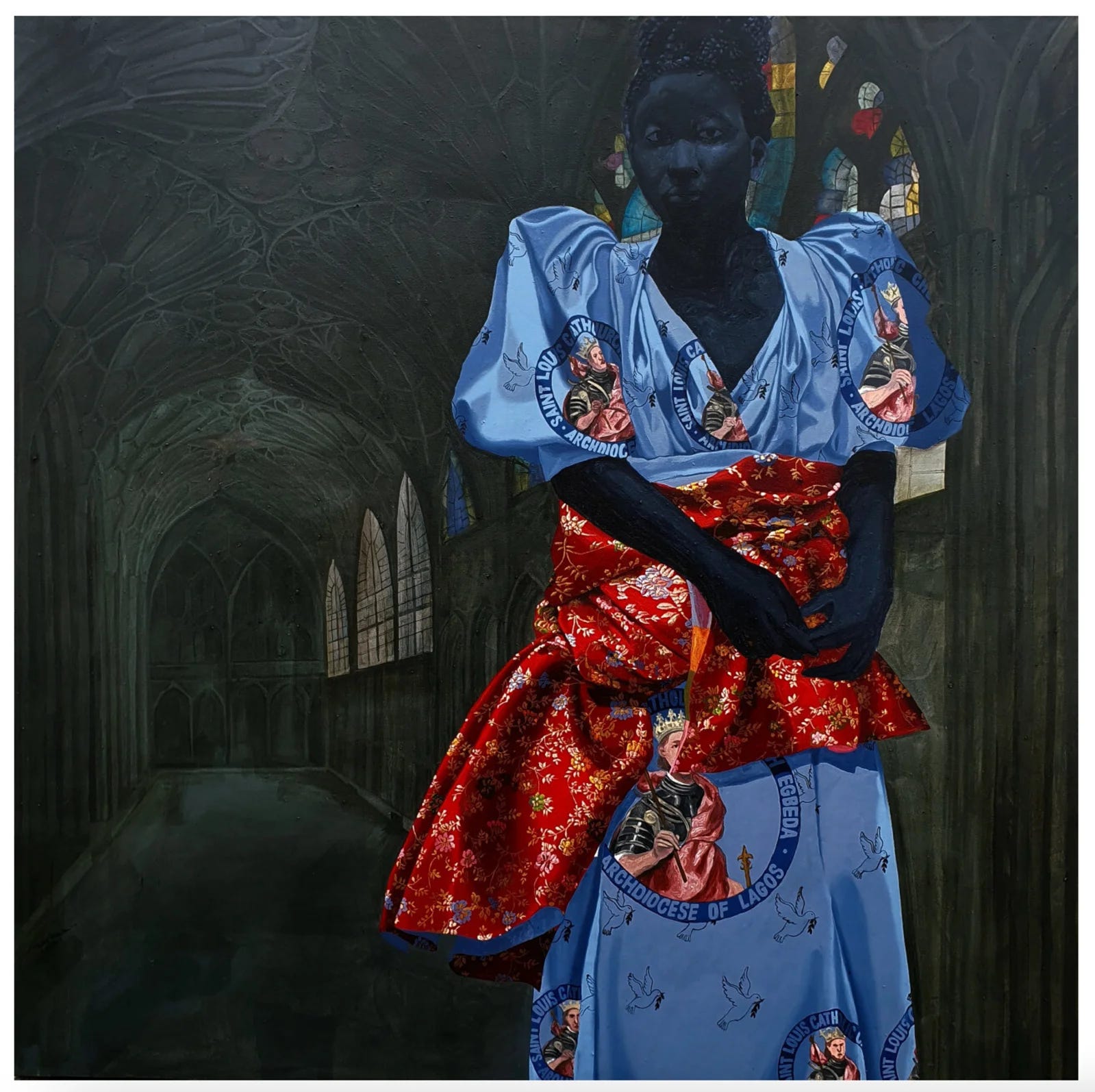
Time Flies in the Shadowed Cloister, 2022. Tonia Nneji. ©️Tonia Nneji
The church was…is my home. What I mean when I say this is church wasn’t simply a place I went to on Sundays—it is the geography of my life. I can map my childhood memories to some of the most important landmarks in American evangelicalism. I was born in Oral Roberts’ City of Faith hospital in Tulsa, Oklahoma. My earliest years were spent on the campuses of the Christian universities where my parents gathered graduate degrees, like Regent University. Eventually, they moved to Abuja, shortly after it was declared Nigeria’s new capital, to found a church and establish the West Africa division of Pat Robertson’s Christian Broadcasting Network. Throughout my adolescence, what time wasn’t spent in school or sleeping was spent in church or the ministry’s offices. A city, a church and I are inextricably linked—we all came of age together. Adulthood has taken me to a handful of cities, and in each of them finding a church has been as important as finding an apartment. Along the way, I’ve picked up a few denominational dialects. Protestants are my kinfolk, and I speak fluent Pentecostal. Drop me in any church in any city though, and I’ll have a degree of literacy.
It is impossible to spend as much time inside anything as I’ve spent in the church and not gather some scars. I could tell personal stories, like the ways I was shamed as a child for not meeting the impossibly high standards pastors’ kids are held to. I could tell institutional ones, like how during my last semester at Oral Roberts University, Obama’s inauguration revealed just how tightly racism has its hands around evangelicalism’s neck. Or how, my first semester there, a famous televangelist told the student body in so many words we would go to hell if we didn’t vote Republican. I can tell sordid cross-continental tales about scandals in the body of Christ, and the communal trauma in their wake. There’s trauma I’ve carried in my body, such as vaginismus—a form of PTSD common amongst survivors of purity culture.
My distance from the church, however, is not the result of church hurt. I stopped going to church because I was exhausted, not because I was angry. Death by a thousand paper cuts.
To step into church as a woman, a Black woman, a thinking woman, a feminist woman is to sometimes feel like stepping into enemy territory. Over the years, I’ve grown weary of the sanctification of patriarchy and the normalization of misogyny—the endless sermons that call women’s submission holy and male leadership God-ordained. I’ve lost patience with pastors who lack serious theological training. “God qualifies the called” has become the bar for leadership in many a Protestant church, and “touch not my anointed” has become a bulletproof shield against accountability for too many. I’m irritated by a materialism and superiority complex that disguises itself in language about favor and grace, and an obsession with church growth—all of which leads to a transactional approach to God and to humans…a faith-based capitalism if you will. I’ve grown very, very, very tired of the disease that is anti-intellectualism in the church: a refusal to grapple with the hard questions of our day, and a timidity to challenge harmful doctrines and practices in the name of faith. We love God with all our hearts, souls and strength, but we often forget that great commandment also calls us to love God with all our minds.1
The thing is, after a while, your teeth and hands can grow weary from continually having to chew the meat and throw away the bones. The church is home, yes. But sometimes loving the church can feel like loving an abusive partner: the kind of relationship in which you understand why someone has become who they are, hold space for their contradictions, and remember that when things were good, they were really good. Until one day, the cost of staying outweighs the uncertainty of the wilderness.
For me, for many, leaving the church is sometimes not just necessary, but holy. 21.9% of adults today in the US are former Christians, and in a striking reversal of social norms, women who have historically been the most religious demographic around the world are now leaving the church in droves—especially Gen Z women.
But cut me, and I’ll bleed church. I miss church every Sunday and many days in between. God and I will always go together like white on rice. Still, I miss the rituals of religion. You see, in this blood are pints of communion, in these veins are stored scriptures, and in these palms and feet are the rhythms of countless praise and worship songs.
While I’m telling the whole truth, if I tell stories of a lifetime of disappointment from the church, I must marry them with stories about the ways the church has saved my life since my birth. It is the church that provided my parents—poor, immigrant students—with a crib, baby clothes, formula and diapers when I was born because they couldn’t afford it. It’s the church that paid my school fees when my father died, supplying the very education with which I pen this essay. For all my grievances against the institution(s), I should tell you about my mother, and so many church mothers, who have rescued so many lives, in so many ways, on so many days. Or about my work in refugee and IDP camps in Southern Sudan and Northern Nigeria where I saw how the church ensures the survival of communities in ways humanitarian organizations cannot and governments do not.
For all its failings, few institutions have been able to successfully replicate what the church provides. I know this to be true in my own life. Social scientists are also increasingly documenting the macro-costs of growing religious decline. For example, in the western world we are seeing a rise in religious disaffiliation and a rise in loneliness, and research suggests these trends are not unrelated. Indeed, history has repeatedly shown that revolution without rebuilding can lead to its own destruction.
It takes courage and integrity to deconstruct from Christianity. But I can’t help wondering if, for some of us, this is only half the work. For too long, there have only been two options available to progressive Christians: leave the church or stay. But what if we’ve overlooked a third option? What if there is a way to reclaim what is life-giving in this religion, dismantle its harmful parts, and begin the work of large-scale reform?
This may sound naïve or radical until you consider this: Christianity has a long revisionist history.
One night, many years ago, I was having a debate with my mother about why she considers drinking alcohol un-Christian. One of my favorite things to do is have long debates with my mother about Christianity (whether she shares the sentiment is debatable). On this occasion, I had just completed a course in Côte d’Azur, and after this glorious time in the South of France (which mind you, she paid for), I was unwilling to accept that something as divine as wine is not a gift for God’s children. We went back and forth, tossing scriptures at each other like tennis balls, until my mother finally exclaimed: “Ohhhhh Blessing! Not drinking alcohol is what we of the Evangelical and Pentecostal culture have decided, okay!”
Probably not what she intended, but it was the first time it occurred to me: Christianity is a culture. Here’s the gnarly thing about culture: people make culture.
So much of what is considered sacrosanct in Christianity has human fingerprints all over it.
Take Christianity’s most foundational question: Who is Jesus? For the first 300 years of Christianity, the different groups that called themselves Christian could not agree on this. Some believed Jesus was fully human, some thought he was the greatest being God had ever created (but not God), and others believed Jesus was fully God who only appeared to be human. Worried that a fractured Christianity would threaten the stability of the Roman empire, Constantine called a conference to settle this question via a vote. Out of the 325 AD Council of Nicaea came the Nicene Creed: establishing Jesus as fully God and fully human.
The books that make up what we call the Bible were also decided by a series of councils. Books like Hebrews, 2 Peter and Revelation—now universally accepted as scripture, were once fiercely debated. Women were excluded from these processes, and many of the texts that didn’t make the canonical cut were books that center women’s spiritual authority like The Acts of Paul and Thecla and The Gospel of Mary. In short, what we call the Bible, and what we don’t, was decided by men.
Then there’s Christian identity. Because Christianity has become a culture with so many tribes and sub-tribes, it’s easy to forget that for a thousand years, there was only one way to be a Christian: Catholic. In that era, the Pope was the ultimate source of authority in the church, and the average Christian could not access the Bible. Priests mediated access to God, and salvation was sold. Christians could purchase indulgences—letters of pardon guaranteeing forgiveness of sins.
That is, until a German monk named Martin Luther began exploring a simple question: How do I find a merciful God? Finding no answers in the status quo, he published a letter, now known as the ninety-five theses, to the Catholic church’s leadership. Luther’s ideas were not new, but the invention of the printing press meant they spread like wildfire. The result? The Protestant Reformation, which changed Christianity forever by creating new denominations, and establishing new theological principles, like sola fide—the concept that we are saved by faith alone.
Sometimes Christianity’s reforms have been sparked by less noble convictions than Luther’s. King Henry VIII for example, initiated the English Reformation, which created the Anglican tradition, because the Pope wouldn’t grant him an annulment and he wanted to marry his mistress.
Christianity has long been malleable. The theology, the scriptures, the institution…all of it has been shaped by human hands. Often, white ones. Mostly, male ones.
Christianity is not less sacred because of its human history. One of the miracles of this religion is that despite the meddling of humanity, it has survived for over 2,000 years. “Soldier come, soldier go, barracks remain” as the Nigerian proverb goes.
The uniqueness of this moment is there is an opportunity for new hands to shape Christianity. Christianity actually isn’t declining as a whole—its color is simply changing. Christianity is now primarily Black. The symbolic weight of this evolution cannot be overstated. In 1910, two-thirds of the world’s Christians lived in Europe (North America was a distant second). Today, the African continent is home to a third of all Christians on earth. Even in North America, where Christianity is declining, Black Protestants have the highest retention rate of any religious group—higher than even white evangelicals.
As the new majority, will Black Christians work to decolonize Christianity and to model Jesus’ radically inclusive and communal model? Or as Liepollo Pheko brilliantly explores, will we merely continue the white imperial project?
Christian women must also decide if we will remain patriarchy’s most faithful warriors. Christianity cannot survive without women. This isn’t hyperbole—it’s data. Around the world, it’s women who fill church pews, do a lot of the unpaid labor that sustains churches and socialize children into Christianity, ensuring its continuity.
Will women use the power we’ve long held to insist on a more gender progressive faith? Or continue to cede faith to patriarchy?
People make culture. People sustain culture. People can change culture.
How much change is too much change? Where is the line between reform and an entirely new religion? I imagine many in the Catholic church asked questions like this when Martin Luther published his theses in 1517, or in 1906, when William J. Seymour, a son of formerly enslaved parents, began hosting revival meetings in an abandoned building in Jim Crow America. The Azusa Revivals—where women preached, Black and white Christians worshipped together, and people spoke in tongues and fell in the spirit—were once considered a radical departure. These revivals birthed Pentecostalism.
Today’s normal is often yesterday’s heresy.
And you know who wasn’t scared to be called a heretic? Jesus.
Thanks for reading Thinking About…! If this essay resonates with you, please share.
Jesus was the original deconstructionist. If there was one thing Jesus was going to do, it was subvert a scripture and challenge a religious tradition. There wasn’t a mountain too high, or a slope too slippery for our Lord. The ritually impure? Touched them. Society’s outcasts? Hung out with them. His contempt was reserved for the religious establishment. You may think reading—not reading the act, reading the art—was invented in the cauldron of drag culture. But I raise you Matthew 23: bar for bar, verse for verse, Jesus read religious leaders for filth, calling them hypocrites, blind guides, white-washed tombs, snakes and more.
Jesus didn’t flip tables just for the sake of it: his point was always that human liberation matters more than scriptures, and mercy more than tradition. When religious leaders accused Jesus of breaking the Sabbath by plucking grain, he said to them: “The Sabbath was made for man, not man for the Sabbath.”2 Jesus was a Jew, not a Christian, but if he were flesh amongst us today, I wonder if he would remind us: Christianity was made for man, not man for Christianity.
For Jesus, the work didn’t stop at deconstruction: in his famous sermon on the mount, he reminded his followers: “Do not think I have come to abolish the law or the prophets: I have not come to abolish them but to fulfill them.”3
How far is too far when it comes to reconstruction? Jesus showed us we go as far as justice requires. For Jesus, fulfillment of the law wasn’t about the preservation of scripture or tradition, but rather, the liberation of humanity. And Jesus’ liberation was never about an altar call or a sinner’s prayer: it looked like healing people, feeding them, defending them, spending time with them, and seeing them.
When I think about how frightened we can be to revisit theology and traditions, I think about Jesus’ parable of the talents. A servant given one talent buries it in the ground out of fear and returns it to the master untouched. The master’s verdict is unsparing: he calls him a wicked and lazy servant. The master’s indictment is not for losing the talent—it’s because the servant failed to take a risk. Preservation is not always stewardship.
Perhaps we are wicked and lazy, when we cling to scriptures and old ways of being Christian out of fear, even when we see the real harm it causes our neighbors—like our queer neighbors.
Perhaps, we are wicked and lazy when we consider the fact that even the Bible makes the case that God is open to revision in the direction of justice. About 3,000 years ago, five women—Mahlah, Noah, Hoglah, Milcah, and Tirzah—challenged an inheritance law that scripture tells us God directly gave to Moses. The law would have left them with nothing because they were women. Moses took their case to God, God said they were right, and the laws were changed. It’s right there in your Bible, in Numbers 27.
Christianity has been at its finest when its theology and traditions have fueled movements for justice and freedom, such as the abolition movement in Europe, the civil rights movement in America, the anti-apartheid movement in South Africa, and the movement for economic justice in Latin America that gave rise to liberation theology.
Liberation is the task of Christian reconstruction today, and I will stake all my bets on this.
Perhaps the central question this generation of Christians must ask is the same one Martin Luther asked 500 years ago: How do we find a merciful God?
What would a reconstructed Christianity look like? I do not know. This is a love letter written with bruised hands. And the more I know God, the less certain I am of so many things.
Like, hell. I could tell you about how the Hebrew Bible actually references Sheol and Gehenna, none of which are eternal fires for punishment; or about how the hell described in modern Christianity borrows greatly from Dante’s 1320 Inferno and Greek mythology. I’ll tell you this instead: one of my first jobs as a law student was in the Child Exploitation and Obscenity Section of the US Department of Justice. Day after day, I analyzed cases about people who did the most deplorable things you could never imagine to babies and children—some of them repeat offenders who will never repent. I wish those vile people a lot of evil, but I wouldn’t wish an eternal fire on even them.
I want a God more merciful than me.
The more I know God, the less I fear God. To know God is to know perfect love, and perfect love casts out all fear.
Love is the law. Love is the wrecking ball with which we demolish, and the concrete with which we rebuild. Love is the place where we begin to conceive a God more expansive than the contemporary Christian imagination allows. And, who better to (re)imagine than those who believe “faith is the substance of things hoped for and the evidence of things unseen?”4
Matthew 22:37-39; Mark 12:30-31; Luke 10:27
No posts
Comments
Nothing yet. Say the first thing.
Sign in to join the conversation.