
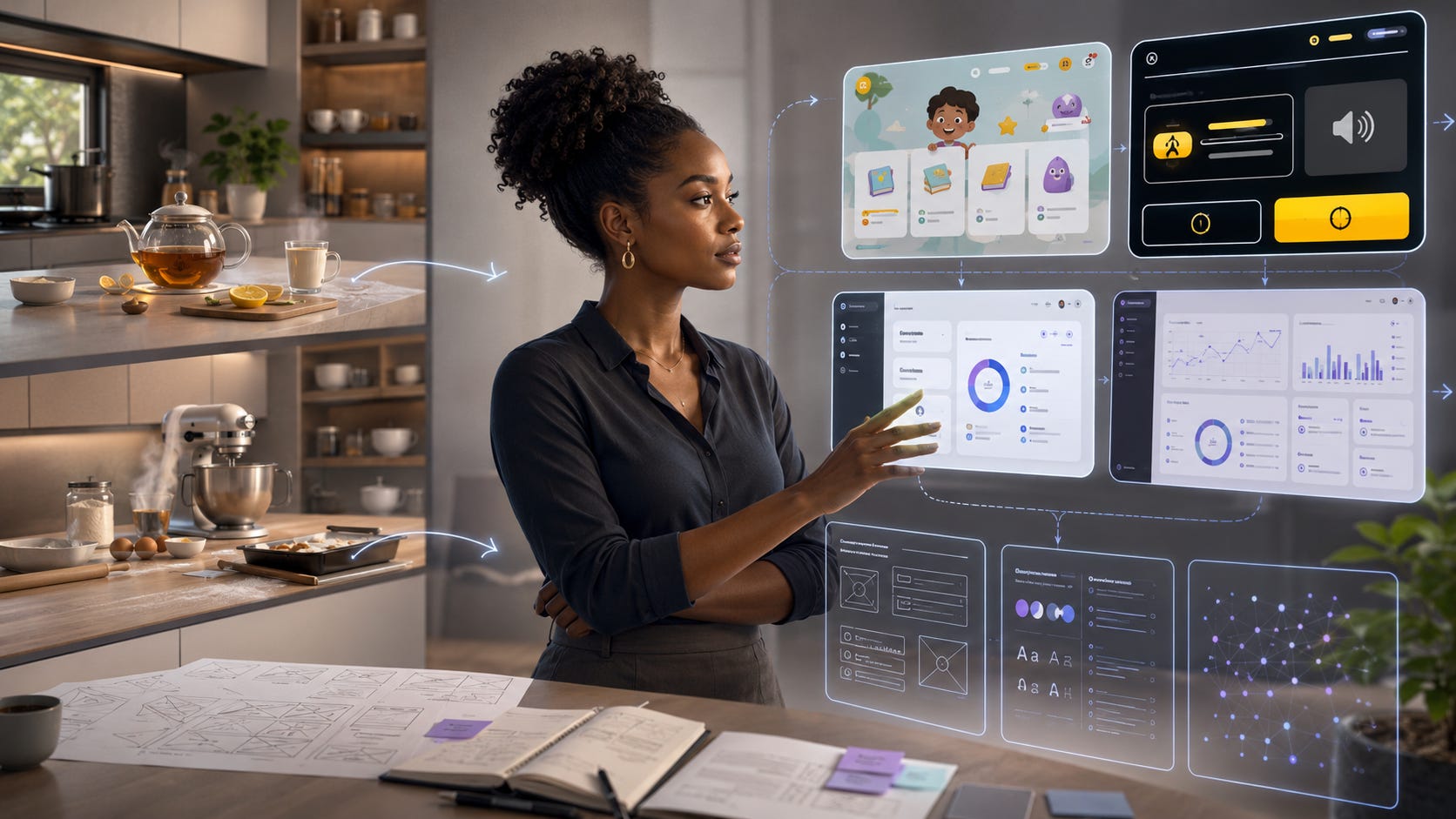
This morning, I walked into my kitchen and immediately knew something was different.
My daughter had decided to surprise me. 🤩
She had tidied the entire kitchen, rearranged several items, placed a beautiful flower pot on the countertop, and even brought out one of my fancy pots that I had hidden away and used it as a decoration. 🤷♀️😂
I stood there smiling.
Everything felt fresh, everything was still my kitchen, but somehow, it felt as though it had been thoughtfully reorganized.
As I admired what she had done, a thought crossed my mind.
What if our digital products could do something similar?
Imagine walking into your kitchen tomorrow morning and discovering that it had quietly rearranged itself for what you were about to do.
If you wanted to make tea, the kettle, mug, tea bags, and sugar would already be within easy reach. Later, if you decided to bake, the same kitchen would subtly reorganize itself so that the flour, measuring cups, mixing bowls, and baking tray were exactly where you needed them. 😁
That idea might sound futuristic, but it is becoming surprisingly real.
One of the most exciting conversations in UX and AI today is Generative UI. To define this term in its simplest form, generative UI is when AI creates and arranges things like text, images, videos, buttons, and other content based on what each person needs at that moment. Instead of presenting every user with exactly the same interface, AI can begin creating or reorganizing the interface itself around what each person is trying to accomplish. Google recently announced new generative UI capabilities that can assemble interactive layouts, graphs, simulations, dashboards, and other interface elements in real time based on a person’s request.
Think about what that could mean.
A beginner might see a beautifully simplified interface with just the essentials.
An experienced professional could immediately receive advanced tools without searching through multiple menus.
Someone with low vision might automatically receive larger controls, stronger contrast, and a layout adapted to their accessibility needs. Research into adaptive and accessible generative interfaces is already pointing in this direction.
As exciting as this sounds, it also raises important questions.
If every interface can change, how do we maintain consistency?
How do users build confidence if screens constantly rearrange themselves?
How do we ensure AI adapts thoughtfully instead of creating confusion?
These are no longer engineering questions; they are UX questions.
The more I think about my daughter’s thoughtful kitchen makeover, the more I realise that she did not simply move things around. She rearranged them with care because she believed they would look better, work better and make Mum happy.
That is exactly how I think AI should behave.
Not by changing things simply because it can, but by thoughtfully adapting experiences in ways that genuinely help people.
Perhaps the future of UX is not designing one perfect interface. Perhaps it is designing intelligent systems that know when, how, and why an interface should adapt.
After all, the interface may change, but people should always remain at the centre of every design decision.
#BlessingSeries #GenerativeUI #UXDesign #ArtificialIntelligence #UserExperience #HumanCenteredDesign #HumanCenteredAI #DesignThinking #ProductDesign #UXResearch #DigitalAccessibility #Innovation #FutureOfDesign #ResponsibleAI
Comments
Nothing yet. Say the first thing.
Sign in to join the conversation.