
Ten rounds, 240 picks, and 24 front offices trying to out-think each other for a week straight. Now that the dust has settled, here’s the full breakdown: who came away with the best class, who found the hidden gems everyone else missed, and where the real value was hiding in this year’s draft.
A quick note before diving in: every grade here, the team rankings, the best picks, the steals, leans on projected ceiling rather than what’s already shown up in a box score. A polished college arm putting up clean numbers right now can still rank behind a raw, live-armed high schooler who hasn’t faced real competition yet, because the bet is on what these guys turn into, not who’s furthest along today. Keep that in mind as you read.
Team grades below measure how much each front office beat expectations at the moment they were actually on the clock, not just who accumulated the most raw ceiling. Every pick is compared against the typical talent grade expected at that exact draft slot, so a round-eight find who outperforms round-eight expectations counts the same, tool for tool, whether he’s a bat or an arm. That removes the lean toward hitter-heavy classes you’d get from grading pure ceiling alone, and it means a club that stockpiled picks doesn’t automatically out-grade a club that drafted efficiently with fewer selections.
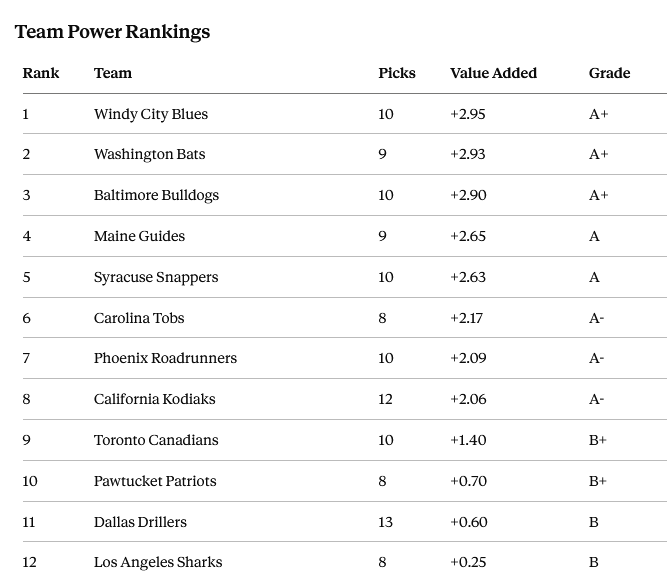
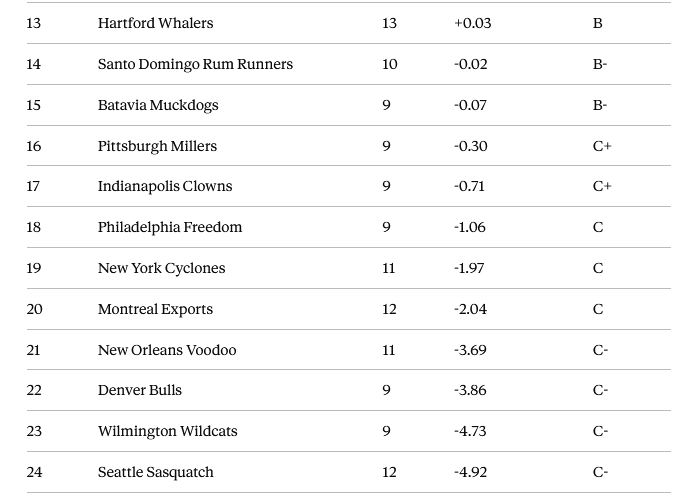
Windy City, Washington, and Baltimore top the league, and this is genuinely the deepest catching class in recent memory, seven of this draft's top ten hitting grades belong to backstops, which is a big part of why Baltimore vaults into the top three off the back of Cam Wise alone. Seattle and Wilmington remain at the bottom, a long string of picks that underperformed their slot rather than any single disaster.
Frankie Woods, C, Hartford Whalers (#36 overall) —
Woods grades as the single best hitter in the entire draft, and it’s built almost entirely on defensive value. The bat is raw, a .218 average as a junior at Pacific, but the receiving skills and arm both grade as legitimately elite, the kind of two-way catching foundation that doesn’t show up in a rough batting line.
Derek Strickler, C, Syracuse Snappers (#27 overall, round 2) —
Strickler hit .394 with a .460 on-base percentage over 25 games as a high school junior, striking out just eight times against 13 walks. The power hasn’t arrived yet, but the receiving skills behind the plate already look like a real asset, giving him a chance to profile as a catcher who controls the game beyond just his bat, one of the two or three best all-around prospects anyone in this draft landed.
Laron Cortes, SP, Los Angeles Sharks (#7 overall) —
Cortes is the best true starter in the class, full stop. A 1.64 ERA, a 0.81 WHIP, and a 14-to-1 strikeout-to-walk ratio as a senior at Seton Hall Prep, sitting mid-to-upper 90s with a delivery that already repeats. He already has the pitch count and stamina to profile as a starter right now, not just a projection.
Marshun Chua, SP, California Kodiaks (#12 overall) —
A 1.92 ERA and a sinker that generates weak contact backed up a dominant senior season at Alac C. Pope High School, with a fastball already touching the low-90s. That kind of ground-ball-heavy, contact-management approach is exactly what tends to hold up as pitchers face better competition, making him the best true first-rounder in the class.
Evan Thayer, RP, Washington Bats (#43 overall, round 2) —
The best pure stuff, command, and movement combination anyone drafted, full stop. A two-pitch sinker-curveball mix, already touching the low-90s, with plus command behind it. The one asterisk is role, the stamina and repertoire keep him in the bullpen rather than a rotation, but a dominant reliever is still a real weapon, and Washington got one two rounds later than the grades suggest they should have.
Kyle Guidry, CL, Maine Guides (#53 overall, round 3) —
Guidry’s summer at Bourne was as close to unhittable as it gets for a college closer: a 2.92 ERA, a 1.09 WHIP, and a 10.2 K/9 over 19 appearances, sitting 94-96. Maine landed a ready-made bullpen piece three rounds after the top relievers in the class typically would have gone off the board.
DeWitt Flores, RP, Hartford Whalers (#55 overall, round 3) —
Flores might have the single best raw arm anyone drafted. A 97-99 mph fastball paired with a 2.31 ERA, a 0.86 WHIP, and a 10.0 strikeouts-per-nine mark over 10 outings at Oregon is late-inning stuff, and Hartford got it in the third round.
This class also turned up an unusually deep group of relievers with real, immediate-impact stuff beyond just Thayer, Guidry, and Flores above. Maine doubled up on the trend with Harry Rickets in round ten, Hartford’s Flores brings a fastball that would headline most bullpens in the league on its own, and Santo Domingo found one of the best-graded arms still on the board with just eight picks to go in Mark Brooks. Roughly a third of the pitchers taken this year project as bullpen arms rather than future rotation pieces, a real asset for the clubs that landed them even if it wasn’t always the plan going in.
Beyond Thayer, Cortes, Chua, and the two catchers already covered above, a handful of other picks stand out as genuine value relative to where they came off the board, run here from round 10 down to round 1.
Mark Brooks, RP, Santo Domingo Rum Runners (#232, round 10) —
The surface stats are ugly, a 7.16 ERA and a 1.71 WHIP over 10 outings as a junior at TC Roberson High School, but the underlying command and suppression traits both grade as legitimately elite, the best in the entire relief pool by a wide margin. The stuff itself is modest, sitting 89-91, which is almost certainly why the results haven’t caught up yet. Landing that kind of ceiling with just eight picks to go in the entire draft is about as good as value gets this late.
Reilan Friedrich, C, California Kodiaks (#217, round 10) —
Just six games logged at Mater Dei High School, but a .333 average and a .929 OPS from a catcher who won’t turn 17 until after draft day is the kind of tiny sample worth circling. Landing the youngest player in the entire draft class as a late-round bet is a real swing for California, on top of the pitching depth they already loaded up on early.
Max Santacroce, C, Los Angeles Sharks (#199, round 9) —
A .299 average with legitimate defensive tools behind the plate at North Carolina, though the approach still needs work, 40 strikeouts against just 14 walks. Finding a two-way catching prospect with this kind of glove in round nine is a real find regardless.
Cam Wise, C, Baltimore Bulldogs (#210, round 9) —
The batting line is genuinely rough, a .198 average and a .603 OPS at Arizona State, but he still walked 24 times, and the defensive package behind the plate is strong enough on its own that the model rates this as real value even before the bat catches up.
Hugh Zamora, C, Carolina Tobs (#178, round 8) —
Limited to 26 games at Long Beach State but flashed real ability behind the plate to go with a respectable bat, exactly the kind of gamble that pays off if the physical tools translate to a bigger workload.
Damian Leachman, C, Santo Domingo Rum Runners (#112, round 5) —
A .307 average with a .410 on-base percentage at USC, backed by real receiving ability behind the plate. A well-rounded college catcher landing in round five is a quiet, low-risk win.
A fun exercise once the tool grades are in: which current major leaguers do these prospects’ skill sets actually resemble? Matching each drafted player’s profile against the league’s OSA Top 20 turns up a few strong comps.
Laron Cortes (LAS) and Franklin Pennell (PHX) —
This is closer than any other comp on the board. Pennell has turned modest raw velocity into a 7-2 record and a 2.87 ERA at the big-league level by pounding the zone and getting the ball to move, exactly the type of pitcher Cortes already is. If the translation holds, Los Angeles didn’t just get a good arm at pick seven, they got a blueprint for one already succeeding in the majors.
Evan Thayer (WAS) and Tarik Williams (PHI) —
Williams pairs big raw stuff with real feel for the strike zone, a 3.36 ERA and 63 strikeouts over 69.2 innings this year. Thayer's sinker-curveball combination points toward that same power-and-command shape, just without the innings or the third pitch yet to fully get there.
Kyle Guidry (MAI) and Blaze Houk (TOR) —
Houk's a mid-rotation arm who gets by on solid, well-rounded stuff rather than one standout weapon, a 6-3 record with a 4.23 ERA over 66 innings. Guidry’s summer at Bourne showed the same kind of well-rounded, multi-pitch approach that projects best as a bullpen weapon with rotation traits.
Buddy Yanez (TOR) and Justen Fairclough (HAR) —
Fairclough gets outs almost entirely on command rather than stuff, a 2.78 ERA built on pinpoint control. Yanez’s summer, all pitchability and zone control with modest velocity, points toward that exact same pitch-to-contact profile succeeding at the highest level.
Frankie Woods (HAR) and Alec Bridges (PHI) —
Bridges has turned power and patience into a .302 average and 16 home runs at third base. Woods’ bat carries a similar shape, real over-the-fence pop paired with a discerning eye, even if the college numbers haven’t caught up yet.
Derek Strickler (SYR) and Jeffrey Lauer (MON) —
Lauer is a pure contact-first infielder, a .290 hitter who puts the bat on the ball far more than he drives it. Strickler’s game runs the same way, an advanced hit tool without much present power, the kind of profile that plays even before the strength fills in.
Damian Leachman (SDR) and Braedin Kim (MON) —
Kim is the top overall talent in the league right now, a .354-hitting catcher who controls the game on both sides of the plate. Leachman’s game isn’t at that level yet, but the shape matches, a patient, contact-oriented approach from a catcher who already handles the defensive side of the position well.
Hugh Zamora (CAR) and Davey Page (PAW) —
Page is a steady, well-rounded corner bat who won’t wow anyone with one standout tool but does everything capably. Zamora’s limited track record shows the same kind of balanced profile, no real carrying tool yet, but nothing missing either.
Windy City, Washington, and Baltimore built the most efficient classes in the league, finding real value at nearly every slot instead of just cashing in premium picks. Washington’s discovery of Thayer in round two might be the single most talked-about story once this class starts reaching the higher levels, and the unusual depth at catcher, seven of the ten best offensive grades in the entire draft, gives a handful of clubs a real head start behind the plate for years to come.
No posts
Comments
Nothing yet. Say the first thing.
Sign in to join the conversation.