
0:00
-18:28
Growing up as a middle class boy, in a small town in America in the 1960s and 1970s, I was taught two visions of what the future had in store for me.
They were presented to me by the teacher of American culture—the TV.
One vision of the future was the Flintstones.
The other?
It was the Jetsons.
As a young man I decided the best move I could make was to become like George Jetson—even though almost none of what he had in his home existed in the world at the time of my childhood.
To me, the Jetsons weren’t just the vision of the real future I could imagine versus the literal Stone Age. In my house, we even had a black and white TV.
The most important part about being like the Jetsons to me was I thought it was my best chance to avoid having to pedal my stone and wood car to work every day when I grew up.
And, I wasn’t thinking about the ramifications of having a robot dress me, comb my hair and brush my teeth for me so I could get in my flying car and go to work.
I was only thinking about flying a car to work and I didn’t even have a driver’s license.
Today, fully immersed in the 21st century, we now have no American culture teacher like television was to our society in the 20th century.
Instead, we have new mass communication tools and a few dominant stories in constant battle with each other for recognition, and political and economic investment and power.
Technology and communication portals are used as tools and as weapons to control ideas and communicate them to the masses.
Some tools, like television still operate much as they used to at least for now.
Others, like newspapers and wired telephones do not even exist in most cases.
There are a select set of dominant stories coming from these portals which are echoed and amplified by tribes of followers who believe that, if enough of the people gather toward their “North Star,” they can control their own destinies and, in the case of America, perhaps even the destiny of the entire world.
But the question is, what would that world look like?
Which brings me to a question about my Mom’s 1981 Masters thesis in Social Work.
—Reflections and images: an exploration of five aged women living independently in a rural community; Mimi Lakritz, Master’s Thesis, May 1981
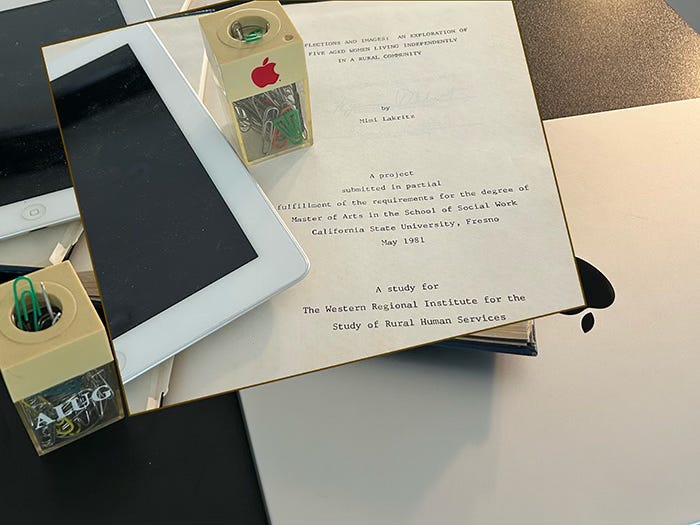
What does my Mom’s 1981 Masters thesis, the Apple Library User’s Group (huh?) and the future all have in common?
The answer, of course, is me.
I took the time to look to these items and experiences from the past to help me determine what we need as a society to succeed today—and in the future.
The answer I found for that question wasn’t robots or artificial information systems people call intelligent.
Comments
Nothing yet. Say the first thing.
Sign in to join the conversation.