
0:00
-13:48
In June of 1978 I graduated from high school with these goofballs.
On the left we have the handsome gentleman named Richard Ketchum waving to the camera. In the middle is Wayne Lantz and on the right is Karl Knapp.
We were four guys with the last names starting with K and L so we were practicing walking into the graduation ceremony together and I stopped to get this shot.
If you look closely, you can see the pin hole where I stuck this photo on the wall of my college dorm room which is an indication of how important the photograph—and my friends—were to me.
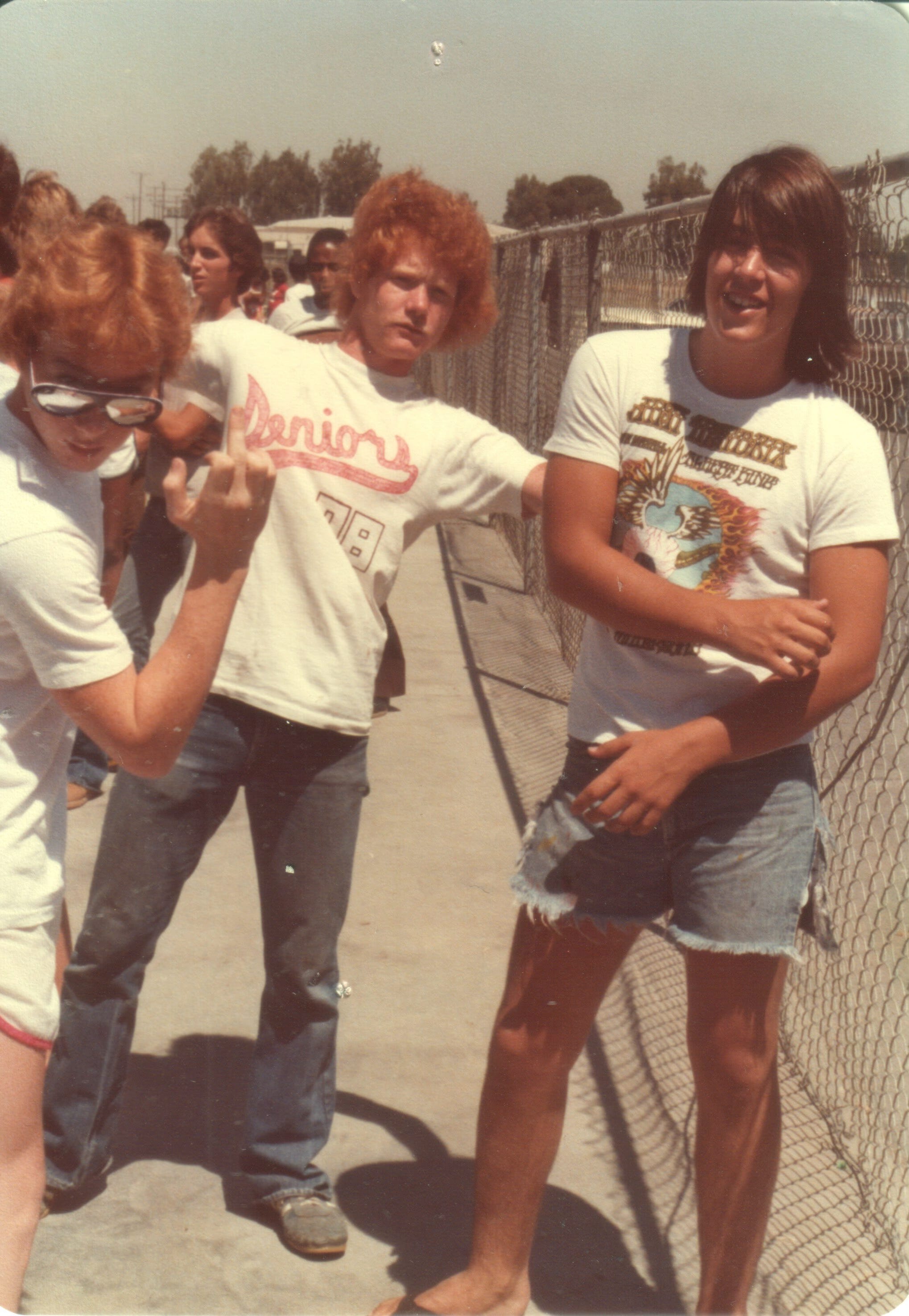
I played Little League baseball with Wayne. Karl and I had art and other friends in common. Richard and I did auto shop and worked on cars during high school. But all four of us went in different directions after high school.
I spent a year at the College of Sequoias in Visalia before heading off to UC San Diego in the fall of 1979.
On one of the last nights I was home before I drove to school that year I hung out with Richard, or “Ketchum,” as we called him. I think he didn’t like any of the other variations of his name. He and I drove around our home town and ended up just talking the evening away.
The biggest memory I have from our time together was a story Richard told me about a new product he found that was attached to a car’s carburetor. He said it would improve a car that got 25 miles per gallon and take it to 50.
He knew I was an environmentalist and I had worked on mock Youth and Government programs and wrote a resolution encouraging the government to increase minimum mileage standards for American made vehicles. He said the car and oil companies were trying to stall the product and make it sound like it didn’t work. But Richard had seen it and told me it did.
I believed him.
In fact, in 1990, I bought a Geo Metro that got 50 miles per gallon. To this day, I wonder what happened to that car? Contrast that with a new 2025 Ford Mustang I saw in July last year at a Ford dealer in Eugene, OR.
That Mustang gets 18 miles per gallon.
That was a lesson about car and gasoline companies I took with me to college in 1979.
In the winter of 1983, I was completing my final credits for graduating with a degree in Communication at the University of California, San Diego.
The Communication program at UCSD was not a full department at the time. As a result, most of my professors over the years were from other departments such as Philosophy, Political Science, Sociology, and Visual Arts/Film.

The Muir College division I attended at UCSD encouraged students to have at least one or two minors. By the time I finished my Communication requirements I had achieved Minors in Political Science and Philosophy.
At the time I was only two classes short of a minor in Visual Arts. Since then, I went on to get my California State Social Science Teaching Credential, and a Masters in Education, which gave me the opportunity to take many additional graduate school courses.
During those years I took enough art classes to earn a bachelor’s degree in Art.
More importantly, I wrote curriculum and I taught Multimedia production classes for almost four decades to thousands of students and their teachers.
My focus in this work is always to help people to Communicate Your Ideas.
Today, the UCSD Department of Communication looks much the same as it was back in 1983. The department’s mission reveals the wide range of ideas students are exposed to:
The Department of Communication has brought together scholars from across the arts, humanities, and social sciences — including anthropology, cognitive science, data science, education, film and digital media, geography, linguistics, information studies, journalism, media studies, political science, public health, sociology, theatre & performance studies — to foster a community of scholars and artists. Here in COMM, undergraduate and PhD students from all backgrounds can work together to learn about how these communication impacts our lives, our communities, and our planet.
We see communication as a cultural, institutional, technological, geographical, artistic and cognitive phenomenon, inextricably anchored in and shaped by questions of democracy, diversity, social justice, and social change.
—emphasis added
If you have a degree in Communication from this department at the University of California, San Diego, you have a degree that instills a wide-range of views of the world and gives you a big picture understanding of the way Communication impacts our lives in that world.
That perspective allows me to see the truth about America’s Friendly Fascist Government today and to find ways to communicate about it.
That’s why I’m writing so much about Electric Vehicles and the environment.
We must also remember that this government—and its supporters—are trying very hard to bully their way to destroy our methods of using technology, communication, and education to support the learning of facts, history, and ideas.
One of the most important things I learned at UCSD I learned during my first quarter there in the fall of 1979. In the class, Introduction to Communication as a Social Force, I learned a very important fact about media, and media production.
According to the professor of this class with 300 students in a lecture hall, 95% of all the video media that had been produced since the invention of video tape recording—no longer existed.
I was immediately shocked by this information. As a photographer and student video producer I had to ask myself a few questions at that point.
One question was: Why would I want to produce media that nobody would care about in 10 or even fewer years?
Another question was: Why exactly does nobody go back to view this material, was it that bad or not useful anymore?
And finally: Does it just break down and become no longer useable?
Just before that Communication Major became a Communication Department I was working on a short video project for a Narrative/Film/Video/Photography course I was taking from the Visual Arts department.
Typical of most student video projects, there were a number of different people who worked on the film including a Writer (Jason Simas) and actors who played a variety of different roles. I was the Executive Producer, Director, Videographer, Editor, and Visual Artist.
At the time we had very little access to computer generated images and text in our video editing systems so I drew the credits with crayons and painted with watercolors. Then, I used the video camera to shoot the images and they became the credits.
(Note: In the clip below I added computer generated text for this presentation.)
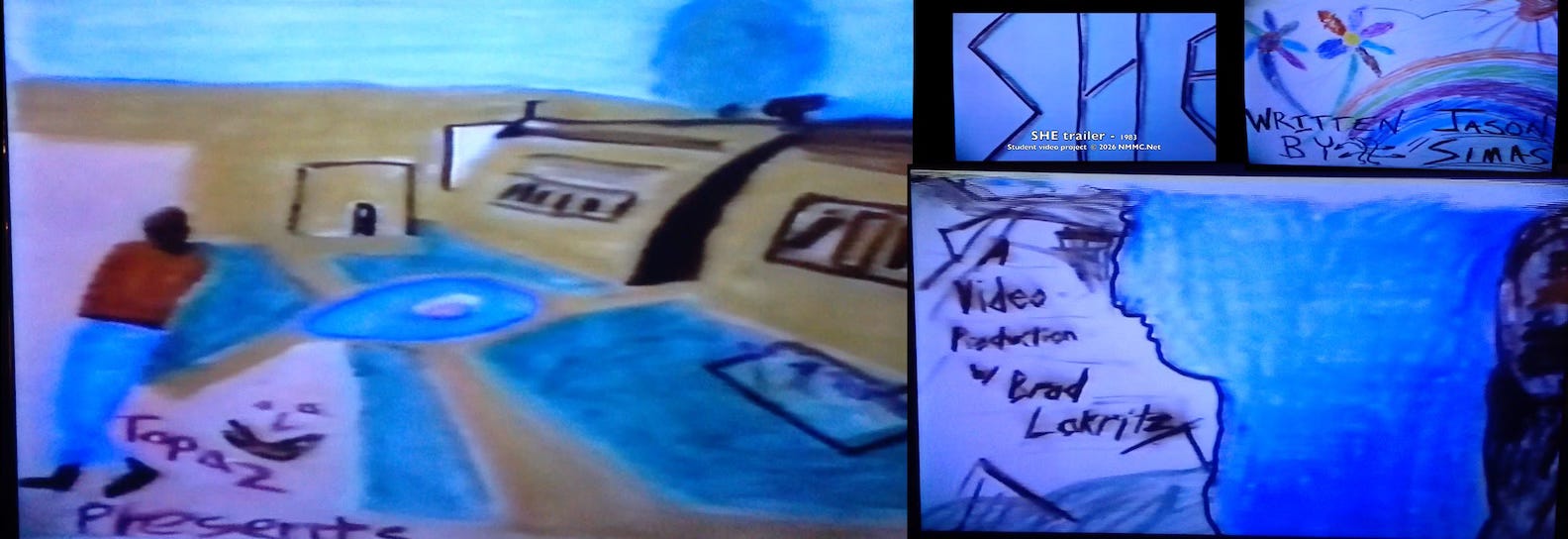
This 1983, original video production by Brad Lakritz, predicts an America where a woman can be President, AND start a war in Kuwait over oil.
The goals of this conflict are to protect America’s interest in foreign produced oil, keep the price of gasoline low, and support American car manufacturers and oil producers.
All at the cost of billions and billions of American tax dollars.
Sound familiar?
In the film there are a number of characters who talk about the President. The idea is for viewers to get to know her from what ordinary Americans say about her.
In the end she attacks Kuwait. The attack occurs some time in the future after 1983 and beyond the Reagan Presidency.
I’ll just remind you that the first Gulf War took place in 1990. In Kuwait. Over oil.
In SHE, the idea of a woman as President of the United States only works if she’s willing to go to war for oil. She’s following generations of government and business connections to support gasoline powered vehicles and large, modern road systems for them to drive on.
All with hundreds of billions of your tax dollars.
In fact, I believe that if you want to calculate the true cost of a gallon of gas today you would need to add decades of billions of dollars in government subsidies and military support for oil exploration and retrieval all over the world.
That’s why, in the end, our articulate character talked about how much her husband must have been making on the war before exclaiming that:
“She’ll be a war hero, and American’s will be driving their cars more than ever.”
I’m glad SHE did not end up like the 95% of all the other media that was created at the time (and perhaps since even more). I believe it’s important to note that I and others were talking about these issues a long time ago and they are still important today.
The film I made 43 years ago was as much about America being willing to vote for a woman as President as it was about America being willing to going to war for oil.
I do believe the two ideas are connected because one will not happen if she’s not willing to do the other.
Unless some other things change.
Looking back on SHE now, I see it as not really about the environment at all.
But I can make it that today.
Which I will continue to do by calling for the true cost of a gallon of gas and the true benefits of Electric Vehicles to be revealed to Americans.
There are plenty of other things going on in our world today that also need our attention and concerns.
I wonder what “Ketchum” thinks about of all this today.
Thanks for reading today!
True Story: The UCSD campus sits just west of the Miramar Naval Air Station in North San Diego County. At the time there was very little development in the area and the campus itself was largely undeveloped. This meant we had ample access to outdoor spaces, trails, and views of the ocean and surrounding hills and valleys.
For SHE we went out and waited for planes to fly out so we could shoot the “reporter on site war scene.” We were fortunate to get two of the Air Force AWACS to fly out along with several fighter jets during time we recorded the scene.
Unfortunately, the video equipment we had was not much better than what I used in middle school. Also, my camera skills were—to put it kindly—undeveloped. Still, we got the shots we needed and it worked.

Comments
Nothing yet. Say the first thing.
Sign in to join the conversation.