

In 1849 a man named William Thompson walked the streets of New York approaching strangers. He was well dressed, well spoken and entirely convincing, and his question was always the same: did they have enough confidence in him to hand over their watch for safekeeping? Many did, and he walked away with it. When he was eventually arrested, the New York Herald named him a confidence man. We shortened it over time to con.
More than 170 years later the technique is unchanged, because the con artist’s first job has never been to take anything from you. It has always been to make you trust them so completely that you give it willingly.
The con artist’s first job has never been to take anything from you. It has always been to make you trust them so completely that you give it willingly
In 2025 UK victims lost more than £102 million to romance fraud alone, across 10,784 reported cases, equating to almost £280,000 lost every single day1. The average victim lost £9,500, but some individual losses reached £1 million. Those are only the cases that were reported, because one of the most reliable side effects of being conned is shame, and shame keeps people quiet.
One of the most reliable side effects of being conned is shame, and shame keeps people quiet.
Romance fraud is the most visible version of this, but it is far from the only one. The same techniques that drain someone’s life savings through a fake relationship are the techniques that have been used for decades in honey trapping, corporate espionage and state-sponsored manipulation of business people and government officials. The goal can change, but the playbook generally doesn’t.
Before we get into how it works, there is one thing worth saying directly. Most people who read this will assume it could not happen to them. Most people who have been through it assumed exactly the same thing beforehand.
Who Gets Targeted
The image most people have of a scam victim does not match the reality. The assumption tends to be someone elderly, isolated, perhaps not particularly digitally literate, someone who simply did not know better, the data however, does not support that profile.
Which? research into the psychology of scams found that fraud most consistently succeeded not when victims were naive but when they were distracted, stressed or exhausted, operating, as the researchers put it, beyond their emotional window of tolerance2 . In those moments, the mental bandwidth we normally use to question things, check things and slow down is simply not available. I’m sure we can all agree that we have been in that state, some of us, probably regularly.
The City of London Police confirm that romance fraud in 2025 affected people across every age group, every income level and every professional background3. Men submitted more reports than women, but women lost more money overall. Almost half of total losses came from people aged 55 to 74, but victims as young as teenagers and as old as their nineties were recorded, there is seemingly no profile that makes you safer.

How They Do It
The con does not begin with a request for money, by the time money is mentioned, the real work is already done.
What scammers understand, and what most of their victims do not realise until afterwards, is that the human brain operates in two modes simultaneously. There is the rational mind, which checks facts, asks questions and notices inconsistencies, and there is the emotional mind, which runs on feeling, connection and instinct. The goal of every con, from the simplest phone scam to the most elaborate romance fraud, is to move you out of your rational mind and into your emotional one, and keep you there for as long as it takes.
Which? research identified two primary tactics used to achieve this4 .
The first is relationship building.
Scammers invest significant time in making you feel known, understood and valued before they ask for anything. They remember what you told them last week and they share things about themselves that feel intimate and real. Specifically, they find similarities between your life and theirs. Research shows that people are significantly less likely to question someone they feel a connection with, regardless of how recently that connection was formed or how little they actually know about the person behind it .5
The second is urgency:
“A problem has arisen that requires immediate action”
“Your bank account has been compromised”
“The investment window closes tonight”
“The money is needed now”
Urgency works because it removes the time and space needed to think clearly. It collapses the gap between feeling and doing, which is precisely its purpose.
Any situation that demands you to act immediately, before you have had the chance to speak to someone else or simply sleep on it, should be treated as a signal rather than a deadline.
These two tactics work effectively together. The relationship lowers your guard, coupling with the urgency prevents you from raising your guard again at the critical moment.
Running beneath both of them are a set of psychological biases that scammers exploit without their victims ever noticing:
Authority bias makes us more compliant with people or institutions that appear credible or official.
Liking bias makes us more willing to help and less willing to disappoint people we feel warmly towards.
Similarity bias makes us trust people who seem like us, who share our background, our interests, our values.
To be very clear, none of these biases are weaknesses, instead they are normal features of human cognition. They become vulnerabilities only when someone is deliberately engineering them.
[I will be writing an article on authority bias in the coming weeks]
The Playbook
Once the relationship and the urgency framework are in place, the manipulation moves into a more specific set of techniques. Research into romance fraud and ‘pig butchering scams” (a form of long-term investment fraud that combines romance with fabricated financial opportunity) identified five techniques that appear consistently across almost every documented case.6
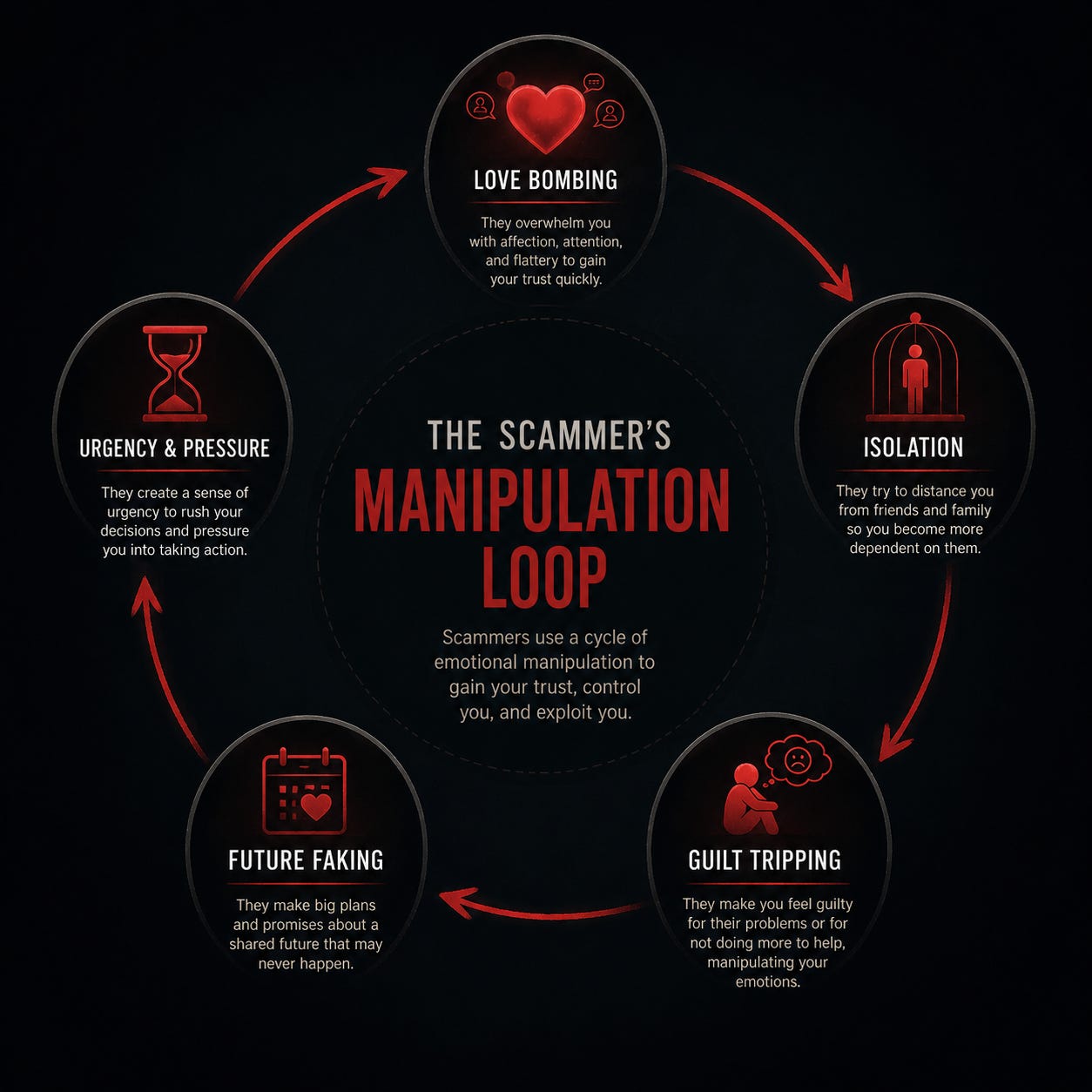
Love bombing is the first and often the earliest signal. It involves an overwhelming intensity of attention, affection and apparent investment in the victim that arrives far too quickly to be genuine. Compliments that feel extraordinary, messaging at all hours, a level of interest and enthusiasm that feels flattering before it starts to feel unusual. Most people who have experienced it describe it as intoxicating at first, and it’s that intensity that is the point. It creates a sense of connection and obligation that makes what follows feel reasonable by comparison.
Isolation follows naturally from love bombing. Once the connection feels established, the scammer begins, often subtly, to discourage the victim from discussing the relationship or the financial situation with anyone else. It is framed as privacy, or as protecting something special, or as concern that others would not understand. The effect is to remove the very people most likely to notice that something is wrong.
Guilt-tripping is deployed when the victim shows hesitation or begins to ask questions. The scammer expresses hurt, disappointment or disbelief that after everything they have shared, their word is being doubted. This technique is particularly effective because it reframes the victim’s entirely reasonable scepticism as a personal failing rather than a sensible response to an unusual situation.
Future promises (now referred to as ‘future-faking’) deepen the emotional stakes at precisely the moment the financial requests begin to escalate. Plans are formed, and a picture perfect life together is described in specific, tangible detail. The money being requested is framed as an investment in something shared, something real, something the victim is now emotionally committed to as much as the scammer appears to be. By this point the victim is not giving money to a stranger, they believe they are giving it to someone they love, for a future they both want.
Urgency and pressure close the loop. Decisions must be made before there is time to think, to check, to ask someone else.
Each of these techniques serves the same function: to ensure that by the time anything is asked of you, your emotional mind is so thoroughly engaged that your rational mind has very little left to work with

Honey Trapping
Romance fraud targets individuals, honey trapping targets power.
The techniques are identical, the goal is different. Where romance fraud is most often designed to extract money, honey trapping is designed to extract information, access, leverage or compromise. It has been practised by intelligence services for centuries and it remains one of the most consistently effective tools available precisely because it exploits the same human vulnerabilities that make romance fraud so difficult to defend against.
MI5 distributed a 14-page document to hundreds of British banks, businesses and financial institutions warning explicitly that Chinese intelligence services were cultivating long-term relationships with Western business people and exploiting sexual relationships to pressurise individuals into cooperation7 . The was a response to documented operations that had already succeeded, it was not theoretical.
The targets are not chosen at random, they are selected because of what they have access to, what they know or what their cooperation would be worth. Senior executives, government officials, military personnel, anyone who holds information or influence that someone else wants are all in scope. The approach will feel like luck, like chemistry, like an unexpected connection with someone who seems to understand them in a way nobody else quite does. That feeling is manufactured with the same precision that goes into every other stage of the operation.
The digital age has expanded the reach of honey trapping considerably. LinkedIn, dating apps and social media platforms have made it straightforward to research a target in detail before making contact, to construct a persona that mirrors their interests and values, and to initiate what appears to be an organic connection without ever meeting in person - in my industry, we refer to this as social engineering. The romantic or sexual element is not always present, sometimes the trap is professional, a flattering approach about a business opportunity, a consulting arrangement, a speaking invitation. The vulnerability being exploited is not always loneliness, interestingly, the vulnerability can be ambition, or ego, or simply the pleasure of feeling recognised by someone impressive.
The psychological foundations are the same - manufactured trust, emotional manipulation, the careful exploitation of human connection. The execution is considerably more patient, the target considerably more deliberate, and the people running the operation considerably more skilled.

The Red Flags
Knowing how the playbook works makes the red flags considerably easier to spot. None of them are definitive on their own, but in combination, they are worth paying serious attention to.
The connection moves unusually fast. An intensity of interest, affection or professional flattery that arrives before it has been earned should make you pause. Genuine relationships, professional or personal, develop at a pace that reflects the reality of two people getting to know each other. When that pace is artificially accelerated, there is usually a reason.
They are never quite available in the way a real person would be. Video calls are consistently avoided, postponed or conducted under conditions that make clear identification difficult. In-person meetings are always subject to some complication. They are abroad, they are working, something always comes up. TSB research found that victims on average made eleven payments before the scam was uncovered8. In most of those cases the victim had never once seen the person they were sending money to in real time.
They ask questions that probe beyond the natural scope of the conversation. In a romance context this often means questions about financial situation, property ownership or pension arrangements. In a professional context it means questions about access, systems, colleagues or internal processes. Scammers research their targets and tailor their approach, unusually specific questions are often a sign that someone already knows more about you than the conversation would suggest.
They discourage you from talking to anyone else. This will be framed as something reasonable, privacy, or protecting the relationship, or concern that others would not understand. The people most likely to see what you cannot see are kept away from the information they would need to raise the alarm.
Your instinct is already talking. Research published in Frontiers in Psychology in 2026 found that fraud victims consistently described a point at which something had felt wrong, a moment of hesitation or unease that they dismissed, minimised or allowed to be talked away9. That feeling is not nothing, it is your rational mind trying to get a word in edgeways. When it speaks, listen to it, and do not allow someone else’s reassurance to be the reason you stop.
Read my previous article on 'Instincts'
What To Do
If something does not feel right, stop before you do anything else. The urgency you are feeling is almost certainly being created for you.
Tell someone. The isolation element of the playbook exists precisely because outside perspective is the single greatest threat to the operation. A friend, a family member, a colleague, anyone who knows you well enough to tell you honestly what they think.
Shame is the reason most people do not do this, and shame is exactly what the playbook is designed to create and exploit.
Search the images. A reverse image search of any photograph you have been sent will often reveal whether it belongs to someone else. Scammers routinely build their personas around images taken from other social media accounts, stock photography sites or legitimate public profiles. This takes less than thirty seconds and has stopped more cons than most people realise.
Never send money to someone you have not met in person, regardless of the circumstances or the explanation. The same applies to gift cards, cryptocurrency transfers or any payment method that cannot be reversed. If you are being pressured towards any of these, the pressure itself is the answer to any question you might have about whether the situation is legitimate.
If you are in the UK and believe you have been targeted, report it to Action Fraud at actionfraud.police.uk or by calling 0300 123 2040.10 If you believe you may have been the subject of a honey trapping or professional compromise operation, speak to your organisation’s security officer before taking any other action.
This piece is not a guarantee against being targeted, because nobody can offer that. This is hopefully an understanding of how the playbook works. Thank you for reading!
Safety and Security. From someone hired to protect.

Sources
Romance Fraud 2025 Annual Data - City of London Police, 2025. https://www.cityoflondon.police.uk/advice/advice-and-information/fa/fraud/personal-fraud/romance-fraud/
The Psychology of Scams: Understanding Why Consumers Fall for APP Scams - Which?, 2022. https://media.product.which.co.uk/prod/files/file/gm-c66f3d70-3928-4dee-bb8b-481405be2b5e-the-psychology-of-scams-understanding-why-consumers-fall-for-app-scams.pdf
Romance Fraud 2025
The Psychology of Scams
Ibid
An Explorative Study of Pig Butchering Scams — arXiv, December 2024. https://arxiv.org/pdf/2412.15423
Honeytrap Warning: Love Interest or Sexpionage? — ClearanceJobs, February 2024. https://news.clearancejobs.com/2024/02/14/honeytrap-warning-love-interest-or-sexpionage/
TSB Fraud Report 2025 — TSB Bank. https://www.tsb.co.uk/fraud-prevention/
Mental Health and Psychosocial Sequelae of Fraud Victimisation: A Systematic Review — Frontiers in Psychology, March 2026. https://www.frontiersin.org/journals/psychology/articles/10.3389/fpsyg.2026.1805536/full
Report Fraud — Action Fraud UK. https://www.actionfraud.police.uk
Comments
Nothing yet. Say the first thing.
Sign in to join the conversation.