
The most common question asked about domestic abuse is why the victim doesn’t leave. It is the wrong question, and understanding why it is wrong is the beginning of understanding everything else.
I have spent my working life in protection, and most of what I write here concerns threats that arrive from outside, the hostile surveillance, the opportunist mugger, the stranger in the crowd. This piece is about the threat that lives in the house.
Domestic abuse sits awkwardly in the security world’s usual frames, because the perpetrator is not an intruder to be kept out but a person who was invited in, trusted, and loved, and every professional instinct we have about perimeters and access control fails at the front door of a home where the danger is already inside. It is also, statistically, a far more likely threat to the people reading this than almost anything else I cover. So I want to treat it with the same seriousness this publication gives to any other threat picture, which means looking honestly at how it works, what the law now offers, and what practical protective thinking looks like for anyone living it or watching someone they love live it.
It is also, statistically, a far more likely threat to the people reading this than almost anything else I cover.
Before we start, I want to say one thing, which is that if any of this is your life right now, there is a number at the end of this article that is free, confidential and answered around the clock, and you do not need to have decided anything to call it - however, I respect that is far easier said than done.
Coercive control is the architecture of abuse, and the violence, where there is violence, is only its enforcement arm. The pattern is a gradual assumption of ownership over another person’s life. It rarely announces itself, and in the early days it often wears the costume of devotion. Wanting to know where you are all the time looks like care, wanting you all to themselves looks like romance, managing the money looks like helpfulness. Criticism of your friends and family arrives dressed as insight, they don’t really appreciate you, and each strand seems small on its own, which is precisely why the pattern is so hard to see from inside. Control is never built in a day but in increments, each one sitting just below the threshold that would trigger alarm.
By the time the pattern is established, the person inside it is isolated from the people who might have named what was happening, financially entangled or dependent, and systematically taught to doubt their own judgement. That last one matters more than any lock on any door. When someone has spent years being told that their memory of events is wrong, that their reactions are excessive, that everything wrong in the relationship originates with them, they lose the instrument a person uses to assess danger, which is trust in their own perception. I have watched highly capable people, people who run businesses and manage teams, sit in front of me unable to say with confidence whether what was happening to them was abnormal. That is not weakness, it is the intended product of a process that works.
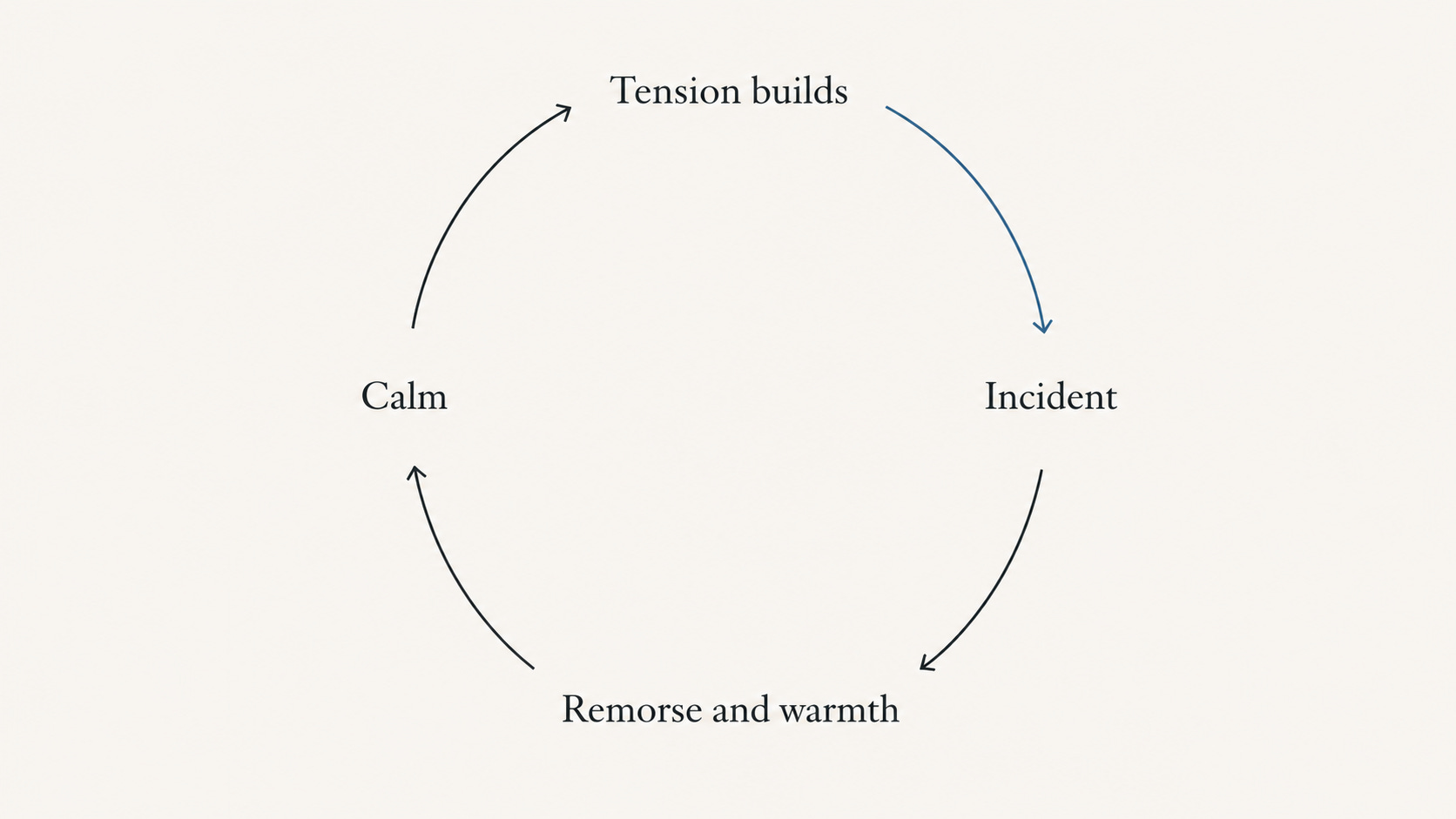
And then there is the loop itself, the thing that answers the question we started with. Abusive relationships are almost never uniformly awful, because they cycle, with tension building until something breaks, followed by remorse, warmth, and the person you first fell in love with returning like weather. Psychologists call the mechanism intermittent reinforcement, and it is the same mechanism that makes gambling addictive.
Reward delivered unpredictably binds far more powerfully than reward delivered consistently, and when the reward is love and the alternative is fear, the bond it creates is one of the strongest attachments a human being can form. People do not stay because they are foolish, they stay because they are caught in one of the most effective behavioural traps that exists, one that has been reinforced hundreds of times, and because the practical barriers, the money, the children, the housing, the fear of what happens next, are real. And they stay for one more reason that my profession understands better than most, which is that their risk assessment is often accurate, and I will come back to that.
Everything in my profession begins with intuition, and I want to spend a moment defending it, because it is the faculty abuse is specifically designed to break. In protective work we are taught that intuition is not mysticism but rapid pattern recognition, the brain processing a thousand small signals faster than conscious reasoning can, and the security industry’s foundational text on the subject, Gavin de Becker’s The Gift of Fear, makes the point that violence is almost never as sudden as survivors initially describe, because when you walk it back with them, the signals were there and were noticed, and what failed was not perception but permission, the permission people give themselves to act on what they already know.
In protective work we are taught that intuition is not mysticism but rapid pattern recognition.
If you are inside the relationship, the cues rarely announce themselves as fear of the person, because the mind resists that conclusion about someone it loves, and so the signal arrives in disguise.
It arrives as rehearsal, the discovery that you compose ordinary sentences in your head before saying them, testing each one for how it might land.
It arrives as monitoring, the way you read the sound of the car door or the key in the lock and know from those seconds what kind of evening it will be.
It arrives as editing, the growing list of true things you no longer mention, friends you saw, money you spent, opinions you hold, because the cost of mentioning them has quietly become too high.
It arrives as relief, the physical loosening in your shoulders when they leave the house, which is perhaps the most honest signal a body can send, and it arrives as exhaustion, because managing another person’s moods as a full-time occupation is depleting in a way that love is not.
None of these, alone, is proof of anything. Together they form a pattern, and there is one meta-signal that sits above them all, which is the question itself. People in sound relationships do not lie awake asking whether what is happening to them is normal, and they do not find themselves searching online for the definition of coercive control at two in the morning. If you are asking the question, the asking is data, and it deserves to be treated as such rather than argued away, because as the first section of this article explained, the doubt doing the arguing was manufactured by the very situation you are trying to assess.
The cruelty of coercive control is that it degrades the instrument you would use to detect it, which is why the professional advice is not simply to trust your gut but to lend it corroboration. Say what you have noticed out loud to one person outside the relationship, or to the helpline at the end of this article, and listen to how it sounds leaving your mouth. Victims often report that they understood their situation for the first time while describing it to someone else, because speech forces the pattern out of the fog of daily normality and into a form the mind can finally examine.
The cruelty of coercive control is that it degrades the instrument you would use to detect it.
If you want evidence that isolation is the active ingredient rather than a side effect, the pandemic provided it at national scale, because in March 2020 the state delivered every abuser’s core objective, a household cut off from outside eyes, overnight and with legal force. The United Nations came to call what followed ‘the shadow pandemic.’
Calls to the National Domestic Abuse Helpline rose 25 per cent within the first two weeks of lockdown and were running 66 per cent above pre-pandemic levels within two months, while visits to the helpline’s website, where a woman can request a safe time to be contacted, rose by 950 per cent, a tenfold increase that tells its own story about homes where even a phone call had become impossible. Sixteen women and children died in suspected domestic homicides in the first three weeks alone, the highest the Counting Dead Women project had recorded in over a decade.
But the most instructive number from that period points the other way. While helpline demand rose by two thirds, domestic abuse incidents reported to police rose by only around four per cent. That gap is the whole phenomenon in two figures. The window a victim uses to seek help, the commute, the school run, the hours a partner is out, had been closed by law, and people were reaching out through websites at three in the morning because reaching out required the one thing lockdown had abolished, which is time unobserved. The quiet in the official figures was not peace but the sound of the trap working, and it is a permanent lesson in how to read domestic abuse statistics, because recorded abuse measures the ability to report, not the reality behind the door.
And when researchers later analysed tens of thousands of police-recorded abuse crimes in detail, they found the sustained rise arrived not during lockdown but across the long period after it lifted, which will surprise nobody who has read this far. Lockdown froze thousands of relationships at the point where someone would otherwise have left, and separation delayed is danger deferred, not danger avoided. When the doors reopened, the deferred separations began, and services on both sides of the Atlantic have run above pre-pandemic levels ever since.
Nor is the gap between experience and consequence a pandemic artefact, because the most recent official figures show it is the permanent architecture of the system. In the year to March 2025, the Crime Survey estimated that 3.8 million people in England and Wales experienced domestic abuse. In the same year, police recorded around 816,000 domestic abuse crimes, the CPS charged just under 54,000 suspects, and 41,000 offenders were convicted.
For most of legal history, the criminal law could only see abuse in incidents, the assault, the injury, the broken door, while the pattern itself remained invisible to it. That changed in England and Wales in December 2015, when controlling or coercive behaviour in an intimate or family relationship became a criminal offence in its own right under section 76 of the Serious Crime Act 2015. The offence is committed where someone repeatedly or continuously engages in controlling or coercive behaviour towards a person they are personally connected to, where that behaviour has a serious effect, meaning it causes fear of violence or serious alarm and distress that substantially affects daily life, and where the perpetrator knew or ought to have known it would. It carries up to five years in prison.
The law has kept moving in the years since, and the Domestic Abuse Act 2021 widened the offence so that the victim and perpetrator no longer need to live together, which brought ex-partners and estranged family members properly within reach, and it recognised children who witness abuse as victims in their own right.
Since February last year, offenders convicted of coercive control and sentenced to twelve months or more are automatically managed under the multi-agency public protection arrangements, the same framework used for other serious offenders, which forces police, probation and other agencies to cooperate on the risk they pose. Scotland went further still, with its 2018 legislation treating coercive control as a central offence carrying up to fourteen years. None of this makes prosecution easy, because evidencing a pattern is harder than evidencing an incident, and the conviction numbers remain modest against the scale of the problem. But the significance is real all the same, because the law now officially recognises that the cage is the crime and not merely the blows.
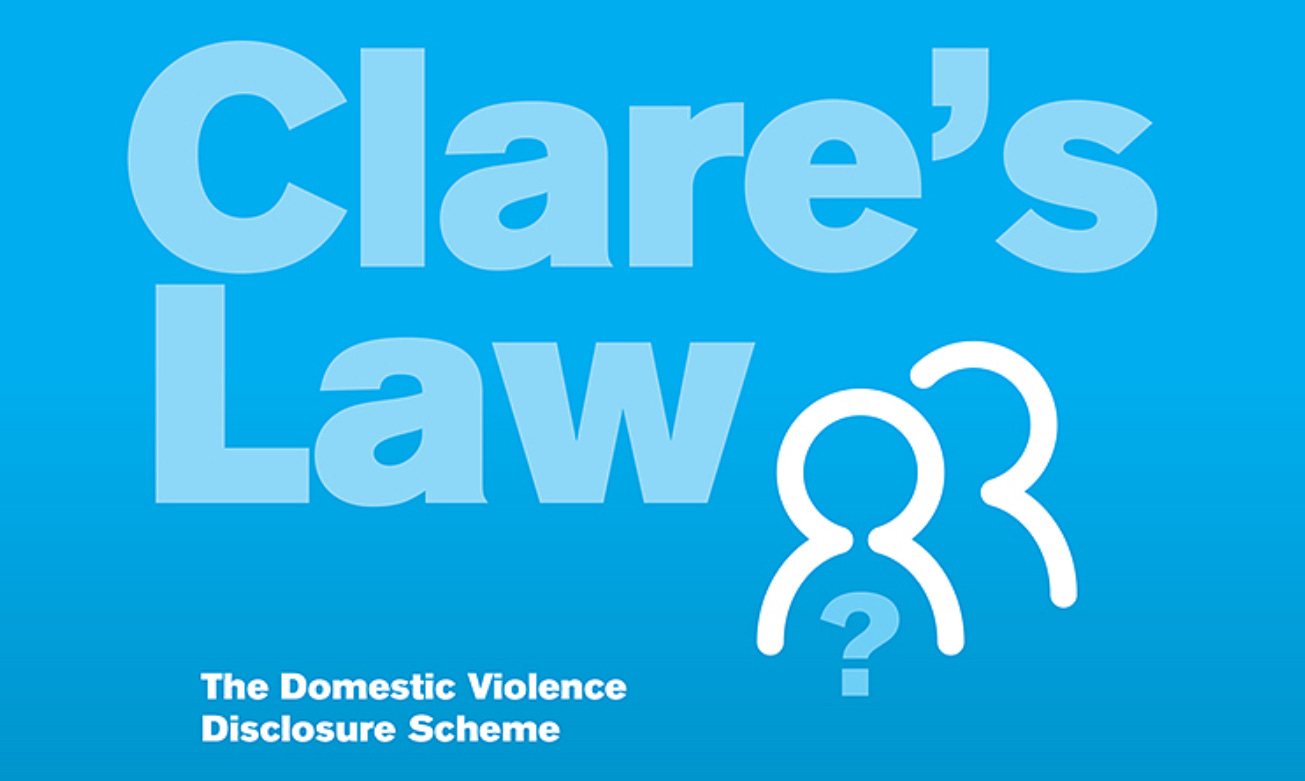
There is one legal tool that I think remains dramatically underused, and it exists because of a woman named Clare Wood. Clare met a man on Facebook in 2007, unaware that he had a history of violence against women that was known to the police. She ended the relationship when it became controlling, and in 2009 he murdered her. Her father campaigned for years on a simple principle, that the information which might have saved his daughter existed inside the system and simply never reached her, and in 2014 the Domestic Violence Disclosure Scheme, known as Clare’s Law, was rolled out across England and Wales, with versions following in Scotland and Northern Ireland.
The scheme has two parts, and the first, the right to ask, means anyone can apply to the police for information about whether a current or former partner has a history of abuse or violence. You can apply about your own partner, and, and this is the part too few people know, you can also apply if you are worried about someone else’s partner, a daughter’s, a friend’s, a colleague’s. The second, the right to know, means police can proactively disclose to someone they believe to be at risk, without anyone asking. Disclosure is not automatic, it has to be judged lawful, proportionate and necessary to protect the person at risk, and where a third party applies, the disclosure itself is made to the person at risk rather than to the applicant, which is right, since the information belongs to her safety and not to anyone else’s curiosity.
Two honest caveats from someone who deals in risk for a living, and who has sat with people while they made these applications. I have helped individuals through the Clare’s Law process, and what I can tell you from that experience is that the application itself is straightforward, but the moment is not, because asking the question means admitting to yourself that it needs asking, and that admission is often the hardest step anyone takes. I will also tell you, without detail, that the record a disclosure reveals can be longer than anyone expected and shorter on consequences than anyone would believe. Recorded incidents do not always become charges, charges do not always become convictions, and convictions for assaulting a partner too often end in cautions and suspended sentences rather than custody, which means a history that would end a career in my industry can leave a man walking free and dating again with nothing attached to him but a file. Clare’s Law exists precisely because that file follows him silently unless somebody asks.
A clean disclosure is not a clean bill of health, because domestic abuse is chronically underreported and plenty of dangerous people have no record, so absence of information must never be read as absence of risk. And a disclosure does not make a decision for anyone. Some people receive one and stay, for all the reasons the first section of this article describes, and the disclosure has still done its work, because it has planted accurate information where gaslighting had been growing. If you take one practical thing from this article, let it be that this scheme exists, that it is free, and that you can start an application through any police force’s website or by calling 101.
Here is where I want to offer what my trade actually knows, because the principles that protect a principal from a hostile threat translate, with care, to this situation, and one of them is uncomfortable and needs saying first.
In protective work we assess risk as a function of capability, intent and opportunity, and we pay closest attention to the moments when risk spikes rather than assuming it sits at a constant level. In domestic abuse, the research and practitioners in the field agree that the spike comes at separation. The period around leaving, and the weeks and months after, is consistently the most dangerous window in an abusive relationship, because the entire system of control is collapsing and the person who built it knows it. This is the reason the professional advice is never simply to walk out tonight, and it is the reason victims who hesitate are often reading their situation more accurately than the friends urging them to just go. I don’t want to sound dramatic, but leaving is not an act but an operation, and operations are planned.
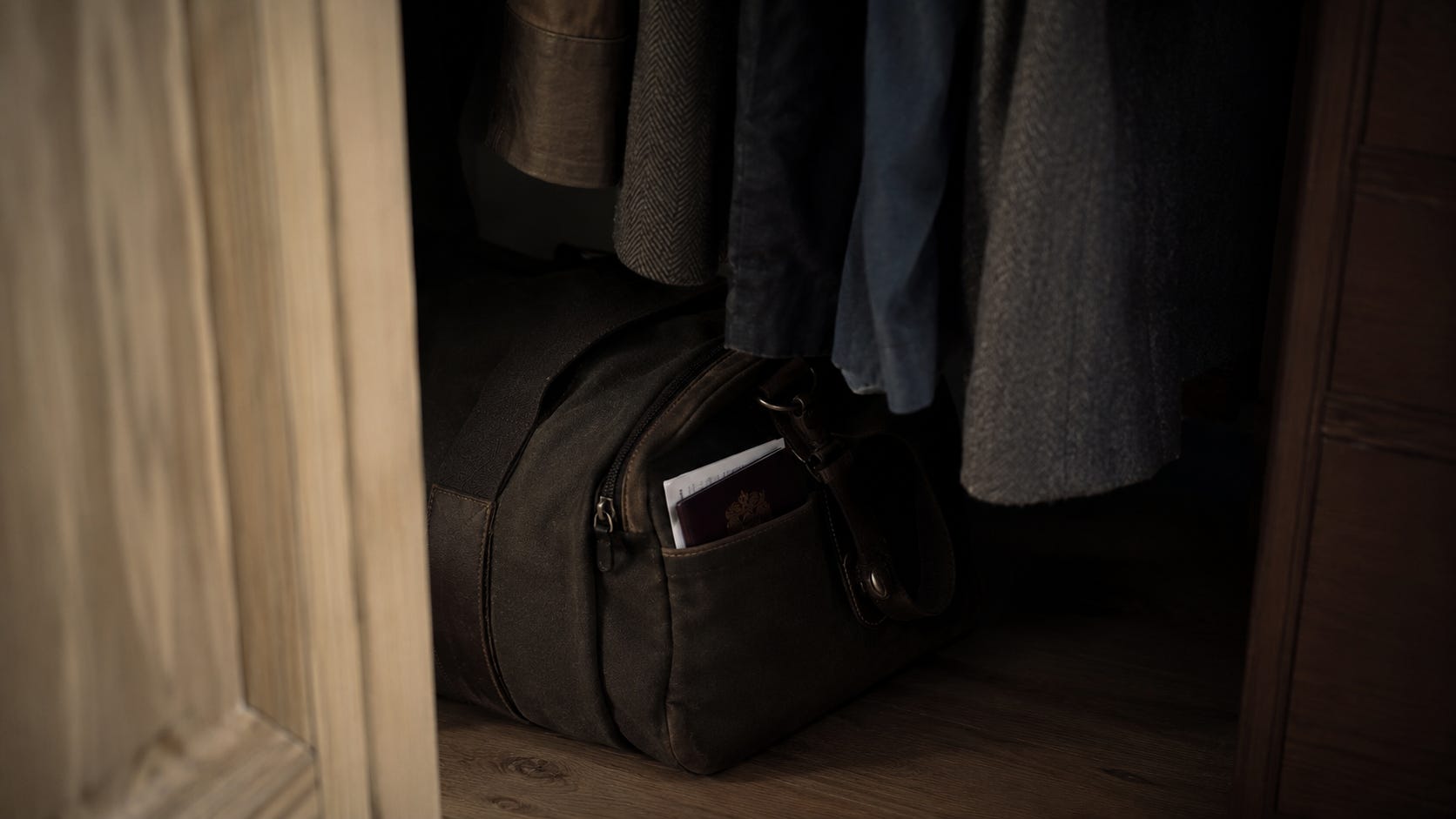
Planning looks like this, and none of it requires having decided anything. It means speaking to the specialists first, not on your own device (more on this in the next paragraph) and then reach out to the helpline below or a local domestic abuse service, because they do safety planning every day and can connect you to an independent advisor who will know your local options. It means quietly assembling the practical foundations, identity documents, bank access, medication, essentials for children, held somewhere the other person does not control, perhaps with someone you trust. It means agreeing a code word with one or two people that means come now or call the police, and it means thinking about predictability, because the person who knows your routine best is the one you may need protection from.
And it means taking the technology seriously, because this is where the modern version of this threat lives and where my own casework has taught me the most. I have conducted technical sweeps for people being harassed and stalked by ex-partners, and the pattern repeats. The surveillance in these situations is rarely exotic. It is the shared phone plan that shows call records, the location sharing switched on years ago in happier times, the shared cloud account that mirrors photographs and messages to a device you never see, the children’s tablets, the smart doorbell, the car’s connected app, and occasionally something physical that a sweep finds and an ex-partner should never have been able to place.
What those jobs have shown me is that the client’s instinct was right long before the evidence appeared. If you feel surveilled, treat that feeling as information worth checking rather than a flaw in yourself. If you are planning to seek help, do it from a device the other person has never had access to, a work computer, a library terminal, a trusted friend’s phone, because browser histories and synced accounts report to their owner. Most police forces and the helpline can advise on a proper technology safety check before you change anything, and the order matters, because suddenly locking an abuser out of everything can itself trigger the escalation you are trying to avoid. This is exactly the kind of sequencing a protection professional thinks about, and specialists exist to think about it with you.
A few practical points on reaching out without leaving a trace, because in a controlled household the search for help is itself a risk, and these small pieces of tradecraft matter more than any of the sophisticated measures people imagine.
Call the helpline from a phone that is not your own, a trusted colleague’s, a friend’s, or a work phone, because even a freephone call sits in your mobile’s call log where a partner who checks your phone will find it. If you must use your own mobile, memorise the number rather than saving it as a contact, and delete the call from your log afterwards.
Do your reading on a device the other person has never touched, a work computer, a library terminal, or a friend’s phone, since browser histories, synced accounts and shared cloud services report back to whoever else holds the keys. Support sites, including Refuge’s, carry a quick exit button that jumps instantly to an innocuous page, and it exists because this problem is universal.
Do not suddenly wipe everything, because a phone that is abruptly cleaner than usual is itself a signal to someone who monitors it, and unusual behaviour is what a controlling partner is attuned to. Keep your visible patterns ordinary and do the sensitive things elsewhere.
Set up a fresh email address, created on a safe device and never opened on any shared one, for anything to do with services, solicitors or housing, so that nothing arrives where it can be read.
At work, consider telling one trusted person, because a workplace is often the only environment an abuser cannot see into, and a colleague who understands why you are borrowing their phone at lunchtime is a genuine protective asset.
None of this is about deception for its own sake. It is about ensuring that the process of getting help does not raise the risk before the help arrives, which is the same principle every protective operation runs on.
The same principle of trusting the pattern applies when you are on the outside looking in, and the cues available to a watcher are different but no less readable.
What you are watching for is a dimming, a person becoming a quieter, smaller, more careful version of themselves, and it tends to show in the same handful of ways.
Contact becomes rationed and strange, with messages answered at odd delays and in a flatter voice than you remember.
Plans get cancelled late and often, usually with apologies that feel rehearsed, and when you do see her, part of her attention stays on her phone in a way that reads less like distraction and more like duty.
You may notice that decisions which were once hers alone now route through the partner, dressed up as consideration, the reflexive I will just check, and you may notice new self-criticism in her mouth that sounds like it was written by someone else.
The partner, meanwhile, is often perfectly charming to you, and I want to flag that disparity specifically, because it is one of the most reliable cues there is. When a person you love is visibly diminishing inside a relationship while the partner presents beautifully to the outside world, the gap between those two observations is not evidence that you are imagining things. In my line of work we would call it the signature of impression management, and de Becker would say you have already noticed what is happening and are now negotiating with yourself about whether you are allowed to believe it.
Watching someone you care about disappear into a relationship like this is its own kind of powerlessness, and most of the instinctive responses make things worse, because ultimatums isolate further, and criticism of the partner tends to be reported back and used as evidence that you are the enemy.
What works is slower and harder, and it starts with staying in contact, even when it is rationed and strange, because the abuser’s project is isolation and your continued presence is quiet resistance to it.
Say what you see, once, gently, without demanding agreement, something as simple as observing that she seems less herself lately and that you are there whenever she wants to talk.
Believe her if she discloses, because the response to a first disclosure shapes whether there is ever a second.
Never pass anything she tells you back into the relationship.
And remember that you have standing under Clare’s Law to ask the police a question, and standing at the helpline below, which takes calls from concerned friends and family as well, to ask how best to help.
What you are doing, in professional terms, is keeping a channel open and holding information ready for the moment she is able to use it. That moment may take longer to arrive than you can easily bear, and the channel matters anyway.
The National Domestic Abuse Helpline, run by Refuge, is 0808 2000 247. It is free, confidential, and answered twenty-four hours a day, every day of the year, and you do not need to be ready to leave, or ready to do anything at all, to call it.
In Wales, Live Fear Free offers the same on 0808 80 10 800.
In an emergency call 999, and if you cannot speak, stay on the line and press 55 when prompted, which signals to the operator that you need help.
This is a subject that deserves more than one article, and it will get more than one here. If you have read this far and recognised your own life in any of it, then the sentence I most want you to take away is this one. The doubt you feel about your own judgement was manufactured, the loop you are caught in was built around you, and both of those things mean it is not you, and you are not alone.
Safety and Security. From someone hired to protect.

[1] Section 76, Serious Crime Act 2015, legislation.gov.uk, and CPS prosecution guidance on controlling or coercive behaviour.
[2] Home Office guidance on the Domestic Violence Disclosure Scheme (Clare’s Law), and force-level scheme pages including Avon and Somerset and West Yorkshire Police.
[3] Domestic Abuse Act 2021 provisions on personal connection and children as victims, GOV.UK factsheets.
[4] MAPPA management of coercive control offenders from February 2025 under the Victims and Prisoners Act 2024.
[5] Refuge, National Domestic Abuse Helpline.
[6] Refuge helpline demand figures during lockdown and ONS reporting on domestic abuse during the coronavirus pandemic, 2020 to 2021, with Counting Dead Women figures via the House of Commons Library.
[7] Peer-reviewed change-point analysis of police-recorded domestic abuse crimes in a UK force, Crime Science, 2023, on post-lockdown trends.
No posts
Comments
Nothing yet. Say the first thing.
Sign in to join the conversation.