
➤ 5 days until the August 4, 2026 primary | ➤ 830 days until Nov. 7, 2028
➤ 96 days until the Nov. 3, 2026 midterms | ➤ 907 days until inauguration day 2029

We give you the facts others ignore at a crucial time. We give you vital news on Virginia’s Black community. To our subscribers: Thank you for standing with us. We will always be grateful for your trust and support. Follow us: 🦋 BlueSky | Facebook | Threads | 📧 : BlackVirginiaNews@gmail.com | donate here

✊🏽 Black Power War Room | 🗃 Democracy Docket | 🗃 Exec Order Tracker |
🗃 Trump Litigation Tracker: Legal Challenges to the Administration

Virginia State University Launches Annual Data Series on Economic State of Black Men and Boys
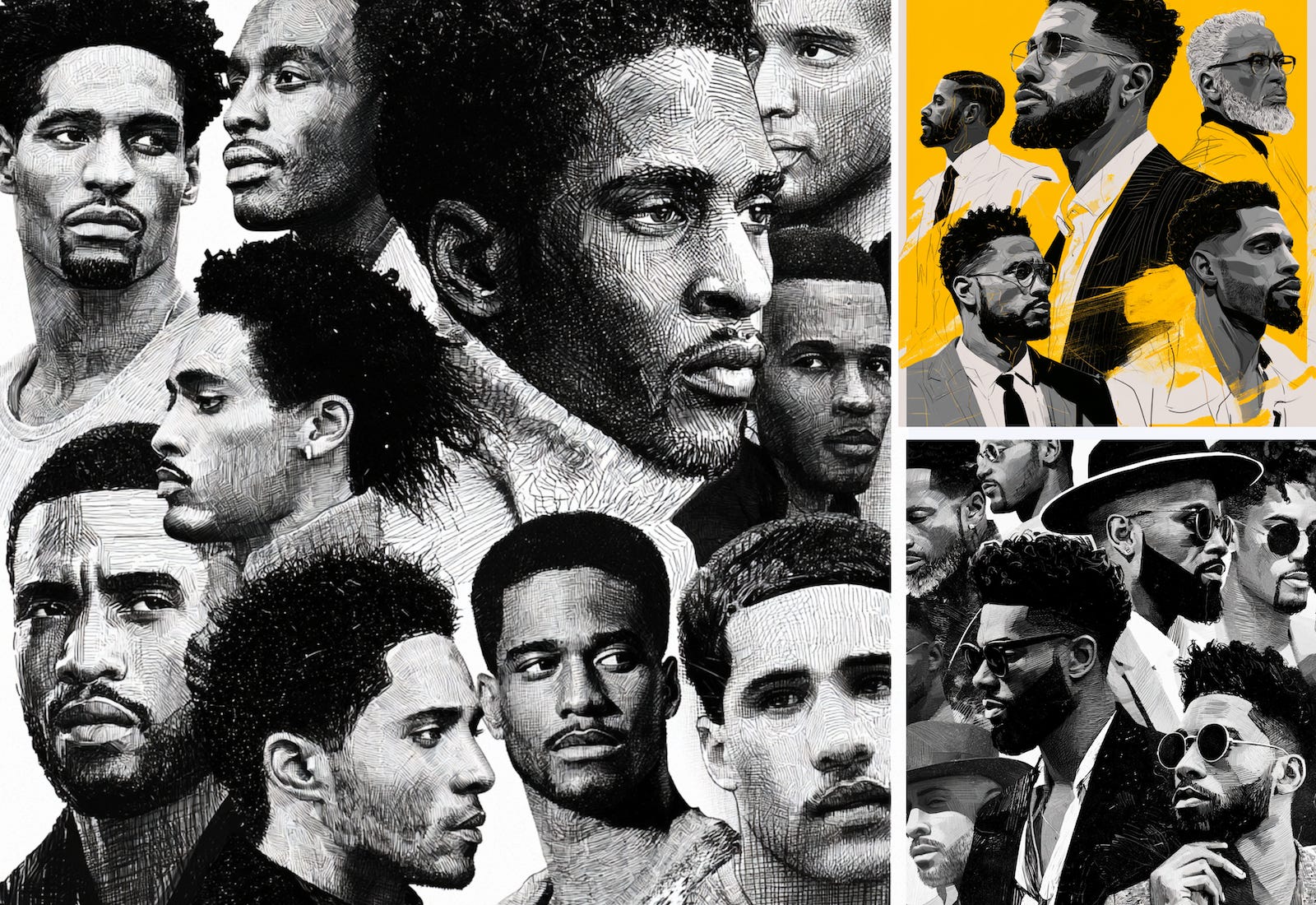
🚩 The John Mercer Langston Institute for African American Political Leadership at Virginia State University released the first edition of a new annual research series on July 30, presenting data on the economic and educational conditions facing Black men and boys nationwide.
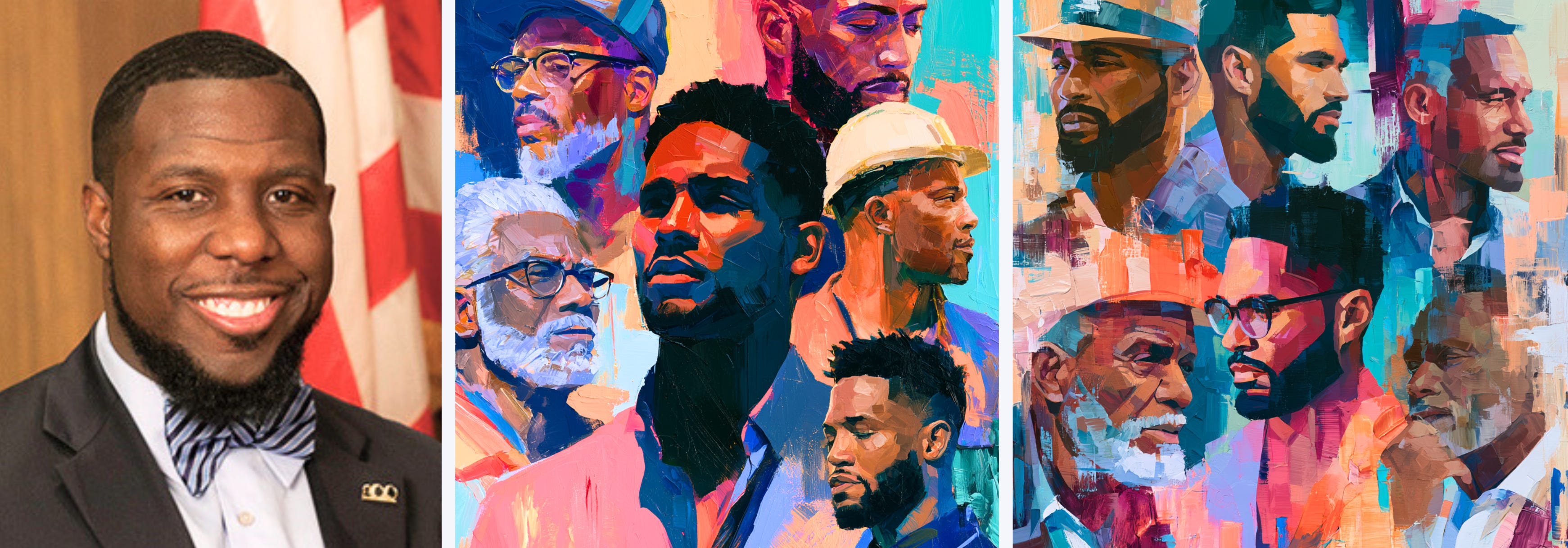
Above: Dr. Wes Bellamy of Virginia State University, left, presents a report on the economic state of Black men.
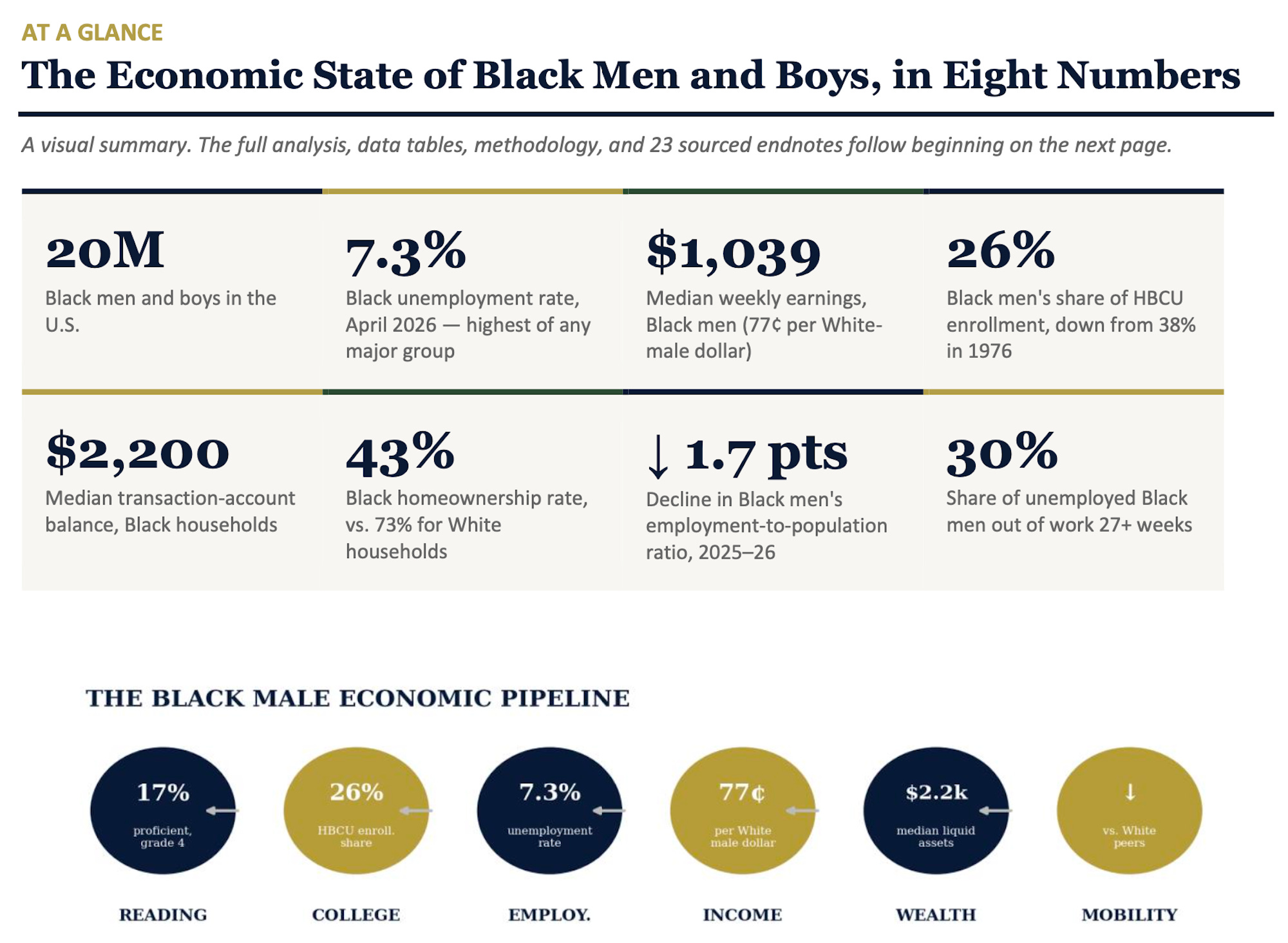
Above: A piece of the one pager for the report on The Economic State of Black Men and Boys in the United States
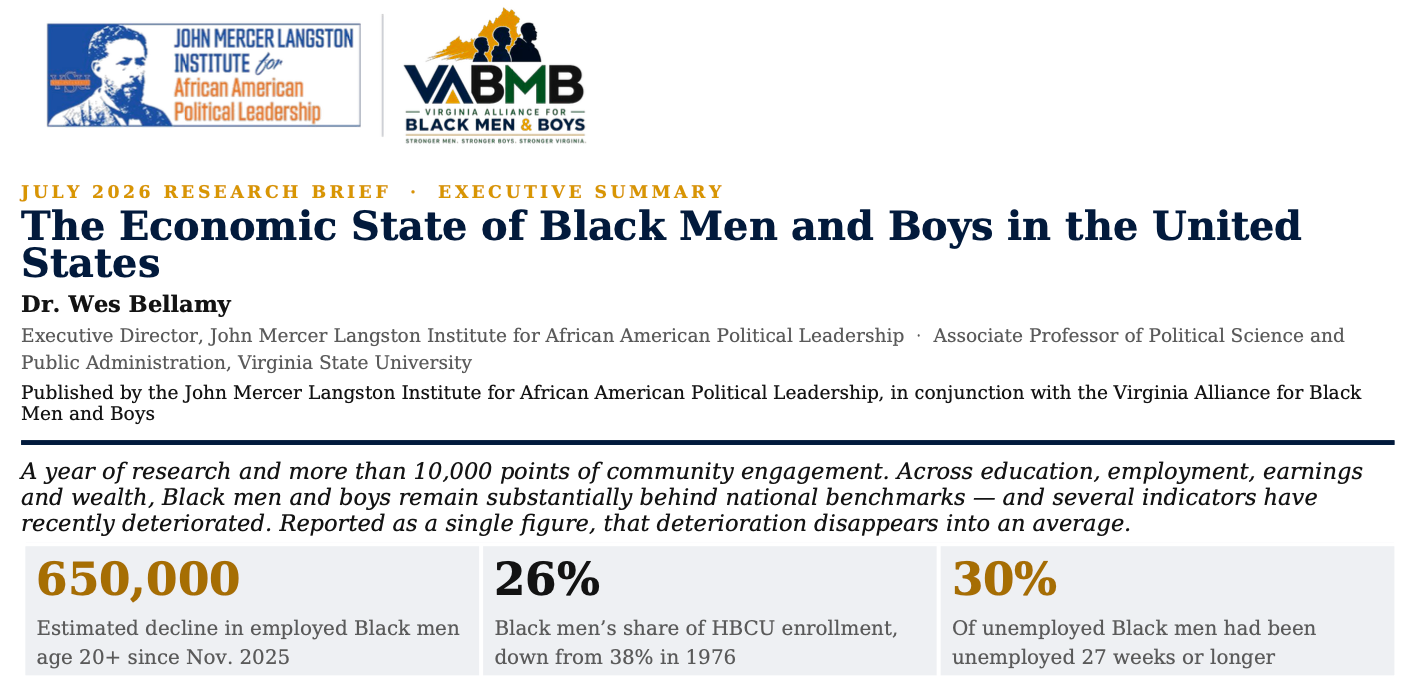
The report, The Economic State of Black Men and Boys in the United States, was unveiled during the 2026 BlackPrint Leadership Institute at the Jefferson School African American Heritage Center in Charlottesville. It was produced in partnership with the Virginia Alliance for Black Men and Boys.
Dr. Wes Bellamy, executive director of the John Mercer Langston Institute, is the report’s principal author. The research draws on data from the U.S. Bureau of Labor Statistics, the U.S. Census Bureau and the National Center for Education Statistics, along with more than 10,000 points of community engagement gathered over a year of field listening sessions.
Among the report’s findings, Black men’s enrollment at historically Black colleges and universities has fallen to 26% of the student population, down from 38% in 1976.
The report covers early literacy, college enrollment, employment, earnings, household wealth and economic mobility. It comes as policymakers nationwide debate workforce participation, higher education access and economic competitiveness.
Other key findings include:
Early literacy: On the 2024 NAEP, ~17% of Black fourth graders and 14% of eighth graders performed at or above NAEP Proficient in reading; more than 60% of Black eighth graders were below NAEP Basic. NAEP Proficient is not grade-level proficiency under state standards. The grade-4 figure rose from 8% (1992) to 18% (2015), then stalled at ~17% (2024).
Enrollment decline: Black male undergraduate enrollment fell about 22% at degree-granting institutions between 2010 and 2022, and about 25% at HBCUs. Fewer Black men were enrolled at HBCUs in 2022 than in 1976 (Windsor & Reeves, AIBM, Aug. 22, 2024).
Degree gap: Among Black adults 25–34, about 26% of men and 38% of women hold a bachelor’s degree or higher — a gap of ~12 percentage points, wider than in several other major groups. Advanced degrees, labor-force participants: 10.8% vs. 15.7%.
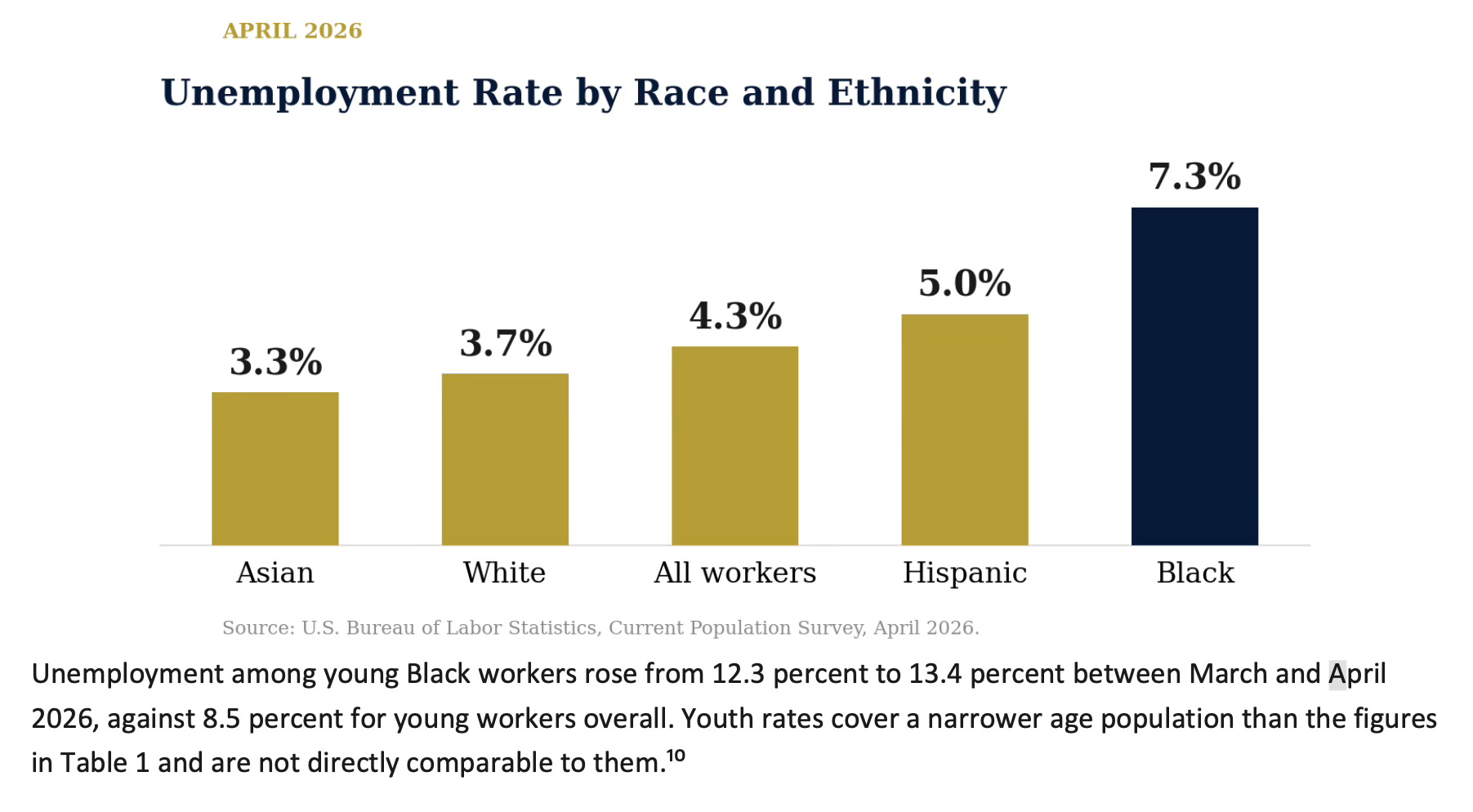
Withdrawal: Black men’s employment-to-population ratio fell 60.5% to 58.8% between Q1 2025 and Q1 2026 — 1.7 points, a relative decline of ~2.8% — concentrated among men without four-year degrees. In the period examined they were the only major race-by-gender group shown to decline; Black women’s was flat.
Concentration: Transportation, warehousing and logistics are major sources of employment for Black men and have seen virtually no job growth since 2022. The sector shed ~90,000 jobs over a recent twelve-month period.
Earnings: Median usual weekly earnings for Black men were about $1,039 in 2025 vs. $1,354 for white men — approximately 77 cents on the dollar. Black women earned $942, a $97 weekly gap. That narrow gender gap is convergence at a low earnings level, not equality.
Wealth: The median Black household holds ~$2,200 in transaction accounts vs. $10,000 for white households; homeownership is 43% vs. 73%. These are household measures, not measures of Black men’s wealth. Average unemployment runs ~25 weeks.
Mobility: Black men have substantially lower adult employment and earnings than white men raised at comparable parental income levels. Parental affluence does not protect Black boys from downward mobility the way it protects white boys.
“Communities cannot solve what they do not measure,” Dr. Bellamy said. “This report establishes a baseline for accountability — not only for government, but for universities, employers, nonprofits, and all of us who care about the future of Black men and boys.”
Dr. Bellamy said the report aims to build consensus on current conditions so that data, rather than assumptions, guides future investments and decisions.
Organizers timed the report’s release to coincide with the BlackPrint Leadership Institute, a one-day program for young Black men focused on civic engagement, financial empowerment, leadership development and community action.
“The young men participating in BlackPrint today represent possibility,” Dr. Bellamy said. “This report helps explain the landscape they are inheriting, while the Institute is designed to equip them to change it. Research without leadership accomplishes little. Leadership without research lacks direction. We believe both are essential.”
The Langston Institute said the report will become an annual publication, with future editions expanding to cover educational attainment, workforce participation, civic engagement, health and family economic mobility.
The report will be distributed to state and federal policymakers, higher education leaders, school divisions, nonprofit organizations and philanthropic groups. The Institute said it welcomes invitations to present the findings to legislative bodies, educational institutions and community groups.






PODCAST EP73: Is the Sleeping Giant of Black Voters About to Wake Up?
BLACK VIRGINIA NEWS is reader-supported because truth demands independence. As Ida Wells said, “The way to right wrongs is to turn the light of truth upon them.” Subscribe, free or paid, and help keep the light on.

BLACK VIRGINIA NEWS 👊🏽“One had better die fighting against injustice than die like a dog or a rat in a trap.” —Ida Wells. Support our unbossed indy news and win! Thank you!

⭆ SUBSCRIBE TO BLACK VIRGINIA NEWS. 📬 “One had better die fighting against injustice than die like a dog or a rat in a trap.” —Ida Wells. 👨🏽💻 Send press releases, submissions, tips, pitches, comments and corrections to BlackVirginiaNews@gmail.com.
Comments
Nothing yet. Say the first thing.
Sign in to join the conversation.