
One of my favorite quotes on competition came an early 2000’s cheerleading movie: To be the best, you have to compete against the best, and beat them.
Startup culture kept some of the best ideas and founders out simply because they didn’t have the access or resources to build. You needed technical skills or engineers, capital, or all three just to get an idea off the ground, but AI has reduced a lot of those barriers.
Being able to build quickly is becoming less of a competitive advantage when so many more people can do it. The advantage is shifting toward insight, distribution, customer understanding, execution, and identifying overlooked problems. However, with more people entering the arena to compete, more mediocre ideas will flood it too. We’ll see the same problems tackled by more founders, some with genuinely innovative approaches and others building slightly different versions of what already exists.
So when everyone can build, what actually makes a startup worth paying attention to?
First off, most ideas aren’t going to be original. The execution may be, or it may simply be better than existing solutions. AI doesn’t suddenly give us the ability to come up with ideas no one has ever thought of before. What AI does is give more people, especially those who may have lacked the resources to build, the ability to test whether their approach to an existing problem is actually better.
When building becomes accessible to more people, the competitive advantage shifts. Understanding a problem better than everyone else, knowing exactly who you’re building for, finding a better way to reach them, and actually getting people to use and pay for what you’ve built become harder to replicate than the product itself.
That’s going to be the tradeoff of the AI era in startup culture. We’re going to get way more clutter, much more copycats, and probably a lot of startups that won’t last. However, among all of that could be founders and ideas that simply needed greater access to have a chance to thrive.
So while we’re moving from ‘who can build?’ to ‘who can stand out?’, the same human problems remain. Who gets discovered, and why? Who gets access to the rooms, investors, customers, media, and opportunities that can turn a product into a successful company?
If you’re building, my advice is to get in front of as many people in the startup community as possible. The same way people network to get their foot in the door for a job, founders need to network to get eyes on their products.
Download apps like Luma, Partiful, Meetup, and Eventbrite. Get involved with your local startup community. Head to your local library and find out what entrepreneur and startup organizations exist around you. Subscribe to newsletters from founder, fundraising, and startup organizations. Show your face, meet other founders, ask investors the questions you can’t easily Google. Apply for accelerators, pitch competitions, demo days, and other opportunities that put you and your product in front of people who otherwise may never know you exist.
AI may have made it easier to build your way into the arena, but it certainly hasn’t eliminated the need to network your way into the right rooms.
Speaking of getting into the right rooms, here's an opportunity I think founders should consider.

As Founder & CEO of Black Tech Pipeline and Co-founder of Sift Skills, I’m super excited to serve on the SXSW Pitch Advisory Board to help discover the next generation of innovative startups!
SXSW Pitch 2027 is an incredible opportunity to potentially pitch your startup on one of the world’s biggest stages in front of investors, industry experts, media, and business leaders, with the potential to gain valuable exposure, feedback, connections, and even funding.
Since it started, SXSW Pitch has helped launch hundreds of startups that went on to secure funding, strategic partnerships, acquisitions, and global recognition.
If you’re building something transformative and ready to showcase your company, I’d love to encourage you to apply for SXSW Pitch 2027!
Apply HERE 🔗
Dropping a shameless plug that will also help the founders reading this.
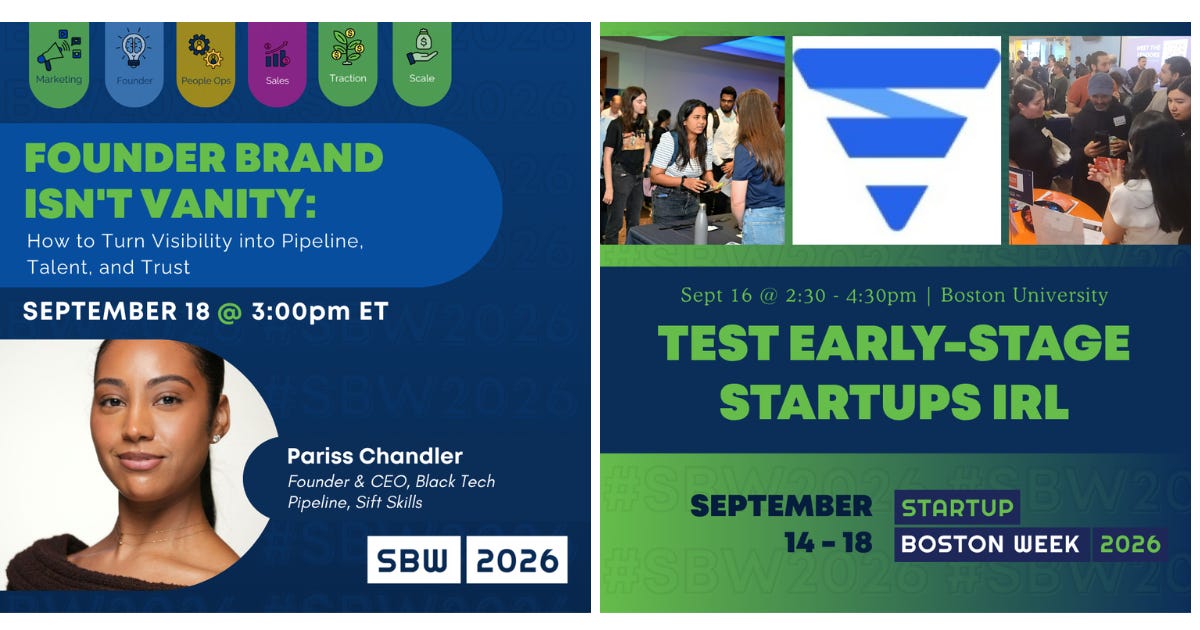
I’ll be speaking at Startup Boston Week on September 18th at 3 PM in a session called, Founder Brand Isn’t Vanity: How to Turn Visibility into Pipeline, Talent, and Trust.
I’ll also be participating in the Test Early-Stage Startups IRL event, where I’ll be demoing Sift Skills to potential users and getting honest, real-time feedback.
Startup Boston Week is a FREE, five-day conference that brings together founders, startup operators, investors, students, and ecosystem builders from across New England for a week of learning, networking, and connecting with the startup community.
There are 100+ sessions and 250+ speakers, so whether you’re building a startup, supporting one, looking for investors or resources, or simply trying to get more involved in the ecosystem, you should attend.
Register for free HERE 🔗
Have an opportunity you want to share with our community? Email us at: newsletter@blacktechpipeline.com to get started.
No posts
Comments
Nothing yet. Say the first thing.
Sign in to join the conversation.