
In the rolling hills of northeastern Pennsylvania, where the echoes of the coal industry still linger in the landscape and the local economy, a new battle over energy and technology is unfolding in the borough of Archbald. Cornell Realty Management LLC wants to build a massive data center campus called Wildcat Ridge on more than 500 acres.
Like data centers everywhere, it would need reliable power, backup generation, and yes, some environmental trade-offs. But instead of a straightforward zoning process focused on the facts, the developer now finds itself asking a majority of the Archbald Borough Council to step aside. Six of the seven members, the company argues, have already shown their hand.
This is not some abstract legal technicality. It is a textbook case of local politicians forgetting the difference between campaigning and governing. The council members in question - Madonna Munley, Erin Owen, Larry Marchetti, President Lou Rapoch, Lisa Osborne, and Larry West - have been widely quoted in the local media expressing clear bias against data center development in general and this specific project in particular. They have framed the proposal not as a land-use question subject to the borough’s own zoning code, but as an existential threat to the community’s character. In doing so, they have crossed a bright legal line.
Here is Page 1 of the letter which the Cornell’s lawyers sent to each of the 6 council members:
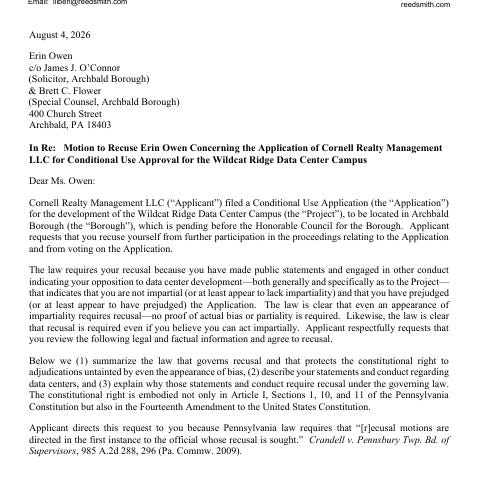
Under Pennsylvania law, members of a municipal body performing quasi-judicial functions like deciding a conditional use application must avoid not only actual bias but even the appearance of it. The Pennsylvania Municipalities Planning Code and longstanding due-process principles demand impartiality. When officials publicly telegraph their opposition before the evidence is fully heard, they risk forfeiting the right to sit in judgment.
The developer’s attorneys are most likely correct under the law: these six members are obligated to recuse themselves. The only alternative is to appoint a hearing officer and restore some measure of fairness to a process that has already stretched across eight hearings and is heading into a ninth.
What we are witnessing in Archbald is a familiar and unfortunate pattern. Local politicians, sensing the political winds, rush to align themselves with the loudest voices in the room. In this case, those voices belong to residents organized under banners like “Stop Archbald Data Centers,” armed with studies predicting dire health and noise impacts from the facility’s diesel backup generators.
That’s fair enough: Citizens have every right to raise concerns. But elected officials charged with quasi-judicial duties do not get to join the protest before the hearing is over. Their job is to weigh the evidence, apply the ordinance, and decide according to the law, not according to which side generates the most applause or the most social-media outrage.
By inserting themselves so publicly into the opposition, these council members have not only likely violated the standards of impartiality required by state law, but also undermined the legitimacy of the process they oversee. Due process is not a slogan for the applicant chant without meaning. It is the foundation that protects everyone involved - developer, residents, and the borough itself - from arbitrary decision-making.
When officials treat a zoning hearing like a political rally, they invite exactly the kind of legal challenge now before them. And if a court later finds the process tainted, the delays and costs will fall on the taxpayers who elected these officials in the first place.
This episode also reveals something larger about the current moment in American energy and technology policy. Data centers are the physical infrastructure of the digital economy. They power the cloud, artificial intelligence, and the everyday services people take for granted. They require substantial electricity, and yes, backup generation that must meet state air-quality standards.
Pennsylvania’s Department of Environmental Protection already regulates those emissions through a permitting process designed to protect public health. Yet local politics often prefers theater to the quieter work of regulation. Officials who campaign against “the industry” in general make it harder for any specific project, whether good, bad, or indifferent, to receive a fair hearing based on its actual merits and compliance with existing rules.
This example is thick with irony. Archbald’s council previously amended its zoning to accommodate data centers. Now a majority of its members appear determined to make sure this particular one never gets built. Rather than inspiring confidence in local governance, this kind of bait-and-switch signals to investors that the rules are only as stable as the next election cycle or the next wave of public meetings. Communities that treat every large project as a political opportunity rather than a regulatory one eventually find themselves left behind.
There is a better way. Council members who cannot set aside their publicly stated opposition should simply recuse. Let an impartial hearing officer complete the record. and allow the evidence to speak for itself. If the project fails to meet the borough’s or state standards, deny it cleanly. If it complies, then approve it.
That is how the system is supposed to work. Currying favor with voters by abandoning the obligations of office is not leadership. It is the shortest path to legal trouble and long-term economic stagnation.
Archbald’s data center fight is a small story in a small borough. But it is also a clear example of a larger problem: the temptation of local politicians to play activist rather than referee. To be clear: These council members are far from isolated examples. Right now, the governors of two of America’s most populous states - Kathy Hochul in New York and Greg Abbot in Texas - are engaged in similar behavior.
Back to Pennsylvania: Its’ law is unambiguous. Those who have already declared their bias have an obligation to step aside. The sooner they do, the sooner the process can return to the only standard that matters - whether the project follows the rules the community itself and the state have put in place. The only thing public posturing to please protesters can do for officeholders is get them into a self-imposed jam.
And there they are.
That is all.
Comments
Nothing yet. Say the first thing.
Sign in to join the conversation.