
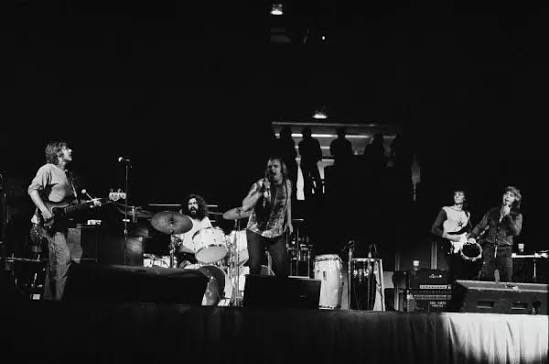
Rare Earth in concert, ca. 1971.
Treasury Secretary Scott Bessent Says the Strait of Hormuz is about to lose its strategic importance - Check out this clip from Bessent, telling an interviewer that most Middle East oil will be able to bypass the Strait of Hormuz within the next 2-3 years:
Transcript:
Interviewer: There’s some who’ve speculated the straight will never go back to being the way it was before. What would you say?
Bessent: I would say, I would take, I think they’re saying that in a doomsday sort of way. I would put it in another way. The Strait is never going back to the way it was, because the Iranians have tried to use it as a choke point. We are going to see over the next two years, the Strait’s going to become irrelevant. It is going to just become another body of water. And I would say that more than 50 or 70 percent. Of the energy that moves through the strait now is going to go through underground pipelines.
[End]
Say, where have readers here heard that prediction before? Why, right here at David Blackmon’s Energy Additions way back in April, as it happens.
Here’s part of what I wrote on April 9 in a piece for the Daily Caller:
All these factors and more highlight an urgent need to build a direct trade route to the Mediterranean for Middle East-produced commodities that are so vital to global supply. That is the vision of the IMEC plan.
NewMed Energy CEO Yossi Abu told the Financial Times: “You need oil pipelines, railway connectivity throughout the region, onshore, without giving others bottlenecks to choke us,” adding that alternatives to shipping via Hormuz were needed for people “to control their own destinies, with their friends.”
It seems beyond argument that the ongoing Iran crisis has starkly illustrated the risks involved in allowing the terrorist regime to threaten global supply chains – and thus, the health of the global economy – for 47 long years without developing alternative routes. This is madness that cannot be allowed to persist.
The major holdup to moving forward with the IMEC plan is gaining Saudi Arabia’s approval of funneling the oil and other key commodities through Israel to Haifa. In addition to the longstanding religious conflicts between the two nations, there is the fact that Haifa has also been vulnerable to terrorist attacks by Hezbollah and other Iranian proxy groups.
So, IMEC is not a perfect solution, but any alternative will also face risks in this historically high-risk region of the world. A perfect alternative may not even be possible, but preserving the status quo is the highest risk option of all.
[End]
Bessent focuses on pipelines to the Med as the alternative, but it is more than that. Every exporting country on the Arabian Peninsula is already also working on solutions involving rail and highways because oil is far from the only commodity being disrupted by the on and off closures at Hormuz. Urrea for fertilizers, 20% of the global helium supplies and other crucial commodities need to sustain the global economy are also being held up.
It’s all a massive need that, as Bessent correctly says, will be resolved within the next 2-3 years.
****************
Comments
Nothing yet. Say the first thing.
Sign in to join the conversation.