
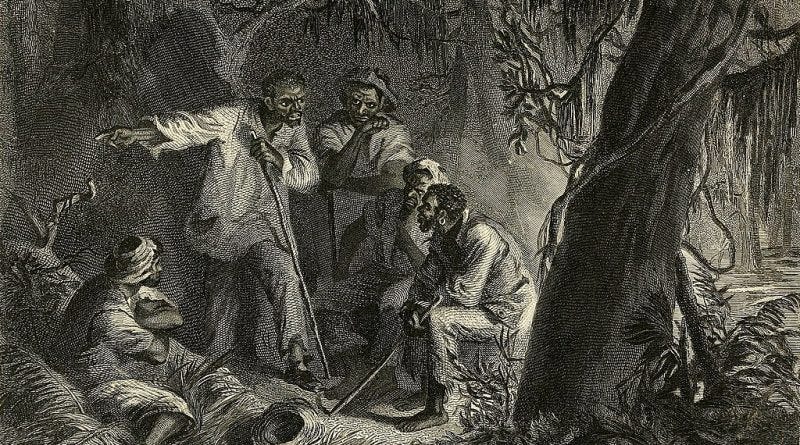
“Do you not find yourself mistaken now?” This was the question the Justices of the Peace posed to Nat Turner regarding his prophecies.
The Southampton Insurrection was crushed by local slavers and their accomplices, but not before at least fifty-five white people were killed. Turner’s prophecies, divined years prior to the revolt itself, helped Turner foment, time, and execute what would become one of the most famous uprisings in history.
One influential insurrectionary vision began on May 12th, 1828. “I heard a loud noise in the heavens, and the Spirit instantly appeared to me and said the Serpent was loosened, and Christ had laid down the yoke he had borne for the sins of men, and that I should take it on and fight against the Serpent, for the time was fast approaching when the first should be last and the last should be first,” Turner recalled during his trial. This is the prophecy to which the Justice of the Peace objected. “Do you not find yourself mistaken now?”
To which Nat Turner replied “Was not Christ crucified.”
black medicine || black magic is a Black trans written, reader supported publication. Your support sustains my work as an herbalist, rootworker, and diviner working in Hoodoo tradition. Consider becoming a founding member to keep this work possible for me.
Nat Turner would not see the end of enslavement. His captors hanged him November 11, 1831. Thirty-four of Turner’s comrades were caught; nineteen were hanged; twelve were sold; nineteen were acquitted: four of those back to freedom, the rest back into enslavement.
Did he know that for every white person killed, the whites would in turn kill two Black people? Was Turner instructed on the best hiding places in his dreams, or left to discern his intuition’s illuminations in a mortal crisis? Did he know he would be skinned and eaten after his death?
There is a chance that Nat Turner went to his grave believing he divined inaccurately, that he’d led many to their deaths without achieving their ultimate aim. There is a chance that what was revealed to him was completely different; he may have seen over thirty years more of bondage, Jim Crow beyond, and freedom still not fully here—and acted on his vision as he was taught by his spirits, the beliefs of all that came after be damned.
Either way, I imagine his prediction came with some grief. Our ancestors were once human, and will be again. They sat under the same emotions, lived with the same intrusive thoughts, obsessions, shynesses, insecurities, weaknesses of character, and faults as we find in ourselves today.
To predict is to know you may be disbelieved, mocked, dismissed. To predict is to risk misinterpretation: your own and that of others. To predict is to know the bad outcome, the painful debility, the excruciating death before it happens and know you may be unable to stop it.
Shortly before the 2024 election, I sat down in the digital realm with the students in the tarot membership I ran at the time. It was the third week of our Political Fortune Telling course, and we focused on year prediction spreads, which I feel are among the most essential spreads in a reader’s library.
I encouraged the attendees of the workshop to develop their own theory of the year spread. This was not an invitation to announce what they saw, but an opportunity to scrutinize our group pull over the course of the year. I didn’t love what I saw laid out before us: for Sept-November 2025, we pulled the Six of Swords reversed and The Tower. The primary figures of our year were Knight of Wands and Eight of Swords, both reversed.
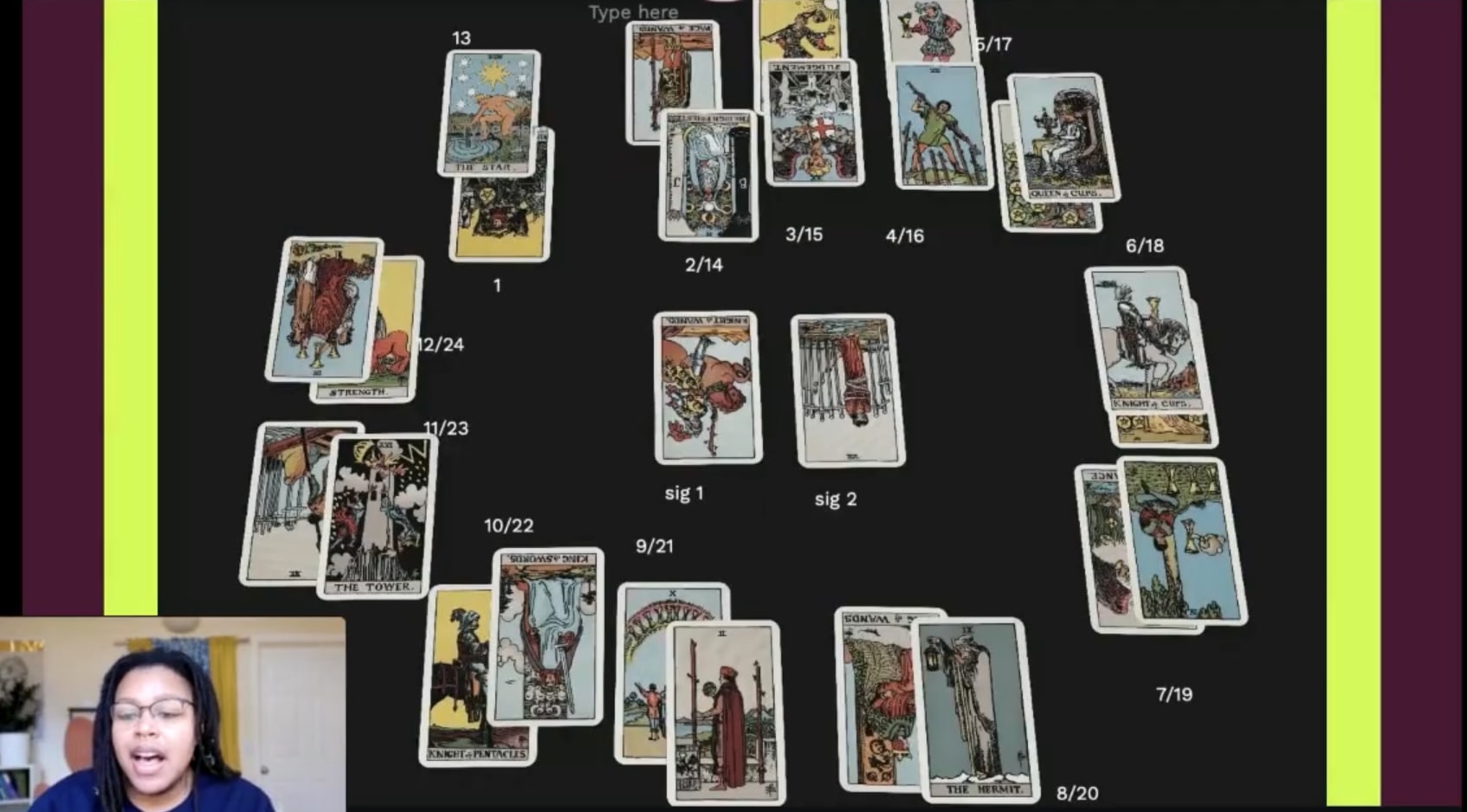
It didn’t look great, and it wasn’t great—at least not within the political realm for which we were predicting. And it wasn’t the only terrible prediction that’s been made manifest. While my feelings on voting are complex, and sometimes self-contradictory, I cringe when leftists deign to suggest that our lives would be exactly the same under Kamala Harris. As I’ve said before, and will say again, I think it’s very embarrassing for a Black person to want to be president, but the president and a cop? Geez.
And still, to watch the public fully shit upon calls to abolish police and prisons, advance racial justice, and create a more equitable society by re-electing Donald Trump’s, then see it culminate in what we always knew would be a worse future is the grief of prediction. To see a full walkback of any advances made in the Movement for Black Lives rolled back within a year or so, after years of Democrat rule able to accomplish next to nothing is exhausting.
Thanks for reading black medicine // black magic ! This post is public so feel free to share it.
Prediction is a long bet, sometimes generationally long. There’s divination that diagnoses what already exists, prediction of things yet to come, prediction that sees a way out of where we’re at. All of those contain the potential for serious grief.
So strong a grief can come from prediction that it results in inaction, the sensation of being stuck in place. Yet as Nat Turner’s words remind us, we must act all the same. The answers may not come within our lifetime, and yet we must act on what we see and know. Through the terror, through the violence, and yes, through the grief.
Turner revealed his plans to only four men, and called his uprising “the work of death.” His own death in the process was all but assured, and did come, but so too did the death of chattel enslavement in the United States—and his was a mighty blow.
We cannot know exactly what he did and didn’t know. What we know is that he moved forward all the same.

Cromwell, John W. “The Aftermath of Nat Turner’s Insurrection.” The Journal of Negro History, vol. 5, no. 2, 1920, pp. 208–34. JSTOR, https://doi.org/10.2307/2713592. Accessed 3 Feb. 2026.
Gray, Thomas (November 5, 1831). “The Confessions of Nat Turner, the Leader of the Late Insurrection in Southampton, VA”. Documenting the American South. page 11: Thomas R. Gray; Lucas & Deaver, print. Retrieved September 7, 2025.
Kaye, Anthony E. “Neighborhoods and Nat Turner: The Making of a Slave Rebel and the Unmaking of a Slave Rebellion.” Journal of the Early Republic, vol. 27, no. 4, 2007, pp. 705–20. JSTOR, http://www.jstor.org/stable/30043545. Accessed 3 Feb. 2026.
Comments
Nothing yet. Say the first thing.
Sign in to join the conversation.