
Like any Black person of a certain age, I’ve spent the last few days feeling the cultural loss of D’Angelo. He was a singular talent, among the truest examples we’ve ever had of Black Music.
He sprung from Pentecostal countryside churches, from what Dr. Katrina Hazzard-Donald calls the “African Religious Complex.” There’s no denying him on either side, and there’s no denying the deep, deep knowledge of god he evidenced in his sound.
I loved everything about D’Angelo’s music, and I’m sorry everybody seems to have done him so bad. May his passing spark a thousand conversations about how women, and everybody else, contribute to rape culture.
black medicine // black magic is a reader-supported publication. To receive new posts and support my work, consider becoming a free or paid subscriber.
The intimacy that his work sparked, not just sexual but in and between the African diaspora itself, will live forever. He was a griot of the highest order. He used what he had to lift us all up. What could be more beautiful?
One of the things I loved most about D’Angelo’s music was his falsetto. That high, ringing, gender-complex sound that Dr. Hazzard-Donald reminds us in Mojo Workin’: The Old African Hoodoo System was a priestly register.
She writes “two types of sacred voice—a voice that was nasalized toward falsetto and a second gravelly voice—would move from the traditional African priest and other sacred workers into plantation Hoodoo and finally into the black Christian pulpit” (p. 171).
D’Angelo’s sound linked him to The Black Church and what preceded it. It propelled our culture memory as African people into the future. This is part of what enslaved Africans with origins in the Congo sought to do with The Black Church all along.
On Pinkster
It’s incorrect to say that all of our ancestors came to this country as non-Christians, and were forcibly converted here. If we as a culture were more serious about the study of enslavement in the North, some of the earliest sites of enslavement in the US, we would be more comfortable expressing that fact.
This is especially true of certain groups of enslaved people from West Central Africa. Like their progeny throughout this land, their relationship with Christianity was very different from their white slavers. To start, many of them converted for political reasons.
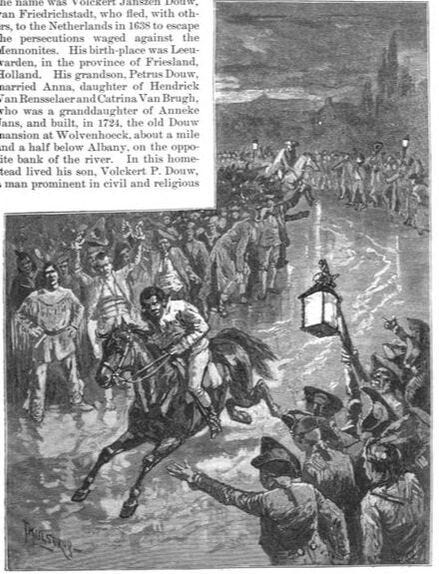
We know with some certainty that the enslaved people of New York came often from Congo-Angola both due to historical record and because of their own proclamation. It was not unusual for Africans enslaved in early New York to take Congo as a surname. Long live Anthony Congo, Simon Congo, Gracia D’Angola, Paolo d’Angola, the whole First Eleven, for whom on Pinkster we cry hi-a-bomba, bomba, bomba and hail the new Pinkster King, the oldest we can find, and say those names in silence that have long been lost to the ocean of time.
As Jeroen Dewulf writes in The Pinkster King and the King of Kongo: The Forgotten History of America’s Dutch-Owned Slaves “The abundance of names ending in “Congo” and “Angola” indicates that the overwhelming majority of slaves composing the charter generation in New Netherland were of West-Central African origin” (p. 39).
We also know this because as this ugly nation was founded, there was one prominent source of enslaved people: Luanda, the capital of Angola.
“This is not surprising, since Luanda was at that time the dominant source of American-bound slaves. The slaves’ typically Lusitanian baptismal names such as Francisco, João, Manuel, Luís, António, Sebastião, Bárbara, Catarina, and Maria as well as surnames such as Britto [Brito], Premero [Primeiro], Albiecke [Albuquerque], and Portogys [Português] also indicate that the large majority of them had gone—with various degrees of exposure—through a process of Iberian Catholic acculturation before” (p. 39).
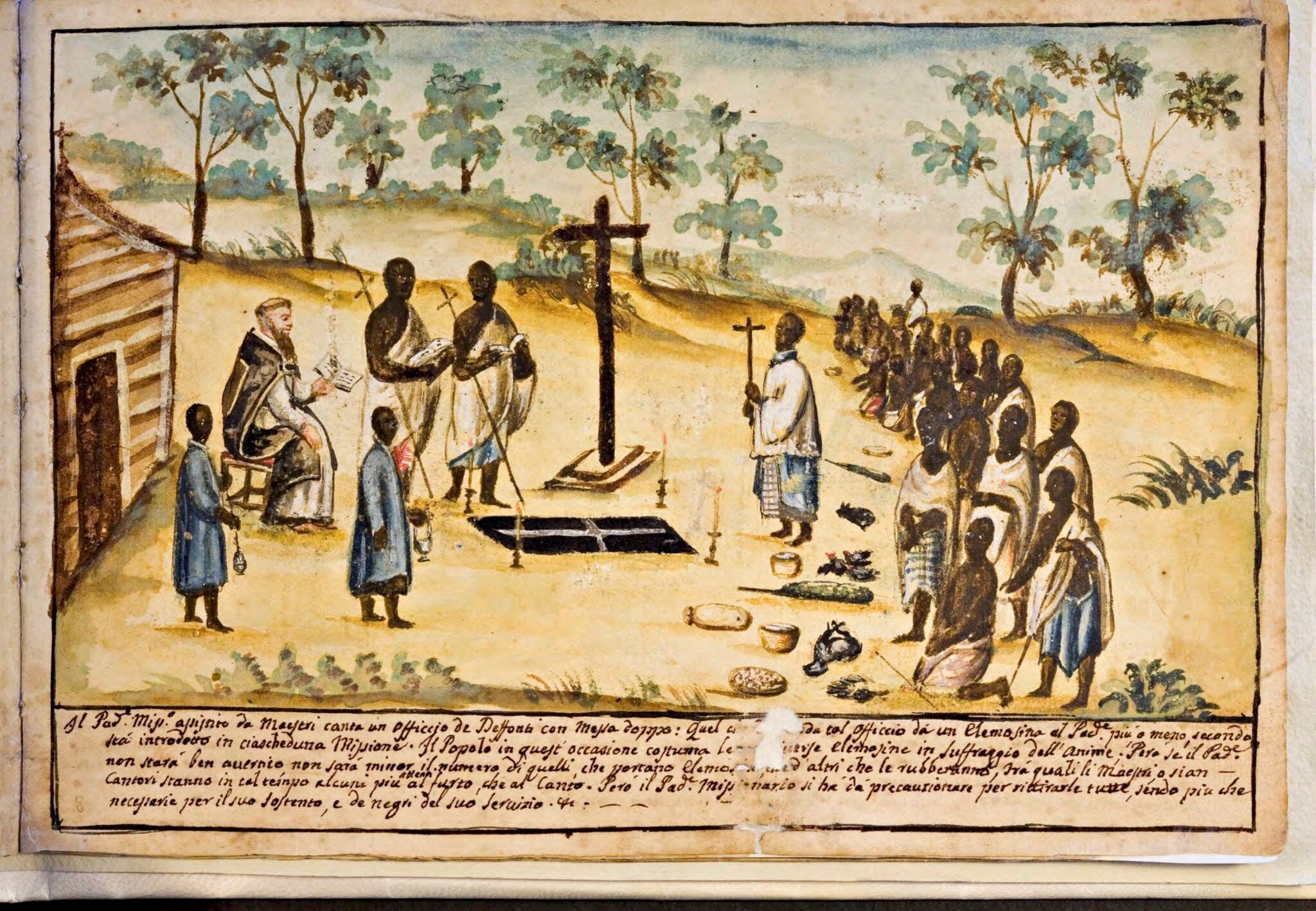
But like our ancestors, this proclaimed Christianity among continental Kongos was mostly declared to be eligible for participation in public and political life. Even white people understood that underneath the cross lay the Dikenga.
An early Dutch colonizer, “Olfert Dapper claimed that the Kongolese ‘only pride themselves to be Christians … in the presence of Europeans … because they know that this is in their interest … but in reality they are heretics and idolaters” (p. 44).
It is also in the knowledge of this, and so much else, that we understand Hoodoo to be a Kongo tradition in the diaspora. It is with this knowledge that we honor the part of Hoodoo The Black Church preserved for us to reimagine. It is in this knowledge that we honor the genius and sacrifice of our enslaved ancestors.
Hi-a-bomba bomba bomba and drums. And drums.
There’s some speculation, though it has yet to be confirmed, that this bomba bomba bomba may have been “the Kongolese rainbow and snake god Mbumba.” Dewulf also notes that bomba “may be a reference to the words for “secret” or “mystery” in Kikingo” (p. 126-128).
The Dikenga Everywhere
And that’s just New York while it was the second largest slave city after Charleston, South Carolina: a city where 42% of people were slavers in 1703.
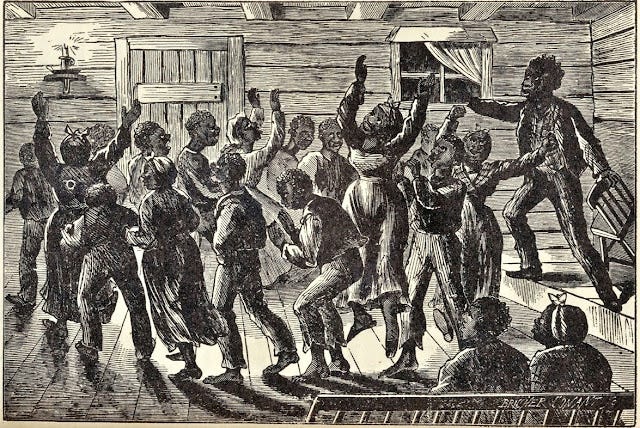
There’s the vast influence of Kongo spiritual religious thought on the Stono Rebellion. The minkisi in St. Louis. The ring shouts all over, but also in Georgia.
Kongo was, especially in those early years, among the most primary places where people were kidnapped and trafficked for enslavement. Regardless of the complexities of currently available genetic testing, which are imperfect at best, the majority of people enslaved in the US who were trafficked directly from Africa came from west-central Africa and Senegambia.
For so long, we’ve been denied any conclusive knowledge of our origins on the continent. There can be real confusion and discrimination that results from that. There are also health risks, allergies, methods of self-care, and ways of making family denied by this schism.
Yet we remember our history in everything we do—what we do from there can be harder to decide.
Diasporic Duties + Contemporary Black Life
I could be wrong about this, but ultimately my personality is that of any childhood diagnosed autistic, and so I wouldn’t know until someone gets upset with me, but it seems like the quiet part of these overheated, protracted diaspora wars is why did you sell us? Why didn’t you come back to get us?
With the way the diaspora loves to pick Black Americans to pieces, you’d think it would have come up.
Few Black Americans learn about pre-enslavement African history. We often don’t understand the complex matrix of issues that led to enslavement itself. We’re unaware of the ways Africans resisted and capitulated; we rarely speak about how that shapes contemporary conflicts and our relations with other Africans in the Americas.
What is there beyond this skirmish, what are the responsibilities of diaspora, what would reparations look like between and among African rooted people, and most importantly what do those working in Kongo traditions owe the Congo?
We remember our roots in our sounds, in how we worship in our churches and at our altars, in how we take care of our hair, in how we suck our teeth. But how do we care about our root places into the future?
On this last question, I’m excited to be talking to Alexis McKenney this Thursday, October 23rd at noon ET for an IG Live called “Land + Lineage in the Diaspora: Hoodoos and Congo Solidarity” just in time for Friends of the Congo’s Congo Week.
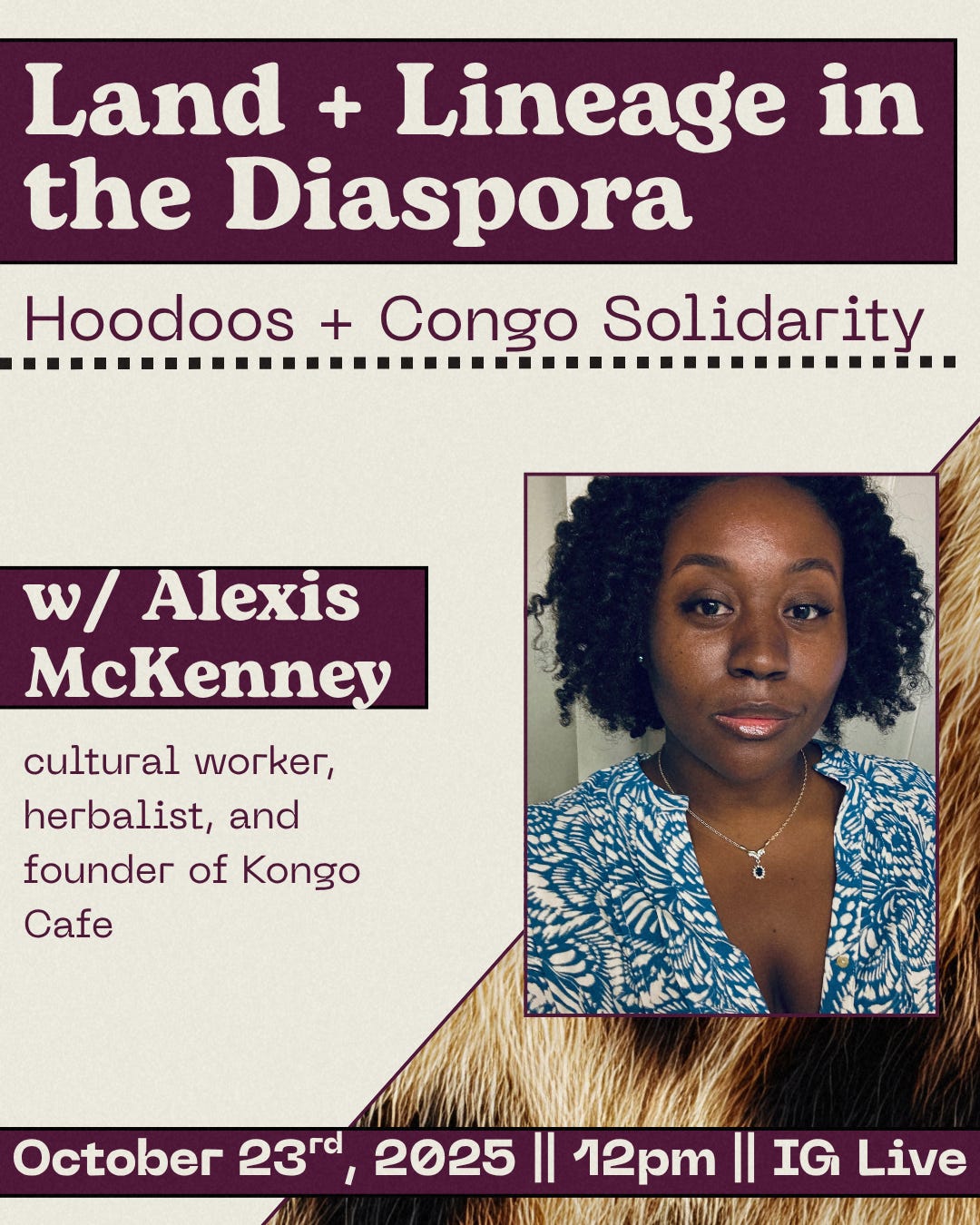
The question of repair, including reparations, and the right to return as more than just moving to the continent will be foregrounded.
I hope you’ll join us.
If you’ve been reading my Substack for a while, you know I have complex feelings about the increasingly common assertion that Hoodoo is inalienably and always a tradition worked for liberation. It definitely is a liberation tradition. We’ve worked roots and every other manifestation of conjure to get free since we arrived upon these shores — I don’t dispute that in any way.
We’ve also tied wombs and natures, killed our neighbors, and made people go out of their minds. I guess we just got different mentors. I guess we just read different books. To me, the liberation conjure sits beside some nasty work, and I don’t have no problem with that!
But the major part of why it rings like a marketing slogan expressed by certain Hoodoos is because of the silence about the genocide in the Congo while the Dikenga proliferates. Never have Hoodoos been more aware of how much Kongo religions influence our own.
I’m not saying we should have solved problems we probably don’t understand as well as those living through them. What I’m saying is if you’re loud and proud about Hoodoo being exclusively and always a liberation tradition, where’s the uproar for the Congo? Where’s the solidarity?
I admire Alexis for her efforts to raise awareness and money from a Hoodoo perspective, and we should all be doing this. It should break our hearts what’s happening to our cousins, and it should rouse us to action.
Many of us, myself included, often struggle to know where to begin. Most of us don’t speak French or Kikongo, and thus can’t vet fundraising efforts. It’s hard to know where to start. To me, all solidarity starts with education. Perhaps this Congo Week, we can begin there.
The Books
Dewulf, Jeroen. The Pinkster King and the King of Kongo: The Forgotten History of America’s Dutch-Owned Slaves. Jackson, University Press of Mississippi, 2016.
Hazzard-Donald, Katrina. Mojo Workin’: The Old African American Hoodoo System. Chicago, University of Illinois Press, 2012.
Rockie, Simon. Death and the Invisible Powers: The World of Kongo Belief. Bloomington, Indiana University Press, 1993.
black medicine // black magic is a reader-supported publication. To receive new posts and support my work, consider becoming a free or paid subscriber.
Comments
Nothing yet. Say the first thing.
Sign in to join the conversation.