
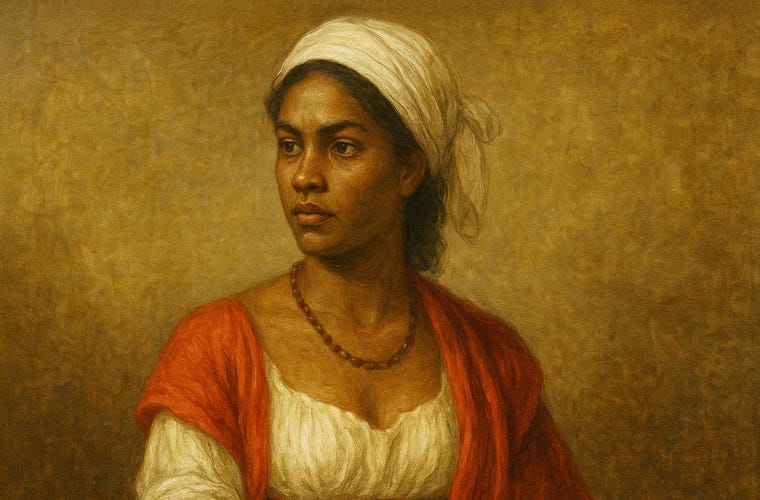
August 14, 1791. The forest of Bois Caïman, Saint-Domingue. A storm tore through the ancient trees with the kind of violence that makes ordinary people seek shelter. These were not ordinary people, and this was not an ordinary night. Hundreds of enslaved Africans moved through the downpour toward a clearing in the forest, summoned by something older and more urgent than fear. They came from the sugar plantations, the coffee fields, the torture rooms of French colonial Haiti. They came carrying something the slaveholders could never inventory, never confiscate,
never burn.
They came carrying their gods.
The storm itself carried meaning. In Vodou cosmology, rain on a sacred night signals the presence of the Lwa - the divine spirits who bridge the human and the divine. The ancestors were already there before the first drum sounded. The sky said so.
The Drums Spoke First
Before a word is uttered, Vodou ceremony opens with rhythm. The drummers that night played Rada - the foundational rhythmic tradition that calls the gentle, ancient Lwa, the grandfathers and grandmothers of the spirit world. Rada rhythms open sacred space. They announce to the divine that the living have gathered and the covenant is ready to be honored.
Then the drumming shifted.
Petwo rhythms carry a different frequency entirely. Petwo - a distinct family of Lwa forged in the fire of Haitian slavery - carries urgency, righteous fury, and heat. Petwo Lwa move fast. They answer the prayers of people who have waited long enough. When the drums moved from Rada to Petwo that night in Bois Caïman, every person in that forest felt the shift in their bones. This gathering was moving toward something irreversible.
Learning this, one song rose up from deep in my memory. Gabriel Hardeman and the Delegation recorded it in 1981, and Black churches carried it through the decade on the strength of a single lyric drawn straight from Jeremiah 20:9:
“Fire shut up in my bones, like Jeremiah, won’t leave me alone.”
That lyric found me again here because it was always about this - the divine fire that slavery could not extinguish, the sacred heat that moves through bodies, through drums, through ceremony, through song. Black people on two continents kept that fire alive in the only vessels the slaveholder could never confiscate. Their voices. Their rhythm. Their God.
Dutty Boukman Stood Before Them
A Jamaican-born maroon, a Houngan - a Vodou priest of significant spiritual authority - Boukman carried the kind of presence that historical records struggle to contain. The French whispered his name with dread. The enslaved carried it with something closer to reverence. Here was a man who had never accepted the theological assignment of the plantation. He did not open a Bible. He did not petition the God of the great house. He lifted his voice toward the Lwa and the forest
shook back.
His prayer survived through oral tradition and later written accounts. It thunders across two centuries with the clarity of a man who understood exactly what he was doing and exactly who he was calling:
“The god who created the sun which gives us light, who rouses the waves and rules the storm, though hidden in the clouds, he watches us. He sees all that the white man does. The god of the white man inspires him with crime, but our god calls upon us to do good works. Our god, who is good to us, orders us to revenge our wrongs.”
He named two different gods. He separated them deliberately. He chose.
That choice changed the world.
Cécile Fatiman Moved Through the Fire
If Boukman spoke the prayer, Fatiman embodied the answer.
She was born around 1771, the daughter of an enslaved African woman and a French nobleman. History remembers her green eyes cutting through the darkness of that night. She served as the lead Mambo - a Vodou priestess - and in Vodou tradition, the Mambo holds equal and often greater ritual authority than the Houngan. Boukman’s prayer was an act of profound spiritual courage - a deliberate, public rejection of the master’s God before hundreds of witnesses. Fatiman’s possession was something beyond courage entirely. She surrendered her body, her consciousness, her very self so an ancestral being could walk in human flesh and seal what words alone could not.
Fatiman danced in possession, her body becoming the vessel for Erzulie Dantor - the fierce, dark-skinned Lwa of motherhood, protection, and revolutionary fury. Where Boukman called the spirits through prayer, Fatiman became the bridge. Her movement was the message. Her possession confirmed that the Lwa had arrived and the covenant was accepted.
A black pig was sacrificed. The blood passed among the gathered. Each person who drank sealed a binding spiritual agreement - a covenant between a people and their ancestral powers, made in the oldest currency humans have ever used to speak to the divine. This was not superstition. This was theology in its most serious, most consequential form.
The ancestors accepted the terms.
Twelve days later, the revolution ignited.
What Happened Next Rewrote History
Within weeks, enslaved Africans burned more than 1,000 plantations. They defeated the French colonial army, then a British expeditionary force, then Napoleon’s finest generals. By 1804, Haiti stood as the first Black republic in the Western Hemisphere and the only nation in human history born from a successful slave revolt.
Cécile Fatiman lived to see all of it. She married Louis Michel Pierrot, who became President of Haiti in 1845. She outlived the revolution, outlived the founding of the republic, outlived most of the world that gathered in that forest. She died around 1883 at approximately 112 years old.
The woman the Catholic Church would call a servant of the devil outlived virtually everyone who called her that. The gods she served that night carried her through more than a century.
The ritual worked.
Then the Church Picked Up Its Pen
The Catholic Church and French colonial historians could not allow Bois Caïman to stand as what it was - a sacred ceremony through which an oppressed people accessed genuine divine power and won. That story threatened the entire theological architecture of colonialism, which rested on a single foundational claim: that the Christian God uniquely authorized European civilization to rule the earth.
So they reframed it. They called it a satanic pact. French physician Antoine Dalmas published his account around 1814 - more than two decades after the ceremony - and described it in terms designed to produce maximum horror in European readers. The Catholic Church amplified the narrative. Bois Caïman became, in the official colonial record, the night Haiti sold its soul to the devil.
Consider the linguistics of that accusation for a moment.
Supernatural. Super - above. Natural - of nature. The word describes nothing more than a realm of experience beyond ordinary human comprehension. The Catholic Church built its entire institution on supernatural claims. Saints performed miracles - that was divine grace. The Virgin Mary appeared at Fatima - that was holy revelation. The Holy Ghost descended on the apostles - that was sacred power. The Church never once called any of those events evil.
The word only became a weapon when Africans accessed the same realm through their own tradition.
The Church did not object to supernatural power at Bois Caïman. The Church objected to who held it.
The Bible the Church Handed Black America Carries These Stories as Sacred Truth
God extended daylight across an entire battlefield so Joshua’s army could finish its military campaign. The solar system paused for a war. Christian tradition calls
that holy.
Boukman and Fatiman gathered a people in a forest and called on spiritual power to launch a war for freedom. The Catholic Church called that demonic.
God opened the mouth of Balaam’s donkey and the animal spoke coherent, argumentative human language. Balaam argued back. Christian tradition calls that divine communication.
Vodou drums, sacred trance, and possession carried spiritual messages through human bodies at Bois Caïman. The Catholic Church called that satanic.
Divine power entered Mary’s body without biological explanation and produced a child who would liberate a people from spiritual bondage. Christian tradition calls that the holiest event in human history.
Divine power entered Cécile Fatiman’s body through the Lwa Erzulie Dantor and produced a revolution that liberated a people from literal chains. The Catholic Church called that devil worship.
Jesus stood at the entrance of a tomb and called a man who had been dead for four days back into living breath. His sister warned that the body already smelled of decay. Christian tradition calls that a miracle.
Boukman stood in a forest and called a people who had been socially dead for generations back into the full dignity of human freedom. The Catholic Church called that a pact with Satan.
Same supernatural reach. Same divine intervention in human affairs. Same audacity of belief that the sacred can move through human bodies, human voices, and human ceremony to change the physical world.
One set of miracles belongs to God. The other belongs to the devil. The only variable is the color of the hands that performed them.
The Deepest Irony Belongs to Cécile
The Catholic Church spent centuries constructing theological arguments for why women lacked the spiritual authority to lead men toward God. No female priests. No female bishops. An exclusively celibate male hierarchy as the only legitimate pipeline to the divine. The Church that demonized Bois Caïman built its entire leadership structure on the erasure of women’s spiritual authority.
Cécile Fatiman stood in a forest in 1791, channeled a Lwa, surrendered her entire self so an ancestral being could walk in human flesh, and watched that covenant produce the liberation of an entire nation.
She was approximately 20 years old on that fateful night. She lived another 92 years to see what she had done.
The Church is still debating women’s ordination. Erzulie Dantor already answered that question in the rain at Bois Caïman.
The Vatican Finally Recognized Haiti in 1860
The price of recognition - Catholicism as the official state religion. The Church lost the military battle completely and won the cultural one quietly. They could not defeat Haiti with Napoleon’s army, so they sent priests instead. The same institution that called the Haitian Revolution a satanic pact spent the next century embedding itself into Haitian national identity, systematically suppressing Vodou practice, and converting the descendants of Bois Caïman away from the very spiritual tradition that had freed them.
This is the long game of religious colonialism. When the sword fails, send
the scripture.
Whose God Is Winning?
Black America inherited a specific religious assignment. The slaveholder’s Bible. The master’s Jesus. A theology carefully engineered to produce endurance - submission to earthly suffering in exchange for heavenly reward. That theology did not emerge from Africa. Slaveholders constructed it as a management tool, and the plantation church handed it down through generations until it became indistinguishable from culture, family, and identity itself.
Black Christians across America carry extraordinary faith, extraordinary devotion, extraordinary spiritual hunger. That faith built communities, sustained families through unimaginable suffering, and powered the Civil Rights Movement. The devotion is real and it deserves profound respect.
The CDC, the Federal Reserve, and the Census Bureau all confirm the same thing - Black Americans lead the nation in maternal death, child poverty, wealth exclusion, and mass incarceration. Four centuries of devoted prayer to the designated God produced survival. It has yet to produce equity.
For 400 years, Black people in America have prayed to the God their oppressor designated as the only path to salvation.
What has been liberated?
Boukman called the gods of his ancestors and freed a nation in 13 years. Cécile Fatiman surrendered her very self to divine possession, sealed a covenant in blood, and lived 112 years to walk through the freedom that ceremony produced.
The ancestors answered that night because their children called the right name.
What god are you calling?
No posts
Comments
Nothing yet. Say the first thing.
Sign in to join the conversation.