
Morning Comrades.
A personal preface to this essay and post scriptum to the essay from last Friday in response to the AI nonsense integration on this platform, which at this point, looks to be illegal for us Euro’s on top of everything else - major chuckles inbound if that is to be the case. Today’s essay is what I had initially planned to send then and throughout the editing of it all I felt increasingly frustrated with myself and wrote a scathing self-critique dealing with comfort and negotiation instead. Truthfully, that critique has more to do with my inner understanding / confrontation with my ageing body. So much of my past political experience and work was physical and over the last five years the excessive punishment and lack of care of said body is catching up with me and I am increasingly aware that a change of actionable politics is necessary for me, so that I can continue. Secondly, and this is the more important part, Ryan Ward responded to my omission in a way that truly reflects my appreciation of him as both a writer and a comrade, when he said:

Without much further ado then, an essay about the renewed Western Red Scare, Surveillance and Material / Metaphysical Architecture that deserves not only our collective contempt, refusal but organised fight against.
The 21st Century has been characterised by a historical inversion, whereby institutions evidently constructed to defend liberal democracy have become the principal mechanisms by which democratic life itself is progressively constrained, or possibly have realised their own true nature by default but not through spectacular coups or dramatic declarations of dictatorship, but through the patient accumulation of administrative powers, surveillance infrastructures, legal exceptions, and technological systems that quietly reconstruct the relationship between citizen and state until dissent itself begins to resemble suspicious activity requiring management rather than a democratic necessity deserving protection.
The genius of this change lies precisely in its banality, for almost every expansion has arrived wrapped in the language of necessity, inevitability, security, durability or public safety, each presented as a temporary response to an exceptional crisis, yet none subsequently relinquished once the crisis has merged into history, leaving behind instead a permanent architecture whose continued existence demands new enemies to justify its maintenance.
The attacks of 9/11 did not purely inaugurate the so-called War on Terror; more so, they inaugurated a new philosophy of governance. The Patriot Act was never simply a collection of emergency measures but a declaration that suspicion should precede evidence, that surveillance should precede criminality even, and that extraordinary powers should become ordinary instruments of administration. Once governments discovered that most of us could be persuaded to surrender liberties in exchange for very vague promises of security, every subsequent emergency merely expanded the precedent. Terrorism became the universal solvent, dissolving constitutional hesitation and legal safeguards once considered indispensable obstacles to arbitrary power; they gradually became obstacles to efficiency. The distinction between intelligence gathering and ordinary policing steadily dissolved until entire societies came to resemble permanently monitored working environments.
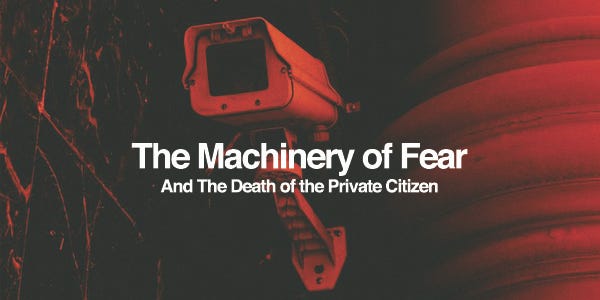
Technology arrived precisely on schedule to make this transformation appear not simply unavoidable but convenient. The proliferation of digital technologies ensured that surveillance no longer required the conspicuous presence of the state, as the smartphone evolved into a voluntarily carried tracking device, every electronic payment contributed another fragment to an ever-expanding archive of behavioural data, and cameras, once presented simply as passive instruments for recording criminal activity, were gradually integrated into interconnected systems of algorithmic observation capable of identifying, classifying and monitoring individuals on a scale earlier unimaginable. Automatic number plate recognition, extensive CCTV systems, facial recognition technologies, predictive policing software, mass online data collection, private data brokers and growing interconnected sensor networks collectively produced something unprecedented: a society in which surveillance no longer requires the visible presence of authority because authority has become embedded within infrastructure itself.
Their remarkable achievement has been to make surveillance appear as customer service and convenience became the ideological lubricant through which populations enthusiastically financed and installed the machinery of their own observation. The old police state required enormous numbers of officers; the new one merely requires software updates whilst continously increasing the number of pigs on the streets. To be clear, the pigs you see on the street are only there to instil obedience through violence and fear, and round us all up when they have had enough.
This is where the public discussion often becomes distracted by technology itself, as though cameras, databases or algorithms somehow possess political intentions independent of those who deploy them. They do not. Infrastructure is never politically neutral because every material and administrative system embodies particular social priorities, whether by directing and privileging certain forms of movement through the construction of roads, reinforcing specific modes of governance through bureaucratic organisation, or concentrating authority through surveillance networks whose architecture inevitably reflects and reproduces existing distributions of power rather than only observing them. The question is never whether technology exists but who defines its targets, who interprets its outputs and which political assumptions quietly become imprinted within its operation.
The construction of specialised policing facilities, expanded intelligence coordination, increasingly integrated public-private surveillance partnerships and extensive digital monitoring capacities must therefore be understood less as isolated developments than as components of a single political direction irrespective of who is currently “in power”. Institutions rarely construct capacities they do not eventually intend to use and our bureaucracies rarely accumulate powers only to leave them dormant. Once the machinery exists, political incentives almost inevitably encourage its expansion beyond its original mandate.
History offers no shortage of examples demonstrating that powers granted to the capitalist state in response to exceptional circumstances rarely remain confined to their original purpose, as legislation introduced to combat organised crime gradually extends into areas of ordinary financial regulation, counter-terrorism authorities migrate into immigration enforcement, emergency policing tactics become standard methods of managing public assemblies, and intelligence techniques refined on foreign battlefields are progressively repatriated and incorporated into the routine administration of domestic society. Categories expand because institutions pursue relevance, budgets seek justification and political authority continually searches for new legitimising threats.
Recent political rhetoric coming out of the US and increasingly European governments surrounding domestic extremism illustrates precisely this pattern. Senior officials have increasingly described a wide range of apparent threats using the language of terrorism, while strategic systems such as NSPM-7 have been presented as strengthening coordination against violent extremist activity. Such measures are routinely presented by our respective governments as necessary responses to genuine security threats, yet the historical record shows that the political utility of security structures frequently lies precisely in the flexibility of the categories they establish. Vague and elastic definitions of extremism, radicalisation or domestic threat allow institutions to expand the limits of suspicion beyond clearly defined acts of violence and towards broader networks of political association, social movements and forms of dissent that confront existing arrangements of power. In this way, the creation of ambiguous threat categories does not simply identify dangers that already exist but vigorously produces new objects of surveillance and intervention, enabling the state to transform political opposition from a legitimate feature of democratic life into a potential security problem requiring administrative management.
The danger does not arise from any single surveillance technology in isolation alone but from the cumulative integration of systems which together transform social life into an increasingly observable and administratively manageable field. Surveillance networks identify behavioural patterns, intelligence agencies consolidate fragmented information into comprehensive profiles, financial monitoring traces relationships and associations through the movement of capital, online networks preserve the traces of everyday communication, artificial intelligence seeks to convert historical data into predictions of future conduct, police institutions expand cooperation past traditional territorial boundaries, and prosecutorial frameworks develop to incorporate forms of evidence generated through these expanding informational infrastructures.
What develops through this process is not simply a more efficient security apparatus but a new mode of governance in which the capacity to observe, classify and anticipate human behaviour becomes a fundamental instrument of social control, allowing institutions to intervene not only in response to actions already taken but increasingly in relation to identified risks, associations and possibilities that have yet to materialise. All this together is normalising a political environment in which participation itself becomes increasingly legible to state institutions.
The vocabulary accompanying this transformation deserves particular attention because language performs preparatory work that legislation alone cannot accomplish. Terms such as “extremist”, “radical”, “subversive” or “terrorist” acquire meaning through continual political contestation rather than immutable legal definition. Throughout history, governments of vastly different ideological orientations have expanded such labels during periods of perceived instability, often with consequences extending beyond the groups originally identified.
One need not imagine fantastical conspiracies to recognise how readily this process can unfold, or rather is unfolding. A society experiencing economic stagnation, widening inequality, declining institutional legitimacy and escalating social conflict will almost inevitably witness increasing protest. Governments, regardless of party, possess strong incentives to distinguish between acceptable and unacceptable opposition. If that distinction becomes overly elastic, the democratic sphere contracts to a point where democracy is just another brand at the dollar store, continuously on sale.
Meanwhile, the absurd theatre of contemporary politics continues uninterrupted. The same corporations harvesting unprecedented quantities of behavioural data present themselves as guardians of community. The same governments insisting they lack resources for housing, healthcare or public transport somehow discover limitless administrative capacity when constructing databases, expanding observation technologies or integrating information systems. Apparently poverty continues an insoluble mystery while omniscience arrives comfortably within budget.
One almost has to admire the elegance of the performance and / or be befuddled at the scenes in play at all times. We are invited to fear one another while rarely examining the infrastructures quietly rearranging the balance of power behind the curtain and public debate becomes fascinated with isolated outrages whereas administrative transformation proceeds through procurement contracts, software integration, policy memoranda and technical standards so mind-numbingly bureaucratic that scarcely anyone notices their cumulative significance until the system appears complete.
This is precisely why clarity is necessary. Freedom is not simply the absence of imprisonment, but the practical ability to organise, associate, criticise institutions, exchange ideas, and participate in political life without assuming that every single interaction adds to a permanent archive awaiting future reinterpretation ( amongst many other variables, of course ). A democracy whose citizens increasingly anticipate observation inevitably begins to regulate itself. Self-censorship requires remarkably little coercion once surveillance becomes sufficiently ordinary.
The deeper question is therefore not whether any particular administration can be trusted, because administrations change while infrastructures remain and powers inherited by one government are inherited equally by its successor. Technologies introduced for admirable purposes today may be deployed very differently tomorrow. Political virtue cannot be permanently legislated into institutions because institutions outlive the intentions of those who create them.
If there is a lesson running from the aftermath of 9/11 to the present, it is that exceptional measures have a remarkable tendency to become ordinary governance. The central mechanism through which exceptional power becomes permanent is the gradual process by which emergency measures are absorbed into the ordinary functioning of the state, as temporary responses introduced during periods of crisis become established procedures, procedures harden into bureaucratic routines, bureaucratic routines become embedded within permanent institutional infrastructures, and those infrastructures eventually acquire the appearance of inevitability, changing what was once recognised as an extraordinary expansion of state power into a seemingly natural and unquestionable feature of everyday governance. By the time anyone asks whether something notable has occurred, it has already been incorporated into everyday life so completely that imagining its absence appears irresponsible and the pigs are at your day for writing a tweet to piss off your local politician.
The question confronting us is therefore not whether future socialist democratic societies require security, they unquestionably do, but whether security can remain accountable to the very freedoms it claims to protect. If that balance is abandoned, if every expansion of surveillance, every broadening of exceptional powers and every rhetorical inflation of political disagreement proceeds without rigorous public challenge, then the category of legitimate dissent narrows by degrees until opposition itself becomes increasingly suspect. History’s most enduring lesson is not that repression begins with everyone. It begins with someone, before gradually discovering that there are always more names to add.
You know the poem.
Yours, warmly,
V.
Thanks for reading! This post is public so feel free to share it.
Comments
Nothing yet. Say the first thing.
Sign in to join the conversation.