
Morning Comrades.
The first part of this argument establishes the central thesis that what is commonly presented as technological and economic “convenience” under contemporary capitalism is not a neutral reduction of friction in everyday life but an ideological form that systematically disguises deepening structures of dependency, in which genuine convenience is progressively replaced by enforced reliance upon privately owned infrastructures that extract value through subscription, access control and continuous mediation, so that autonomy is steadily displaced by participation in systems whose operation is opaque and whose ownership is concentrated, with the result that convenience itself becomes the rhetorical surface through which a broader rentier logic reorganises social life.
…Convenience is therefore not the endpoint but the bait, the polished exterior concealing an economic model whose real objective is to ensure that nothing remains fully yours, nothing functions independently of privately owned infrastructure, and nothing can be meaningfully separated from the circuits through which rent continues indefinitely to flow…
The same structural transformation becomes unmistakable when one turns from finance and identification towards the apparently innocuous realm of culture, because nowhere has the substitution of ownership with access been normalised more completely than in the consumption of music, film, literature and software, all of which have undergone a remarkable ideological inversion whereby the disappearance of possession has been celebrated as though it constituted an advance in freedom, despite representing precisely the opposite. For centuries a book, a record, a painting or a musical instrument entered the possession of its owner as an object that could be used without further permission, lent to friends, inherited by children, repaired, resold or simply left forgotten upon a shelf until rediscovered decades later, and while this model certainly possessed material limitations because physical production required labour and resources, it nevertheless established a relationship in which culture belonged, in a meaningful sense, to those who acquired it. Contemporary streaming platforms have inverted this relationship entirely, persuading consumers that access to millions of songs constitutes a greater freedom than ownership of thousands, despite the uncomfortable reality that access is not ownership at all but a revocable privilege contingent upon continual payment, corporate solvency and contractual agreements negotiated entirely beyond the consumer’s knowledge or influence. One no longer owns one’s favourite album because ownership itself has quietly become economically undesirable from the perspective of capital, which has correctly recognised that a customer who purchases an album once represents a finite source of revenue, whereas a customer who rents access indefinitely represents a perpetual income stream whose dependence increases with every year spent constructing playlists, recommendations and habits that become progressively more difficult to abandon.
This represents far more than a simple alteration in business models because it fundamentally transforms humanity’s relationship with memory, permanence and cultural inheritance. Every library assembled over decades constituted not merely a collection of objects but an archive of lived experience, a physical record of intellectual development that remained available regardless of market fluctuations or licensing disputes. Streaming, by contrast, presents culture as an infinitely flowing present in which works appear and disappear according to negotiations invisible to the audience, algorithms determine visibility more effectively than artistic merit, and historical continuity dissolves beneath an endless sequence of personalised recommendations designed less to deepen understanding than to maximise engagement. Culture thereby ceases to function primarily as a shared historical inheritance and increasingly resembles a continuously refreshed catalogue whose contents remain subject to commercial optimisation, while the individual, deprived of ownership, mistakes abundance for security despite possessing nothing beyond temporary permission to consume. The paradox could scarcely be more complete, for never has humanity enjoyed access to so much recorded culture while simultaneously exercising so little control over its preservation.
Exactly the same logic governs software, where perpetual licensing has displaced permanent ownership with astonishing speed, although the ideological achievement required to accomplish this transition should not be underestimated. Consumers were persuaded that continuously updated applications represented liberation from obsolete software, and in many respects they undoubtedly do provide genuine improvements through security updates, compatibility and new features, yet what quietly disappeared beneath this rhetoric was the notion that software might actually belong to those who purchased it. Instead, one merely leases functionality, remaining permanently dependent upon corporations capable of altering prices, withdrawing features, terminating support or discontinuing entire products with remarkably little democratic accountability. A computer increasingly resembles rented accommodation within which the occupant pays not only for electricity but for the privilege of opening the doors, switching on the lights and continuing to use furniture that technically belongs to somebody else. Every monthly subscription appears individually insignificant, yet collectively they constitute an economic architecture in which ordinary existence is increasingly fragmented into hundreds of recurring obligations, each trivial in isolation yet overwhelming in aggregate, each transforming what was once ownership into an endlessly renewable permission slip.
The consequences extend beyond economics because dependence systematically erodes competence. Every technological system that promises to remove effort simultaneously removes opportunities to exercise the capacities that effort once developed, and while there is obviously no virtue in pointless hardship, there remains an enormous difference between eliminating drudgery and eliminating agency itself. Satellite navigation undoubtedly spares countless motorists frustration, yet widespread dependence upon navigation systems has coincided with measurable declines in spatial awareness. Search engines undoubtedly reduce the burden of memorisation, yet memory itself becomes progressively externalised until individuals increasingly recall not information but merely where information might be retrieved. Predictive text accelerates communication while quietly reshaping language according to statistical probability rather than deliberate expression. Recommendation algorithms reduce the labour of discovery while simultaneously narrowing exposure to commercially advantageous patterns of consumption. Artificial intelligence promises to eliminate increasingly complex cognitive tasks, raising the possibility that entire domains of intellectual activity become outsourced to systems owned not by society collectively but by extraordinarily concentrated private capital. Every convenience removes a difficulty, yet difficulties frequently cultivate abilities whose disappearance becomes visible only once they are no longer widely possessed.
Capitalism presents these developments as inevitable because inevitability itself constitutes one of its most effective ideological weapons. The language of progress is deployed with almost religious certainty, leaving remarkably little room to distinguish between technological advancement as such and particular capitalist forms of technological organisation. To question the wisdom of ubiquitous digital mediation is immediately caricatured as nostalgia, despite the fact that no serious critic seeks a return to mechanical typewriters, horse-drawn transport or candlelight. The argument concerns ownership, governance and power rather than technology itself. There exists nothing intrinsically emancipatory about a privately owned platform that mediates every human interaction simply because it operates through advanced software, just as there exists nothing inherently oppressive about public infrastructure merely because it appears technologically sophisticated. Technology possesses no independent politics. It acquires political significance only through the social relations within which it is embedded, and under capitalism those relations are overwhelmingly organised according to profitability rather than democratic need.
This distinction proves indispensable because defenders of contemporary digital capitalism habitually confuse criticism of capitalist deployment with hostility towards innovation itself, thereby reducing political disagreement to aesthetic preference. Yet one need only imagine identical technologies organised according to radically different principles in order to expose the deception. Publicly owned payment systems accountable through democratic institutions rather than financial monopolies would present entirely different political possibilities. Open-source software maintained as common infrastructure rather than proprietary rent-producing assets would alter the distribution of power fundamentally. Digital libraries preserving universal cultural access independently of commercial licensing would reverse the enclosure of knowledge currently underway. Decentralised communication systems governed cooperatively rather than through advertising monopolies would weaken surveillance capitalism without abandoning technological sophistication. The problem has therefore never been convenience but ownership; never efficiency but domination; never innovation but the concentration of social power within institutions structurally compelled to subordinate every other consideration to the accumulation of capital.
Perhaps nowhere does this become clearer than in the emergence of the so-called smart home, that remarkable achievement whereby ordinary domestic life has been transformed into yet another frontier for data extraction, subscription services and algorithmic dependency. The promise initially appears irresistibly attractive, as thermostats regulate themselves without intervention, lights respond to voice commands as though thought had been externalised into circuitry, refrigerators communicate directly with shopping applications to anticipate consumption before it is consciously registered, doorbells transmit live video feeds straight to mobile phones, and household appliances quietly coordinate their activities through invisible networks that demand almost no sustained attention, until the house itself begins to resemble an intelligent assistant, one that appears to anticipate desire in advance of its articulation and thereby replaces deliberate intention with ambient automation.
Yet beneath this seductive image lies an extraordinary transfer of autonomy away from the occupants and towards manufacturers whose relationship with the home increasingly resembles that of landlords rather than suppliers. Devices increasingly require accounts in order to function, those accounts in turn require continuous authentication to remain accessible, and authentication itself depends upon uninterrupted connectivity to remote infrastructures, so that what begins as a simple act of use is progressively transformed into a chain of compulsory dependencies in which access is no longer immediate or intrinsic but permanently conditional upon external systems of verification and control. Connectivity requires continual compliance with terms of service that may change unilaterally, while repairs become increasingly impossible because software restrictions, proprietary components and remote verification transform ownership into little more than custodianship. The home, historically one of the few spaces relatively insulated from commercial observation, gradually becomes another node within an immense infrastructure of behavioural surveillance whose economic value derives not from improving domestic life but from rendering every aspect of domestic life measurable, predictable and ultimately monetisable.
This logic extends into transport, employment and public administration with almost frightening consistency. Ride-sharing platforms promise convenience while converting workers into permanently monitored contractors whose livelihoods depend upon opaque algorithms they neither understand nor influence. Food delivery applications reduce waiting times while reconstructing urban economies around precarious labour managed through continuous surveillance. Government services migrate online, undoubtedly reducing administrative costs, yet simultaneously rendering participation contingent upon digital literacy, reliable internet access and continual interaction with proprietary technological ecosystems. The queue at the public office disappears, only to be replaced by invisible forms of exclusion suffered disproportionately by precisely those individuals least capable of navigating increasingly digitised bureaucracies. Convenience therefore functions unevenly, enriching those already equipped to exploit it while quietly abandoning those whose lives cannot be seamlessly integrated into the assumptions embedded within digital infrastructures.
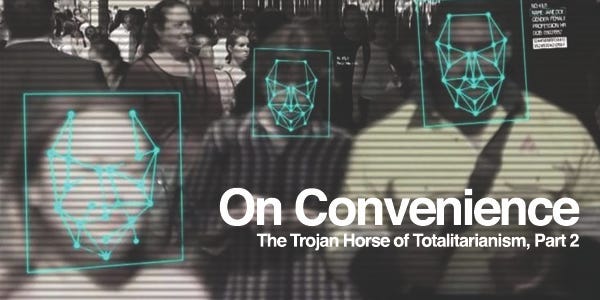
The ideological brilliance of this process lies in the way resistance is portrayed as irrational obstruction. Those who insist upon paying cash are treated with mild suspicion. Those who prefer physical books are regarded as quaint. Those requesting paper documentation appear unnecessarily difficult. Those declining biometric authentication are accused of harbouring inexplicable fears despite objecting not to convenience itself but to the concentration of unprecedented powers within institutions whose incentives remain overwhelmingly commercial. The effect resembles the gradual criminalisation of independence. One need not outlaw alternatives if one can simply redefine them as eccentric, inefficient or socially irresponsible until their disappearance appears entirely voluntary. Consent manufactured through convenience proves vastly more stable than obedience extracted through force because individuals eventually defend the systems that diminish their autonomy, sincerely believing that dependency constitutes liberation.
It is precisely here that enforced convenience reveals itself as the Trojan horse of totalitarianism, not because every technological innovation secretly conceals a dictator waiting to emerge, but because totalitarian forms of social organisation depend fundamentally upon infrastructures capable of comprehensive administration, continuous observation and selective exclusion, all of which become immeasurably easier once populations have willingly abandoned independent alternatives in exchange for marginal improvements in everyday efficiency. The danger is therefore cumulative rather than conspiratorial. No single subscription, taken in isolation, abolishes freedom, no individual streaming platform, considered alone, establishes authoritarian rule, and no isolated digital identity programme, viewed separately from the wider system of which it forms a part, can be said to constitute tyranny in itself; yet it is precisely through this incremental accumulation of individually defensible arrangements that a broader architecture of dependency is constructed, in which the political significance lies not in any one component but in their convergence into an integrated system of continuous access control. Yet history has repeatedly demonstrated that systems designed for one purpose are routinely adapted for another once political circumstances change, and societies that have systematically dismantled analogue alternatives discover, usually too late, that they possess remarkably few resources with which to resist. Freedom resides not merely in rights formally guaranteed upon paper but in the practical existence of alternative means through which ordinary life may continue independently of any single institution’s permission.
Communism therefore confronts this development not by rejecting convenience but by reclaiming it from capital altogether, insisting that technological progress ought to expand human autonomy rather than diminish it, reduce necessary labour without increasing dependence, and socialise productive capacities instead of converting them into permanent mechanisms for rent extraction.
The communist critique begins from the deceptively simple observation that technologies created collectively through generations of accumulated scientific labour ought not to function primarily as private toll booths through which humanity must continually pay to access its own productive inheritance.
If automation reduces labour, the benefit should appear as shorter working hours rather than greater unemployment. If digital systems simplify administration, they should strengthen democratic participation rather than surveillance. If communication technologies connect humanity more effectively than ever before, they should enrich public culture instead of fragmenting it into algorithmically curated consumer niches. If artificial intelligence magnifies productive capacity, its fruits should belong to society rather than becoming another instrument through which wealth concentrates still further within an already oligarchic economy.
The struggle against enforced convenience is therefore not a struggle against technology but against expropriation itself, against the steady enclosure of every sphere of existence within privately owned infrastructures that present dependency as freedom while extracting rent from activities that increasingly resemble the ordinary conditions of life. Capital has discovered that the most profitable society is not one in which commodities are occasionally purchased but one in which existence itself becomes subscription-based, every human activity transformed into a service, every relationship mediated through proprietary platforms, every convenience quietly binding individuals more tightly to systems they neither own nor govern. Against this stands the communist insistence that the immense productive powers humanity has collectively created should finally be organised according to entirely different principles, not because convenience must be sacrificed in the name of ideological purity, but because genuine convenience can exist only where dependence has been abolished, where technology serves humanity rather than capital, and where freedom consists not in frictionless submission to perfectly efficient systems of administration but in the democratic capacity to shape, control and, whenever necessary, refuse the infrastructures through which social life is organised. Only then does convenience cease to function as the velvet glove concealing the iron fist of domination, becoming instead what it should have been from the beginning: one of the material foundations of genuine human emancipation.
As always, thank you for your time and interest.
Yours, warmly,
V.
Thanks for reading! This post is public so feel free to share it.
Comments
Nothing yet. Say the first thing.
Sign in to join the conversation.