
Morning Comrades.
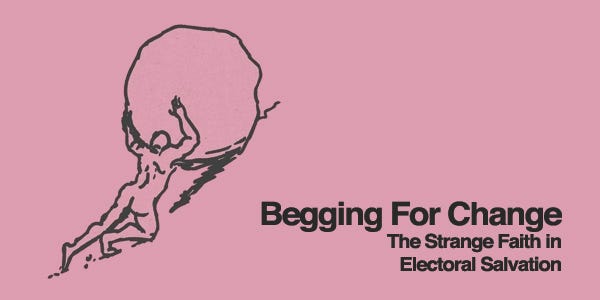
There is something profoundly strange about watching the modern Western left repeatedly rediscover the same political fantasy and then act surprised when reality refuses to cooperate. Every few years, a new figure appears promising to break with the failures of the past, to restore dignity to working people, to rebuild the social contract, to make the economy serve ordinary citizens rather than corporations and investors. The language changes slightly depending on the decade, the candidate, and the political fashion of the moment, but the underlying promise remains remarkably consistent: vote for me, give me power, and I will make your life better.
And somehow, despite decades of evidence suggesting that this promise is far more complicated than it appears, large sections of the self-described left continue to invest enormous emotional and political energy into exactly this proposition. They argue over which candidate is the authentic progressive, which politician represents the real break from neoliberalism, which electoral campaign offers the possibility of finally delivering the social democratic society that has supposedly been just one election away for generations.
The confusion is not that people want better lives, that is obvious and entirely rational. The confusion lies in the willingness to repeatedly place faith in a political mechanism that has spent decades demonstrating its inability, or unwillingness, to deliver the transformation being promised. It is definitely the later, but for the sake of the argument, let’s include the former.
The question is not whether a particular politician is better than another, better for whom and what class in any case, and they never serve ours. The question is much more uncomfortable: why does so much of the West continue to believe that the fundamental structures of power can be transformed by simply placing a more sympathetic person at the top of them?
This is where the contemporary debate surrounding figures such as Plattner, as a symbolic figure almost, because the stereotype he currently represenst is available at any and all 1 dollar stores across the West in all colours and genders, becomes tiresome. The immediate question, whether someone with associations, symbols, or political histories incompatible with anti-capitalist politics should receive support, is actually the easiest one to answer. Any serious anti-capitalist politics that claims to oppose hierarchy, exploitation, nationalism, racism, and authoritarianism cannot simply overlook those contradictions because a candidate offers appealing economic rhetoric.
But beneath that particular controversy lies a deeper and more troubling question. Why does anyone committed to radical social transformation continue to believe that the central problem is simply finding the correct person to operate the existing machinery?
That assumption is the foundation of modern electoral politics itself and says all there needs to be said about anyone still willing to give that farce any meaning.
The Western political imagination has been trained to think of power as something that belongs to individuals rather than systems. Politics becomes reduced to a competition between personalities, history is rewritten as a sequence of individual leaders and their supposed virtues or failures, while social change is imagined not as the result of building collective institutions and organised forces capable of imposing demands upon power regardless of who occupies office, but as the simple act of selecting the correct individual to inherit and manage the existing machinery.
This is an extraordinarily convenient idea for existing power structures because it transforms political dissatisfaction into a search for better management rather than a confrontation with the structures producing the problem.
The historical record of the Anglo-American West should make this obvious.
For roughly half a century, governments of different ideological labels have operated within a remarkably consistent economic framework. The details have changed, and individual administrations have occasionally produced meaningful differences in people’s lives, but the broad direction has remained clear: financialisation, weakened labour power, privatisation, deregulation, expansion of corporate influence, and the gradual transformation of essential social goods into market commodities.
The working class has been repeatedly told that the next election will restore balance. The next government will protect communities. The next leader will finally represent ordinary people. Yet the fundamental relationship between labour and capital remains largely untouched. A government can regulate capitalism, it can, maybe, even soften capitalism and sometimes it can redistribute some of capitalism’s wealth. But attempting to fundamentally challenge capitalism while remaining dependent upon capitalist institutions creates a contradiction that cannot simply be overcome, and doesn’t want to be overcome.
This was understood by many earlier socialist thinkers, who recognised that the state was not merely an empty container waiting to be occupied by whoever had the best programme. Luxemburg argued that reforms could improve workers’ conditions but could not substitute for transforming the social relations that produced inequality in the first place. Gramsci examined how societies maintain stability not only through force but through consent, through convincing people that existing arrangements are natural, inevitable, and simply awaiting better administration. This is perhaps the most important point. The modern West has often mistaken political representation for political power, or rather wanted to to belief so as it stripped themselves of responsibility to actually be “political”.
What emerges is a political cycle that has become almost ritualistic in its repetition: a crisis develops, public frustration intensifies, and a political figure appears offering the promise of renewal, restoration, and a return of control to those who feel abandoned by the existing order. Millions invest their hopes in that individual, not merely as a representative but as a vessel for the possibility of change itself, only for the realities of governing within existing institutions to gradually impose their own limitations. Compromise becomes framed as necessity, transformative language becomes softened into the cautious vocabulary of administration, and the original promises are steadily reduced to a series of smaller adjustments that leave the fundamental structures untouched. Yet when the anticipated transformation fails to materialise, the failure is rarely attributed to the deeper political and economic arrangements that constrained it; instead, responsibility is redirected towards the individual, who is accused of lacking sufficient courage, conviction, authenticity, or ideological purity. The system remains protected from scrutiny, while public frustration is redirected into the endless search for the next figure who can once again promise that this time, finally, everything will be different.
This cycle is one of the great political farces of contemporary Western society because it consumes enormous amounts of energy while directing frustration away from the structures that actually produce social conditions. Anger about declining wages, housing insecurity, economic inequality, and the loss of democratic control is transformed into endless debates about personalities.
People become obsessed with whether a particular politician is sincere while ignoring whether sincerity itself is enough when confronting institutions designed to resist fundamental change. The problem is not participation in elections. The problem is the belief that elections alone constitute political transformation.
There is a significant difference between voting for a government because it may improve immediate conditions and believing that the government represents the mechanism through which society itself will be transformed.
The first is a practical decision and the second is a political illusion.
This distinction matters because the inability to imagine alternatives has become one of the defining characteristics of modern politics. As Mark Fisher famously argued through the concept of capitalist realism, contemporary society has developed an almost total inability to imagine a world beyond capitalism. The future appears closed. The only available choices seem to be different versions of the present.
The result is a political imagination increasingly confined to the search for variations of the same underlying arrangement: a kinder capitalism that promises to soften its harsher consequences, a more regulated capitalism that seeks to discipline its excesses, a greener capitalism that attempts to reconcile ecological destruction with continued expansion, and a more inclusive capitalism that seeks to distribute opportunity more broadly without challenging the fundamental relations of ownership and power upon which the system is built. The vocabulary changes, the moral framing evolves, and the promise is repeatedly repackaged for new generations, yet the central assumption remains untouched: that capitalism itself is not the problem to be confronted, only the manner in which it is administered.
This creates a strange political situation where radical language exists alongside profoundly limited political imagination. Movements describe themselves as revolutionary while their primary demand is the restoration of a social democratic compromise that existed briefly in certain historical conditions and has since been steadily dismantled by the very economic forces that created it.
The nostalgia is understandable. Many people look back to periods when wages were higher, unions were stronger, public services were more robust, and economic security was more widespread. Yet the lesson should not be that we simply need better politicians to recreate that past. The lesson should be that those gains were not gifts handed down by enlightened leaders. They were the result of organised social forces, militant labour movements, mass political struggle, and institutions capable of imposing demands upon capital.
Rights were not granted because those in power suddenly became compassionate. They were won because power was forced to concede.
The fundamental question facing us all is therefore not which politician should be trusted. It is whether politics can be rebuilt around collective power rather than individual representation. Whether people can move from being voters waiting for promises to being organised communities capable of making demands. Whether democracy can mean something more than choosing which professional class will administer a system whose basic priorities remain unchanged.
The problem has never simply been finding the right person.
The problem is believing that one person was ever going to be enough.
Yours, warmly,
V.
Comments
Nothing yet. Say the first thing.
Sign in to join the conversation.