
If you read my article about Black Books Optioned for Film & TV, then you know how challenging it can be to see a book adaptation through to the finish line, especially books written by Black authors. Since then, I had the honor of moderating the Lights, Camera, Literature panel at the Black Book Bash in Jacksonville, Florida.
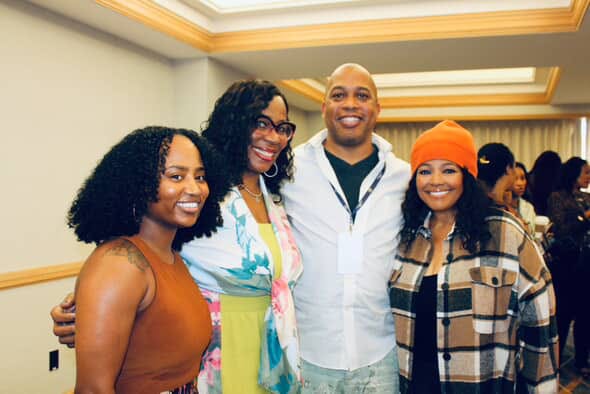


The panel featured three powerhouse creatives shaping literature and entertainment today, and each of them was as kind as they were knowledgeable. Kim Fields was on a tight schedule, but she still took the time to stop by the luncheon and greet everyone. You could instantly feel her warmth and genuine spirit. I also had the chance to chat with Rasheed and ReShonda outside of the panel. ReShonda was such a positive light and had me laughing both during and after our discussion. I truly appreciated Rasheed taking the time to sit and talk with me over lunch. There is something magnetic about his energy, and it was such a pleasure getting to know him. If you haven’t read his latest novel, My Government Means to Kill Me, I highly recommend it. I learned so much from each of them, and it’s clear why they’re all so highly respected in their fields.
ReShonda Tate, a national bestselling author of over 50 books, is known for Queen of Sugar Hill, Let the Church Say Amen (adapted by Regina King for BET), and The Secret She Kept (adapted for TV One). An NAACP Image Award winner, her upcoming novel With Love From Harlem is now available for preorder.
Rasheed Newson, author of the acclaimed My Government Means to Kill Me, a Lambda Literary Award finalist and New York Times Notable Book, is also a television writer and executive producer for Bel-Air, The Chi, and Narcos, with his next novel There’s Only One Sin in Hollywood coming in 2026.
Kim Fields, an award-winning actress, director, producer, and author, has shaped Black television and culture for over four decades through iconic roles like Tootie on The Facts of Life and Regine on Living Single. Her memoir Blessed Lifecaptures her evolution from child star to creative force, and her ongoing work continues to inspire across generations.
A huge thank you to Casey Kelly for choosing me to moderate this panel. This will forever be a core memory for me. The panelists’ insight was both helpful and eye-opening. Here’s a recap with snippets from the discussion.
To start the conversation, I asked the panel what it really takes to see more of our stories on screen. Every author dreams of that “adapted for film” tagline, but few realize how complex the process can be. They each dove into the realities of development, sharing how aligning creative vision with business strategy can make all the difference.
When Rasheed Newson shared this candid look at how Hollywood operates, I was honestly stunned. The harsh reality he exposed angers me, but it’s an important lesson.
His advice to authors: be strategic, not sentimental is extremely valuable. He suggests studying who’s buying what and when. When a studio or celebrity signs a new deal, that’s the moment to pitch. He reminded us that in this business, you must be both valuable and visible to decision-makers.
When the conversation turned to first impressions, Kim Fields didn’t hesitate to share what she’s seen behind the scenes. Whether it’s a script, a pitch, or even an email introduction, presentation can make or break an opportunity.
ReShonda Tate spoke candidly about the first time one of her novels was adapted for film and learning to let go. When Let the Church Say Amen was adapted, several story elements changed for business or casting reasons. “Flexibility is key,” she said. “It’s not the book, it’s the essence of the book.”
Kim also reminded us that sometimes, being the author doesn’t mean you have to be the spokesperson. She shared a story that perfectly illustrated the importance of knowing your strengths and delegating when necessary.
Her message was clear: don’t be the weak link in your own opportunity. If marketing, performance, or pitching isn’t your strength, find someone who can help your work shine.
Kim shared that she doesn’t let labels define her or limit what she can do. She focuses on maintaining creative freedom, choosing projects based on story and impact, not stereotype or expectation.
When we rally behind films and series based on Black-authored books, we amplify stories that have long been silenced or sidelined. Supporting these projects by reading, watching, preordering, or sharing signals to the industry that our stories are both valuable and vital.
We’re shifting gears. Black Fiction University Watch Parties will now be held every other Thursday at 8 PM instead of every Thursday to give everyone time to reflect, and recharge between sessions. I will also send out a monthly watch list of movies and shows to watch on our own and discuss together.
🗓️ Checkout the updated Watch Party Calendar here: Black Fiction University Watch Party Calendar
Would you be interested in joining Black Fiction University’s Book Club, where we read and discuss books that are essential to Black culture?
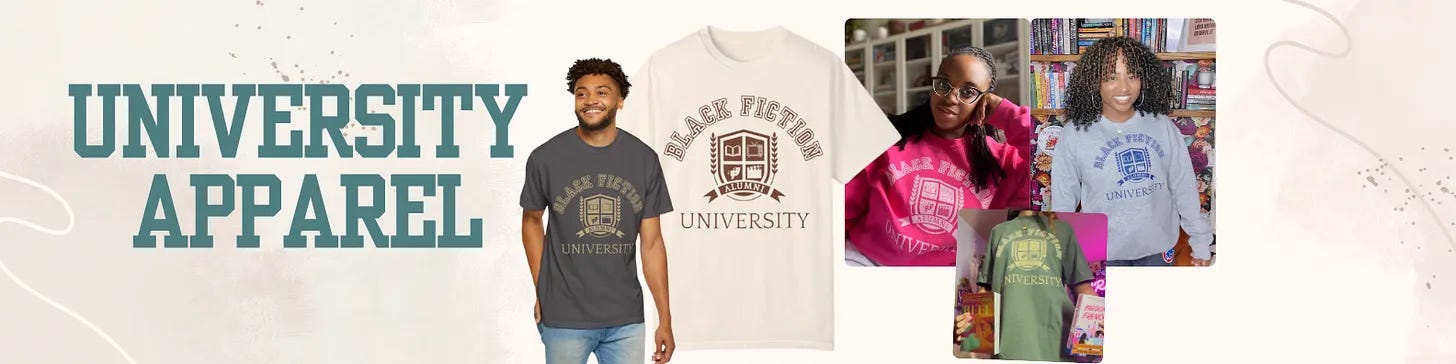
If you learned something new from reading this issue of Black Fiction University. Please consider sharing the article. Black Fiction University is a free newsletter, but if you’d like to show your support, you can represent the movement with official BFU apparel. Sweatshirts and T-shirts are available.
Comments
Nothing yet. Say the first thing.
Sign in to join the conversation.