
I’ve been struggling with how to address the stupendous events over the last couple of weeks. Donald Trump has deliberately, and with malice aforethought, upended the international order and has threatened, insulted, and belittled America’s closest allies. This is worthy of clinical, dispassionate analysis. Unfortunately, my reaction has been much more visceral and emotional; my efforts to draft an academic analysis have proven fruitless and have been overwhelmed by my need to address recent events from a more personal perspective.
Regular readers will remember that I am a veteran of America’s war in Afghanistan. I deployed twice, once (early in the war) embedded with the Americans themselves. Moreover, I was a senior planner and staff officer throughout Canada’s entire involvement in the war – from beginning to end. I’ve said elsewhere that this involved all aspects of the operational side of our mission: training, manning, deployment, sustainment, and – alas – next-of-kin notifications and initial management of casualties originating from Western Canada.
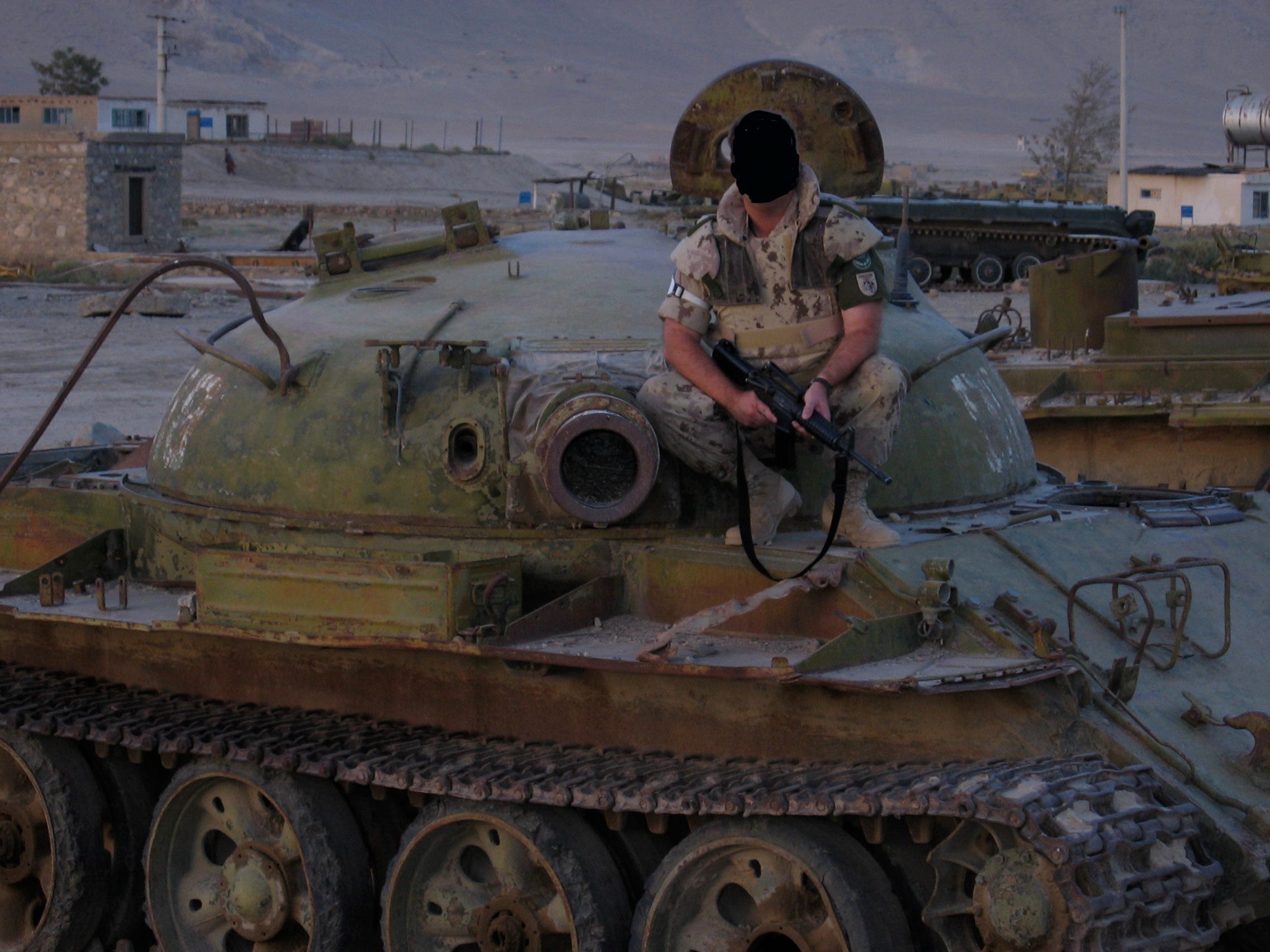
My staff was heroic. We received casualty calls at all hours. My wife grew to hate my BlackBerry and, at one point, smashed it; I was fielding calls from the delivery room when my daughter was born. At one point, my staff branch was 28% manned. Three senior NCOs left with heart issues. I suffered heart issues myself and was hospitalized, adding to my other injuries. Yet, as I wrote about last year, failure wasn’t something that could be tolerated, and we kept on working sometimes 18–20 hours a day, every day.
Things came close to unravelling, and Afghanistan nearly broke the Canadian Army. This chart may help illustrate why. It’s different from most you may have seen, as it depicts the burden on each nation’s army, not on the general population. The burden was very, very high – almost unmanageable.
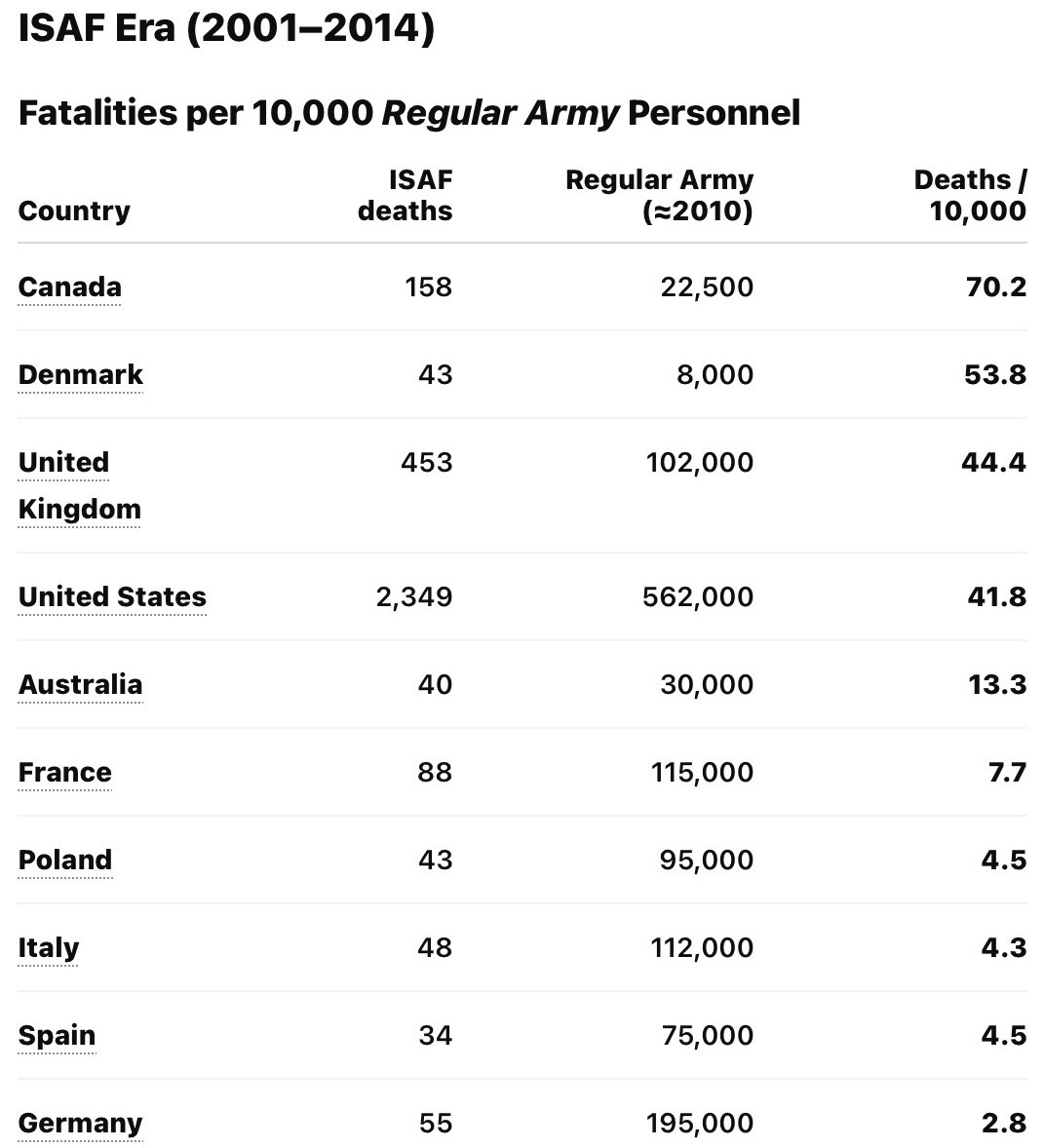
Afghanistan became the entire focus for Canada’s little Army, to the exclusion of almost everything else. As an indicator, Ottawa will tell you that some 40,000 soldiers served in Afghanistan throughout the duration of the mission. But this figure is misleading. It doesn’t account for those soldiers, including your humble author, who served multiple tours. Indeed, most Army personnel serving through the duration of our Afghan mission served multiple tours. I know soldiers with five tours. The effect of such a pace on families, mental and physical health, and careers can only be imagined.
All of this was done in support of the United States and in furtherance of its aims. Afghanistan was an American show from beginning to end, with Canada playing a supporting role and bearing the consequences of American decisions, including their disastrous counterinsurgency strategy. We were there from the very beginning and suffered our first casualties at the hands of overeager and overconfident US Air Force pilots. Later, we commanded in Kabul and then, at NATO (i.e., American) request, assumed the lead in Kandahar Province – the hotbed of Taliban resistance. Coincidentally, this coincided with the US surge into Iraq, and Canada was left conducting brigade-level combat operations with a single battlegroup virtually alone. And we carried on in combat and training roles up to the end of the ISAF mission in 2014. Twelve years spent supporting the United States and American objectives in its so-called “Global War on Terror.”
And what did we get? I described the lack of gratitude and the belittling attitude I encountered while deployed in my essay “My Drift Into Quiet Anti-Americanism” (here). But afterwards, Canada – and the rest of the Allies – were forgotten and written out of the American history of the conflict. Two years after the end of our involvement in the Afghan War, Trump was elected and the insults and threats began.
These were tempered during his first term by staff who acted as a restraint on his worst impulses. Now, during his second term, he is totally unencumbered and is actively encouraged by the absolute worst US society has to offer. This has been translated into threats of tariffs and annexation, and into name-calling and childish insults. Trump was unbalanced in 2016; he is almost certainly mentally ill now.
So I take it personally when Trump insults NATO allies or, as he did a few days ago in Davos, openly insults our contributions to their wars in both Afghanistan and Iraq. MAGA commentators tee-hee about an invasion of Greenland and openly mock Canada’s military capacity. American legislators threaten us. Members of the US Cabinet openly support Alberta separatists who, in turn, hint at American support. For someone like me, it’s hard not to have an emotional reaction both to the insults and to those Canadians who still cannot bring themselves to think of the US as an adversary or – worse – who want to bring Trumpism to Canada.
We are at an inflection point. The scales need to drop from the eyes of those Canadians who think “Trump Derangement Syndrome” is a real thing or who desperately want business as usual. We need emotional responses right now. Trumpism, in all its odious forms, is a grave national security threat, and we need to treat it as one.
And Trump himself? As I was completing this piece, he called our Prime Minister “Governor” again and threatened us with 100% tariffs because of a trade deal with China. He also, likely in a desperate effort to salvage King Charles’ visit in April and Prince William’s attendance at the football World Cup, lavished praise on the British for their contributions to America’s wars in Afghanistan and Iraq. Not a word was said about anyone else.
He, and the United States, can go to hell. And yes, that’s my emotions speaking – and I’m through apologizing.
Comments
Nothing yet. Say the first thing.
Sign in to join the conversation.