
If you haven’t seen the movie Sicario and its sequel, they’re worth a watch. In them, the U.S. government pursues a secret campaign using extrajudicial force against the Mexican cartels with the CIA and special operations forces. They’re important if you believe, like I do, that Donald Trump — and by extension his administration — applies “movie logic” to situations, equating leadership and toughness with things he’s seen in a movie or on TV. Trump is always referring to “ratings” or describing people as being “right out of central casting,” and he has been known to use Hollywood to interpret his worldview literally or symbolically. He constantly uses Hollywood language when describing military operations (“taking out the bad guys,” “obliterating,” “fire and fury”) and tends to see the world through a simplistic, movie-oriented lens where adversaries “need to see strength.” There’s no room for nuance in Hollywood or in Trumpworld.
There’s nowhere in the international arena where Trump’s tendency to conflate real-life situations with movies is more apparent than in his dealings with Venezuela. Because, for whatever reason, Venezuela has become the focus of Trump’s wrath and the stage for the execution of a real-life Sicario scheme. Sicario is, of course, set in Mexico, but the Mexican cartel situation is far too entrenched and complex to provide the easy foil that Trump seeks. Moreover, U.S. ties with the Mexican government run deep, and Mexico is much more a victim of cartel violence than an active ally.
Given this, he’s set his sights on Venezuela. Venezuela has had issues for decades, especially since the 1998 election of Hugo Chávez brought a left-wing populist government to power. At first, Chávez was the darling of the political left, promising economic reforms to benefit Venezuela’s poor and pursuing a foreign policy that set it on a course to be free of U.S. influence. Unfortunately, this didn’t last, and the country entered a long deterioration (even after the death of Chávez and his replacement by Nicolás Maduro) that produced an overreliance on oil money to keep the economy afloat, mass emigration, nationalizations of entire industries, highly politicized security services, and — worst of all, from a U.S. perspective — alliances with Russia, Iran, and a variety of non-state actors. The Venezuelan economy has essentially collapsed, and the regime has found itself in near-constant conflict with the United States through sanctions and diplomatic breaks.
This has led to significant regional instability as Venezuela’s economic situation and political repression have produced refugee flows that have affected its neighbours and, indirectly, the U.S. southern border. This has served to create a pressure point that has been a long-standing and demonstrable concern for U.S. policymakers across the political spectrum.
Thus, Venezuela provides the perfect foil if Trump was looking to manufacture a threat. Its links with Russia and Iran alone would earn it Washington’s ire, and to this must be added the disruption to regional oil supplies and Caracas’s nationalisation of a variety of industries. To the American right wing, it spells one thing: Communism. To politicians like Marco Rubio, the U.S. Secretary of State, who view the world through a Cold War lens and have an incredibly simplistic view of international politics, “Communism” alone makes Venezuela a threat to the United States.
Unfortunately for Trump, Venezuela isn’t a real threat to the U.S. Its military capabilities have degraded significantly over the last two decades (the Venezuelan Navy has a single frigate, and the serviceability of the entire Air Force is in doubt), and the country doesn’t have an ideology where exporting a “revolution” is an imperative. Yes, Venezuela has border disputes with its neighbours and flirts openly with Cuba (much to the upset of the rabidly anti-Communist Cuban-American community in Florida from whence Rubio came), Russia, and Iran, but there’s little evidence that these ties have generated any real threat to U.S. interests.
So, in the absence of a direct threat, Trump has had to manufacture one — and he’s found his excuse on two fronts: immigration and a real-life “cartel.”
As already noted, the dramatic destruction of the Venezuelan economy has produced mass emigration and a tide of asylum seekers looking to leave the country. Some of these are political refugees seeking to escape the oppressive and authoritarian Maduro regime, while others are simply economic refugees forced out by a lack of opportunity and an economy teetering on the brink of collapse. Many — if not most — of these people gravitate to the traditional destination for refugees from Latin America, the United States. Trump’s position on immigration is far too well known to need repeating here. Suffice it to say that he has accused Venezuela of “emptying its prisons” and of sending criminals to the U.S. in an effort to destabilize the country. More hilariously, Trump has confused “asylum seekers” with people confined to mental health facilities, accusing the Maduro regime of emptying its “asylums” to ship mentally ill people to the U.S. It’s farcical, of course, but panders to Trump’s MAGA base and reflects his own deep prejudices.
The “cartel” situation is more complex, for there is indeed a “cartel” operating in Venezuela: the Tren de Aragua and the so-called Cartel de los Soles. Moreover, the U.S. has, for years, accused the Venezuelan security apparatus of supporting the drug trade and has gone so far as to place a $50 million bounty on the head of dictator Nicolás Maduro.
But, as with anything Trump, there are issues with this. First, it’s by no means clear that the Venezuelan government — as a policy — supports the drug trade and meets the definition of a “narco-state,” despite its very serious flaws. Yes, President Maduro has been indicted in the United States, but this relies entirely on U.S.-sourced information, which is certainly subject to bias or fabrication. I’m not saying we shouldn’t believe the U.S. government, but…
Secondly, Tren de Aragua isn’t a typical “cartel.” It generally doesn’t manufacture its own drugs but instead acts as a transporter and facilitator — it’s even in the name, “Aragua Train.” This isn’t to say that it isn’t incredibly violent or that it hasn’t made inroads into the Venezuelan government. It is, and it has. However, it has yet to develop major operations in the United States. Tren de Aragua largely functions as a transporter, human-trafficking and extortion network; it has not been identified in public reporting as a major source of fentanyl destined for the United States. Indeed, the vast majority of fentanyl entering the U.S. comes from Mexico, not Venezuela. Tren de Aragua might be a “threat” in the wider sense but hardly represents a clear and present danger to the security of the United States. A case could be made that the Mexican cartels represent a far more serious threat, yet we don’t see the same amount of sabre-rattling against Mexico.
Regardless of the facts, Venezuela has proven to be the perfect target for Trump’s ire. It’s ruled by a “revolutionary” dictatorship that may or may not have ties to drug cartels. Its collapsing economy has created a wave of refugees, many of whom look to enter the United States. It’s host to a criminal organization that specializes in drug transhipment. All of this equates to the perfect foil for a president looking to demonstrate strength, U.S. hegemony, military power, and Republicans’ anti-Communist credentials. The idea that the threat is either non-existent or overblown hardly matters; Trump will get his win even if it means lying about the fentanyl threat.
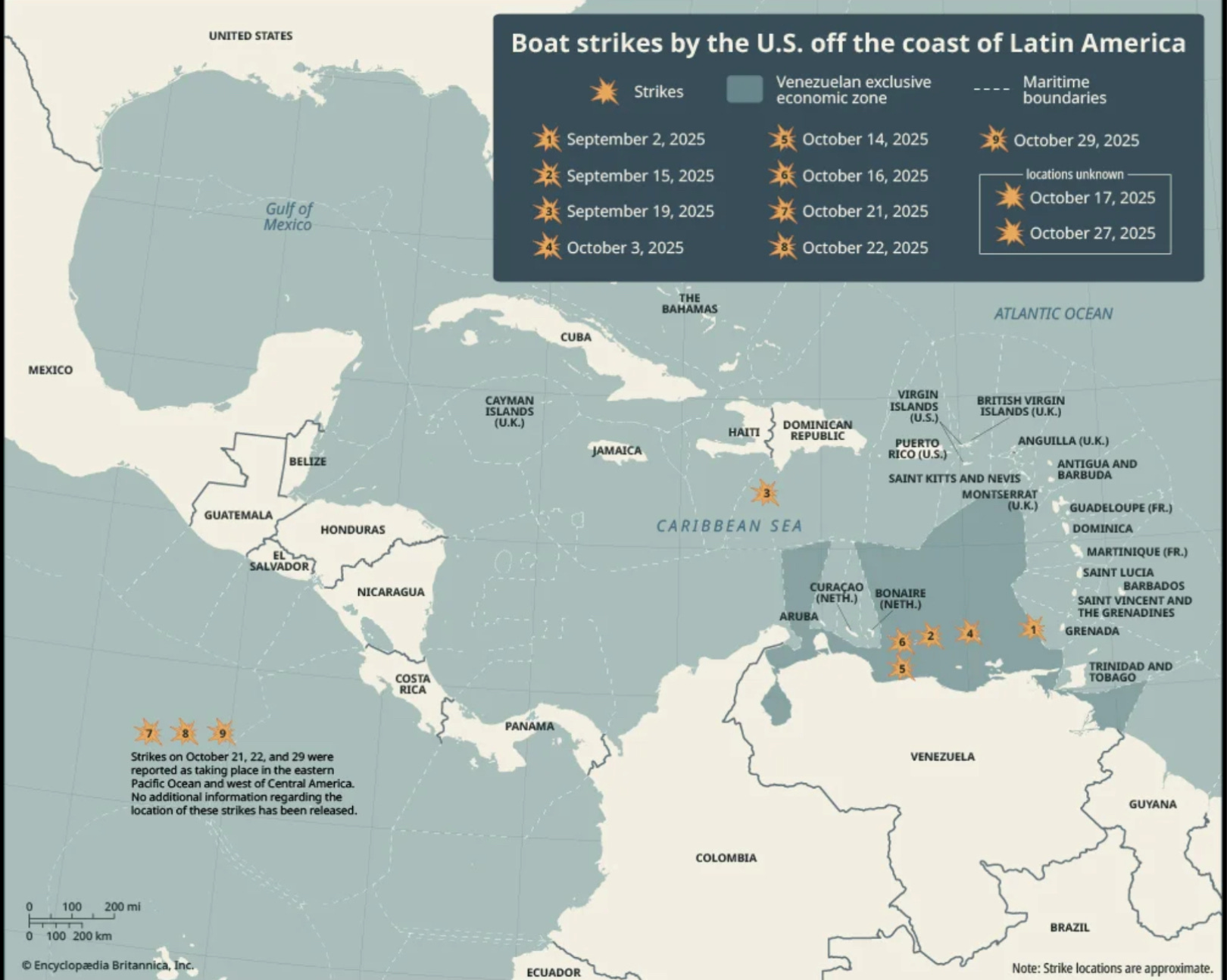
With this in mind, Sicario Redux took shape shortly after Trump took power earlier this year. Maduro was indicted, and CIA destabilization efforts began anew. U.S. support for Venezuelan opposition figures became much more obvious and more vocal. More worrying, the U.S. military began extrajudicial air strikes against boats ostensibly linked to the drug trade and Tren de Aragua. This was done without disclosing any relevant evidence and without demonstrating any link at all to the drug trade. It’s a page right out of a Sicario script but is almost certainly illegal under international law, no matter how much cheerleading is done by Pete Hegseth and Marco Rubio. Worse, the strikes have been extended to Colombian watercraft, with at least one attack occurring in the Pacific, much to the alarm of the Colombian government.
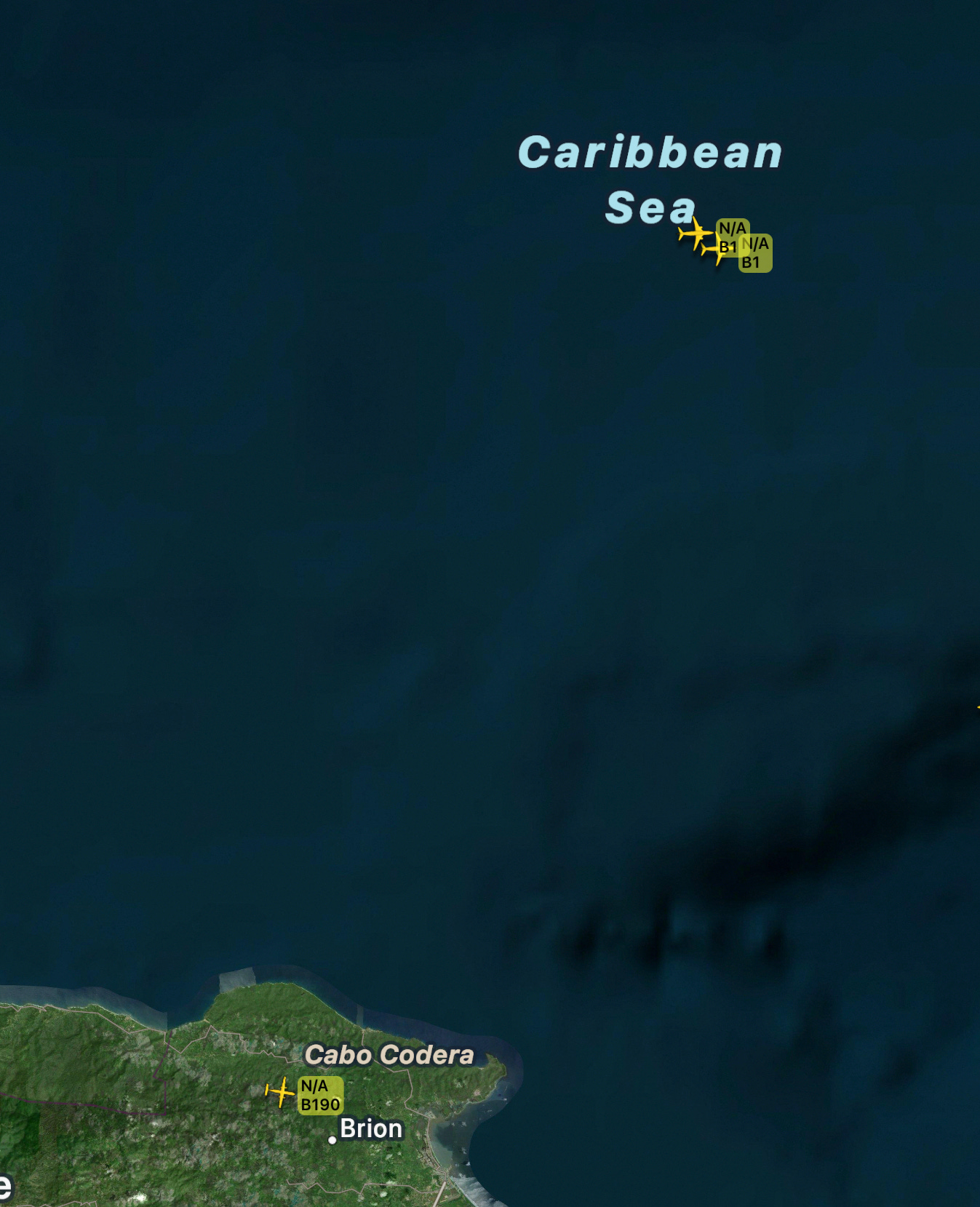
If this wasn’t enough, this week, U.S. Air Force B-1 bombers were observed cruising just outside Venezuelan airspace, having flown extended missions from the continental United States. These were almost certainly show-of-force flights designed to intimidate the Maduro regime and to escalate tensions. Of note, the White House has denied B-1 flights despite their appearing on publicly available flight tracking programmes. We can certainly anticipate more of the same over the next few weeks, perhaps escalating as the USS Gerald R. Ford carrier strike group (CSG) enters the Caribbean.
The deployment of the latter is, in and of itself, a major escalation. The Ford CSG was pulled from Europe at no notice and dispatched across the Atlantic to be parked off the Venezuelan coast. A carrier strike group has more embarked firepower than all the South American naval and air forces combined; a deployment against Venezuela is a massive overreaction designed to intimidate. There’s next to nothing Venezuela can do to counter it. However, a CSG is of limited utility unless the United States is considering a full range of military strikes against Venezuelan targets. Given the current situation and the state of the Venezuelan armed forces, this appears to be quite unlikely — unless Trump wishes to appear tough to his domestic supporters.
What seems far more likely is the Sicario scenario, whereby the CIA and U.S. special operations forces operate within Venezuela to further destabilize the regime and — potentially — conduct direct action against Tren de Aragua. The U.S. would certainly be assisted by elements of the Venezuelan opposition, despite its appearing fractured and without central direction. A message to this effect may have been sent after the award of the Nobel Peace Prize to María Corina Machado, one of the major leaders of the Venezuelan opposition. In her response to the award, Machado was effusive in her praise for Trump, adopting an almost fawning tone — a move that shocked some of the more moderate opposition figures who worry about American intervention and being seen as U.S. puppets.
It is entirely possible that U.S. special forces are already operating in Venezuela, with CIA support. If this is the case, the next step in escalation could well be the use of limited military force, such as air strikes against infrastructure supporting the regime or decapitation strikes against Maduro and other regime leaders. The international backlash will almost certainly be swift and almost universally negative. Aside from Venezuela’s allies like Russia and Iran, the European Union and other like-minded organizations and countries (including Canada) have long pursued diplomatic and economic measures to support democracy in the country, especially in the absence of a full-fledged threat or any real evidence that Venezuela is becoming a “narco-state.”
What we have then is the performative militarization of Trump’s anti-immigration agenda — kabuki theatre shaped by Hollywood imagery rather than strategic necessity. Venezuela is not a direct threat to the United States, and the drug “cartels” that the U.S. claims to be pursuing there are not the same as those operating in Mexico and elsewhere. Moreover, the extent of the Venezuelan government’s participation in drug trafficking is certainly an open question. Finally, Trump has used the minor influx of refugees seeking asylum in the U.S. to use the situation in Venezuela to further his anti-immigrant agenda, providing a litany of accusations without any real evidence.
Operations against Venezuela offer Trump an opportunity to showcase his strength and toughness. Venezuela, with a “revolutionary” government, a collapsing economy, a stream of asylum seekers, and a violent criminal element linked to the regional drug trade, provides a perfect foil for Trump’s “badass” script. The fact that following this script has already resulted in the extrajudicial execution of people and violations of both international and maritime law is of little consequence to Trump and his minions. In Trumpworld, Donald Trump is judge, jury, and executioner — the rest of the world be damned. If the situation escalates further, Canada and other countries will have a decision to make: acquiesce and watch international norms corrode even further than they’ve done thus far, or risk alienating a thin-skinned, egomaniacal Trump — a president who takes every slight personally and translates his pique into retribution. It’s a tough call, but one we may be forced to make.
Comments
Nothing yet. Say the first thing.
Sign in to join the conversation.