
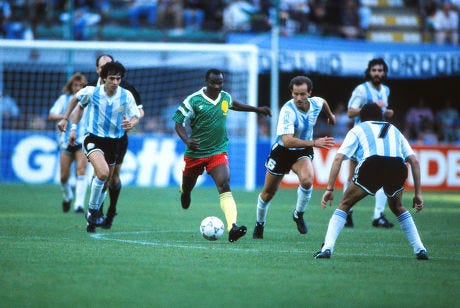
Summer this year brings warm weather, sunburn, and one of the most anticipated sporting spectacles on the planet. The FIFA 2026 World Cup kicks off on June 11, spread across three host nations (the United States, Mexico, and Canada) with 48 countries competing in 104 matches over 39 days. As a Cameroonian, football is more than a hobby. It’s something woven into national pride and core memories. The legend of Roger Milla and the 1990 Indomitable Lions, who stunned the world by knocking out Diego Maradona’s Argentina, is still one of the first things people bring up when I tell them where I’m from. Milla’s dance at the corner flag is iconic. For a country our size, football gave us a language through which we were seen around the world. Our glory days now live mostly in nostalgic YouTube clips and heated family debates about whether today’s players could ever measure up, but the emotional investment is eternal. This year Cameroon didn’t qualify, a sentence that physically pains me to type but I still get to soak up some of the excitement from Atlanta, one of the host cities.
Unfortunately, years of infectious disease training mean that I do not experience mass gatherings like a normal person. Millions of travelers, packed transit systems, summer heat, stadium food, sleep deprivation, and emotionally volatile football fans set my brain running outbreak risk assessments against my will. And the timing is impeccable, because emerging viruses appear determined to make themselves part of the conversation. First came an Andes hantavirus outbreak linked to a cruise ship, words I did not expect to type in this lifetime and now an unfolding outbreak of Bundibugyo ebolavirus serious enough for the WHO to declare a Public Health Emergency of International Concern. With outbreaks dominating headlines and post-COVID anxiety still humming in the background, it’s fair to wonder whether mass gatherings like the World Cup are an infectious disease risk.
The reassuring answer is yes, but probably not in the catastrophic ways people imagine. Fortunately, the health risks most fans are likely to encounter are not exotic hemorrhagic fevers but the same familiar infections that accompany almost every large gathering of people. Historically, major outbreaks linked directly to sporting events have been uncommon. Better surveillance, faster outbreak response, and international coordination mean the realistic risks are smaller and far more boring. Respiratory and gastrointestinal infections like influenza, COVID-19, norovirus, and salmonella are the most common. These are the pathogens that thrive wherever exhausted humans gather in close quarters and collectively decide that hydration and sleep are optional. So instead of panicking, be prepared.
Before boarding a plane in your team’s jersey, emotionally bracing for the inevitable penalty-shootout heartbreak, it’s worth checking your vaccination history. Measles is the big one this tournament. Measles cases and outbreaks have been reported across all three host nations, and dense international travel creates ideal conditions for it to spread. Measles is one of the most contagious pathogens we know of. Fever, rash, red eyes, cough; if those show up during or after travel, seek medical care. COVID, meanwhile, remains very much with us, despite the widespread decision to simply stop thinking about it. Older adults, immunocompromised people, and frequent travelers should still take booster recommendations seriously.
Travel medicine gets more interesting once you remember the World Cup is often only one leg of the trip. A match in Mexico City turns into beach time, family visits, eco-tourism, and a few questionable layovers. Mosquitoes, unfortunately, remain unimpressed by sporting events. If you’re heading beyond the host cities, think about destination-specific risks like dengue, malaria, typhoid and whether preventive medication or vaccines make sense. And because humans are relentlessly optimistic about their own stamina, a brief word on heat; June and July temperatures in parts of Mexico and the southern United States can be genuinely punishing. Heat exhaustion, dehydration, and alcohol are an under-appreciated combination. I know hydration sounds boring, but emergency departments in summer beg to differ.
Hand hygiene remains one of the most effective defenses against respiratory and gastrointestinal infections. This sounds so unglamorous that it is promptly ignored by almost everyone. So I would say it again, wash your hands after using the restroom, before eating and use sanitizer after public transit. Thousands of equally sweaty supporters have touched every surface before you, and they were not thinking about you when they did it.
Food safety counts too. If something has been sitting outdoors in the summer heat for a questionable length of time, trust your instincts and let it go. Open-air stadiums are generally lower risk than crowded bars, fan zones, clubs, and transit systems, so the riskiest part of your day may not be the match at all. Ventilation matters, and if you’re immunocompromised or otherwise medically vulnerable, masking in crowded indoor settings is still entirely reasonable.
Fever with a rash, severe diarrhea, relentless vomiting, significant respiratory symptoms; these are not cues to crack another beer and soldier on to the next match. Seek medical care, and tell whoever treats you where you’ve been. Travel history is one of the most useful things you can hand a clinician, and one of the most commonly forgotten. The overwhelming majority of World Cup illnesses will, thankfully, be mild and self-limited. Early recognition is the most powerful tool we have in outbreak control, and it costs you nothing but a little ego divulging the many questionable choices you may have made while traveling, to a clinician.
There’s also the small matter of medications, which become critically important the instant you forget them. If you rely on daily prescriptions, pack more than you think you’ll need and keep them on you, not in checked luggage. Airlines are unpredictable, chronic conditions like hypertension, asthma and diabetes, reliably, are not.
And because infectious disease physicians become unavoidably parental on the subject of travel please practice safer sex. That may mean HIV PrEP, DoxyPEP for bacterial STI prevention if you qualify, or simply packing condoms you actually intend to use. Large international gatherings create new connections between people, and celebration plus alcohol has never once in recorded history been a solid foundation for sound risk assessment.
Part of what makes the World Cup extraordinary is that for a few weeks every four years, the world collectively agrees to care deeply about something joyful and gloriously irrational. A last-minute goal can dissolve borders, politics, and language barriers in ways diplomats spend entire careers failing to achieve. But it is impossible to talk about this tournament honestly without naming the backdrop it unfolds against.
Immigration enforcement in the United States means some fans who might otherwise travel will quietly decide not to. Others already living in host cities may avoid public gatherings out of fear. A tournament built on celebrating global movement sits uneasily beside an increasingly restrictive conversation about migration and belonging. And then there’s the simple fact that FIFA has through the years turned attendance into a luxury product. Ticket prices, accommodation, and travel costs now place the tournament out of reach for many of the ordinary supporters who give it meaning in the first place.
Football has always belonged most truly to ordinary people. Modern international football, increasingly, does not.
All of this unfolds while public health infrastructure across parts of North America, the United States in particular is being eroded and defunded. Surveillance systems, vaccination programs, laboratory networks, epidemiologists and the machinery that protects entire populations from outbreaks is invisible right up until the moment it fails.
COVID taught us that weakening public health systems doesn’t make infectious disease threats disappear. It just leaves us more exposed to them. For a few weeks this summer, football will deliver joy, spectacle, heartbreak, unity, and refereeing decisions capable of ending lifelong friendships. Perhaps we need some of that right now.
But when the final whistle blows and the champions lift the trophy, infectious diseases will still be here. Measles will still not care about borders and mosquitoes will remain annoying and resolutely nonpartisan. Public health infrastructure will still matter, and we’ll still have to grapple with all of it. For a month, football will convince us that borders matter less than goals, flags, and last-minute miracles. Then the tournament will end, the crowds will disperse, and the work of protecting public health will continue. Viruses won't know the difference.
I am an infectious diseases physician and scientist writing at the intersection of medicine, global public health, society and justice. If this piece resonated with you consider sharing it and subscribing.
No posts
Comments
Nothing yet. Say the first thing.
Sign in to join the conversation.