
I am writing this from Cameroon, where I spent four days participating in a free cancer screening campaign in the Southwest region, an initiative organized by the Association of Cameroonian Physicians in the Americas, in partnership with the Faculty of Health Sciences of the University of Buea and the Buea Regional Hospital. Over four days, the team offered screening for breast, cervical, prostate, and colorectal cancers. On paper, this is what progress looks like bringing together multi-disciplinary international and local teams for access, outreach, early detection. But what I encountered forces a more difficult question. What happens when the frameworks we use for prevention are fundamentally mismatched to the realities on the ground?
Breast cancer is the leading cancer among women in Cameroon, with over 4,200 new cases diagnosed every year. That alone is not surprising. What is striking and deeply concerning is the age distribution. We are not primarily seeing post-menopausal disease, as is classically described in other settings. We are seeing young women. Women between 30 and 50 account for the majority of cases, and in some instances, diagnoses have occurred in girls as young as 17.
This is not the epidemiologic pattern we expect from data generated in high-income settings, where breast cancer incidence rises with age and peaks after menopause. When a disease behaves differently, the response should not be to force it into existing models. It should be to ask why.
Part of the answer may lie in something we have collectively failed to confront with sufficient urgency.
When I was in primary school what would be called middle school in the United States, almost every girl in my class had undergone breast ironing. At the time, it was spoken of in terms of pain. That was the frame through which we understood it, a painful but normalized part of growing up for many girls. What none of us grasped was that this repeated trauma to developing breast tissue might carry consequences far beyond that moment. Decades later, it is becoming increasingly difficult to ignore the possibility that the damage inflicted during those formative years may be contributing to a pattern of early-onset, and often aggressive, breast cancers in very young women.
Breast ironing targets girls between the ages of 8 and 13, particularly those who begin developing breasts early. It involves applying repeated pressure and heat using heated stones or other implements to flatten breast tissue. The stated goal is protection from the predatory male gaze; to reduce visibility, to delay sexualization, to shield girls from harassment, sexual assault, and early pregnancy. But the biology does not negotiate with intent, in reality what this practice causes is direct and repeated tissue injury including chronic inflammation, fibrosis, and disruption of normal breast development. It leaves lasting psychological scars, and plausibly creates a microenvironment that may predispose to malignancy through cycles of injury and abnormal repair. Studies have shown it does little to protect young girls from sexual predation or prevent teenage pregnancies.
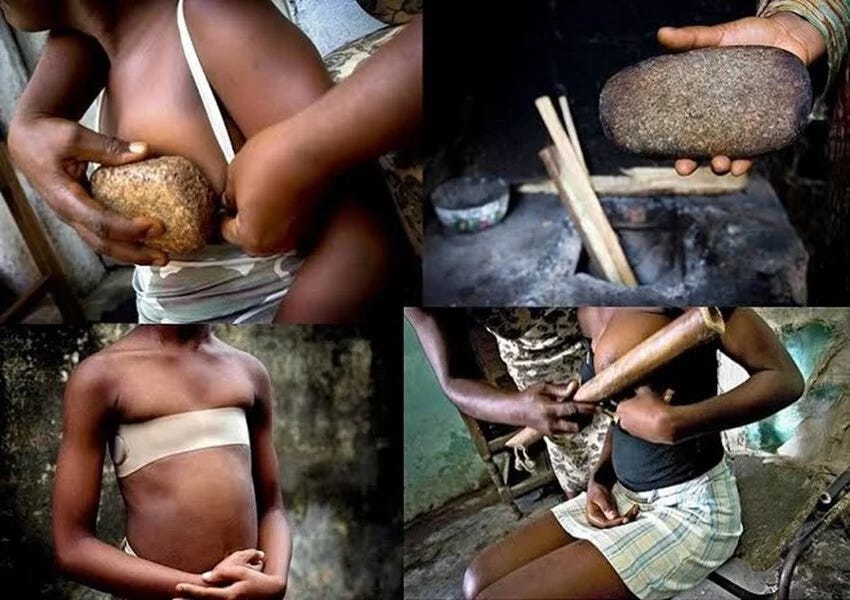
One in four Cameroonian women are estimated to have undergone this practice and in some parts of the country this estimate approaches 50% of women. The practice is not a marginal exposure but rather it is widespread, normalized, and almost entirely invisible within formal risk models. It is also not a Cameroonian problem alone. Breast ironing has been documented across West and Central Africa in Nigeria, Chad, Togo, Benin, Côte d'Ivoire, and Guinea-Bissau as well as in East and Southern Africa, including Kenya, Zimbabwe, and South Africa. Estimates suggest that approximately 3.8 million girls across sub-Saharan Africa are affected ( and this is likely an underestimate). The practice has also been reported among African diaspora communities in Europe, including the United Kingdom, where cases have been documented and prosecuted. This is a regional phenomenon that demands a regional research agenda and a global health response that does not treat it as an obscure footnote from a single country.
In a setting like Cameroon, where health systems are constrained and access to care is profoundly uneven, a cancer diagnosis is often experienced as a death sentence. Screening is not routinely performed, and most cases present at advanced stages where curative treatment is no longer possible. There are more than 21,000 new cancer diagnoses in the country each year, and the mortality-to-incidence ratio sits at approximately 63 percent. That number alone reflects a system where detection comes too late. But statistics do not capture what this looks like in practice.
During the campaign, I met a 23-year-old woman who had traveled nearly 300 kilometers with her eight-month-old child in search of care. What she revealed was not something screening could help with. She had a fungating breast mass and clear evidence of metastatic disease. She was, in every clinical sense, actively dying. This was not a case that had been missed by screening. This was a case that had never had a chance.
Against this backdrop, the limitations of imported screening guidelines become impossible to ignore. Most global recommendations advise starting routine breast cancer screening at age 40. These guidelines are grounded in populations where breast cancer incidence increases with age, and early-onset disease is relatively uncommon. But in Cameroon, the risk landscape is fundamentally different.
If a large proportion of women have been exposed to repeated breast trauma in childhood, and are presenting with cancer in their 30s or earlier, then applying a starting age of 40 is structurally misaligned with the disease we are trying to detect. It ensures that a significant number of cancers will be missed until they are no longer treatable. The guideline, as written, does not protect these women. It fails them by design.
There is still no robust epidemiologic data definitively linking breast ironing to breast cancer risk. I want to be clear about that. But the absence of definitive data should not be misinterpreted as the absence of risk. What we have is a highly prevalent exposure, a biologically plausible mechanism, and a population-level signal of early-onset disease. From a scientific standpoint, this should be more than enough to trigger urgent investigation. We need rigorous studies that examine this exposure, integrate it into clinical and surgical histories, and characterize its potential contribution to carcinogenesis. Until that work is done, we are operating with a blind spot one that disproportionately affects young women who are already at the margins of global health attention. The failure to generate this evidence is a choice with significant consequences.
Breast ironing is often framed as a harmful cultural practice, something to be educated away through awareness campaigns. That framing is incomplete, and in some ways, it is a distraction.
Breast ironing is gender-based violence. It is an act performed on girls’ bodies without their consent, causing lasting physical harm, because those girls’ bodies were considered dangerous. Because their developing breasts were read as invitations to assault, to stigma, to early pregnancy and, no one with authority was willing or able to remove those actual threats. So female family members ( mothers, grand mothers , aunts) intervened in the only way they believed was available to them. They modified the child, because they did not trust the system to protect her.
That context does not excuse the harm. But it does determine what an adequate response looks like. If we are serious about ending this practice, the response cannot be limited to awareness campaigns targeting women and families. It must also directly confront the conditions that make the practice seem necessary: the normalization of sexual violence against girls, the absence of accountability for predatory behavior, and the structural failure to protect female bodies in public and private spaces. Without addressing those drivers, we are asking families to abandon what they perceive as protection without offering anything in its place. That is not a public health strategy.
What this experience makes undeniable, for me, is a broader failure in how global health operates. We have a persistent tendency to universalize recommendations without adequately interrogating local context. We export frameworks built on data from high-income populations, apply them to settings with fundamentally different risk profiles, and call it evidence-based medicine.
In Cameroon, a more rational and ethical approach would include:
Earlier risk assessment for women with a documented history of breast ironing, beginning in their 20s. Consideration of earlier or targeted screening protocols, calibrated to local epidemiology rather than imported age cutoffs. Investment in locally generated data, so that policy is informed by the population it is meant to serve. And a willingness to hold the discomfort of not yet having all the answers, while still acting with urgency in the face of a plausible and prevalent risk.
Because if we continue applying one-size-fits-all frameworks in contexts where they do not fit, we will continue to miss disease, particularly in populations that are already at the highest risk of being overlooked.
The 23-year-old woman I met had traveled 300 kilometers to be seen. She deserved to be seen long before that at 17, or 20, or 23, in a system designed around what her life actually looked like. She deserved screening guidelines written with her in mind. She deserved a public health apparatus willing to ask the uncomfortable questions about what had happened to her body long before any tumor appeared.
We cannot give her that now. But we can decide what we owe the next generation of girls.
We can name breast ironing as gender-based violence and insist on structural responses to the conditions that sustain it. We can demand research that centers populations too long treated as footnotes. We can build screening protocols that reflect local realities, not imported assumptions. And we can stop treating the absence of certainty as justification for inaction.
The girls societal norms ironed flat are growing up. Some of them are getting sick. The least we can do is pay attention.
I am an infectious disease physician and global health researcher who writes at the intersection of medicine, science, and justice.
No posts
Comments
Nothing yet. Say the first thing.
Sign in to join the conversation.