
In the process of researching my video essay about Barbara Stanwyck, I was privileged to encounter some “new-to-me” films and television episodes that truly left an impression. Among them were the episodes of the Western series Wagon Train in which Stanwyck plays Kate Crawley, a swashbuckling freight operator who challenges every notion of femininity on the frontier. Midcentury television features some truly jaw-dropping explorations of normative gender roles—remember that episode of Ozzie and Harriet where Ozzie tells Harriet that she shouldn’t drive because it’s too masculine?—but Kate Crawley really stunned me. Kate’s articulation of her relationship to femininity was far more sophisticated than I had anticipated for 1964. Although she briefly tweaks her gender presentation to earn acceptance from her community, she ultimately reverts back to her true self, insisting she’s “not a lady” and they had “no right to try and make [her] act like one.” (If you have Starz, you can watch the episode here. She plays Kate in another episode, which has generously been uploaded for free on YouTube. It’s not as good, but you’ll definitely get…Kate’s vibe.)
While searching for commentary on this episode, I discovered Catherine Russell’s marvelous book, The Cinema of Barbara Stanwyck: Twenty-Six Short Essays on a Working Star, which quickly became not only an essential text for my essay, but also my favorite book written about Stanwyck. Her book takes an abecedary format, each chapter titled with a letter and dedicated to unpacking a specific film, collaborator, or character in Stanwyck’s career. G for Gambling Ladies, the card sharks scattered throughout her filmography; Z for Zeppo Marx, her agent who convinced her to try comedy; and, of course, K for Kate Crawley, a character who represented alternative modes for womanhood in an era where so few made it to the mainstream. By providing twenty-six on-ramps to her rich and varied life, Russell achieves the most comprehensive understanding of Barbara Stanwyck’s filmography I’ve seen to date. It’s extremely impressive, considering how notoriously “hard to pin down” Stanwyck is.
I was lucky enough to chat with Russell over Zoom about her book and her thoughts on why Stanwyck defined “the look and feel of…what we call classic Hollywood.” I hope you enjoy our conversation below and are encouraged to pick up her book for yourself.
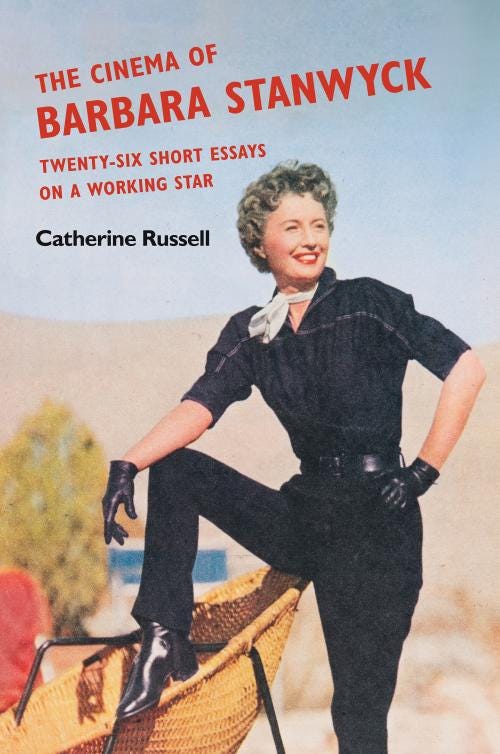
My first question for you is why Stanwyck? Why is she so compelling to you?
There are many great Hollywood actors, so I guess the question is “Why her and not somebody else?” I wanted to write a history of Hollywood. I teach American cinema and I wanted to somehow ask the question about what happens if you put a woman at the center of this history and think about it, not in terms of directors or studios, but in terms of somebody who’s actually I think as responsible as Hitchcock and Wells for the look and the feel of Hollywood films and what we call classical Hollywood. She’s almost always the protagonist of her own films. She very rarely plays a secondary character. Her career enables us to look at what happens, an arc of Hollywood in terms of women’s stories and women-centered stories. Obviously, very few are actually written by women. None of them are directed by women, but they’re built around her to some extent. So that was kind of my impetus.
I had written a book about Japanese cinema and Naruse Mikio, a director of women’s films. I really enjoyed writing that book. I loved it. It was hard. I had to do a lot of work and get stuff translated. His career mapped a history of women’s films in the Japanese film industry. That’s what sparked the question, “Well, can we do this with Hollywood?” There’s no single director who was continuously responsible for women’s films as Naruse was in Japan, but maybe we could do it by virtue of performance. That’s sort of how it started and why I chose her, because she had such a very long, varied career, probably more so than any other actor.
I mean, I don’t like to be competitive. I love Bette Davis and Joan Crawford, but, comparatively, I think Stanwyck lasted longer. She started earlier, lasted longer, and did more variety, including TV. She did a silent film, even though I haven’t actually seen it. That’s a pretty long stretch to the miniseries, right? To me, she is the Naruse of Hollywood just in terms of being a lever or a tool that you could use to unearth many other stories. That’s why my book touches on so many different actors, directors, genres, and themes and so on that her career intersects with. I found that to be a way of doing Hollywood cultural studies from a gender-based perspective rather than great men or great movies or the usual way that film history or these narratives of film history are written. It just seemed like a way to do something different.
Does the format of the book come from that approach?
Yeah, I suppose so. I wanted to avoid the biography version, which was like a linear story, because I’m not a biographer and there have been a lot of biographies. It seemed like a good way to separate my approach from that, and a way to really kind of pull out these different themes that her career raised. The reader would not have the expectations that it’s going to be a rise and fall type of story. I wanted to experiment a little bit with that format instead of trying to figure out how to put it into chapters. There were almost too many chapters, right? There are so many things one wants to say. I didn’t even really cover all the films. I watched all the films, I have notes on all the films, and then I tried to weave them in different ways.
I feel like this is a consistent problem with Stanwyck. I have never written anything as long as that video before. Obviously, the Victoria Wilson book is absurdly long. It’s crazy how she can inspire that length, because there’s so much to cover.
It’s really hard. Right. Stanwyck just went through so many phases. She was a hardworking person and did so much, and so much of it is interesting that it’s hard. It’s hard to find a way to leave anything out, you know?
Stanwyck also is very challenging as a subject because she’s very private and, in a way, very inaccessible. For a star of her stature, there are very few videos of her speaking about herself or her career. Did that affect your research process at all, or shape your approach?
It makes it easier. Until recently, I’ve only written about dead people. They’re not going to get up and disagree with you, you know? It kind of makes it easier to project my own basically feminist sensibilities. We know she wouldn’t agree at all with anything that I think because we know she wasn’t very progressive in many of her political views. She did try to control the narrative through her publicist, but it was a very narrow story that she wanted to be told. That’s why Victoria Wilson’s research is so great. She’s somehow able to dig below the surface.
But yeah, it’s actually easier to write about somebody who didn’t have their own commentary or did not have their own memoir, than somebody who might have. It would be nice for her to say what she thinks, but we don’t have that. What I was mostly disappointed about was the lack of script annotations because I think it’s an interesting way of looking at actors and studying actors, getting access to their scripts and their notes, their marginalia. There’s nothing like that. I did not go to Laramie [her archive in Wyoming]. I was going to do it, and then COVID came, but I asked the archivists, “Can you please go into the boxes and let me know what you find there?” I don’t know if you had a chance to go there.
I really want to go. I haven’t been. But I’m trying to imagine the process of memorizing a whole script and how that might affect how you’re taking notes, you know? [Stanwyck memorized everything, not just her dialogue]
Right, right. The thing is that because she had a house fire, she may have had them in her house and they may have gone, or maybe she just didn’t write notes. Maybe she just did it all by memory. These are questions that still, despite all of the research that’s been done by Victoria Wilson and by myself and by other biographers, we just don’t really know that much about her process.
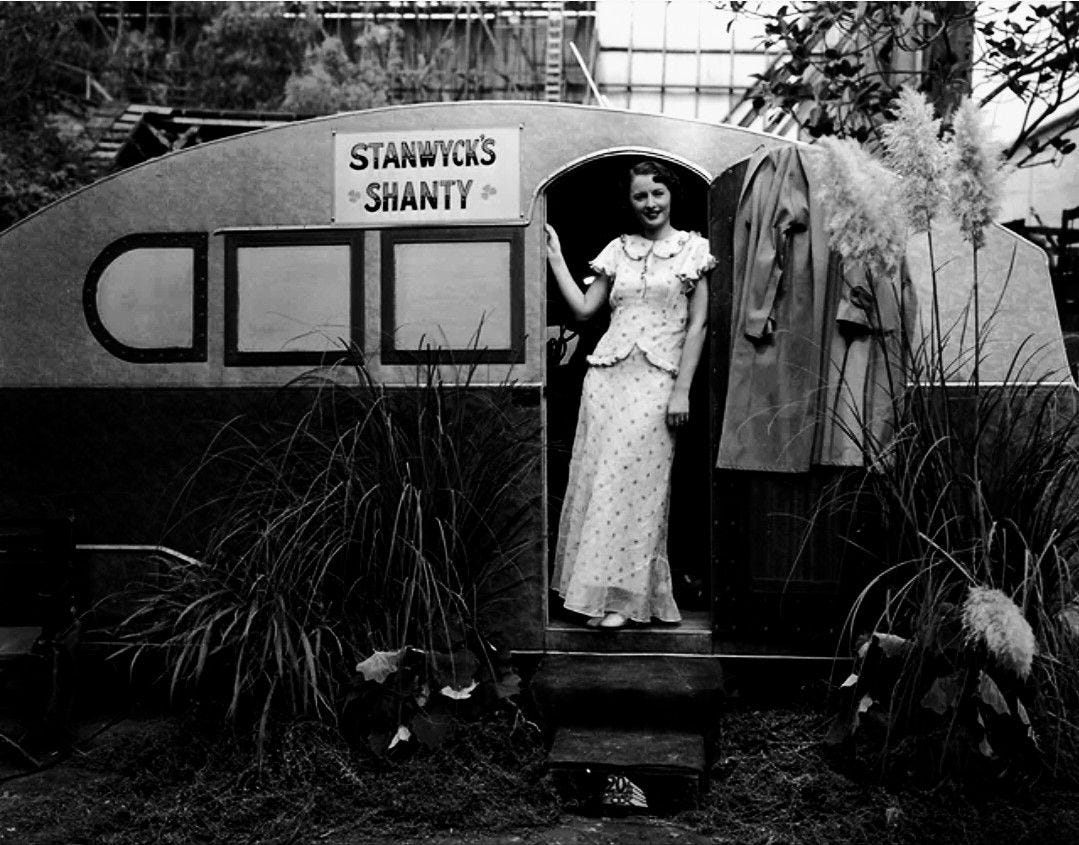
I’m curious about your take on her relationship to fame, because, as you said, she’s private, she’s a compulsive worker, but she’s also not egotistical. Do you think she viewed fame as something an actor of her stature just had to deal with? What is the balance she’s trying to strike between maintaining leading lady status for the sake of the work versus the sake of the status?
I think it’s more for the sake of the work than the status. She really liked to get roles that she could dig her teeth into and could develop as characters. She did later in life get more secondary parts, but again, she didn’t evidently complain about it. [In Executive Suite] with William Holden, she plays an executive. She’s like one of eight, and it comes out of nowhere that she’s just very, very low billed. But there’s no commentary on that. Was she disappointed? We don’t know.
I guess fame just comes with the business, and I think she just took it in stride as much as possible. She actively tried to avoid paparazzi so that she could maintain some privacy. She had this publicist for a great part of her career, so she knew that there was a way you had to engage, but Helen Ferguson doesn’t come on board until the late 30s. At the beginning of her career, she was on her own, but then she had Helen Ferguson as a buffer zone. I don’t know, but she was definitely not a diva in terms of wanting attention or anything like that.
A lot of her early roles gesture toward a connection with the working class, but obviously she moves on from that both in real life as she becomes a very rich woman, and on screen as she gets into this “woman in charge” persona. Is there a specific point of maturation where we see her move on from these chorus girls and working class women into more elegant, “bossy” women? Is there a turning point for you?
I would say it’s with the westerns, like The Furies, where she is in possession of a large home and land. One of the things I find about her Westerns is that they’re so often about property and large homes that you want to keep. I think when she starts doing those Westerns and assuming that heroic persona, then she’s able to lean into her age. In the late 40s, she’s kind of hiding her age or, I mean, she’s not dying her hair, et cetera, but there’s a way in which she still plays these love interests or wives and that kind of thing.
But I think once she gets into the Westerns where she’s asked to fill the role of the landowner, that maybe it gives her some more confidence in her star power. These things converge more—the star power and the power of these characters, even if they’re bad actors. In The Violent Men, where she’s a murderess, she’s still very powerful, you know? She takes that through the rest of her career, including Big Valley and The Barbara Stanwyck Show and all those roles as the homeowner who may have romantic liaisons, but she’s still in charge of the home and the property.
Thinking about her Westerns, or moving into the 1950s, that’s a really interesting time for women of her generation because a lot of them are trying to basically figure out how to pivot when they’re turning 40 and 50 years old. It becomes harder to get these prestige roles, and Westerns are her answer to that. I kept thinking about Katharine Hepburn and how she gets pinpointed as this woman who’s chosen for the “distinguished older lady” roles in prestige films. That’s not something like Stanwyck really gets picked for. I’m curious about that because she seems very respected as a craftswoman and easy to work with. Why one and not the other?
I don’t know enough about Katharine Hepburn. I don’t know if she was with a studio, for example. As we know, Stanwyck was always working freelance, so she had no path laid out for her or projects to choose from. But Hepburn was always sort of aristocratic, you know? I can’t think of her in a working class role. It may be that Stanwyck was so closely associated with that, so that even when she’s an older woman, she’s still always a working woman. In all those Barbara Stanwyck Show roles, she’s almost always working at something, whereas Hepburn tended more often to be cast as the rich matron who doesn’t have to work. I guess that’s the way in which Stanwyck became somewhat pigeonholed or typecast, but I say it’s for better, not for worse. Even when she’s the big homeowner, like in those Westerns—in Escape to Burma, for example, she has a teak farm—she’s still not aristocratic; she’s still rough and ready, right? It’s not really until The Thorn Birds that she becomes a real sort of mistress type.
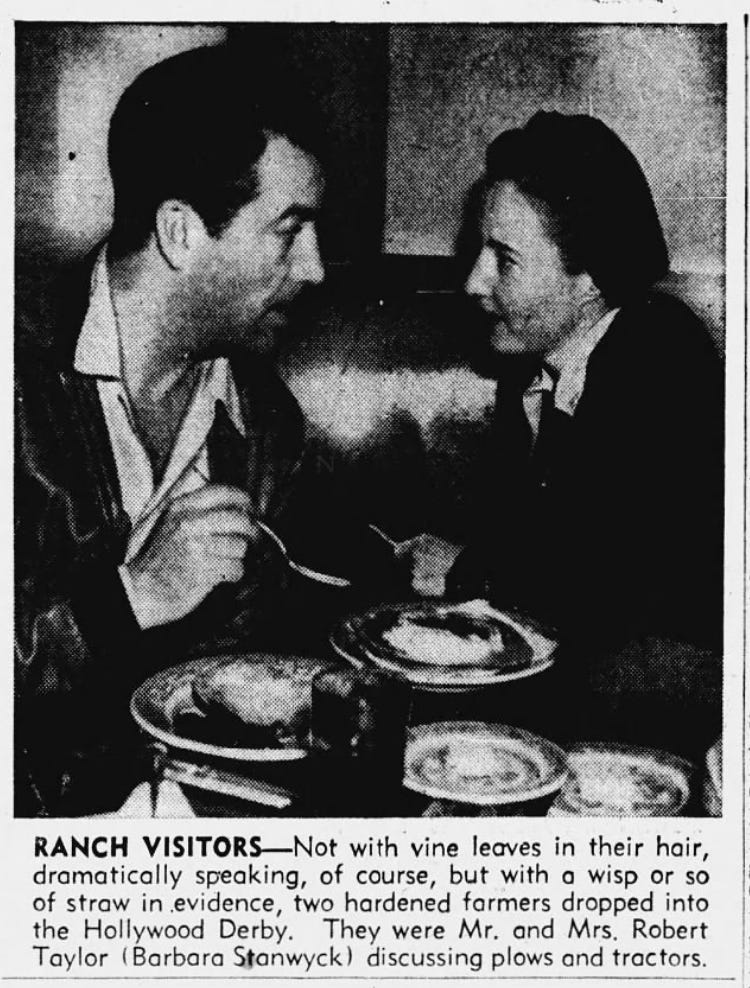
This relates to my next question, because, as you say—she’s working, she’s on the ranch—and it adds a layer of androgyny to her that I think is very interesting for that time period. Do you have a sense of how aware she was of what she was doing? I do think the pattern is so consistent and clearly it has something to do with her taste.
It’s really hard to know. I mean, this is the big mystery. I make the argument in my book that she is modeling different modes of femininity, that there are many ways to be a woman in the world, which seems to us to be very progressive. But did she see it that way? Did she not? I don’t know. This is why I’m very anxious for Victoria Wilson’s second chapter to shed some light on that situation. There’s really no evidence. She had gay male friends, for sure, so it wasn’t like she was that homophobic that she couldn’t understand there were gay people in the world. The only person who asked her point blank was Boze Hadleigh, a writer who I don’t know very much about. He still thinks that she was a lesbian. But, again, there’s no evidence. I don’t think she said anything.
Beyond that subject though, I think I was just surprised by the way that she talks about women, specifically around her work in television. She’s so insistent on a certain kind of representation with the original Western series that she wanted to do. She keeps saying “well, I want to show frontier women this way, and they never do that. They never let us do that.” It’s really interesting to me how she is sensing and expressing some sort of limitation that is put on an entire class.
I mean, it’s true. She was perceptive and ahead of her time. She eventually does get her series. She’s out and about a little bit in The Big Valley, but not as much as I would have liked. She’s mostly, again, a homeowner with a big family. It’s matriarchal. But no, you’re right. She did see something and talked about something that not many people were doing at the time and advocating for women-centered series. When she aligns herself with Loretta Young and these other actors whose shows got canceled all at the same time, I think it’s the one and only time she ever expresses any kind of solidarity with other women. Within Hollywood, there was no sense of women’s solidarity. However, there was an anecdote in Victoria Wilson’s book—I tried to track it down, but I couldn’t find it—that she started a women’s business club, or association of women business owners or something like that in Los Angeles. She contributed money to it, but I was not able to really find out anything.
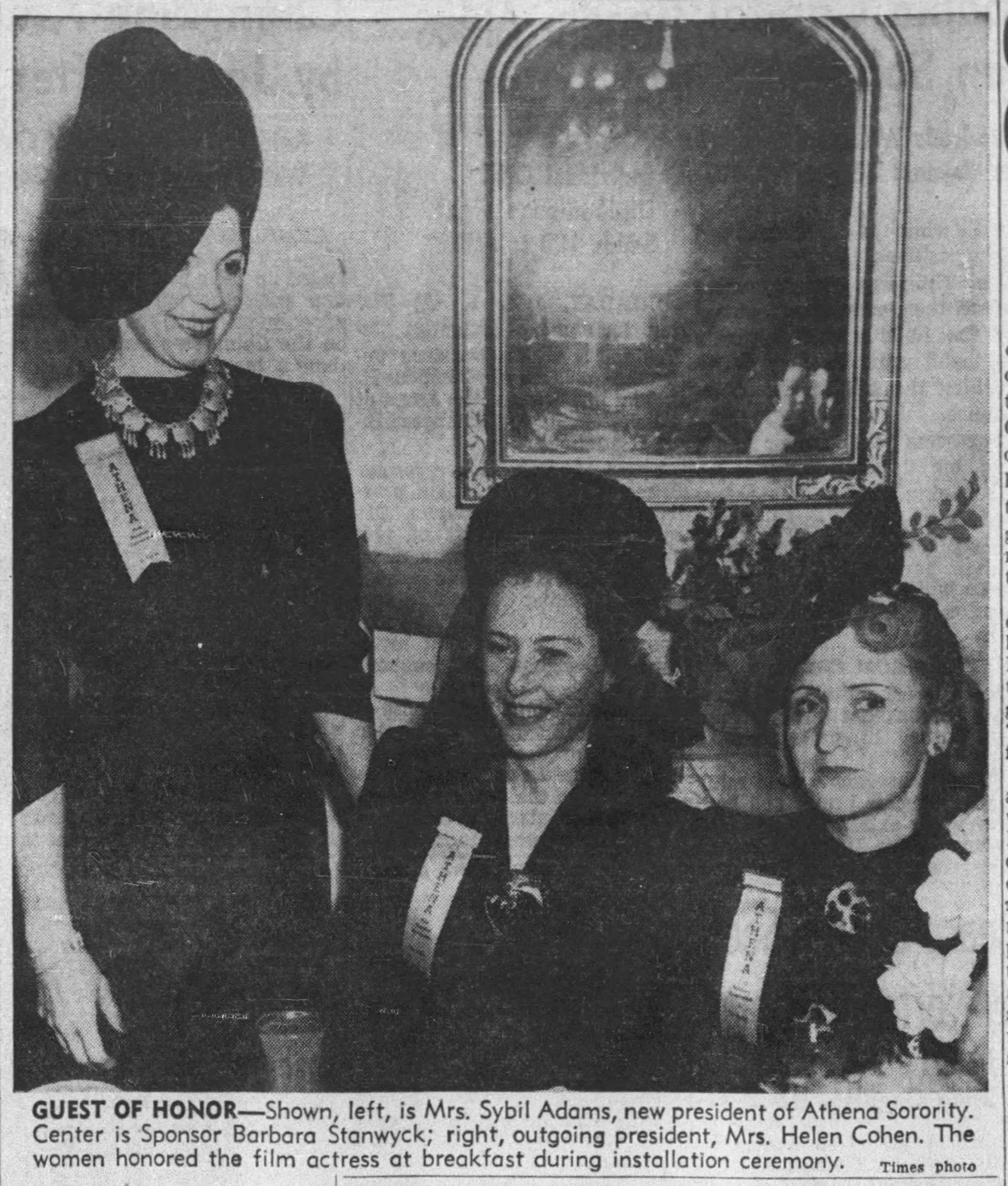
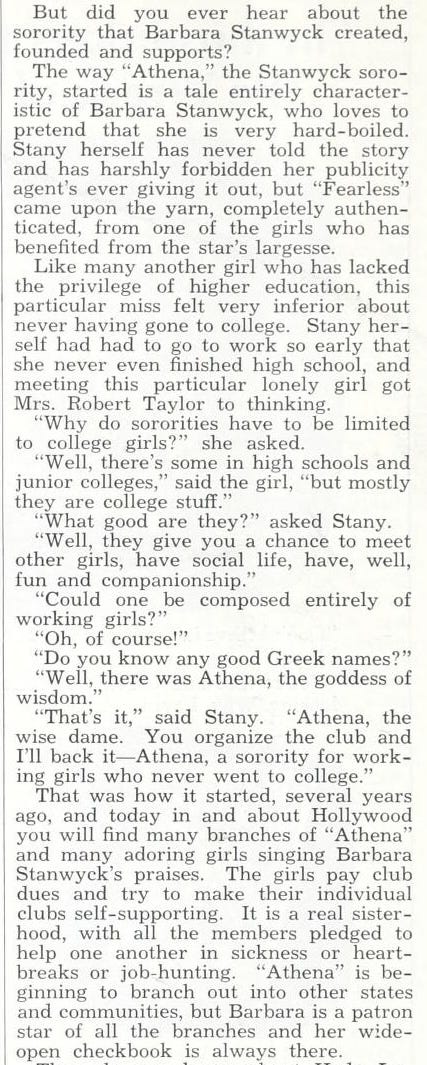
Is that the Athena National Sorority [see below]? I did find that referenced in some old Photoplays or something.
Yes, right. Exactly. Who knows where that went or how long it lasted or what it did. But that’s, that’s the only previous kind of indication on her part that there might have something in common with other women or that there’s something to be said for women getting together and doing something. At a certain point, I don’t really care what she thought or did. They’re good questions, but at the same time, how can we know? We have to kind of work around it. At least that’s what my perspective in that book was.
Yeah, but I think that’s partly why the book is so successful. In a way, I think the most respectful thing when you’re thinking about her is actually just to do what you did, which is focus on the work. She is purposely being evasive about herself with the press. She wants you to think about the work, so focusing on that the most is maybe the best process. It’s all on screen.
Yeah.
I’m so glad you wrote about The Barbara Stanwyck Show because it’s such a fascinating little series. As you write, it’s not necessarily influential in a television historical sense, but it is so informative about her career and the state of it. What is your take on the show? Do you think it’s entertaining?
Oh, yes—very entertaining. I really enjoyed watching it. To me, it really maps the transition from the film industry to the TV industry and the way that she relied on her own networks of actors and writers and directors to have them work with her. The show provided an opportunity for those people to get work. Even if it was just a temporary, precarious type of labor, it was nevertheless work in the industry. So you see a lot of these older actors, but also younger ones. Peter Falk shows up at one point, and that’s sort of a new generation of actors. To me, it’s sort of a transitional phase.
Some of the stories are allegories of her famous films, like Double Indemnity. There are ways in which they take a 90 minute film noir movie and somehow boil it down to a half an hour TV show. That’s very instructive, I think, about what happens when you’ve got the same writers, the same actors, and you just want to kind of recycle the intellectual property. Now it’s pretty common and that happens all the time. With her, star power is the magnetic center for this networking of personnel and storytelling.
Did she have much control over Big Valley behind the scenes? Was her influence on that show similar to The Barbara Stanwyck Show?
I’m not really sure. I think perhaps at the beginning she might have been, but I think that the production context was very tense for her because I don’t think the male actors always appreciated her leadership, shall we say. There were stories of her tangling with Lee Majors. [Producers AI Bezzerides and Louis Edelman] were collaborators with her for a long time, so they probably consulted with her and thought of her as the center of the show. But yeah, I don’t know more than what I wrote in the book.
You write a lot about her voice, and actually charted how deep it goes. What do you think her voice adds to her as an actor?
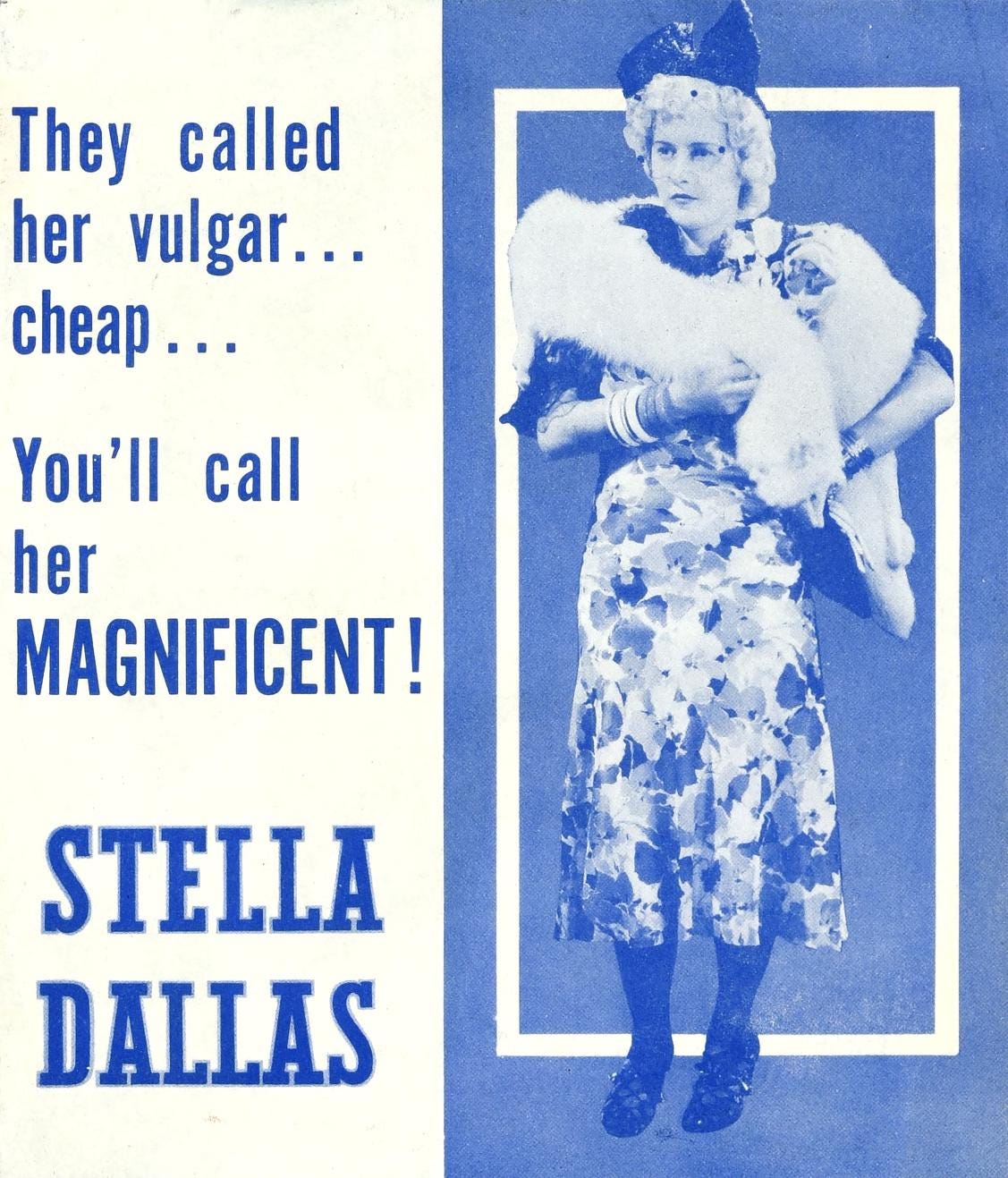
It definitely changes over the course of her career, but I think it was always kind of deep, even at the beginning. I think the film that I took as an example for that study was There’s Always Tomorrow. It gives her a certain kind of gravitas—deeper voices are kind of a register for authority—at the same time as the Brooklyn accent kind of maintains this working class aesthetic. I think you note this in your video, [her accent] never really disappears, even if she tries to cover it up. It sneaks out and she kind of wears it as a badge of honor a little bit to secure her working class roots, which is contradictory to this figure of authority. In a way, that’s what makes her acting so interesting and so important. Being able to contain contradictions in one persona, I think, is a real sign of good acting in the same way that having a character like Stella Dallas, who can have two types of women in the same character, is one of the reasons why that character is so strong. She was able to do that in many different ways.
If you were to interview her today, what would you ask her?
Oh my gosh. I guess I would just like to know more about her process of creating characters, her experience working with different actors and directors, and what she liked about what she got from other people as a collaborator when she was performing. I know there were films that she would have liked to do, like Dark Victory, which went to Bette Davis. Wouldn’t it be interesting to ask how she would have interpreted that role and what she might have done differently? You know, and of course, we would want to ask, like, who did you sleep with really?
[I laughed] Yeah, and then get slapped in the face.
Exactly. Exactly. Exactly. I would like to think I would be more respectful, and ask her questions about her working process.
Of course. Yeah. I’d be too scared to ask the questions I actually want to ask…So the argument I try to make in the video is that she’s so influential and that her approach is so significant because she predicts the way that we view “good acting” now or what a successful career looks like now. What would you say her overall influence is, if you were to sum it up?
I think the work ethic would be one thing, and the modesty. Laura Dern made an interesting tribute. I can’t remember what she said, but if she learned something from Stanwyck, then that would be, I think, interesting to know. We see so many actresses involved in production and executive producing. Stanwyck, I think her influence may have been inspiring perhaps to new generations of women who are in a position more to take control or to have some kind of say over production. I mean, it’s what Stanwyck didn’t quite get to. I think she was close so many times and the films would get funded and so on because of her participation, but then she had to take a back seat once it was in production and would have no control over things.
Something like Walk on the Wild Side had huge potential, you know? When you read the backstory of that production and what it could have been and the ways that it fell apart and failed—can you imagine if she had more control over it? She was one of the first cast, and then there was just so much infighting over the writing that it just didn’t work out as a movie, even though there’s some great scenes and interesting characters. If she had had more control over it, I’d like to think that it could have been a great movie and a really interesting 60s film. In an ideal world, if she had more of a producing role, perhaps it would have been a better film. Anyway, we’re at a very different point now, I think, with the way that actors do have more agency in the way their films come out. Stanwyck kind of inspired that, but also missed the benefits that we’re seeing now.
To conclude, which of her performances would you say are underrated? Which would you recommend people watch if you had to pick a handful?
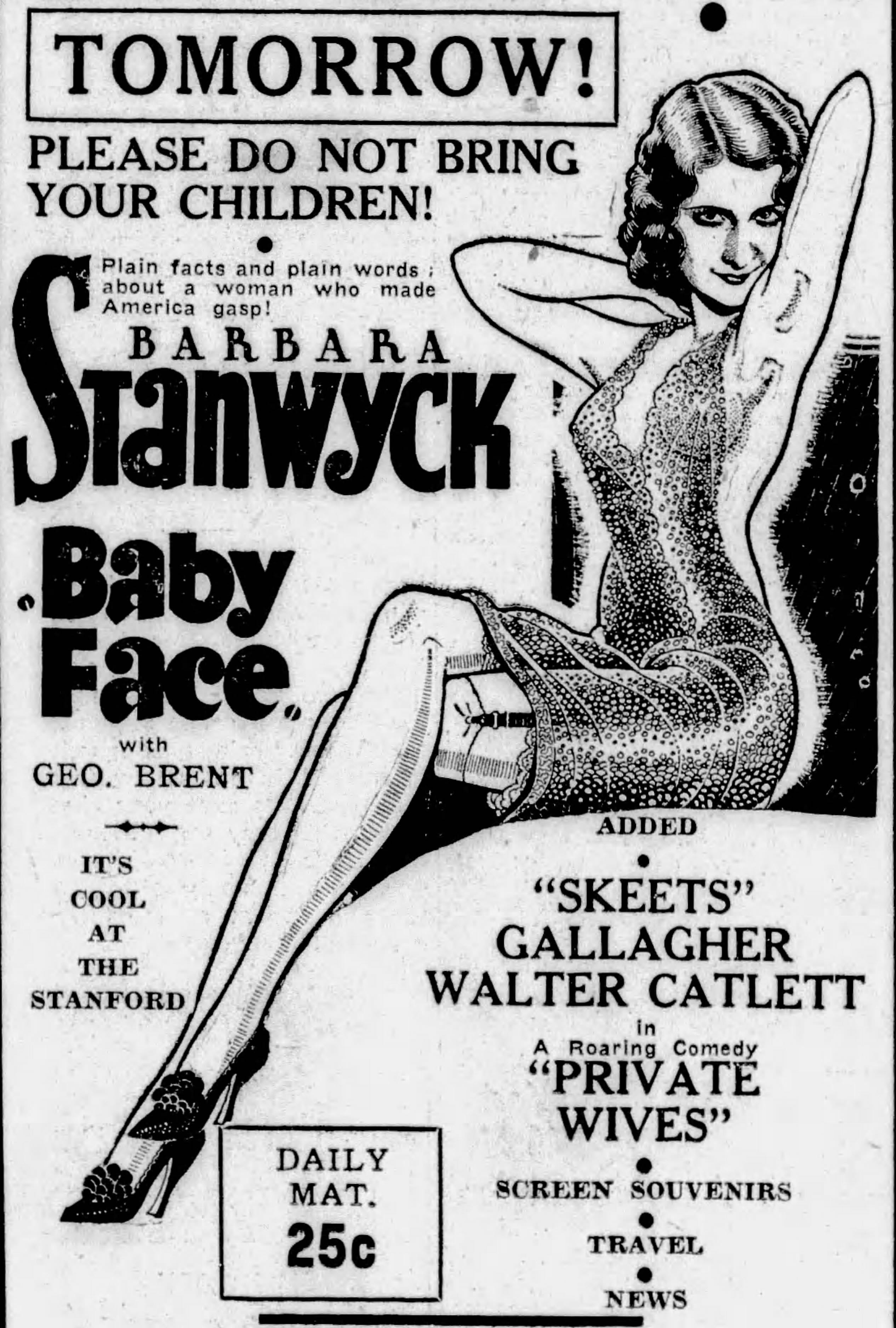
I really like Forty Guns. I don’t know if it’s underrated. I think it’s rated for all the wrong reasons. Also Baby Face. Everybody loves the movie, but I don’t know if her comic sensibility is fully appreciated. That’s one of the things in the book I’m trying to suggest—that something like Phyllis Dietrichson is actually a comic performance. It’s satire, right? She was doing that in Baby Face too. The way comedy was defined at the time was very different, so it’s not until she gets to Lady Eve that she’s really considered to be a proper comic actress, because it’s written as a comedy. Whereas Baby Face is just written as some sort of exploitation film. People think about it more because of its risque dialogue and storyline and so on, but I think the fact that she can pull it off is remarkable. So as a performance, I think it’s underrated.
Comments
Nothing yet. Say the first thing.
Sign in to join the conversation.