
Yes, your mutual fund investments are probably giving negative returns now. Don’t worry, mine are too.
Now, everyone’s thinking what to do next. The blanket statement is “continue your SIPs”. But it’s easier said than done.
You need to actually understand how the war and the Strait of Hormuz closure is affecting your portfolio, so that you can take informed calls. So in the next 5 minutes, I’m going to talk about why (and more importantly how) the war is affecting your investments, and what to do next.
But before that…
The people who understand AI are already using it to get ahead. Everyone else is falling behind. So I’ve started a FREE newsletter that breaks down AI for non-tech folks — no jargon, 5 minutes, 3x per week — less time than you spend doomscrolling before bed.
Except, this actually moves your career forward. Join 8,000+ other subscribers here:
Now, coming back..
First, let’s understand the Crude oil benchmarks.
Crude Oil is exported by a lot of countries, which means a lot of different qualities (and therefore costs). But largely, crude oil comes in 3 varities: Brent, WTI and Oman/Dubai. These 3 are the benchmarks for Crude oil prices, and all countries exporting crude oil, price it according to these benchmarks.
(Important to note however, that India, while importing, has its own benchmark for pricing — it uses the Indian Crude Basket — a weighted average of Brent and Oman/Dubai. Not relevant for this article, but good to know).
We all know about the war. Us-Israel attacked Iran, Iran closed the Strait of Hormuz, through which nearly 20-25% of the world’s oil passes, and oil prices shot up.
Brent, which started the year at $61, is at $94.45 today.
Now, how does the price increase affect India, and eventually you as a consumer + investor?
You see, India imports 85–90% of its crude oil. That makes it the single most important input cost in the economy. Here’s how a spike in crude reaches your kitchen, your EMI, and your portfolio:
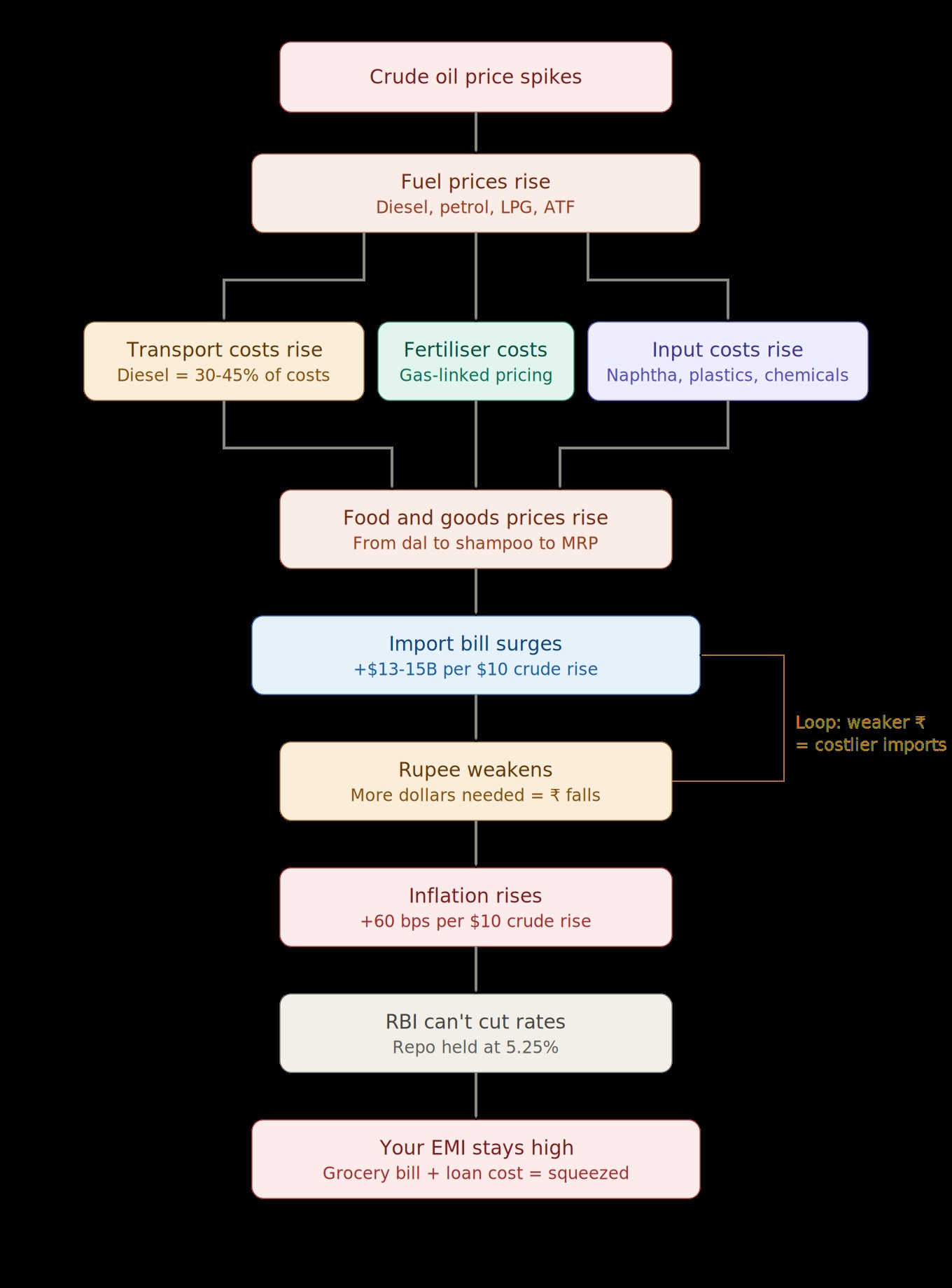
Fuel prices. Crude gets refined into diesel, petrol, LPG, and aviation fuel. Bulk diesel prices already jumped ₹22/litre as import costs surged. Retail prices haven’t moved yet because OMCs are absorbing the losses — but that can’t last forever.
Transport and logistics. Diesel accounts for 30–45% of total operating costs for logistics operators. When diesel rises, freight rates rise. Every truck carrying vegetables from Nashik to Mumbai, every cold chain moving milk from Gujarat — all get more expensive. This is how price increase in crude oil leads to food inflation.
Fertilisers and farming. Natural gas is the primary raw material for making urea, and India’s domestic gas price is now linked to the Indian crude basket. When crude spikes, gas costs follow, and fertiliser production gets more expensive. On top of that, key imports like ammonia and potash ship through the same Hormuz chokepoint. Global urea prices surged from ~$484 to nearly $600 per tonne within weeks. The government has increased subsidy allocation by 11%, but ICRA estimates the subsidy could still overshoot budget estimates by ₹40,000 crore. That’s fiscal deficit pressure.
(A fiscal deficit is the gap between a government’s total expenditure and its total revenue, representing the total borrowing required for the year. It occurs when spending exceeds income, indicating how much the government must borrow to meet financial obligations)
Plastics, packaging, chemicals. When crude oil is refined, it doesn’t just produce fuel. The refining process also yields naphtha and other byproducts that are the base materials for plastics, synthetic rubber, and industrial chemicals. So when crude prices shoot up, the cost of making everything from PVC pipes to shampoo bottles to FMCG packaging rises with it. Manufacturers either absorb the hit (lower margins) or pass it on (higher MRP). And this shows up at the kirana store.
The rupee inflation. India pays for oil imports in US dollars. When crude spikes, the demand for dollars surges — we need more dollars to pay a bigger import bill (every $10 rise increases the annual import bill by $13–15 billion ). More dollar demand means the rupee weakens (already down 7.4% this year). A weaker rupee means costs of all imports increase (because we need to pay more rupees for each dollar). This leads to higher prices for the end consumer, and therefore inflation. To fight inflation, the RBI can’t cut rates — which means your home loan EMI stays high too.
Crude → diesel → transport → food prices → inflation → rates → EMI. That’s the chain.
Sectors getting hurt: Oil Marketing Companies or “OMCs” (BPCL, IOCL, HPCL) are losing ~₹6/litre on diesel and can’t raise retail prices because it’s politically sensitive. Their P/E ratios look cheap, but that’s an earnings trap — margins will stay compressed as long as crude is elevated. Airlines like IndiGo face the same problem: Fuel is 35–40% of their operating costs. Paints (Asian Paints), chemicals, and FMCG companies that use petroleum derivatives as inputs are seeing margin pressure. Banks aren’t directly exposed to oil, but FIIs have pulled ₹1.62 lakh crore since the conflict, and financials have borne the brunt.
Sectors holding up:
Upstream producers (ONGC, Oil India) extract crude oil locally (they have fields in Rajasthan, Assam etc). When global prices double, their selling price doubles too while extraction costs stay flat. That's a margin windfall. The catch: the government has historically forced these companies to sell crude to OMCs at a discount to keep fuel prices down, so how much of the windfall they actually keep is uncertain.
IT benefits from a weaker rupee (because most of the money comes from abroad) — so dollar earnings translate into more rupees.
FMCG and pharma are the classic defensive plays, and DIIs have been rotating heavily into them — ₹1.78 lakh crore pumped into equities over six weeks.
Don’t stop your SIPs. Yeah yeah, you’ve heard this before; it’s still true. Volatile markets are exactly when buying at regular intervals works in your favour (it’s called rupee-cost averaging)
Keep a tab on OMC stocks but don’t rush to buy. Low P/E ratios are tempting, but these stocks won’t recover until crude falls or the government allows a price hike. So you can follow them if you want to invest in them
Consider adding gold. If you don’t already have 5–10% of your portfolio in gold, this is a reasonable time. It’s been a downside protector in every geopolitical shocks. Also a good way to diversify :)
Watch your dollar-linked expenses. If you’re paying for education abroad, paying AI subscriptions in dollars, or planning foreign travel, the rupee falling from ₹87 to ₹95 has already made those 9% more expensive. Honestly? That matters more than what the Nifty does this week.
The peace talks in Islamabad were supposed to be the most important variable for Indian markets. That has gone sideways.
So if the Strait reopens credibly, crude pricess will normalise and the chain will unwind. But if it doesn’t, everything from your grocery bill to your EMI stays under pressure.
Your job isn’t to predict where crude goes. It’s to make sure your portfolio can handle both outcomes.
If you liked this newsletter on finance, I do the same with AI — 5 minute newsletters that will help you get up to speed with AI, from a non-tech perspective, to get ahead in your career.
It has 8,000+ subscribers already. Join now to stay updated!
I’ll see you next week!
Cheers,
Ankur
No posts
Comments
Nothing yet. Say the first thing.
Sign in to join the conversation.