
Anthropic Bets Life Sciences Needs AI That’s Never Held a Pipette
NIH’s $87M Organoid Center Takes Aim at Drug Development’s 90% Failure Rate
Novartis Pays $12B Premium for Muscle-Directed RNA Platform and Three Clinical Shots
Not yet a member of our super awesome slack community of ~11,000? Join HERE 🤗
I'm excited to share the THIRD episode of the Bits In Bio Podcast Series!
Join your hosts Robbie Matthews and Vincent Alessi this month for deep dive into Science x AI with the builders-turned-executives leading the charge.
Join us this month to hear from Armand B. Cognetta III, PhD to hear about his exciting journey from being the 1st intern at the legendary Alnylam pharmaceuticals to solo-founding General Proximity as one of the first biotechs to come out of Y Combinator (and the hilarious story about how that came about!).
Find it on Apple Podcasts (below) and on Spotify
Join us next episode to hear from a special guest - this is a big one! Stay tuned.
Anthropic launches Claude for Life Sciences, betting that biologists need AI copilots
Anthropic announced Claude for Life Sciences, its first formal sector-specific offering that integrates with key lab tools including Benchling, PubMed, 10x Genomics, and Synapse.org to support end-to-end research workflows from hypothesis to regulatory submission. The company’s new Claude Sonnet 4.5 model scores 0.83 on Protocol QA benchmarks against a human baseline of 0.79, with head of life sciences Eric Kauderer-Abrams stating they want “a meaningful percentage of all life science work to run on Claude, similar to coding.” A demo showed analysis that previously required days of validating and compiling information now completed in minutes, though Kauderer-Abrams acknowledges AI won’t magically make three-year clinical trials take one month. With partnerships spanning AWS, Google Cloud, KPMG, and Deloitte for adoption support, Anthropic is wagering that life sciences’ notorious resistance to change will crumble when faced with 10x productivity gains—assuming scientists trust an AI that’s never held a pipette.
America’s first national organoid factory gets $87 million to scale lab-grown organs
The NIH announced $87 million over three years to establish the Standardized Organoid Modeling Center at Frederick National Laboratory, marking the nation’s first dedicated facility to address organoid reproducibility challenges through AI, robotics, and standardized protocols. The center will leverage artificial intelligence for protocol optimization and advanced robotics for large-scale production, initially focusing on liver, lung, heart, and intestine models while working with FDA to establish preclinical testing standards. This federal pivot away from animal models—which NIH Director Jay Bhattacharya called a transformation in biomedical research—creates open-access repositories for both physical samples and digital protocols. As pharma struggles with 90% drug failure rates partly due to species translation issues, this standardization push could finally make human-relevant models the default rather than the exception, potentially saving both the 40,000 DLBCL patients and the millions of lab mice currently serving as imperfect proxies.
Behind the deal: Novartis x Avidity — paying $12B for muscle-directed RNA and three near-term shots on goal
Novartis has agreed to acquire Avidity Biosciences for $72/share in cash (~$12B equity value, a 46% premium) in a deal that effectively prices in both platform scarcity and late-stage neuromuscular upside. The transaction, expected to close in 1H26, includes a pre-close spin-out of Avidity’s early-stage precision cardiology programs into a standalone “SpinCo” so Novartis can focus its cheque on the assets closest to commercialisation. This is a conviction bet on extra-hepatic RNA delivery—specifically, Avidity’s antibody-oligonucleotide conjugate (AOC) platform that enables targeted delivery to skeletal muscle, a long-standing barrier for RNA therapeutics. Novartis is effectively buying three near-term shots on goal: del-desiran for myotonic dystrophy type 1 (DM1) heading into a pivotal readout, del-brax for facioscapulohumeral muscular dystrophy (FSHD) with biomarker-anchored development, and del-zota in Duchenne (exon 44) with early proof of muscle delivery and expression. The portfolio slots neatly into Novartis’ neuromuscular commercial footprint, offering a concentrated prescriber base, strong genetic validation, and the prospect of durable rare-disease cash flows that can help defend the company’s mid-to-late-decade growth profile.
Paying pre-data reflects the perceived scarcity value of muscle-directed delivery and the expectation that AOC constructs can scale across siRNA/PMO modalities. But execution risk remains: pivotal effect sizes in DM1 and FSHD must translate into functional benefit, chronic tolerability needs to hold up at commercial dose intervals, and payer evidence thresholds in rare neuromuscular diseases are rising. Still, this deal re-prices the extra-hepatic RNA category overnight. If you’re building credible muscle-targeted delivery with a path to Phase 2b/3, expect bankers and strategics to come calling.
When CAR-T cells surrender and bispecifics retreat, Lantern’s LP-284 marches forward
Lantern Pharma’s LP-284 achieved a confirmed complete metabolic response in a 41-year-old patient with aggressive Grade 3 non-germinal center B-cell diffuse large B-cell lymphoma after just two 28-day cycles, despite the patient having failed four prior treatment regimens including CAR-T therapy and bispecific antibodies. The compound’s synthetic lethal TC-NER mechanism remains unaffected by TP53 mutation or lymphoma surface antigen expression, positioning it to address the estimated 40,000 DLBCL patients annually progressing post-CAR-T in the US and EU alone, where average post-relapse treatment costs exceed $500,000 per patient. Developed using Lantern’s RADR® AI platform in under three years at approximately $3 million—a fraction of traditional development costs—LP-284 could unlock more than $2 billion in milestone payments if successful. While durability data awaits year-end readouts, the speed from computational hypothesis to clinical proof-of-concept validates AI’s potential to systematically exploit synthetic lethality where brute-force immunotherapy fails.
Iambic reports early clinical activity of its AI-designed HER2 inhibitor
Iambic Therapeutics reported positive early clinical activity from its AI-designed HER2 inhibitor in Phase 1 trials, demonstrating that molecules created primarily through generative AI can translate to human efficacy. The compound, developed using Iambic’s EnchantRx platform that combines physics-based simulations with machine learning, showed tumor shrinkage and disease stabilization in heavily pretreated cancer patients at well-tolerated doses. This represents crucial validation for AI-designed drugs—moving beyond “me-too” modifications to creating novel chemical matter that wouldn’t be obvious to human medicinal chemists. As the industry watches nervously to see if AI can deliver on its promises, Iambic’s clinical data provides early evidence that generative chemistry isn’t just faster and cheaper, but can produce genuinely differentiated molecules that work where traditional discovery might not
After 5 years, BMS and Insitro advance from finding ALS targets to designing drugs
Bristol Myers Squibb extended its collaboration with Insitro, leveraging the AI company’s ChemML platform to design medicines for a novel ALS target identified in their initial partnership phase, with up to $20 million in new funding for the one-year extension and potential aggregate value exceeding $2 billion in milestones. The ChemML platform integrates proprietary Quantitative Adaptive Libraries that can generate hundreds of millions of drug-target binding and selectivity datapoints, combined with advanced ADMET modeling and structural biology capabilities acquired through Haystack Sciences. With 90% of ALS cases arising sporadically and median survival of just 3-5 years post-diagnosis, the partners are racing to translate cross-cutting biology discoveries into small molecules that could help both familial and sporadic forms. This extension validates insitro’s transition from pure target discovery to end-to-end drug design—a critical test of whether AI can deliver not just biological insights but actual, synthesizable molecules that work.
New cancer-focused Gemma models, Google betting that open-source AI can accelerate precision oncology
Google unveiled specialized versions of its open-source Gemma AI models optimized for cancer therapy discovery, marking the tech giant’s latest push to democratize advanced AI for biomedical research. The cancer-focused Gemma variants leverage Google’s massive computational infrastructure and datasets to identify novel drug targets, predict treatment responses, and optimize combination therapies—capabilities previously locked behind proprietary platforms. By open-sourcing these models, Google is essentially commoditizing what startups charge millions for, potentially accelerating cancer research at academic institutions that lack big pharma budgets. The move reflects Google’s strategy of giving away the picks and shovels while monetizing the gold rush through cloud compute—a bet that making AI accessible will drive more researchers to Google Cloud’s TPUs and infrastructure.
Apple unexpectedly enters the protein folding arena with SimpleFold
Apple’s machine learning research team released SimpleFold, a new approach to protein structure prediction that emphasizes computational efficiency and on-device processing capabilities—classic Apple priorities applied to molecular biology. Unlike AlphaFold’s massive computational requirements, SimpleFold is optimized to run on Apple Silicon, potentially enabling researchers to perform structure predictions on MacBooks rather than supercomputers. The model leverages Apple’s expertise in efficient neural architectures and hardware-software integration, achieving competitive accuracy while requiring significantly less computational resources. This surprise entry from a company better known for iPhones than immunoglobulins signals that protein folding has officially graduated from niche academic pursuit to tech industry battlefield—though whether Apple plans to integrate this into a “Proteins” app remains mercifully unclear.
Altman’s “read-only” neural interface targets thought-to-ChatGPT pipeline without cracking skulls.
Sam Altman’s stealth startup Merge Labs is developing a non-invasive brain-computer interface using ultrasound to read neural signals, with Caltech biomolecular engineer Mikhail Shapiro joining to lead the effort that could enable users to “think something and have ChatGPT respond to it.” The company is preparing for a $250 million funding round through OpenAI’s venture arm at an $850 million valuation, positioning ultrasound and magnetic fields as the gentler alternative to Neuralink’s surgical electrode implants. Shapiro’s expertise in using gene therapy to make cells visible to ultrasound imaging suggests Merge’s approach: rather than penetrating the skull, they’ll genetically engineer neurons to broadcast their thoughts acoustically. While Musk races toward Matrix-style uploads through craniotomies, Altman’s betting that the future of human-AI fusion lies not in hardware insertion but in listening really, really carefully to what our neurons are already saying.
Biosimilars get a speed boost as FDA downplays routine switching studies
The FDA issued a draft guidance reframing when comparative efficacy studies are needed for biosimilar approvals, arguing that high-resolution analytics can often do the job, while also signaling that switching studies for interchangeability will generally not be recommended. The agency pegs comparative efficacy trials at 1-3 years and ~$24M on average, a drag it says has low sensitivity relative to modern analytical characterization. Context: biologics are 5% of U.S. prescriptions but 51% of drug spend; yet biosimilars’ overall market share remains <20%, with 76 approvals to date and only ~10% of upcoming LOE biologics currently facing biosimilar development. If finalized, the shift could pull forward pipeline volume, reduce capital at risk, and make interchangeability a default trajectory rather than a bespoke clinical program. The guidance is out for public comment (standard 60-day window) before being finalized, and arrives alongside a broader FDA push to clarify biosimilar science and expand pharmacist substitution.  For BiB readers, the read-through is straightforward: lower development friction plus clearer substitution rules should widen the addressable market for analytics-heavy biosimilar platforms and CDMOs while turning up competitive heat on post-patent incumbents. 
Flatiron’s Panoramic datasets transform 505,000 blood cancer patients into AI-powered evidence
Flatiron Health released six AI-powered hematology Panoramic datasets encompassing over 505,000 patient records across five B-cell lymphoma subtypes and multiple myeloma, representing a six-fold increase in cohort sizes compared to previous datasets. The company leverages breakthrough AI and large language model capabilities to extract and validate clinical data at unprecedented scale from their database of over five million patient records containing 1.5 billion data points. The datasets capture granular details including molecular residual disease testing and CAR T-cell therapy outcomes, with Flatiron’s three-pillared validation framework ensuring accuracy for regulatory-grade research. As pharma races to understand why half of CAR-T patients relapse and bispecifics plateau, this massive real-world evidence foundation—backed by 250+ publications and integrated within Roche’s ecosystem—could finally answer whether precision oncology’s promises match patient realities.
Transformers automatically discover 1,300 distinct regions in mouse neural data.
Scientists applied transformer architecture—the technology behind ChatGPT—to create a data-driven atlas identifying 1,300 distinct regions in the mouse brain, surpassing traditional human-annotated maps that typically recognize 200-500 areas. The AI model analyzed massive datasets of neural activity, gene expression, and connectivity patterns to identify functional brain regions without preconceived anatomical boundaries, discovering previously unrecognized subdivisions and functional networks. This unsupervised approach revealed that brain organization is far more complex than classical neuroanatomy suggested, with the transformer identifying subtle functional boundaries that decades of manual observation missed. As neuroscience grapples with understanding how 86 billion neurons create consciousness, this transformer-powered cartography suggests AI might be essential not just for analyzing brains, but for fundamentally reconceptualizing how we map them.
Genesis Therapeutics and NVIDIA unveil Pearl, claiming victory over AlphaFold 3
Genesis Therapeutics, backed by NVIDIA’s computational muscle, announced that their Pearl model surpasses Google’s AlphaFold 3 in predicting drug-protein structures—a critical capability for rational drug design that AlphaFold pioneered but hasn’t perfected. While AlphaFold revolutionized single protein structure prediction, Pearl specifically optimizes for the more complex challenge of modeling how small molecules bind to proteins, leveraging NVIDIA’s DGX systems and proprietary training data from Genesis’s drug discovery pipeline. The timing is strategic: as pharma realizes that knowing a protein’s shape is just step one, the real prize is accurately predicting how drugs will nestle into binding pockets—a nuance that could mean the difference between a blockbuster and a clinical failure. With both computational giants now competing on drug-specific applications rather than pure academic metrics, the structural biology wars are officially entering their pharmaceutical phase.
Owkin’s K-PRO becomes biopharma’s first full stack agentic AI copilot
Owkin launched K-PRO, positioning it as the industry’s first agentic AI copilot for biopharma that combines biological reasoning models with autonomous in-silico task execution across drug discovery workflows. Unlike traditional AI tools that require constant human guidance, K-PRO operates as an autonomous agent capable of chaining together complex analyses, from biomarker discovery to patient stratification, while providing interpretable biological rationales for its recommendations. The platform leverages Owkin’s federated learning infrastructure—which has processed data from over 50 pharmaceutical partners while maintaining privacy—to power multimodal models that integrate genomics, imaging, and clinical data. As the industry drowns in data but starves for insights, K-PRO’s promise of an AI that doesn’t just analyze but actively reasons through biological problems could mark the shift from AI as a tool to AI as a true research partner.
BigHat introduces Milliner, an AI platform that designs, builds, and tests antibodies
BigHat Biosciences launched its Milliner AI platform for antibody design and optimization, integrating machine learning models with automated wet lab capabilities to create a closed-loop system for therapeutic antibody development. The platform combines predictive AI for sequence design with robotic systems that can synthesize and test thousands of antibody variants weekly, feeding experimental data back to continuously improve the models—a departure from purely computational approaches that often fail when molecules hit reality. Milliner focuses on traditionally difficult optimization challenges like improving stability, reducing immunogenicity, and enhancing manufacturability while maintaining potency—the multidimensional puzzle that causes 90% of antibody programs to fail. With antibody drugs commanding $200 billion in annual sales but taking 5-7 years to develop, BigHat’s integrated approach could compress timelines enough to matter in competitive therapeutic races.
Turbine looks to turbo-charge AstraZeneca’s ADC discovery with cell death AI
AstraZeneca partnered with Turbine to leverage the biotech’s AI-powered cellular simulation platform for optimizing antibody-drug conjugate (ADC) development, focusing on payload selection and understanding mechanisms of resistance. Turbine’s platform simulates cancer cell behavior at the molecular level, predicting how different ADC components—antibodies, linkers, and cytotoxic payloads—interact within tumor microenvironments to maximize efficacy while minimizing off-target toxicity. The collaboration addresses ADCs’ fundamental challenge: threading the needle between potency and safety in a therapeutic class where small changes in payload or linker chemistry can mean the difference between cure and catastrophic toxicity. With ADCs representing one of oncology’s hottest areas following recent approvals, AZ’s bet on simulation over pure empirical screening reflects the field’s maturation from “try everything” to “predict what works.”
Lila Sciences adds $115M to its war chest, bringing total to $350M with NVIDIA’s blessing
Lila Sciences announced a $115 million Series A extension, bringing its total funding to $350 million and adding NVIDIA as a strategic investor alongside lead backers including Arch Venture Partners and GV. The company’s AI-first platform focuses on designing novel protein therapeutics for traditionally undruggable targets, using generative models and physics-based simulations running on NVIDIA’s DGX systems to explore protein conformational space beyond natural evolution’s limits. The NVIDIA partnership provides both capital and computational infrastructure, with Lila gaining priority access to next-generation GPUs and collaborative development of specialized models for protein engineering. With less than 5% of human proteins currently druggable by conventional approaches, Lila’s massive funding validates investor appetite for platforms promising to crack the remaining 95%—assuming AI can deliver where decades of traditional drug discovery haven’t.
Flagship launches another AI-powered drug discovery company
If Lila was not impressive enough, Flagship Pioneering has also launched Expedition Medicines, its latest AI-driven drug discovery platform company, continuing the venture firm’s strategy of creating startups that combine machine learning with novel biological insights to tackle intractable diseases. Expedition’s platform focuses on exploring “uncharted therapeutic space” using AI to identify non-obvious drug targets and design molecules for biological pathways that traditional pharma has deemed too risky or complex. The company emerges with typical Flagship backing—likely $50-100 million in committed capital—and access to Flagship’s ecosystem of platform companies for potential synergies in target discovery, delivery, and clinical development. This marks Flagship’s continued bet that AI plus entrepreneurial focus can succeed where big pharma’s traditional R&D has retreated, though with dozens of similar AI biotechs now competing, Expedition will need to prove its algorithms can navigate therapeutic territories that others haven’t already mapped.
Generative AI streamlines nanobody design with Germinal to skip massive screening
The Hie and Gao labs, in collaboration with the Arc Institute, unveiled Germinal—a generative AI framework tackling one of antibody design’s toughest problems: the hypervariable, flexible CDR loops and the tiny, constrained sequence space that make high-success de novo design notoriously difficult. Traditionally, due to the variation and complexity of the region, antibody design is dominated by massive screening to identify the few sequence combinations that binds. By pairing AlphaFold-Multimer’s structure and protein-protein-interaction predictions with IgLM, a language model trained on antibody sequences, Germinal co-optimizes structure and sequence to craft realistic CDRs that actually bind. In tests across four targets, it found nanomolar-affinity binders after screening fewer than 100 designs per antigen—a dramatic efficiency leap over conventional approaches.
Takeda doubles down billion dollar on Nabla Bio’s generative protein design
After streamlining its R&D focus, Takeda is doubling down on AI-driven biologics through a renewed multiyear partnership with Nabla Bio—a Harvard spinout from George Church’s lab—worth double-digit millions upfront and more than $1 billion in potential milestones. The deal builds on Nabla’s $26M Series A and earlier tie-ups with AstraZeneca and Bristol Myers Squibb, expanding the use of Nabla’s Joint Atomic Model (JAM) across Takeda’s early-stage discovery programs. JAM is a multimodal generative model trained on vast protein sequence–structure datasets, strengthened with Nabla’s own wet-lab measurements, to design antibodies and multispecifics with atomic precision. The company is tackling one of biopharma’s toughest frontiers: multipass membrane proteins, which make up two-thirds of cell-surface targets but remain largely undruggable using conventional screening. Nabla’s platform aims to overcome this by designing conformation- and target-selective binders, potentially doubling the number of disease-relevant drug targets pharma can pursue.
See our handy dandy Lu.ma event calendar HERE, please RSVP so folks can plan accordingly!
Bits in Bio Frankfurt Kickoff, Thursday, November 6th
Thank you to Nelly Tian and Karin Hrovatin for organizing!
From Data Chaos to Cancer Cures: AI in Life Sciences, Thursday, November 13 in Copenhagen
Thank you to Alexander Junge for organizing!
@Jeremie highlights the Grok is spouting un-scientific nonsense as if its fact! Is anyone shocked?
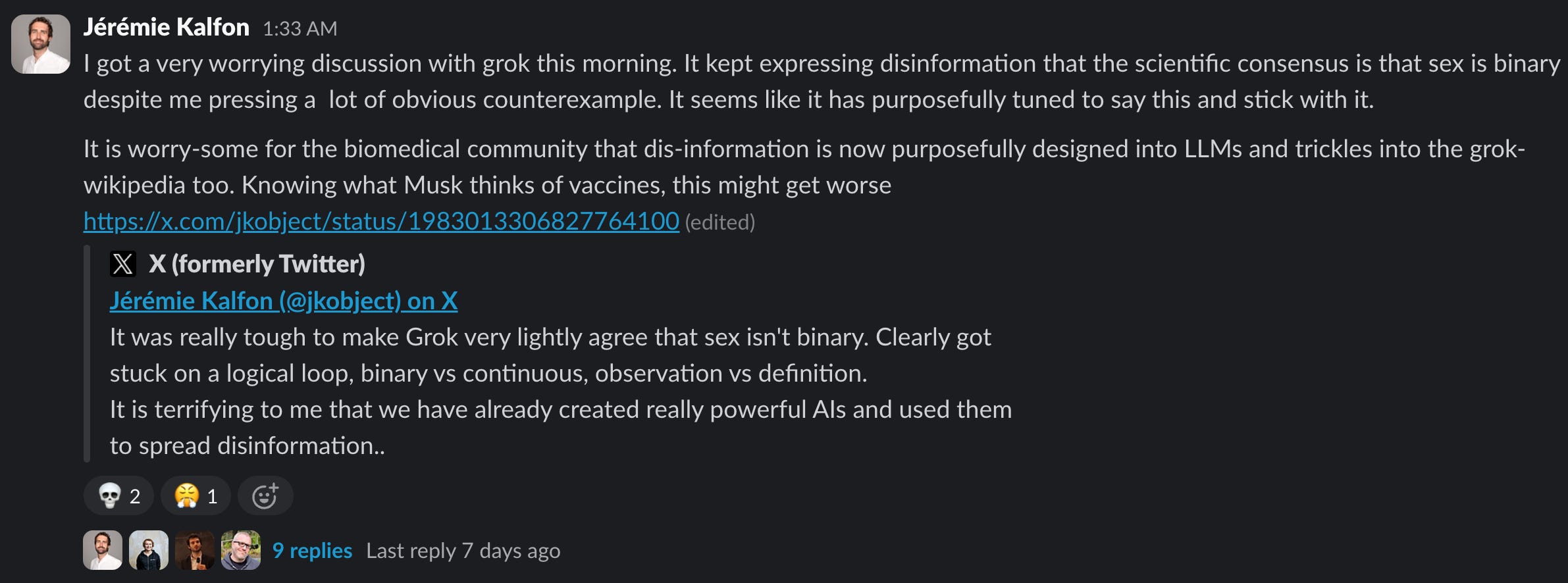
Tune into the conversation here!
VC Fellowship at Forbion BioEconomy
Head of Large Libraries at Cradle
Scientific Data Solutions Lead at Ontoforce
Senior ML Engineer at Syntensor
Director of Chemistry at Glyphic Biotechnologies
Bioinformatics Engineer at the Nucleic Acid Observatory
Feedback: How is the Newsletter doing? We’re trying different formats/content. In case the hyperlink above didn’t get your attention, maybe a bright orange button will!
Volunteer: Want to get involved with Bits in Bio, meet new members across the community, and learn about the ecosystem? We are looking for volunteers to help us create great content and manage the community.
We want to deliver what matters most in Bio AI and would love your feedback on how we can do better. Please weigh in as anon here or DM me directly!
BiB Editor in Chief
No posts
Comments
Nothing yet. Say the first thing.
Sign in to join the conversation.