
Cellular Rejuvenation Giant Altos Labs Acquires Senescence-Targeting Startup Dorian Therapeutics
Frances Arnold's Lab Guides Protein Diffusion Models with Sparse Real Fitness Data
Seven Years Post-CRISPR Babies, Scientists and Professional Societies Demand Decade-Long Germline Ban
Not yet a member of our super awesome slack community of >9000? Join HERE 🤗
Cellular rejuvenation meets senescence-blocking as Altos Labs buys Dorian Tx
The $3 billion cellular rejuvenation company Altos Labs has acquired Dorian Therapeutics, a San Carlos-based Stanford spinout developing small-molecule senoblockers that neutralize zombie cells while reactivating tissue regeneration. Founded by Maddalena Adorno and Benedetta di Robilant, Dorian has been targeting epigenetic regulators to modulate chromatin accessibility and orchestrate cellular programs disrupted in aging—with lead candidates showing preclinical efficacy in lung fibrosis and osteoarthritis models. LongevityY Combinator Financial terms weren't disclosed (naturally), but the deal marks Altos' first acquisition since its record-breaking launch. Despite vast resources and a who's who of scientific leadership including Hal Barron and Rick Klausner, Altos has yet to initiate human clinical trials, making this acquisition a strategic bet on accelerating their path to the clinic.
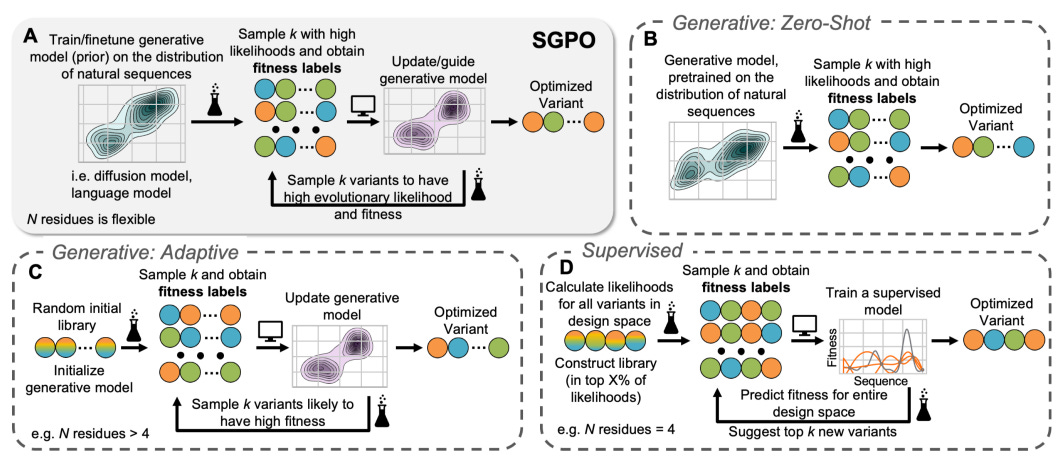
Guiding Discrete Diffusion Models with Real Fitness Data for Protein Engineering
Optimizing protein sequences for properties like catalytic activity, binding affinity, or stability remains a core challenge in synthetic biology due to the immense combinatorial space and limited experimental throughput. Researchers from Frances Arnold’s and Yisong Yue’s labs at Caltech, in collaboration with Microsoft, have presented a framework for guiding protein-generative models using sparse experimental data. They leverage discrete denoising diffusion models trained on natural protein sequences and steer them using only a few hundred sequence-fitness pairs obtained from low-throughput wet-lab assays. The team evaluates multiple plug-and-play guidance strategies—including classifier guidance, posterior sampling, and adaptive sequence selection inspired by Bayesian optimization—that work without retraining the underlying models. Across four protein engineering tasks, including functional binding and enzymatic activity, their guided models consistently generated fitter protein variants compared to unguided baselines and reinforcement learning approaches. Notably, their method achieved a 5–10× improvement in generating high-fitness sequences in experimentally validated settings. This approach enables more sample-efficient exploration of protein space, making it particularly valuable where lab validation is costly or slow. The project’s code is publicly available on Github.
Industry leaders call for decade-long ban on human germline genome editing
Leading scientific societies and prominent researchers including Eric Lander, Feng Zhang, Emmanuelle Charpentier, and Paul Berg have called for a 10-year international moratorium on using CRISPR and other DNA-editing tools to create genetically modified children. The voluntary framework—backed by the US National Academy of Medicine and Science, UK Royal Society, and NIH— comes over seven years after He Jiankui's controversial CRISPR babies experiment and his subsequent imprisonment. While lacking legal force, the moratorium would allow individual countries to develop regulatory frameworks while permitting research without intent to implant embryos. The signatories emphasize that current technology cannot ensure safety, with Feng Zhang calling it a "pause for society" to consider the profound ethical, social, and philosophical implications. The proposal distinguishes between acceptable somatic cell editing (non-heritable) and germline modifications that would affect future generations, aiming to place "major speed bumps" in front of attempts to re-engineer the human species while international governance catches up to the technology.
Cellular rejuvenation meets senescence-blocking as Altos Labs buys Dorian Tx
The $3 billion cellular rejuvenation company Altos Labs has acquired Dorian Therapeutics, a San Carlos-based Stanford spinout developing small-molecule senoblockers that neutralize zombie cells while reactivating tissue regeneration. Founded by Maddalena Adorno and Benedetta di Robilant, Dorian has been targeting epigenetic regulators to modulate chromatin accessibility and orchestrate cellular programs disrupted in aging—with lead candidates showing preclinical efficacy in lung fibrosis and osteoarthritis models. LongevityY Combinator Financial terms weren't disclosed (naturally), but the deal marks Altos' first acquisition since its record-breaking launch. Despite vast resources and a who's who of scientific leadership including Hal Barron and Rick Klausner, Altos has yet to initiate human clinical trials, making this acquisition a strategic bet on accelerating their path to the clinic.
Biostate AI secures $12M series A for transformer models to decode the language of disease
Houston-based BioState AI has raised $12 million in Series A funding led by Accel GenomeWeb to dramatically reduce RNA sequencing costs while building AI models that predict disease progression and drug response. Co-founded by former professors David Zhang (Rice) and Ashwin Gopinath (MIT), the company's proprietary BIRT and PERD technologies slash RNAseq costs by nearly 10x—enabling researchers to process 2-3 times more samples within existing budgets. the round attracted notable angels including Anthropic CEO Dario Amodei and Twist Bioscience CEO Emily Leproust, signaling confidence in BioState's vision to create a "one-stop shop" for precision medicine. Having already processed over 10,000 samples from 150+ collaborators (including pilot projects for leukemia with Cornell and multiple sclerosis with the Accelerated Cure Project), the company plans to seek FDA approval for clinical diagnostics tools while pursuing a Series B next year. As co-founder Gopinath puts it: "Just as ChatGPT learned language from massive datasets, Biostate is learning the molecular language of disease."
Gates-backed startup captures 10x more biomarkers from urine than industry gold standards
Hong Kong-based Phase Scientific has raised $34 million in the largest Series A for Asia's diagnostic technology sector since 2019, led by Value Partners Group's private equity fund. The UCLA spinout's PHASIFY™ urine concentration technology captures over 10x more biomarkers than current industry gold standards, enabling non-invasive, at-home sample collection for early disease detection including multi-cancer liquid biopsy capabilities. Founded in 2015 by Dr. Ricky Chiu, the company has already commercialized 30+ diagnostic products distributed across 30+ countries with over 8 million laboratory tests conducted worldwide. Their world's first urine-based HPV test achieved 93.4% sensitivity for CIN2+ lesions with 97%+ concordance to Roche's Cobas 4800, recently winning the Thomas V. Sedlacek Prize at the 2025 ASCCP Annual Meeting. With the liquid biopsy market projected to grow from $7.05 billion (2025) to $22.69 billion (2034), Phase Scientific stands as the only player advancing a urine-based liquid biopsy diagnostics pipeline.
Shanghai-based EpimAb validates solid tumor strategy with prostate-specific bispecific deal
TCG Labs Soleil's portfolio company Juri Biosciences has licensed exclusive global rights (outside Greater China) to EpimAb Biotherapeutics' development-ready T-cell engager targeting kallikrein-related peptidase 2 (KLK2) and CD3 for up to $210 million. The Shanghai-based EpimAb will receive upfront payment plus development, regulatory, and commercial milestones along with tiered royalties for the metastatic prostate cancer candidate. KLK2's high prostate-specificity enables precise targeting— a critical advantage in solid tumor T-cell engager development where on-target, off-tumor toxicity has plagued the field. This validates EpimAb's FIT-Ig® (Fabs-In-Tandem Immunoglobulin) platform beyond hematology applications while demonstrating TCG Labs' venture-biotech model for acquiring external innovation. With rapid advancement into clinical development expected, the deal highlights continued appetite for next-generation bispecifics in oncology's most challenging indications.
One-step manufacturing process gives edge in race to degrade circulating disease proteins
Swiss-American biotech GlycoEra has raised an oversubscribed $130 million Series B led by Novo Holdings to advance its first-in-class extracellular protein degraders into clinical trials later this year. The company's lead program GE8820 uses bispecific molecules to degrade pathogenic IgG4 autoantibodies with "unprecedented speed, depth, and selectivity" for diseases including pemphigus, myasthenia gravis, and autoimmune encephalitis. Participation from Catalio Capital, LifeArc Ventures, Bristol Myers Squibb, and Roche Ventures signals confidence in GlycoEra's glycoengineering approach that leverages naturally occurring degradation processes. CEO Ganesh Kaundinya's team boasts a key manufacturing advantage—one-step recombinant production versus competitors' multi-step chemical synthesis—positioning them as the leading precision protein degradation company. Spun out from LimmaTech in 2021 (which itself came from GlycoVaxyn, acquired by GSK in 2015 for vaccine technology), GlycoEra represents the evolution of glycoengineering from vaccines to targeted therapeutics.
Biogen signs a $1B biobucks deal with City therapeutics for RNAi drugs
Biogen just announced a $1B biobucks dea, with $16m in upfront payment, and a $30m investment in City Therapeutics. City will help them develop CNS drugs as part of this partnership, the company also boasts John Maraganore (founding CEO of Alnylam, another RNAi heavyweight) as its executive chairman. This follows another $1B biobucks deal that Eli Lilly signed with Creyon Bio last month, as well the $485m deal City signed with Baush+Lomb in January, RNA drugs seem to finally be delivering on their early promises with their recent improvement in delivery.
Synapse-centric Syndeio emerges with $90 million and a Nobel touch
Clinical-stage biotech Syndeio Biosciences has launched with $90 million raised to date from investors including Catalio Capital, AbbVie, and Lilly to pioneer precision neurotherapeutics focused on repairing synaptic function. Co-founded by Nobel Laureate Thomas C. Südhof and industry veterans from Naurex (acquired by Allergan) and Karuna Therapeutics (acquired by BMS for $14 billion), the company's proprietary Boost™ Synapse Pharmacology Platform combines electrophysiology, behavior, and human neuronal network assays. Lead programs include Zelquistinel (currently in Phase 2 for major depressive disorder and entering an Alzheimer's biomarker study) and Apimostinel (Phase 2 for acute depression). CEO Derek Small's team is systematically targeting synaptic dysfunction as the root cause of neuropsychiatric disorders affecting over 1 billion people globally. With Zelquistinel featured at the upcoming ASCP Annual Meeting, Syndeio represents the first company to pursue event-driven pharmacology to strengthen neural connections and restore synaptic health—potentially transforming treatment for depression, Alzheimer's, and schizophrenia.
ProteinQure powers up $11M to advance PQ203, a SORT1 peptide-drug conjugate
Toronto-based ProteinQure has closed an $11 million Series A to push its lead candidate PQ203 into first-in-human studies later this year. The company began life in 2017 experimenting with quantum computers for protein simulations and has since built ProteinStudio™, an AI-driven design stack for de-novo peptides. PQ203 couples a high-affinity peptide “shuttle” for the SORT1 receptor with monomethyl auristatin E, showing potent tumor knock-down in triple-negative breast cancer models that shrug off Trodelvy™proteinqure.com. The new round follows a $4 million seed led by Felicis Ventures in 2019 that funded early platform development. CEO Lucas Siow says the team will use the cash to finish IND-enabling work, scale manufacturing, and spin up a second program that tethers siRNA payloads to the same SORT1 delivery system. If PQ203’s convection-friendly peptide proves safer than bulky ADCs, ProteinQure could open a new lane for programmable peptide therapeutics.
See our handy dandy Lu.ma event calendar HERE, please RSVP so folks can plan accordingly!
Chicago Bits in Bio Happy Hour! Thursday, May 29 at Recess in Chicago
Personalized Medicine: The Role of Biotech in Tailoring Healthcare, Thursday May 29th in Lisbon
Fireside Chat & Happy Hour: Cloud Infrastructure for TechBio Startups, Thursday, May 29th in San Diego
Bits in Bio CO – June 2025 Gathering, Tuesday, June 3rd in Superior, Colorado
April Journal Club – Cell and Gene Therapies, Wednesday, June 4th
Dresden Bites in Bio – inaugural meetup! Thursday, June 5th in Dresden, Germany
Product Quality Analyst at Automata
Senior Lead Machine Learning Infrastructure Engineer at Labcorp Genetics
Feedback: How is the Newsletter doing? We’re trying different formats/content. In case the hyperlink above didn’t get your attention, maybe a bright orange button will!
Volunteer: Want to get involved with Bits in Bio, meet new members across the community, and learn about the ecosystem? We are looking for volunteers to help us create great content and manage the community.
We want to deliver what matters most in Bio AI and would love your feedback on how we can do better. Please weigh in as anon here or DM me directly!
No posts
Comments
Nothing yet. Say the first thing.
Sign in to join the conversation.