
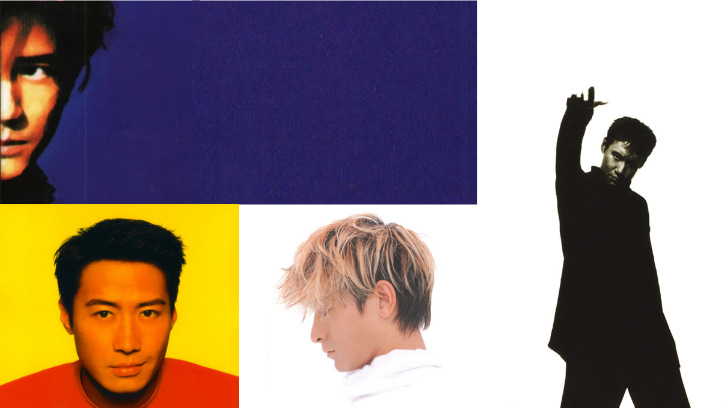
I realized I didn’t really highlight much music from the Four Heavenly Kings in my last article, so I thought I’d do a part two and look back at some of their most iconic tracks. Since each of their catalogs are pretty huge, I decided to keep things simple and digestible.
The format is straightforward: three tracks per singer, each falling into one of three categories—one ballad (slow song), one non-ballad (uptempo), and one cover. While many of their biggest hits were covers of Japanese or Western songs, I’ve chosen to highlight original tracks in the ballad and uptempo sections, with cover songs given their own dedicated category.
Naturally, a list like this is highly subjective and personal, so it’s by no means definitive—think of it more as a guided sampler!
Along with the three track selections, I’ve also included other song recommendations as well. They don’t have a write-up, but if you like what you hear, definitely give them a listen. I’ve consolidated everything into a Spotify and Youtube playlist to make it easy for you to check out.
With that out of the way, let’s dive in.
Best Non-Ballad - "Born To Be Wild" (餓狼傳說)
In contrast to Cheung’s usual ballads like "Goodbye Kiss" (吻別) or "The Legend That Never Ages" (不老的傳說), "Born To Be Wild" goes full rock mode, with big guitars and pounding drums. Who would've thought Cheung had it in him?
The music video features some early digital effects that haven’t aged well but are fun to revisit.
As a kid in the ’90s, I was always intrigued by its Chinese title—it shares the same name as the SNK arcade game Fatal Fury. I adored the game and always hoped there was some deeper connection. Turns out, the closest link was the song being used in the Hong Kong version of the Fatal Fury OVA. Not the most exciting, but a connection nonetheless.
Best Ballad - "Goodbye Kiss" (吻別)
“Goodbye Kiss” is arguably Jacky Cheung’s most iconic Mandarin ballad. Released in March 1993, it was the title track of his fifth Mandarin album. The song is pure karaoke royalty—you’d be hard-pressed to find a Chinese speaker who doesn’t know the chorus by heart. It won Song of the Year at the 5th Golden Melody Awards and played a major role in cementing Cheung’s reputation as the “God of Songs.”
Best Cover - "Loving You More Each Day" (每天愛你多一些)
“Loving You More Each Day” is a cover of "Manatsu no Kajitsu" by the Japanese pop band Southern All Stars. A Mandarin version of the song, with the same name, also appears on Cheung’s aforementioned Goodbye Kiss.
I remember the moment I found out it was a cover, it actually led me to become a fan of Southern All Stars. Cheung’s voice is a bit too refined compared to Keisuke Kuwata’s huskier tone, which is why I slightly prefer the original Japanese version. Still, you really can’t go wrong with either.
Best Non-Ballad - "Foolish Child" (笨小孩)
“Foolish Child” exists in two versions: a solo take and a much stronger rendition featuring Blackie Ko (柯受良) and Jacky Wu (吳宗憲) on vocals. If you ask me, the latter definitely takes the cake.
The song is interesting, it being a blues track, which is a genre that isn’t really explored much in Chinese pop. However, it fits the lyrical theme perfectly: a tongue-in-cheek romp about growing up in hardship, being fearless and innocent. The nod to blues is well thought out. The lyrics were also penned by Lau himself. Could they be autobiographical? Only Lau knows.
Best Ballad - "The Love-Forgetting Potion" (忘情水)
It doesn’t get any more classic than Lau’s "The Love-Forgetting Potion." The inspiration for the song reportedly came from composer Chan Yiu Chuen (陳耀川), who once overheard a flight attendant ask lyricist Preston Lee (李安修) whether he wanted wine or water while on a plane. This sparked the idea to combine "forgetting love" and "water," likening it to the mythical Meng Po soup that erases memories of past loves. The track served as the ending theme for the popular 1994 film Tian Di. More recently, Taiwan’s indie synth-pop band Sunset Rollercoaster delivered a pretty banging cover.
Best Cover - "I Hate Myself for Loving You" (我恨我癡心)
I never would have imagined Andy Lau covering Joan Jett & the Blackheart’s “I Hate Myself for Loving You,” but here we are in 2025 talking about it. This cover appeared on Lau’s 1989 album, just a year after the original release. While Lau is best known for his acting career and a vast catalog of tearful ballads, he’s not usually recognized as a rock vocalist. Despite that, he does a solid job interpreting the track. His deep voice offers an interesting take on the original.
Best Non-Ballad - “Eyes Want to Travel" (眼睛想旅行)
This one’s fun. I still remember this phase in Leon Lai’s career when he was working closely with producer Mark Lui (雷頌德). For those who don’t know, Lui was one of the hottest producers of that era, known for pushing EDM into one of the most popular trends of early-2000s Cantopop.
Personally, I’m not the biggest fan of this track, but I chose it because I think it perfectly captures the quirky side of Leon—the kind that’s so cheesy and borderline tacky, it becomes oddly endearing. Beyond the countless bizarre quotes he’s given us over the years, his eccentricity shows best in the updated version of the song, “Body Wants to Travel” (全身想旅行), which he released during the height of the pandemic.
Here’s an excerpt from that version’s lyrics: “Passports are covered in grime, leather boots have begun to stink, I’m just staying at home, touching my thickest coat.” Yes, really. That’s just some classic Leon being Leon.
Best Ballad - "Will You Come Tonight" (今夜你不會來)
One of the most popular ballads in Lai’s catalog, this track was the lead single from his 1991 debut Mandarin album of the same name. It went on to top multiple charts and nab a best song award.
A funny anecdote: the song went viral shortly before Nancy Pelosi’s visit to Taiwan in 2022, as Chinese netizens began quoting its lyrics while speculating whether she would actually show up. The meme gained so much traction that the song was temporarily banned in Mainland China for obvious reasons.
Best Cover - "Summer of Love" (夏日傾情)
A cover of the Japanese track “Saigo no I Love You” by Shinji Tanimura, “Summer of Love” is a solid rendition, but what really stands out to me is the ad it was used in. It was the first in a series of long running commercials by Hutchison, one of Hong Kong’s biggest telecom companies.
These ads introduced viewers to a recurring character named May, who was portrayed by different models over the years. The one featuring “Summer of Love” is especially hilarious—of course the diehard fan gets a phone call to talk to her idol. Thanks, Hutchison! And let’s not forget those massive mobile phones in the ad. Talk about a blast from the past!
Best Non-Ballad - "Sing This Song" (唱這歌)
I’ll always remember this song as the Pepsi theme in late ’90s Hong Kong. It was a masterclass in branding—though I haven’t found any stats showing how effective the crossover actually was. Still, the track perfectly captures everything great about Aaron Kwok: bombastic style, wild dance moves, and slick production. Exactly the kind of energy Pepsi wanted to tap into.
The lyrics, though, leave a bit to be desired. Written by his longtime collaborator and manager, Siu Mei (小美), they’re a little nonsensical—but undeniably cool-sounding.
Best Ballad - "The Call Of Love" (愛的呼喚)
I was genuinely surprised when I revisited this track for this article. The arrangement sounds pretty amateurish—even by the standards of that era—but the chorus is just too good to ignore. Interestingly, like the Leon track, this one was also used as the theme for a telecom marketing campaign by one2free. A perfect way to sync that irresistible hook to sell some phone service. Guess the ad agencies back then were onto something.
Best Cover - "Loving You Forever" (對你愛不完)
A cover of Japanese pop singer Toshihiko Tahara's "Shiruetto ni wa Odorenai," "Loving You Forever" was released in 1991 on Aaron Kwok's debut album. As I mentioned in a previous article, Kwok was the last of the Four Heavenly Kings to debut—and interestingly, he debuted in Taiwan, not Hong Kong. One thing worth pointing out is that, despite releasing a lot of Mandarin songs throughout his career, Kwok never quite nailed the pronunciation. Still, this track is the one that comes to mind when I think of his early work. Just try not to be too hard on his Mandarin.
No posts
Comments
Nothing yet. Say the first thing.
Sign in to join the conversation.