

If you’re an Indiana fan, you’ve heard some version of this since the 2025 College Football Playoff seeding began – “Indiana only won because its roster is full of 24-year-olds!”
Folks still subscribe to this idea today, even though one look at the Indiana Scholarship Chart (formerly maintained by BSB) and season-long statistics will prove most of Indiana’s production was not from its oldest players.
But this idea is deserving of analysis. The only problem is that age-related data is difficult to come by in college football, which is why tangible analysis around this topic has been sparse and erratic in its results. There is no definitive number for the average age of rosters; they’re all estimations. (More on this later)
Rotowire recently published the best analysis I’ve seen on this so far and found that Indiana is tied for 105th in the FBS, with an average age of 20.1, in 2026. That is 55th among 67 Power 4 teams and 15th in the Big Ten. (More on this later)
But there are few answers regarding 2025 roster ages. To make the best estimation, I took a similar approach as RotoWire, but focusing on On3 data to estimate each player’s age.
In 2025, Indiana’s average age was approximately 20.3 years old. That ranked 33rd among 68 Power 4 (plus Notre Dame) teams and 9th in the Big Ten.
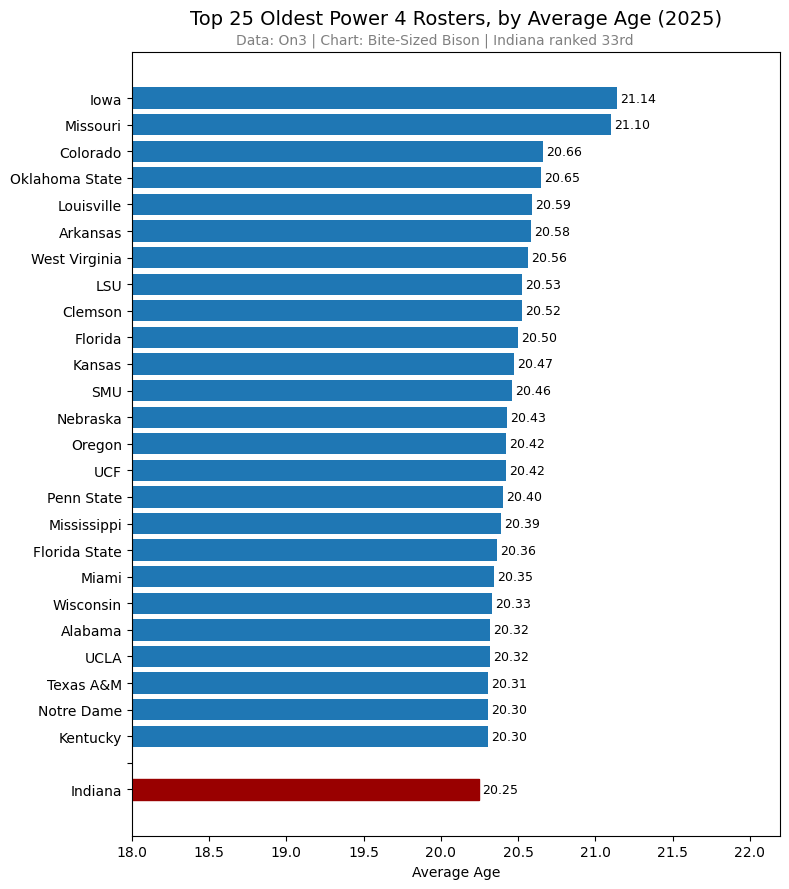
Was Indiana really that old in 2025? No. This is far from Indiana simply bullying teams with older players.
The Hoosiers are still working their way through the “roster crisis” – as Curt Cignetti diagnosed it – that the current regime inherited. The staff is still leaning on the transfer portal heavier than Cignetti would like, while the high school prospects they’ve signed develop (some already being key contributors to the championship team).
So while pointing to the age of Indiana’s roster is a fallacy (and seems like cope), there is truth to the idea that Indiana is younger than it was a year ago. The chart below shows the distribution of ages on Indiana’s roster.
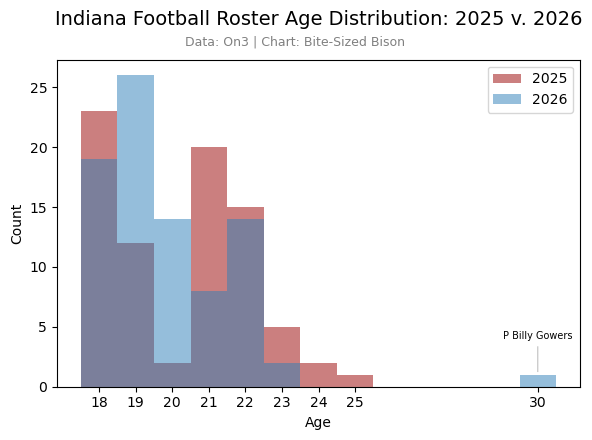
In 2026, Indiana will have fewer players at ages 21 through 25 than it did in 2025. Yet, it returns the 52nd-most production from last season (12th in Big Ten), according to Bill Connelly at ESPN. Indiana also added the 8th-highest rated transfer class (3rd in Big Ten), according to 247Sports.
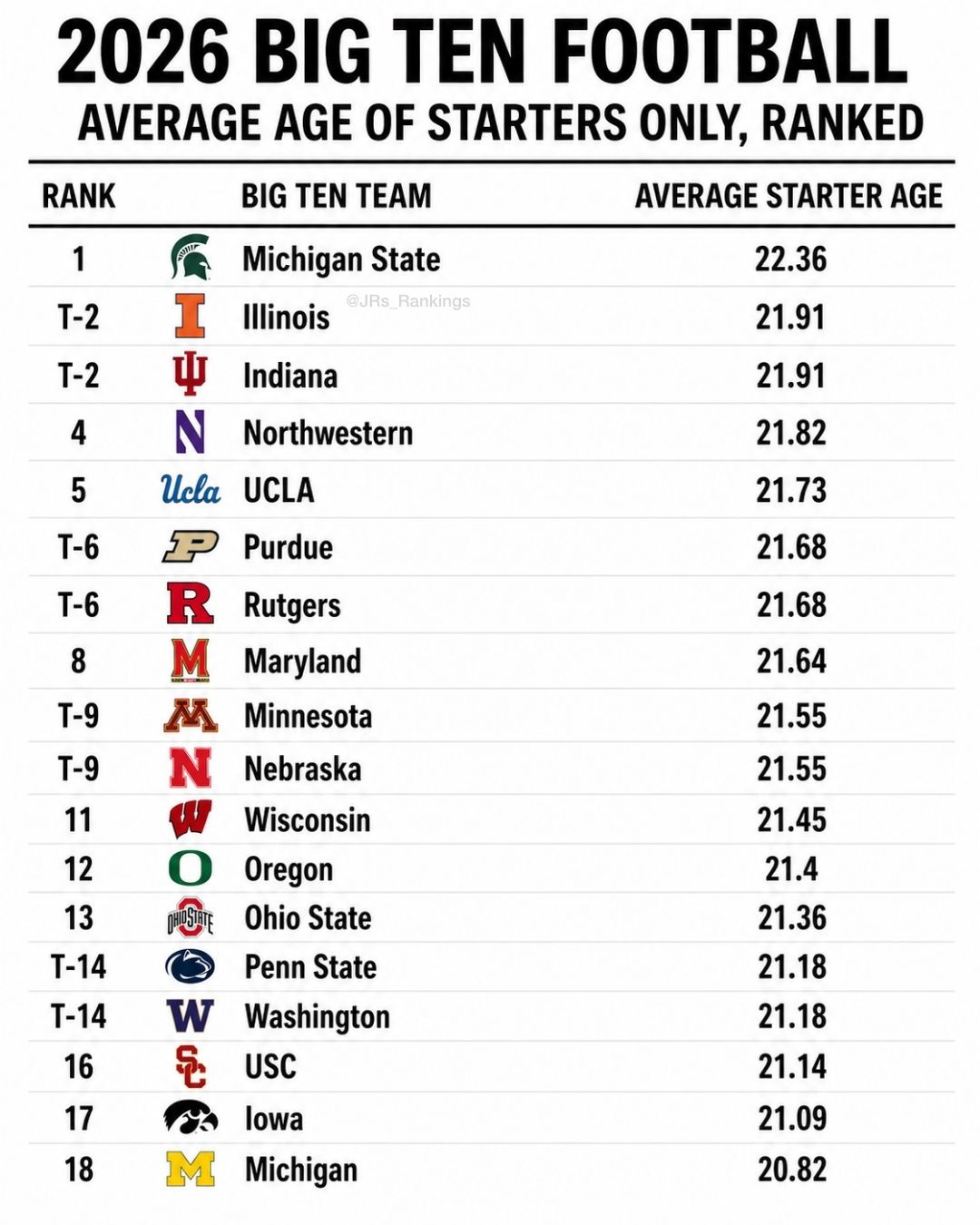
Lastly, when considering only the anticipated starters in the Big Ten, Indiana is one of the older teams, according to RotoWire data.
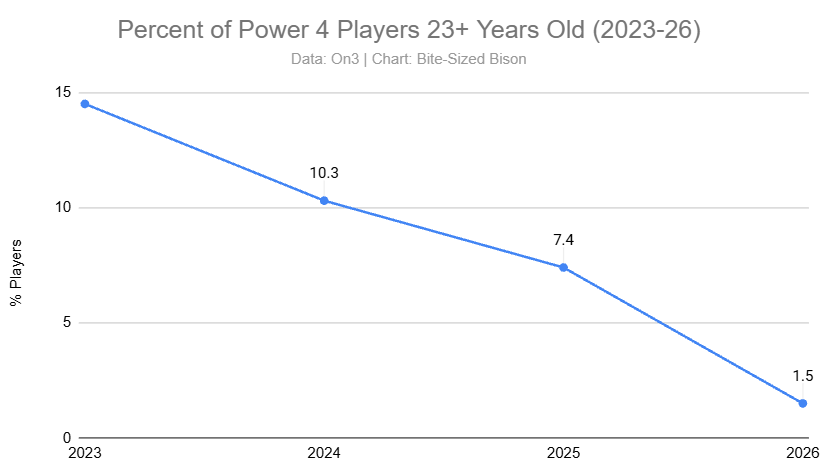
College football is getting younger at the top. The chart below shows the average age trend in the Power 4 conferences (plus Notre Dame) from 2023 to 2026.
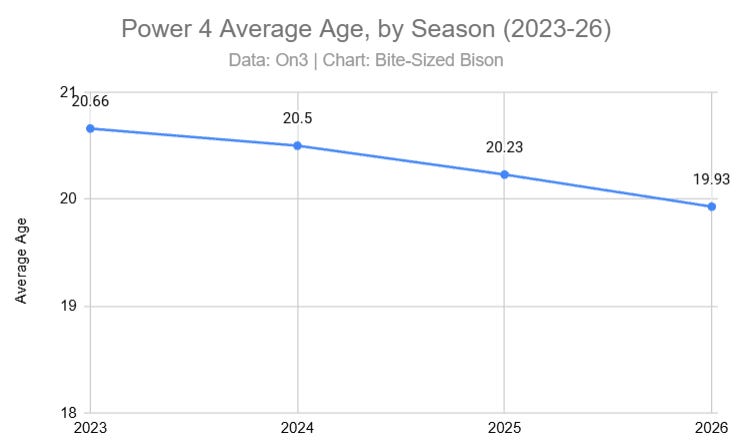
Part of this can be attributed to the COVID years timing out as we inch further away from 2020. This may change in future seasons, depending on what the courts do with the possible fifth year of eligibility. Below is the percentage of Power 4 players who were 23+ years old from 2023 to 2026.
There are numerous other inferences that can be made for why rosters are getting younger.
The one I personally subscribe to is that, due to enormous NIL funds going to high school signees, teams rush to play guys earlier so the money can see the field. In RotoWire’s analysis, the following teams are outside the top-100 in average age on their 2026 rosters: Oklahoma, LSU, Florida State, Miami, Alabama, Texas A&M, Notre Dame, Ohio State, Tennessee, USC, Texas, and Georgia. Nine of those 12 teams were just in the top-10 in 2026 high school recruiting classes. Six were in the top-10 in 2025.
But what is certain is that, given that players are getting younger, a premium has been placed on effective evaluation (which sets Cignetti apart from other coaches), and coaches need to be better than ever at teaching their systems, developing players faster, and weaponizing their schemes with inexperienced actors.
Or programs need to decide whether investing in the best high school recruiting classes is serving their teams like it once did.
As noted above, there are no definitive, exact numbers available for certain measures of age in college football.
There are two primary reasons why: 1.) Most colleges and universities are restricted from sharing student data, such as age and birthdate, with the public, and 2.) recruiting websites like On3, 247Sports, and Rivals were not built to accommodate this type of age analysis, so data (both internal and external) is difficult to leverage for this particular effort. On3 is the closest, as it’s the newest and most responsive to recent trends in college football, such as discussions around NIL compensation and age.
RotoWire’s analysis was effective because it compared team rosters across multiple sites to ensure players and class designations (sophomore, redshirt junior, etc.) were present. It then modeled ages for players based on those class designations.
BSB created a model very similar to RotoWire’s.
Comments
Nothing yet. Say the first thing.
Sign in to join the conversation.