

Indiana enters its second bye week at 11-0 with what BSB’s win probability model (using SP+ data) projects to be a 98% chance of defeating rival Purdue in West Lafayette on Black Friday night.
The Hoosiers remain one of the most efficient teams in college football and have posted the 2nd-strongest Strength of Record nationally, despite playing the 38th-toughest schedule.
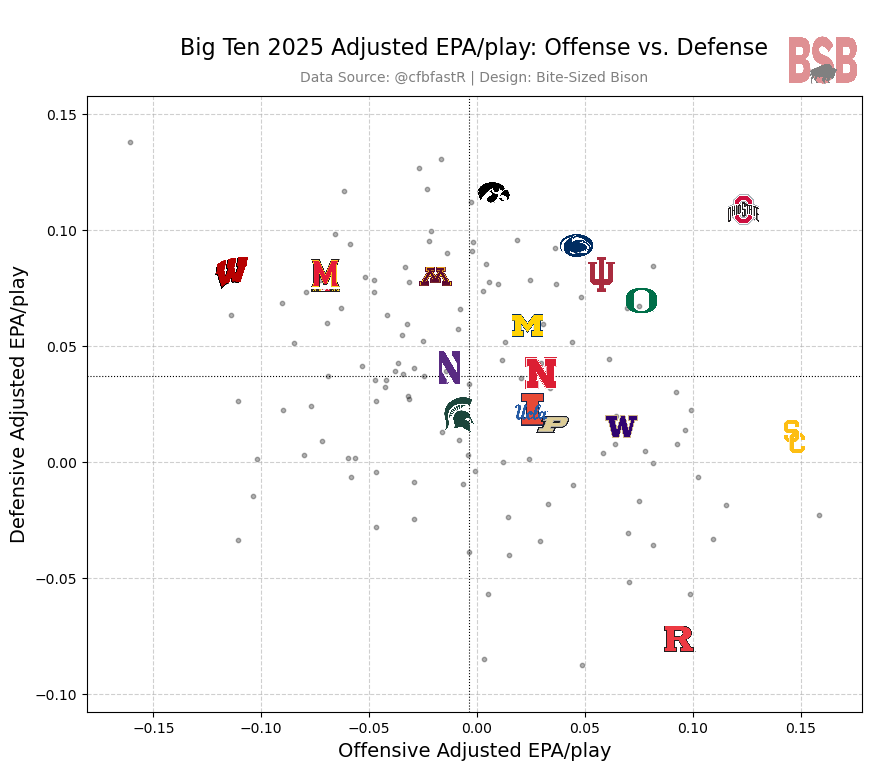
This has been a different season than Indiana played in 2024. I talked about it on the latest episode of CrimsonCast this week, and that’s what the section below seeks to convey as well.
Let’s learn some more about this historic 2025 Indiana Football team…
Indiana retained its offensive coordinator from 2024 to 2025 and ranks 17th in adjusted offensive EPA/play, after ranking 9th last season. But the efficiency hasn’t been achieved in exactly the same manner. Mike Shanahan has adjusted the scheme to fit the new roster, and at the highest level, it becomes obvious how personnel slightly changed this offense.
For those who don’t know, the four most popular personnel groupings are:
10 personnel — 1 RB, 0 TE
11 personnel — 1 RB, 1 TE
12 personnel — 1 RB, 2 TEs
21 personnel — 2 RBs, 1 TE
While this naming convention paints with broad strokes (my capstone project for my Master’s in Data Science explored this very idea), it is helpful in identifying offensive tendencies.
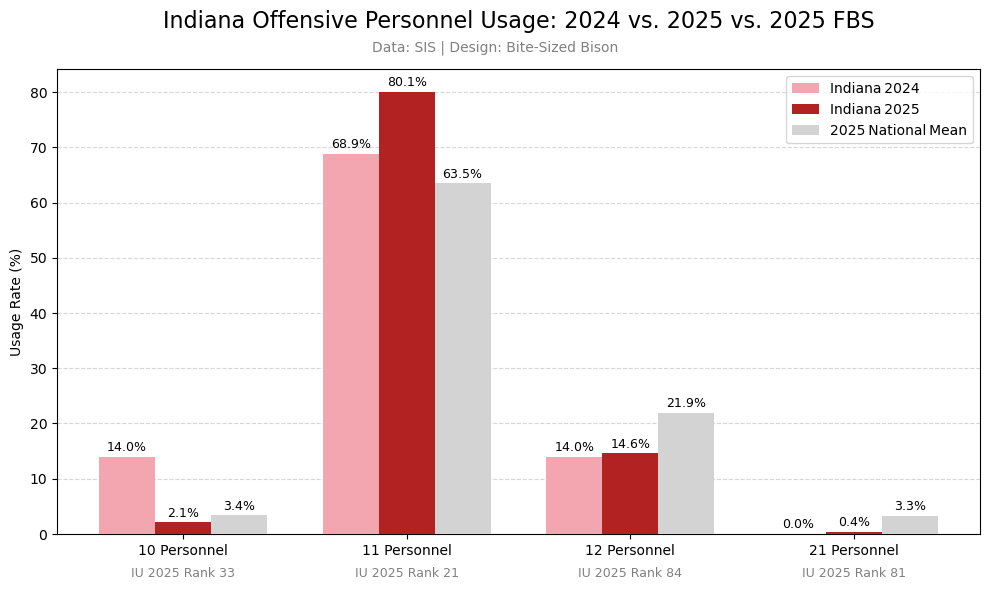
In 2024, Indiana was both thin at TE and deep at WR, which led to the 12th-highest rate of 10 personnel in the nation. These were largely obvious passing situations, where Zach Horton was taken off the field and replaced by a fourth receiver, often a second slot WR, like Ke’Shawn Williams. When passing out of 10 personnel, Indiana averaged 8.4 yards/attempt (25th nationally).
What is most notable about this chart, though, is that, even with two capable pass-catchers at TE, in Riley Nowakowski and Holden Staes in 2025, Indiana is running 12 personnel at a nearly identical rate as it did in 2024. One of my predictions during the preseason was that Indiana would run much more 12 this year, given less depth at WR and multiple additions at TE, but, while Indiana is running the ball nearly 12% less out of 12 personnel than in 2024 (see chart below), it’s still only passed the ball 23 times out of 12 personnel, through 11 games. Tight ends have only been targeted on 3 of those 23 passes.
The Hoosiers have been one of the most loyal offenses to 11 personnel, which we now understand — Nowakowski has shown not only an elite ability to block at TE but also an ability to eat YAC in the passing game when needed; Omar Cooper has been dangerous at slot and on the perimeter, while EJ Williams (on the perimeter opposite Elijah Sarratt) has been improved; Holden Staes has not been the dynamic TE anticipated during the preseason. It’s the versatility at skilled positions that allows Mike Shanahan to stay in 11 80% of the time.
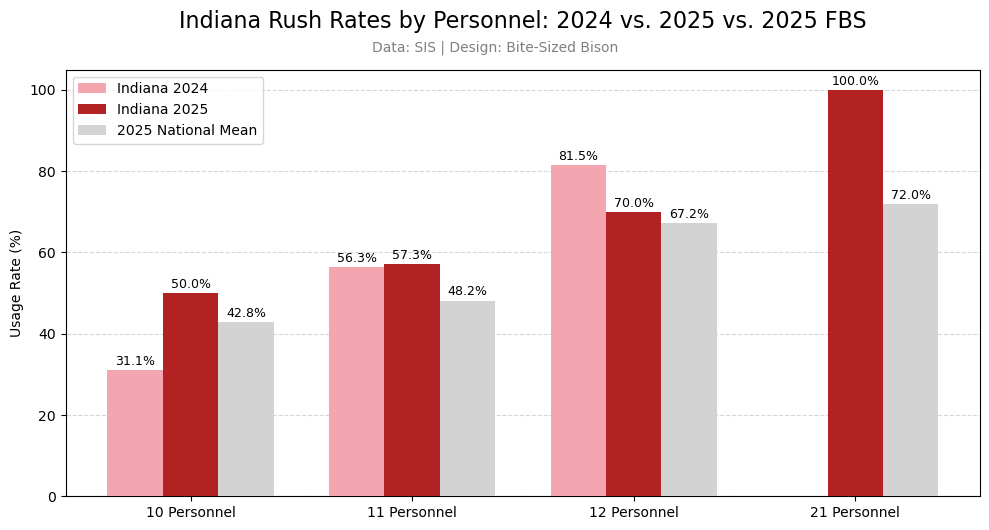
The rushing rates shown above do a great job of further detailing the differences between the 2024 offense and the 2025 offense, particularly the 50% rush rate out of 10 personnel, where the rush rate has jumped by nearly 20% between seasons and has surpassed the FBS average. The Hoosiers have bigger, better blocking WRs in 2025 (3 in the top-30 among Big Ten WRs), which allows Indiana to remove TEs from rushing plays and still find production. In this personnel package, Indiana ranks 5th in EPA/rush.
The Hoosiers are also running far less often out of 12 personnel. This one is more obvious than the spiked rushing rate in 10 personnel — Holden Staes can catch passes too. Staes is rarely the sole TE on the field, and less than half of his snaps are spent in run-blocking scenarios. He’s targeted on every 8 routes that he runs. Staes’ presence has given Shanahan a small wrinkle of versatility within 12 personnel.
Indiana doesn’t use 21 personnel often. In fact, the only game it used 21 personnel was against Penn State, when it was noted in BSB that Roman Hemby and Kaelon Black were in the same backfield a few times during short-yardage situations. That was the first time in the Curt Cignetti Era that Indiana used 21 personnel.
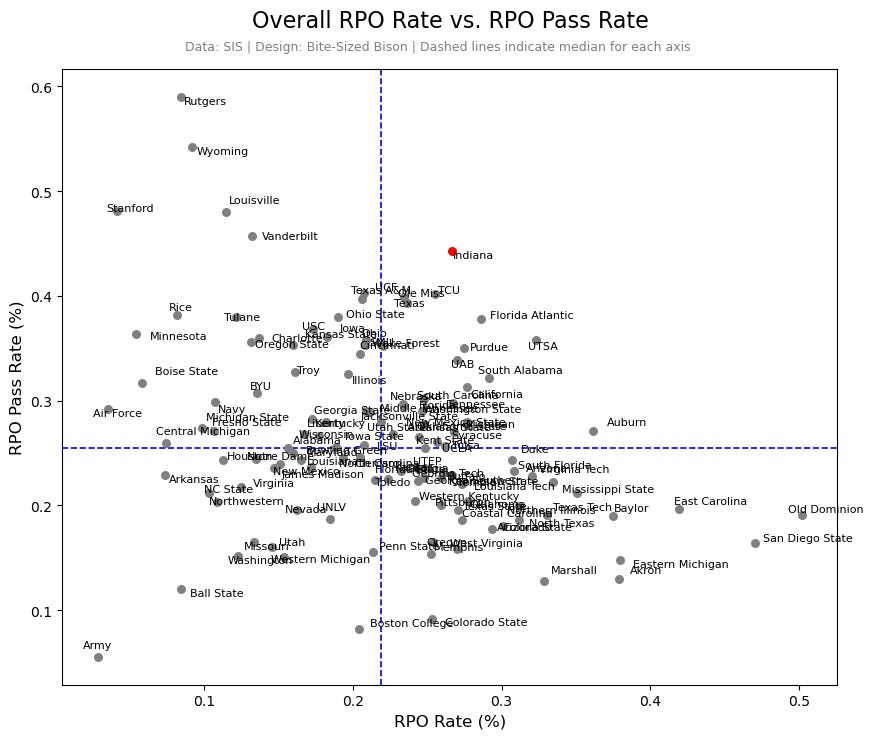
What is shown in this Run-Pass Option (RPO) rates chart is that no team in the country runs RPO at the rate that Indiana does while also passing out of RPO as often as Indiana does. The Hoosier rank 33rd in overall RPO rate and 6th in RPO pass rate. This was somewhat predictable when Fernando Mendoza committed to transfer to Indiana. Some BSB readers may remember this chart from Parker Fleming last offseason, which details the rush rates against RPO and play action rates in 2024:
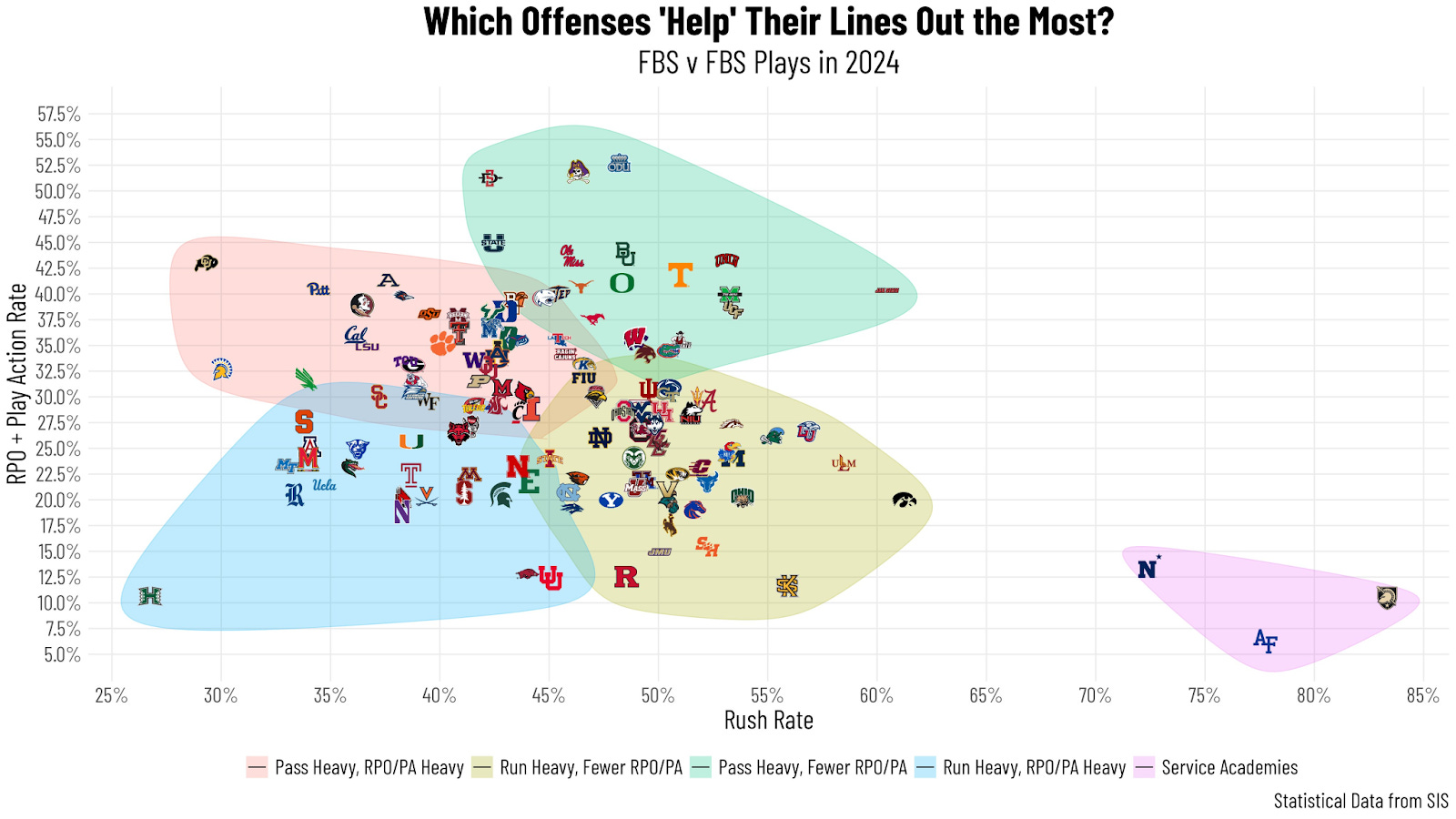
I wrote that, given where Cal is on this chart, Mike Shanahan may be hoping to move Indiana upward (more RPO) and leftward (lower rush rate). Well, neither of those has changed, but what has is how often Indiana is throwing out of its RPO sets. The Hoosiers averaged 4.9 passes out of RPO in 2024 and are currently averaging 8.1 in 2025 and lead the nation in total RPO dropbacks. The IU offense gains 55 yards vai RPO passes per game and 97.6% of attempted passes out of RPO are catchable.
This doesn’t mean Indiana is ignoring the run out of RPO. In fact, you’ll notice that Indiana runs the ball more than half the time out of RPO. On those runs, it ranks 7th in EPA/attempt and averages 6.0 yards/carry.
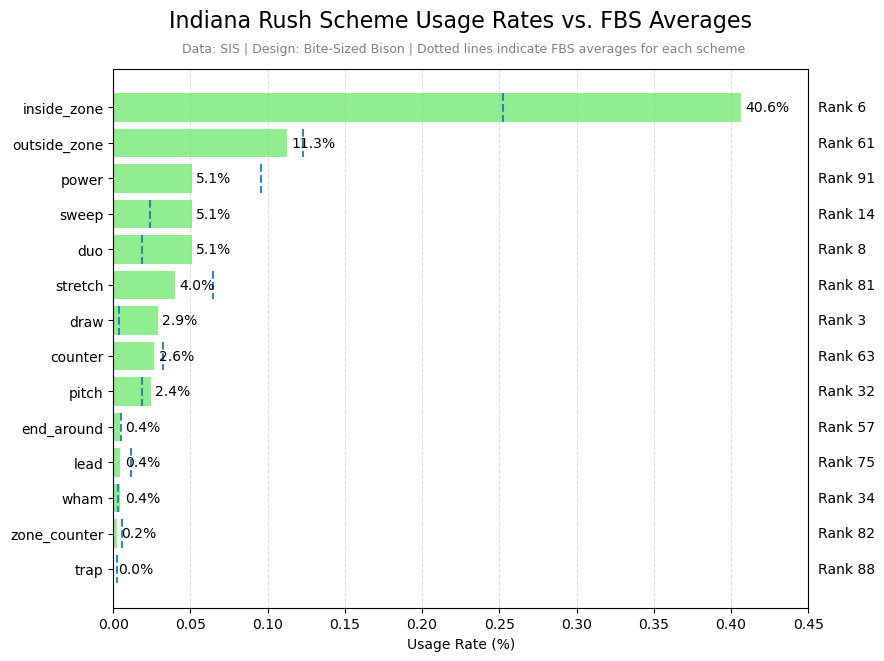
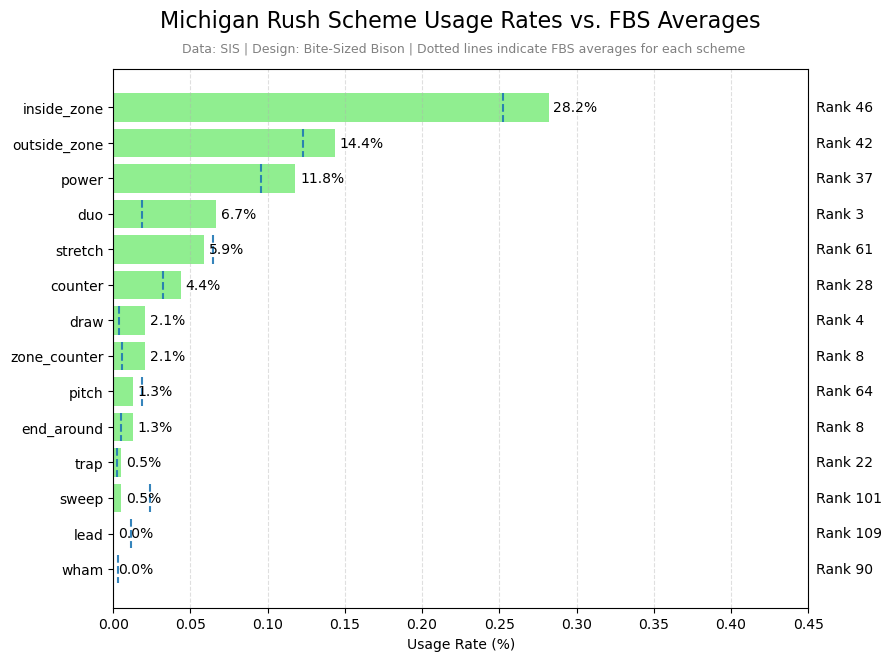
As the rushing schemes visual above shows, Indiana overwhelmingly favors the inside zone rushing scheme. Inside zone asks offensive linemen to blocking at a 45-degree angle, all moving in the play-side direction, while the ball carrier finds creases to hit vertically (for more details, watch this video). It’s a great scheme for offenses that have athletic linemen but not necessarily the strongest. Another concept that is closely related to the concepts of inside zone is Duo, and Indiana ranks top-10 in rushing rates for both of those schemes. When running either inside zone or Duo, Indiana ranks 24th in EPA/rush and averages 6.0 yards/rush.
Indiana is one of the most successful teams when using the draw. Mike Shanahan injects misdirection in subtle ways throughout games, particularly when he’s looking for separation from the defense, and draws have been useful in short-yardage situations. Indiana ranks second nationally in first downs recorded via draws.
There are several signals in this chart that suggest Indiana is scheming around its guard play in the rushing attack. One of them is how relatively few power schemes Indiana uses. Power is a concept that leans on pulling guards and opening gaps (learn more at this video). The Hoosiers are successful when they do run power — 16th in EPA/carry — but they’re well below average in rush rate. Also, Indiana’s sweep and pitch rates have jumped from 2024 to 2025 — 48th in sweep + pitch rushes in 2024 to 12th in 2025. Much of this could also be attributed to a higher ceiling of talent in the backfield, able to work in that space a bit more effectively than the RBs in 2024.
Indiana has been really effective on the ground in 2025, when compared to 2024 (4.4 yards/carry in 2024 to 5.3 in 2025).
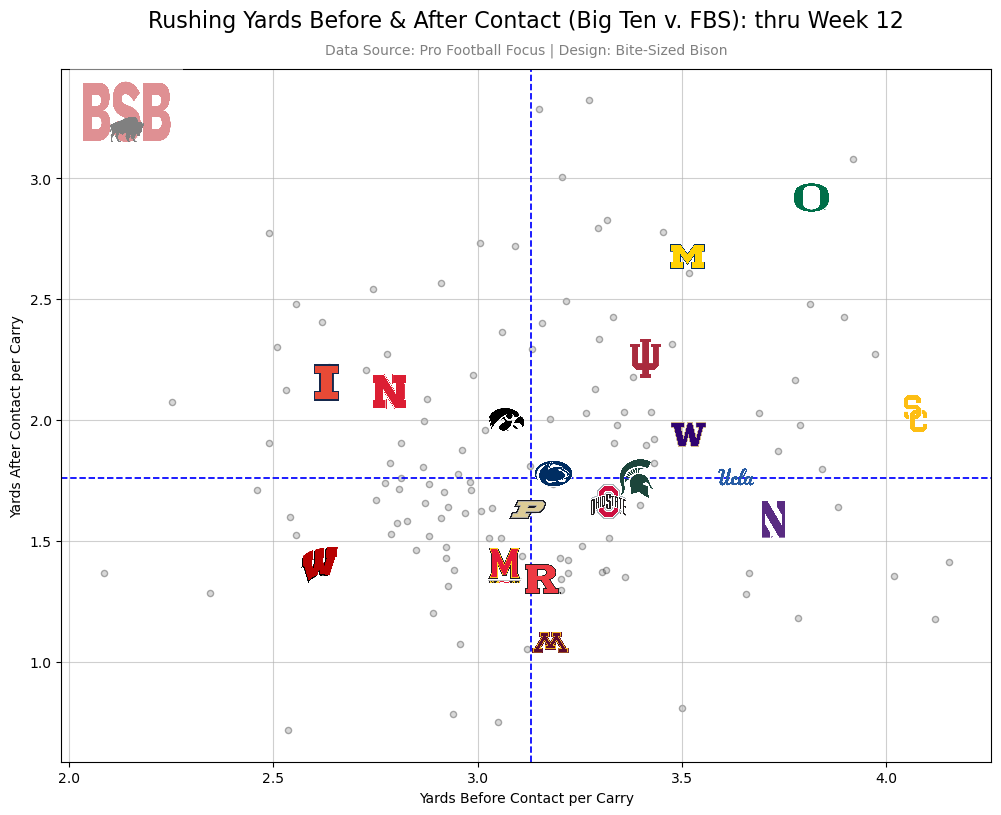
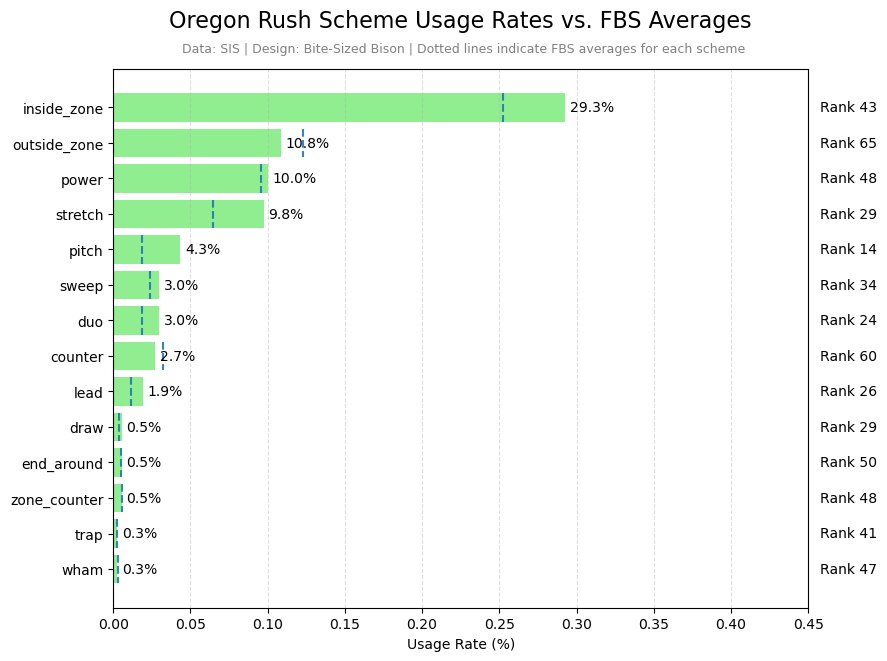
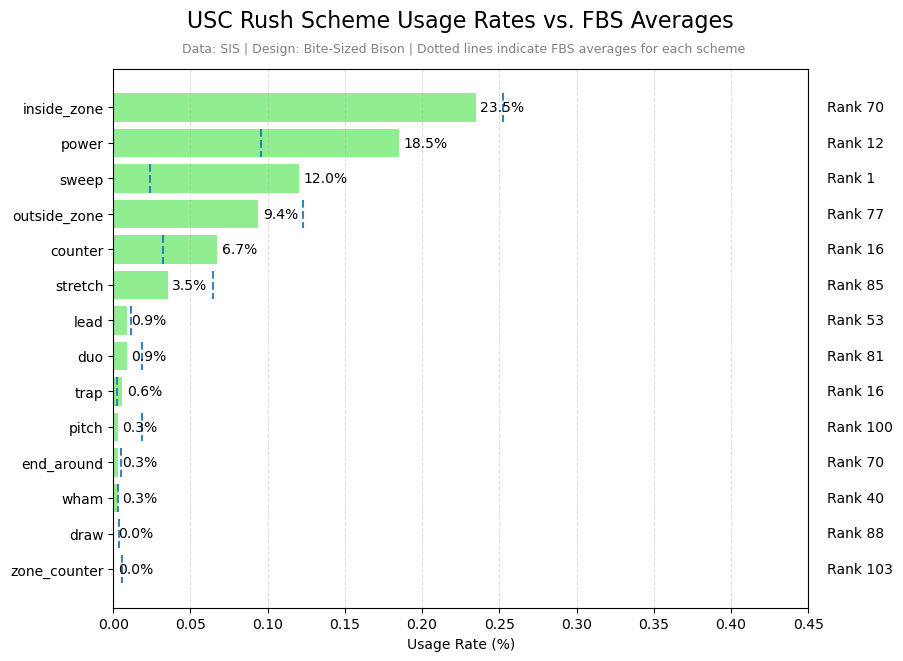
Below are the rushing schemes used by Oregon, Michigan, and USC.
It may be helpful to view the BSB Scholarship Chart while reading this section of the newsletter.
There are several moments in the college football recruiting calendar where recruiting — to the casual fan — randomly heats up. We’ve just recently entered one of those moments, lovingly called “flip season” by CFB recruiting nerds like myself. At this point:
Most recruiting classes, within functional programs, have been stacked and holes identified. Much of this was done in June and July. High school recruits like to focus on their football seasons, which are beginning to come to close now, freeing them up to reconsider their college decisions.
Programs’ future outlooks are being aired and coaches fired as a result — looking at programs like Penn State, Wisconsin (coach not fired), LSU, Florida, Arkansas, Oklahoma State, UCLA, and others. These moves untether a lot of solid high school talent from programs with fairly recognizable brands.
The end of the regular season is approaching, so most programs are now strategizing for the transfer portal, which is open Jan. 2-16 (with a special 5-day window for CFB teams’ players to enter Jan. 20-24). Without the spring portal period in 2026, teams will want to have the high school class locked down even earlier to prioritize the portal in January.
Indiana has already seen its 2026 class undergo some changes this week, with three new commitments — former Penn State WR commit Lavar Keys, former Wisconsin OL commit Ben Novak, and former Colorado SAF commit D’Montae Tims — and a de-commitment — QB Cash Herrera. Indiana’s class currently sits at 28th by 247Sports Composite Rating, and there is plenty to consider moving forward.
How do these new commitments fit into the class? What may come as a surprise, given where these recruits are flipping from, is that they aren’t the highest-rated commits in the class. Lavar Keys is the highest-rated among new commits (No. 766 overall), which ranks 11th in Indiana’s 2026 class. Indiana is adding these recruits to fill out the class rather than to define the class.
What do we make of the Cash Herrera de-commitment? I am 99% confident in saying this was a decision made by the Indiana staff, not by Herrera’s camp. Herrera wasn’t Indiana’s first or even second choice in this class, and things have changed around the perception of this position for Indiana in 2025. This separation could signal a number of things, but something to keep in mind is the forecasted schedule within the room. There is a bit of a logjam at QB, with three freshman QBs behind Fernando Mendoza, who should leave after 2025. Alberto Mendoza would likely be next in line to start, but I’d bet a lot of money on Indiana bringing in a high-quality transfer (like, very high-quality) for 2026, forcing Alberto to compete for that job as a redshirt sophomore. If Tyler Cherry — who had already used his redshirt in 2024 — can retain his year of eligibility after his season-ending injury in 2025, he would actually be on the same schedule as current true freshman Jacob Bell. Plus, the Hoosiers already have their 2027 QB commit, in Jameson Purcell. If the staff feels good about the development of the three freshmen QBs, there isn’t an urgency to bring in a 2026 QB, especially if the price isn’t right. They may also have their eyes on another 2026 QB too.
Who has notably burned their redshirt in 2025? With one game left in the regular season, there are two young players right at the 4-game line who I’d expect sidelined for Purdue — WR Davion Chandler and SAF Byron Baldwin. Given that postseason games don’t count toward eligibility, I’d anticipate Baldwin having a legitimate role in the defense during the CFP and Conference Championship while maintaining his redshirt. Several notable young players who’ve burned their redshirts are:
WR Charlie Becker (will be a true junior in 2026)
WR LeBron Bond
DE Daniel Ndukwe (will be a true junior in 2026)
DT Mario Landino (will be a true junior in 2026)
LB Rolijah Hardy (will be a true junior in 2026)
DB Jaylen Bell
DB Garrett Reese
Any early ideas of how the staff might handle the portal? Much of this will be determined by departures. Fernando Mendoza should leave for the NFL, and there are others who could leave early — Carter Smith, Omar Cooper, and even D’Angelo Ponds. I also anticipate that the staff is having conversations with younger players about hitting the portal when January arrives, which would open up some scholarships. This could be an entirely separate post, but, assuming those departures all take place, some early positions of need would be: QB, RB, WR, TE, C (if they don’t move Bray Lynch there), DE, DT, SAF, and P. It will most likely be another busy portal season for Indiana, but it should also be the last, with the recruited talent aging up after 2026.
How is this year’s sophomore class performing? If you’ve read BSB for longer than the last few months, you might know that I was raising a mild concern in the preseason regarding how Indiana would blend the transfer/Tom Allen Era classes (current juniors and older) with the recent big recruiting classes. That left a bit of a chasm at the current sophomore class, who would be asked to contribute soon (though, I didn’t realize that would mean mostly by the end of this season!). This class is comprised of Charlie Becker, Daniel Ndukwe, Mario Landino, Rolijah Hardy, Nico Radicic, and former MSU DE transfer Andrew DePaepe. That’s the entire class, and by reading that list, you can see that the staff has done a phenomenal job scouting and developing a disjointed group built by recruits already signed onto Tom Allen’s staff in the 2024 class (such as Becker) and others they brought in at the last second (Ndukwe, Landino, and Hardy, among others). Those particular names were allowed to burn their redshirts before others in the same 2024 class, but other names that could be added to that list as redshirt freshmen are Khobie Martin and Adedmaola Ajani. This line of talent, which represents the changing administrations, appears to be coming along nicely and is what you want to see from a staff that wants to prioritize high school recruiting over the portal. As Indiana recruits a higher tier of talent behind that line, the staff will find stability with time.
Comments
Nothing yet. Say the first thing.
Sign in to join the conversation.