
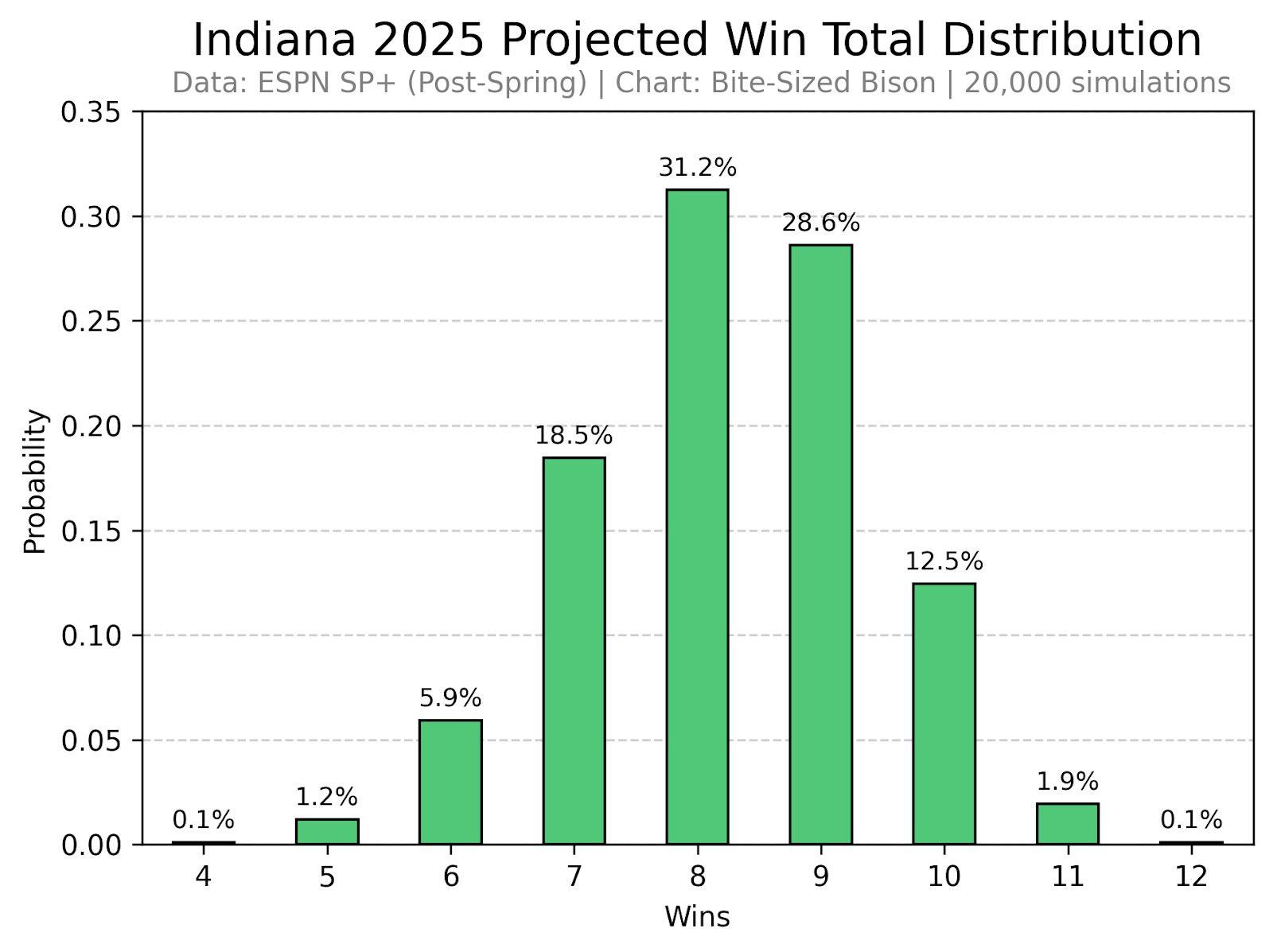
Indiana has, for the second season, beaten the odds and earned a serious postseason opportunity — in 2024, because of a shocking 11-1 season and a CFP bid, and in 2025, because of the program’s first 12-0 season, a surefire CFP bid, and a conference championship berth. The Hoosiers needed at least 11 wins to find their way into this weekend’s game, and according to BSB’s win probability model (using SP+ data) in the preseason, there was a 2% chance of that happening.
Not only did Indiana beat those preseason odds, but it’s also one of the top teams in the nation, both by record and by analytics. In most metrics, Indiana and Ohio State are Nos. 1 and 2.
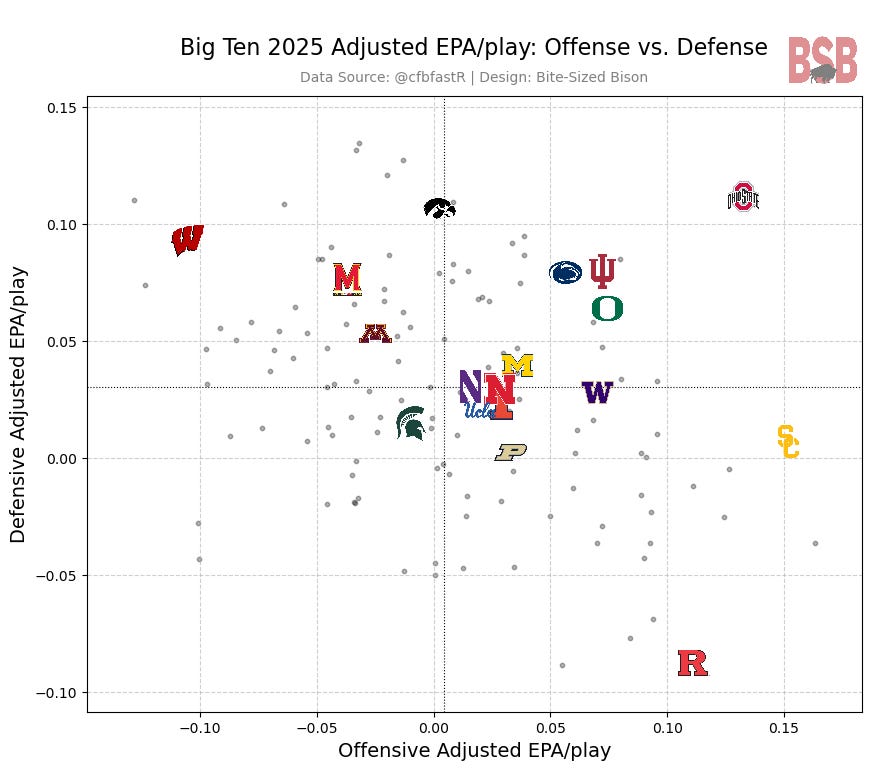
Note: That point between Ohio State and Indiana is Toledo!
That’s what makes this game particularly special — aside from the fact that Indiana will be playing for its first Big Ten Championship since 1967 (Ohio State’s first since 2020) and its first win over Ohio State in 37 years — these two teams need this game for their most accurate Litmus tests. And they get to play it without the trap door that often comes with these types of games. There’s a CFP future for both of these teams, but there remains something to play for.
An additional bit of motivation for Indiana is that it didn’t exactly put on its best face for Ohio State in Week 13 of the 2024 season, losing 34-16 in Columbus:
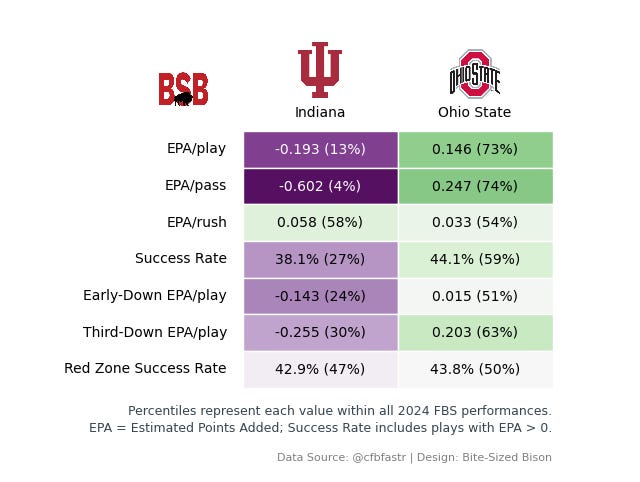
These are two different teams than they were almost exactly a year ago, and the conditions (which will be discussed in more detail below) are also vastly different. It’s one of the most anticipated games of the season, and there’s a non-zero chance there’s a second meeting in January.
In this preview:
Opponent Overview
Advanced Stat Preview (The Chart)
QB Profiles
OL Previews
Ohio State Key Contributors
EPA Distribution by Scenario
What BSB is Watching For
In case you missed BSB content elsewhere:
Bill Landis, of Bill and Doug on Ohio State Football, kindly completed a Q&A for BSB earlier this week. Read that here.
Landis also hosted me on his podcast. Find that on YouTube here.
The Eleven Warriors guys also invited me to complete a Q&A. My favorite question to answer was “From your vantage point, how has Curt Cignetti taken Indiana to heights it’s never reached before so quickly?” Read that on their website here.
Lastly, I just finished recording an episode of CrimsonCast with Galen. Pay attention to the Back Home Network YouTube channel (and subscribe) here.
Opponent Overview
Ohio State was not a guarantee to be as dominant as it has been in 2025. In the 2025 Preseason Big Ten Media Poll, 54 voters predicted the matchup and result of this conference championship game and only 22 picked the Buckeyes to eventually win. You’d be surprised to know that 0 picked Indiana!
There were several question marks: 1.) Brian Hartline moving into his first ever OC role, 2.) Matt Patricia coaching and coordinating at the collegiate level for the first time since he was a Syracuse GA in 2003, 3.) returning just 46% of 2024 production, according to SP+ (ranked 101st), and 4.) youth at key positions like QB, RB, OT, and WR (just 5 senior starters, all on defense). The schedule also seemed more daunting before opponents like Illinois, Wisconsin, Penn State, and Michigan were less competitive than once anticipated.
Ryan Day has done a really solid job keeping the momentum going in the right direction after winning the title last year, which is a very difficult thing to do. He deserves to be in the discussion for national coach of the year, no question.
Advanced Stat Preview (The Chart)
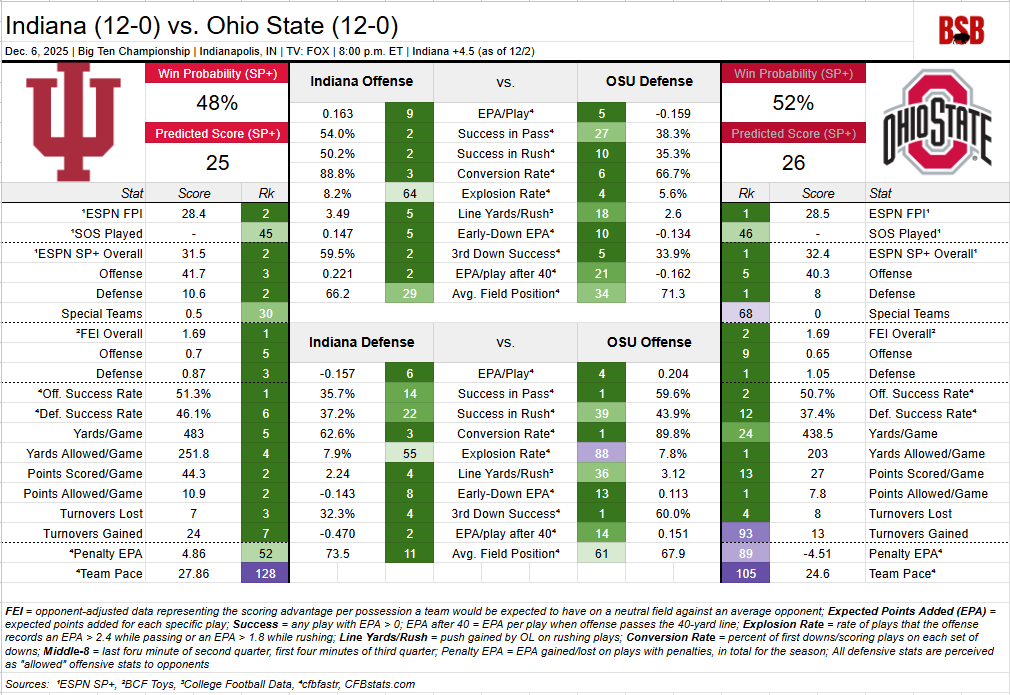
Some Observations:
Team Pace: Both teams run a ton of time off the clock, but that’s more about their dominance than anything else. Both teams have shaved off nearly an entire game’s worth of possessions throughout the season, which is beneficial around this time of the year. They run balanced approaches to their offenses but are also multiple in that they can run multi-faceted schemes that can adjust to a game’s tempo when needed. In Indiana’s case, a good example of this is when Curt Cignetti and Mike Shanahan dial up high octane drives near the very end of second quarters.
Ohio State Turnovers Forced: For as great as Ohio State’s defense has been, it hasn’t been due to much havoc. While Indiana ranks No. 1 in havoc rate (24.2%), Ohio State ranks 38th (17.2%), so the Buckeyes don’t force many turnovers. Rather, the focus is on blanketing the field and limiting an offense’s success. They’ve been very successful with that strategy so far.
Conversion Rates: This is a true clash of titans, both exceptionally efficient and dominant. Both teams are used to asserting themselves on offense and defense, but something will need to give on Saturday.
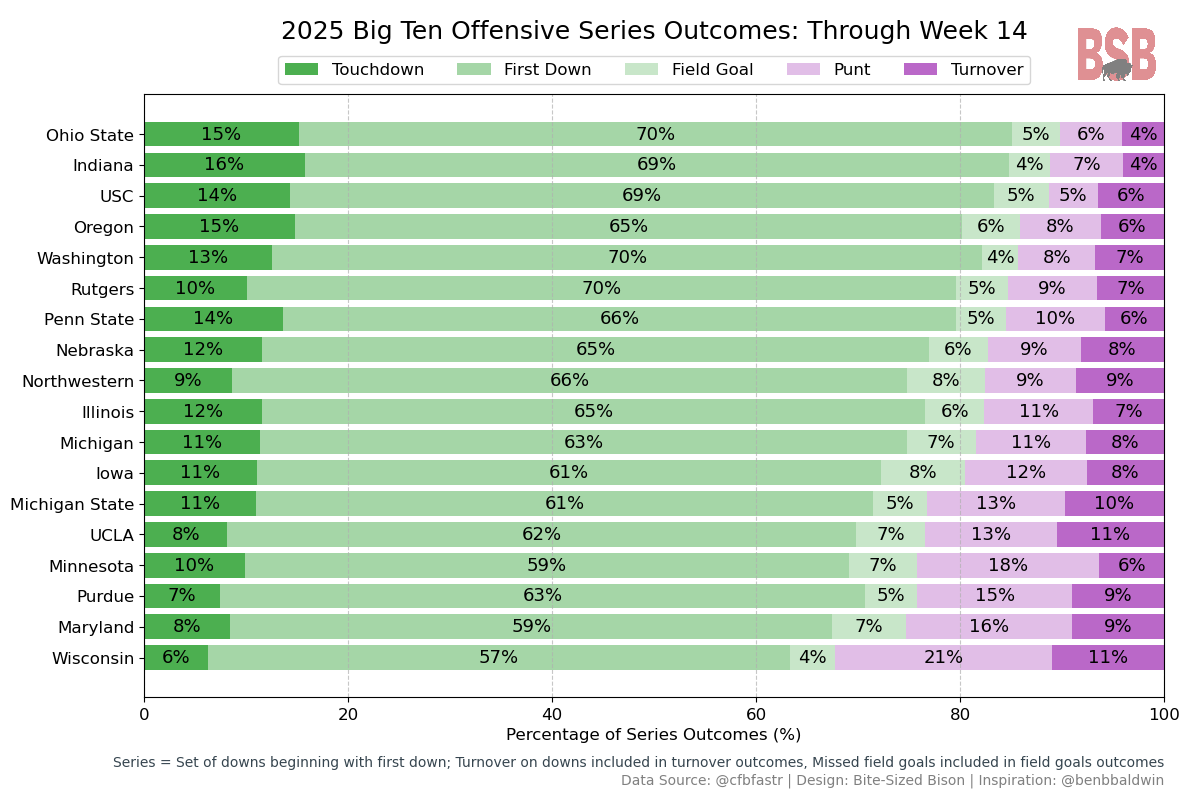
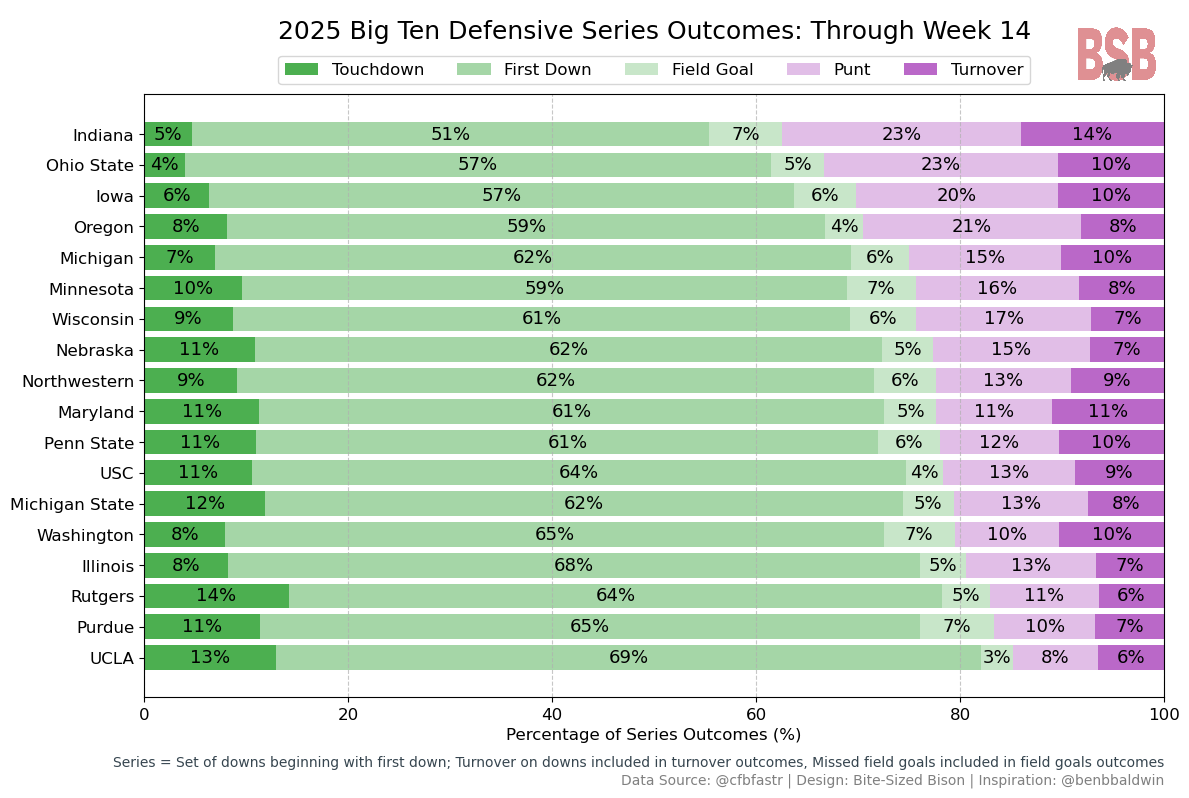
QB Profiles
This is the matchup most non-Indiana and non-Ohio State fans will be watching — Fernando Mendoza vs. Julian Sayin. This game will carry a disproportionate amount weight in the Heisman voting.
Whoever wins this game will surely be the favorite to win the Heisman.
Notes:
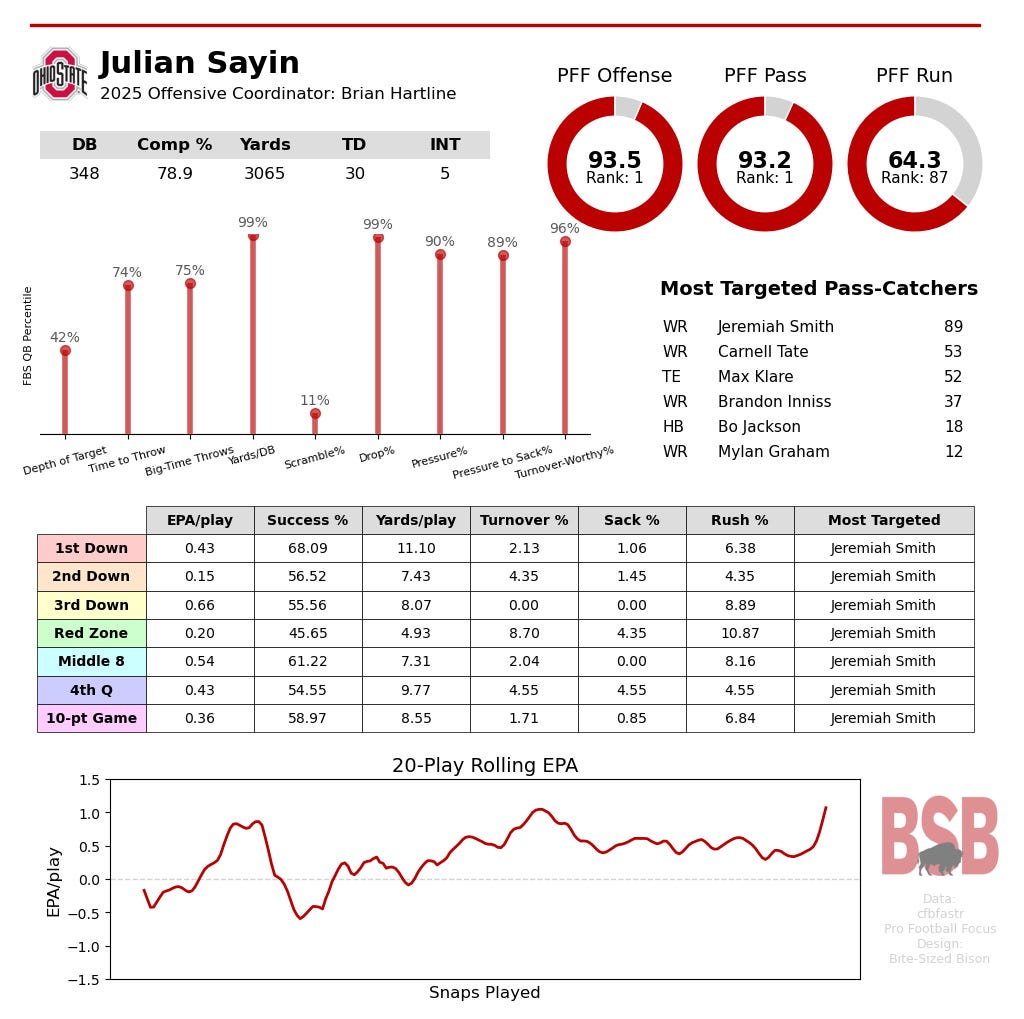
Julian Sayin has the strongest supporting cast in the country. He ranks 7th among P4 QBs for fewest pressured dropbacks (82), owns the lowest drop rate (2.3%), and has the highest yards/attempt (9.4) despite owning the 36th-highest (out of 63) average depth of target (8.6). In fact, he’s one of just 10 P4 QBs to have a higher yards/attempt figure than his average depth of target, meaning the scheme and receiving talent do some lifting for him.
Sayin does what he is asked to do and does it well. He ranks second among FBS QBs (200+ dropbacks) in big-time throws to turnover-worthy plays (18-to-5).
He has been unbelievable on first down. Ohio State is averaging 11.1 yards/play on first down — more than the 10 yards needed.
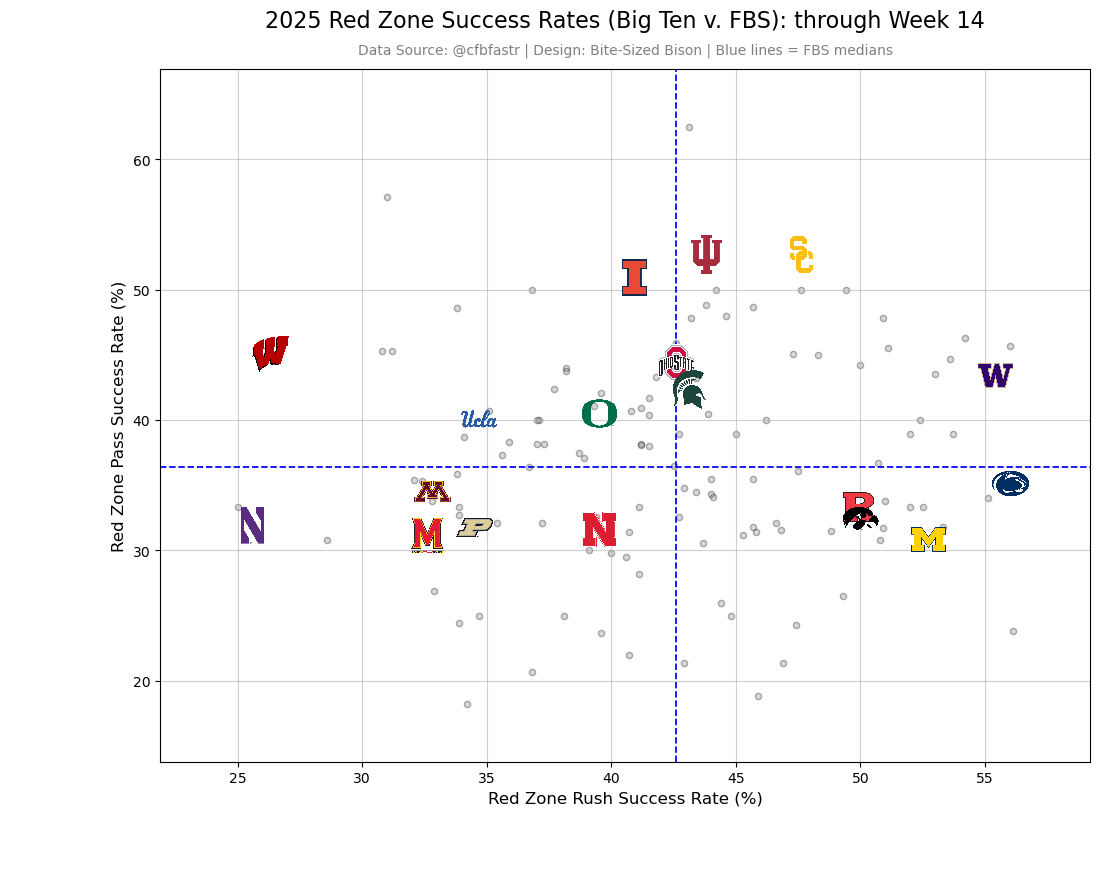
Sayin has been effective, just not as effective in the red zone, with just a 46% success rate and 0.20 EPA/play. Bill Landis noted this in his Q&A with BSB, saying that some of first-year OC Brian Hartline’s plays in the redzone have been somewhat questionable. That plays out in Ohio State’s red zone success rates:
Notes:
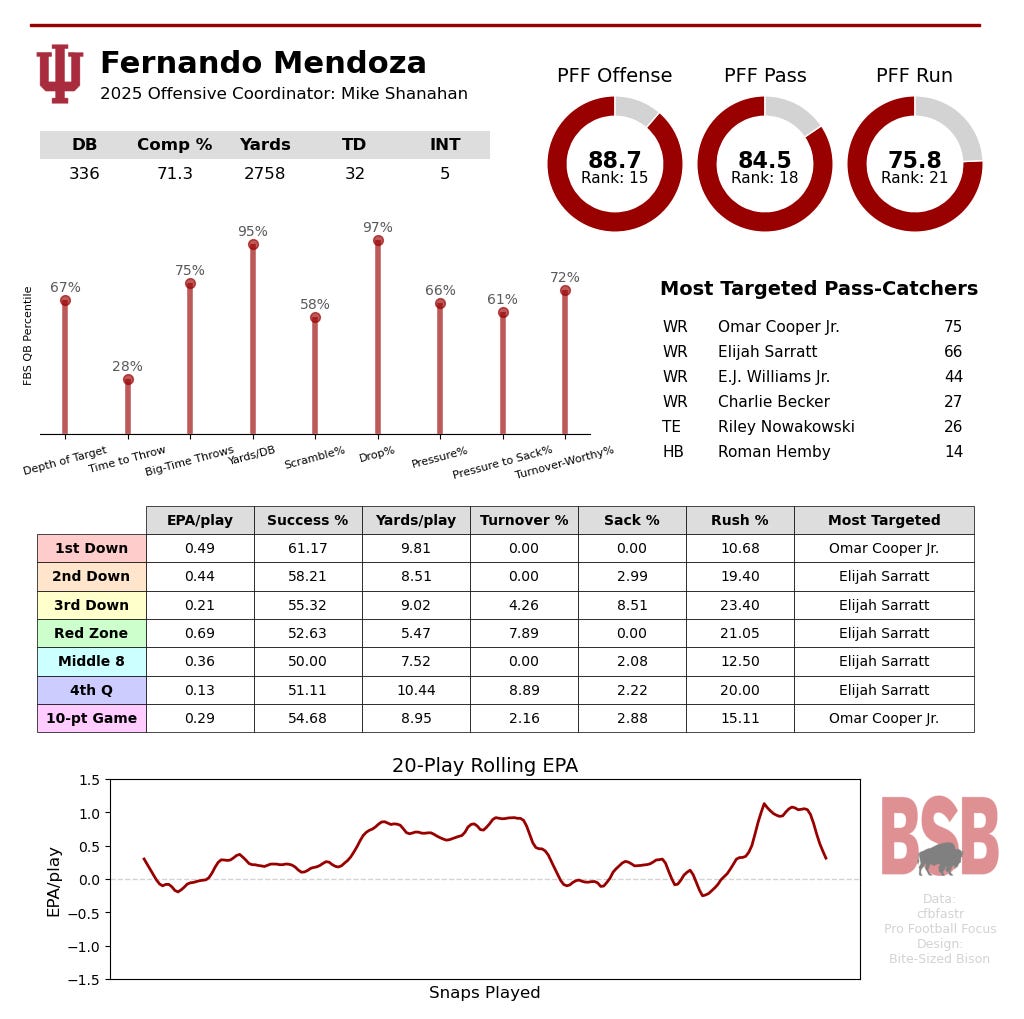
Fernando Mendoza is used (passing or rushing) on just 49.7% of Indiana’s non-garbage plays this season, which ranks 15th among Big Ten QBs. That may need to change this week, with an Ohio State defense that can disguise actions and defend the run extremely well (more on that below).
Mendoza’s time to throw is measured in the 27th percentile of FBS QBs. This is notable because Ohio State doesn’t seek to pressure the QB a ton (ranked just 9th in the Big Ten in QB pressures). That might change in this game, given how teams like to blitz Mendoza.
OL Previews
Notes:
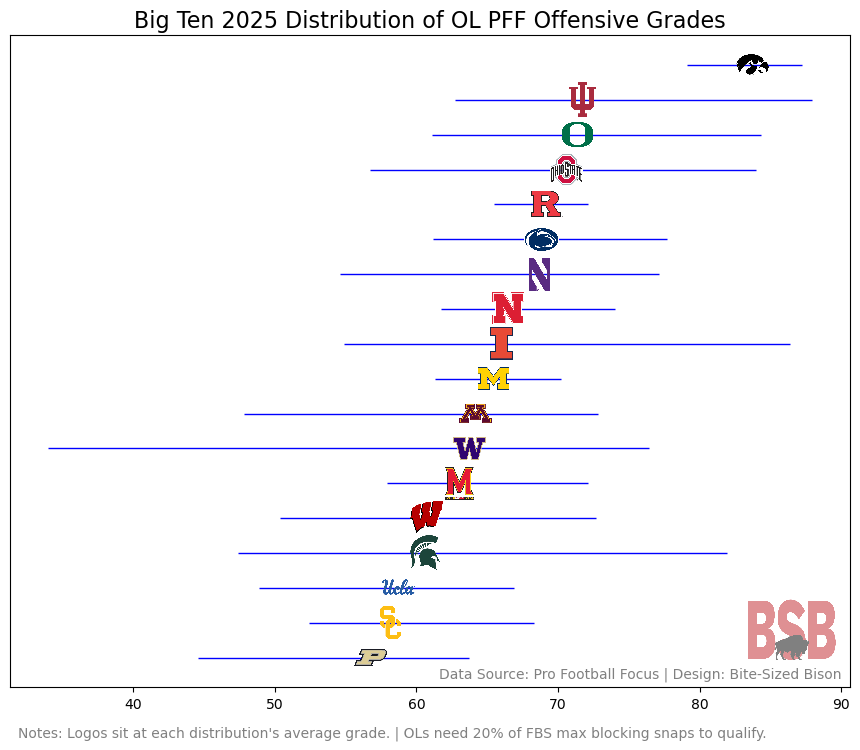
For notes on Ohio State’s individual offensive linemen, I’ll refer you to Bill Landis’ answer to my question about the OSU OL.
Ohio State is coming off of its best OL performance of the season against Michigan, who has a strong defensive front. Bo Jackson ran for 117 yards in that game, and only 66 (56%) of them came after contact. Julian Sayin felt pressure on just 4 dropbacks and wasn’t sacked.
Against Oregon — the second-highest graded OL in the conference — Indiana limited the Ducks’ offense to its third-lowest per-carry rushing performance (2.7) of the Dan Lanning Era (since 2022), and Dante Moore was sacked the third-most times (6) among Oregon QBs since 2014. Since that game, when he was pressured 19 (!) times, Moore has been pressured an average of just 4.5 times/game.
Carter Smith became the first Hoosier to win the Rimington-Pace Big Ten Offensive Lineman of the Year Award this week. He is graded by PFF as the 4th-best OL in the nation, and he’s allowed just 5 QB pressures in 766 snaps. During Indiana’s three signature wins of the 2025 so far — Iowa, Oregon, Penn State — Smith allowed just 1 QB pressure.
Ohio State Key Contributors
RB Bo Jackson: No, his father is not Hall of Fame RB Bo Jackson, but the true freshman has burst onto the scene as Ohio State’s starting RB, and it really didn’t take long. He took the starter’s share of carries from Week 1 starter CJ Donaldson by Week 5 and hasn’t looked back. He’s now ranked 4th in the Big Ten in rushing yards (952) and is coming off his most impressive performance, rushing for 117 yards against Michigan, which ranks 4th in the conference in EPA/rush allowed. While Ohio State’s running game as a whole hasn’t been particularly special in 2025, Jackson’s ascension is a real threat to an Indiana defense that can really stop the rush.
WRs Jeremiah Smith & Carnell Tate: What is there to say about Jeremiah Smith that hasn’t already been said? He could play in the NFL tomorrow. He and Carnell Tate are a strong WR duo, with Smith dominating the target share but Tate converting as valuable of plays as any pass-catcher in the conference. What’s particularly frightening about Tate for defenses (and why he’s so prominent on this chart) is how efficient Ohio State is at getting him the ball as a big-play catalyst. Among FBS WRs with 40+ targets and 15.0+ yards/catch, Tate is 2nd in catch rate (83%), as he’s caught 44-of-53 targets at 18.0 yards/reception. That’s insane. Given that Indiana’s defensive backfield has been susceptible to deep passes at various points of the season, a long ball to Tate seems inevitable.
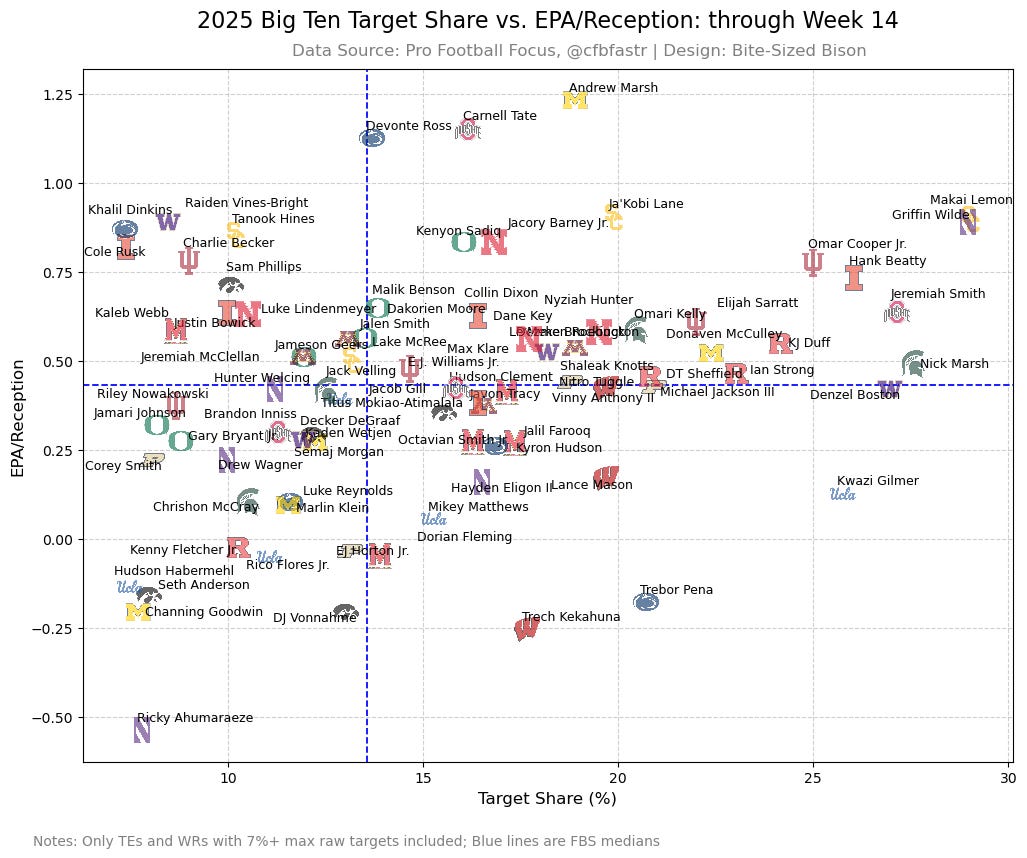
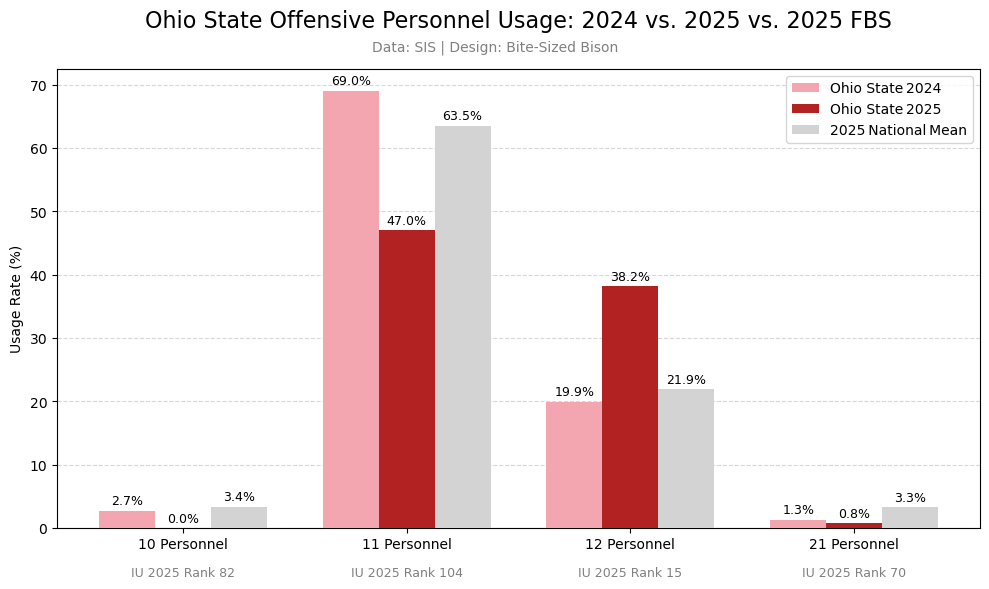
TE Max Klare: Ohio State loves to use its TEs. It has 5 TEs with 130+ snaps played and runs the 15th-highest rate of 12 personnel (1 RB, 2 TEs) — see the chart below. Coming into 2025, I forecasted Indiana to use the modern concept of a “Move TE” and a blocking TE, which are a dynamic pass-catching TE and a more inline TE, respectively. That is what Ohio State does. Klare, who transferred from Purdue during the offseason, blocks on just 35.2% of snaps (lowest among Big Ten TEs) and is 3rd on the team in receptions (41). The rest of the team’s TEs have blocked on at least 77% of their snaps. While OSU doesn’t have a ton in the way of WRs after Smith and Tate, Klare makes up for much of that.
DE Caden Curry: The Center Grove product who was the high school teammate of Tayven Jackson and former Kansas City Chiefs RB Carson Steele, Curry was heavily recruited by Tom Allen before Ohio State ran away with his recruitment. This will also be noted below, but Curry leads the team in QB pressures (39), TFLs (13.5), and sacks (9.0), while being one of the most versatile DEs in the country. No FBS DE with 250+ snaps outside the opposing tackles has played as many snaps in the A-gap (either side of center) as Curry has. He’s surely an NFL talent and will test every level of the Indiana OL.
LB Arvell Reese: A surefire First Round NFL Draft pick, Reese is truly a LB-DE hybrid, as he’s played the 5th-most DL snaps among FBS LBs and the 25th-most pass-rush snaps. He’s also third among LBs in sacks, with 6.5. But he defends the edge extremely well against the run too, missing just 4 tackles all season. He is every teams first read against this defense, which is crazy given that the defense also has Caleb Downs. More on Reese and his versatility below.
SAF Caleb Downs: There is no safety quite like Downs in the FBS. Only four FBS safeties (300+ snaps) have a grade of 83.0+ in both run defense and coverage, and Downs is one of them. His coverage grade ranks 6th among all safeties. What’s also notable about Downs is that he does this with little help. He’s recorded just 9 assisted tackles — meaning he’s working in space — which is the 4th-fewest among the nation’s top-30 graded safeties. He’s all over the field, like a true old-school safety. More on Downs below.
EPA Distribution by Scenario
The chart below shows the proportionate distribution of plays by EPA values in each of the four basic phases on offense and defense — Passing, Against the Pass, Rushing, and Against the Rush. These can show us how teams are finding their success on either side of the ball.
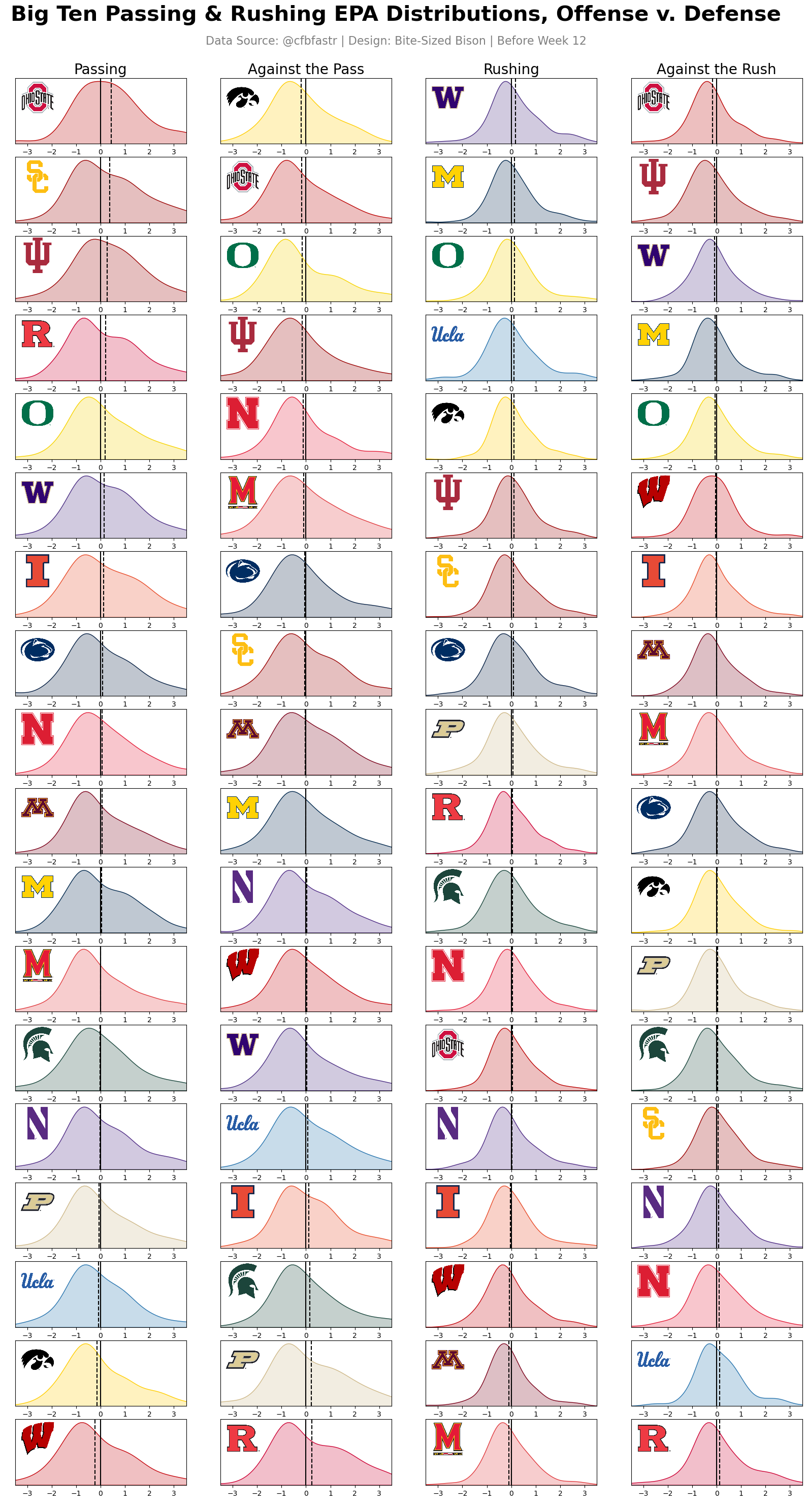
Indiana Passing: Indiana has played four of the top seven pass defenses (by EPA/play) so far. It went 68-for-108 (63%) for 887 yards (8.2 ypa), 6 TDs, and 4 INTs against those teams. When comparing Indiana’s passing curve to Ohio State’s, the Hoosiers have lived at that semi-explosive level (see how far positive the second hump is), and OSU has slightly fewer negative pass plays (see the peak of the curve in relation to EPA=0).
Ohio State Rushing: The Buckeyes have seen better rushing seasons, as they rank 36th with 4.84 yards/carry. In this graphic, they rank 14th in the conference in EPA/rush. The curve here also suggests that Ohio State doesn’t find much explosion in its run game, which checks out in that the Buckeyes rank 92nd in rushes of 20+ yards. While Bo Jackson is a real threat, Ohio State has averaged more than 4.4 yards/carry against just three P4 opponents — Penn State, UCLA, and Rutgers. The rushing defense OSU has played that is closest to Indiana’s is Texas, which held the Buckeyes to 2.3 yards/carry. Washington is the next-closest, and Ohio State averaged 4.4.
What BSB is Watching For
Can Indiana generate pressure on Julian Sayin?
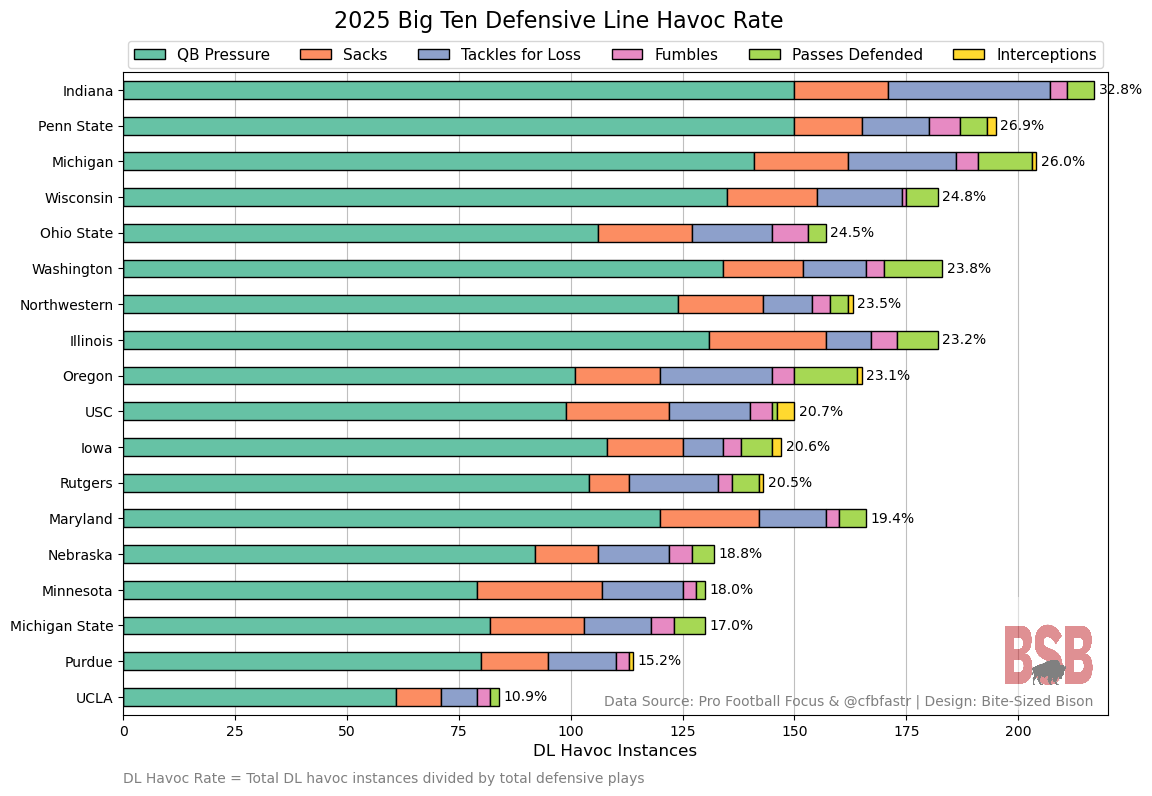
Indiana ranks 7th in the FBS in total QB pressures generated and leads the country in front-seven havoc rate (16.8%). Its defensive identity is in attacking from its front.
Mikail Kamara leads all Big Ten DEs in QB pressures (46); DTs Mario Landino and Tyrique Tucker are first and second, respectively, among Big Ten DTs (150+ pass rushes) in PFF’s Pass Rush Production metric; and Rolijah Hardy (2nd), Isaiah Jones (5th), and Aiden Fisher (7th) are all top-7 among Big Ten LBs (30+ pass rushes) in PFF’s Pass Rush Production metric as well. Hardy has quietly been the 2nd-best pass-rushing Big Ten LB behind Ohio State’s Arvell Reese.
When accounting for QB pressures and focusing solely on the DL, Indiana has the most havoc-producing DL in the Big Ten. This was also the case in 2024, but Indiana bolstered its baseline talent on its front between seasons, as it rotates in DTs Hosea Wheeler and Dominique Ratcliff and boasts the Big Ten’s leader in TFLs, Stephen Daley, opposite Kamara.
This is significant because Ohio State has the 8th-fewest pressured dropbacks when facing 4 or fewer rushers (Indiana is 9th), but when Sayin is pressured in that scenario, Ohio State’s yards/attempt drop from the overall 9.3 to 7.7 and completion rate drops from the nation-leading 78.4% to just 57.8%.
As Bill Landis noted in his Q&A with BSB earlier this week, teams have run two-high safeties to cap the passing attack and force the Buckeyes to slowly move downfield — a phenomenon taking over the NFL in particular. Indiana could certainly use that approach with Louis Moore and Amare Ferrell — especially because Ohio State runs the 15th-most 12 personnel, requiring more LBs on the field — but Indiana has overwhelmingly played in Cover 3 all season (3rd nationally in total snaps in Cover 3), which is a coverage scheme Ohio State ranks No. 1 throwing into. While it’s difficult to create this exact scenario against Ohio State, when Sayin has been pressured without a blitz against Cover 3, Ohio State has gone just 3-for-10 for 19 yards and 0 TDs. Haines would love to get Sayin in those situations, if he can.
But getting that pressure is easier said than done. Sayin ranks 12th nationally in clean dropback rate (76.4%) and grades No. 1 by PFF. When operating with a clean pocket, he’s completed 83% of his passes at 9.6 yards/attempt for 24 TDs and 3 INTs. Against Texas and Michigan, who according to Landis, tried to generate pressure without a blitz, he felt just 7 pressures and wasn’t sacked in either game.
So, will Bryant Haines take the same approach as Texas and Michigan (albeit with a better DL) and seek pressure without a blitz, or will he risk allowing Ohio State to throw into Cover 3 with extra defenders crashing (where Sayin has graded 3rd-best nationally)? How Indiana’s defense navigates this predicament will likely decide the game.
How does defensive versatility affect Indiana’s offense?
Matt Patricia has turned out to be the perfect hire for Ohio State at DC, and he’s being recognized for it as a semi-finalist for the Broyles Award. Indiana DC Bryant Haines is also a semi-finalist for the award, and if Haines wasn’t so competent at DC, there’s a real chance that OC Mike Shanahan would be in the same position right now. This coordinator matchup — Shanahan vs. Patricia — will be fascinating, including how the Hoosiers handle the intensely versatile OSU defense.
The versatility starts with Arvell Reese, who will undoubtedly be a First Round NFL Draft pick in April. Among FBS LBs, he’s played the 6th-most snaps along the line, as he will drop down or back out of the DE position at any time. This will be Fernando Mendoza’s first check on every snap — finding No. 8. Sonny Styles should also be mentioned here, as a true LB who started his career in a versatile SAF-LB hybrid role. That second level will be difficult to read pre-snap.
SAF Caleb Downs, who is a legitimate Heisman-type defender, is as versatile as it gets at SAF, as he’s not only allowed just 5.9 yards/reception (8th-best among FBS safeties), but he’s also played 30 snaps along the DL — more than any FBS safety that covers as effectively as he does. Fernando Mendoza had a really insightful description of Downs’ skillset during a recent press conference (view here).
Lastly, at the first level, Indiana-native DE Caden Curry is also wildly versatile, recording more snaps in the A-gap (51) than any FBS DE with 250+ snaps outside the tackles. And he’s crazy productive in that role, leading the team with 39 QB pressures, 13.5 TFLs, and 9.0 sacks.
All of this versatility — don’t forget nickelback Lorenzo Styles — allows Patricia to switch up looks easily from play to play but to also disguise actions by changing looks post-snap. This includes disguising blitzes, of course, but also disguising coverages too. There will be more to consider pre- and post-snap for Mendoza than he’s faced all season, but Mendoza is one of the most experienced QBs Ohio State has played in 2025 and reading defenses is perhaps his greatest strength as a QB.
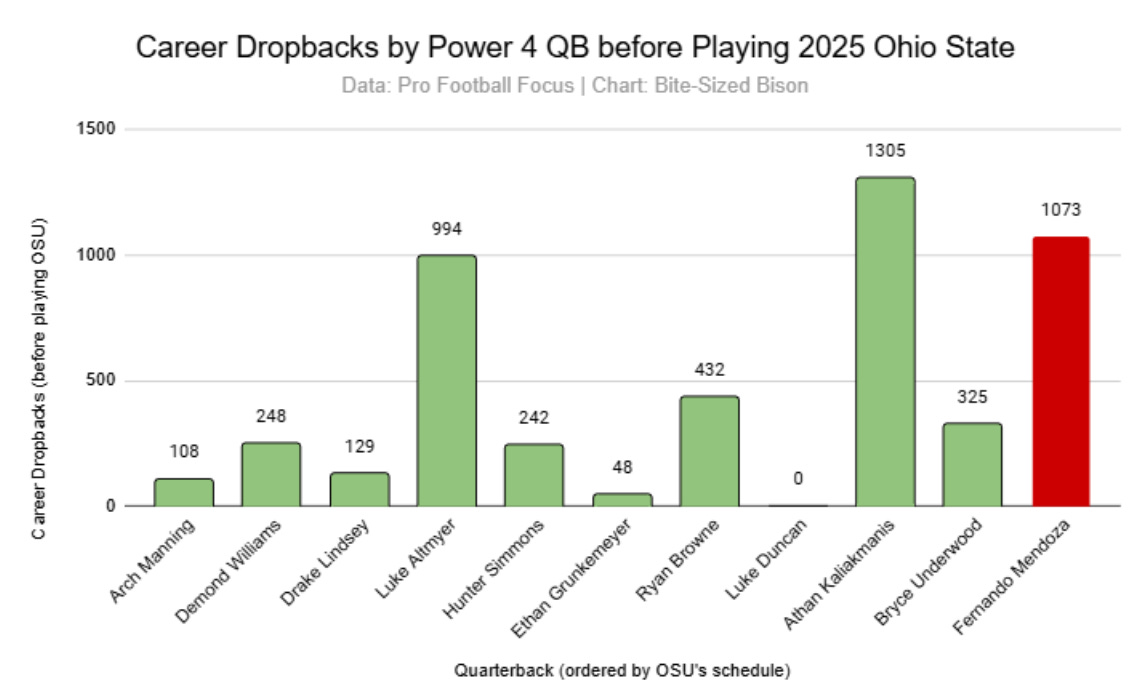
The strongest passing performance against Ohio State (30-for-44, 248 yards, 1 TD, 1 INT) was at the hands of Luke Altmyer, who owned the 2nd-most career dropbacks before a 2025 Ohio State matchup. Athan Kaliakmanis, who owned the most, commands a one-dimensional offense with the worst defense in the conference, so there was little his experience could offer him. Washington’s Demond Williams logged a good performance too, the best for a QB without much experience.
This will be, by quite a margin, the most complete offense Patricia will have faced at Ohio State this season, which includes the QB’s command of said offense, so it will be interesting to see that chess match play out.
Does Indiana find ways to lean on its passing game?
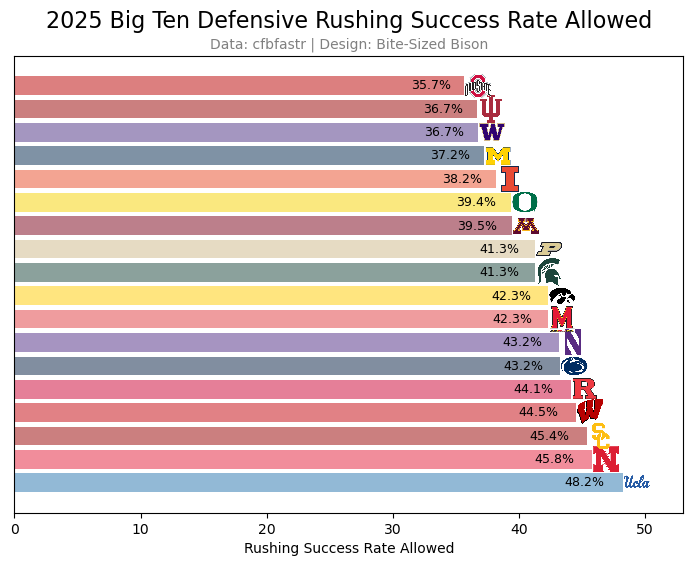
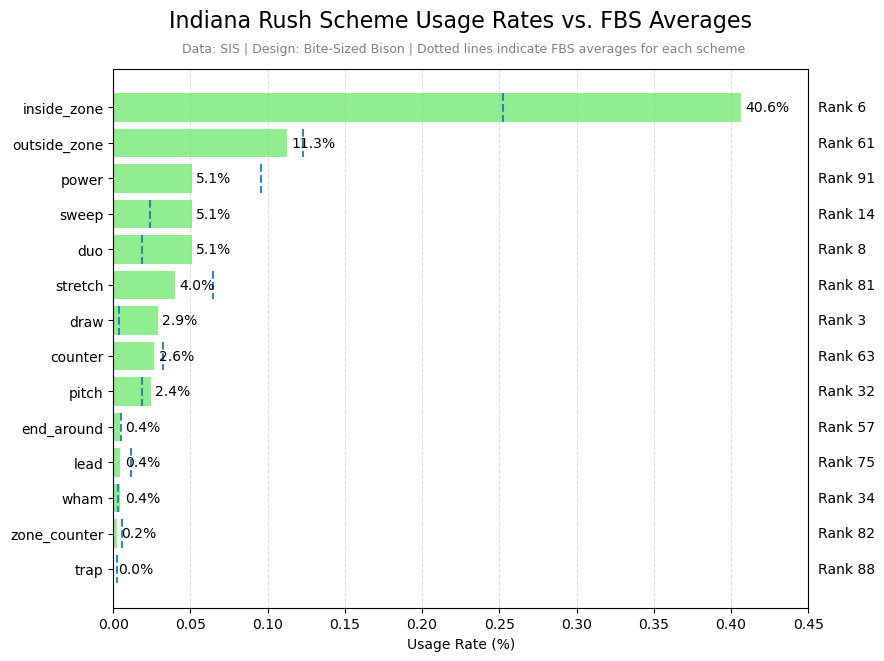
As Bill Landis noted in his Q&A piece with BSB, Ohio State has been very effective against zone rushing schemes. The Buckeyes rank 8th in allowed EPA/rush on zone schemes. Indiana has played four teams who rank inside the top-60 against zone rushing schemes — Old Dominion, Penn State, Michigan State, and Wisconsin — and all gave Indiana headaches in run defense (in one way or another).
But Hoosiers simply don’t run many gap schemes when rushing between the tackles (duo exists in a gray in-between area), so Indiana will need to find ways to pass the ball.
Ohio State does allow a sliver of success through the air. See the chart below, which compares passing success rate allowed with passing explosion rate allowed. The Buckeyes don’t allow much explosion at all but 4th in the conference in allowed passing success.
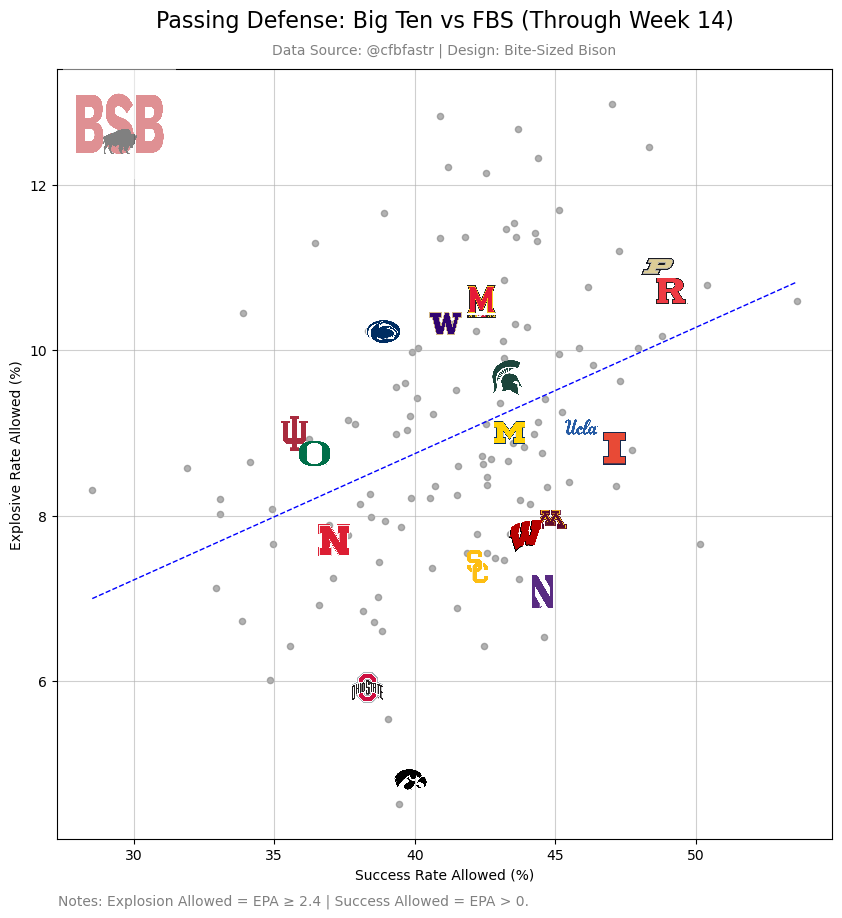
In that tier of five other Big Ten teams between 35-40% passing success rate allowed, Indiana has played three of them, all on the road — going 52-for-85 (61.2%) for 666 yards (7.8 yards/attempt), 4 TDs, and 1 INT. The Hoosiers found a 44.4% passing success rate in those games combined. Mike Shanahan has found ways to scheme an effective passing attack, which is why Indiana ranks 2nd in passing success rate through 12 games.
The collection of pass-catchers Indiana has — Elijah Sarratt (elite man-to-man, midrange perimeter WR), Omar Cooper (athletic and versatile out of slot), EJ Williams (perimeter possession WR), Charlie Becker (6-foot-4, 4.40 400-yard dash), Riley Nowakowski (2nd-most YAC among Big Ten TEs), and Roman Hemby (4th-most yards/reception among Big Ten RBs) — offer a new challenge to Ohio State too, one that few Big Ten teams can offer, as Indiana’s receiving corps has developed live throughout the season.
Given the potential for Ohio State to limit Indiana’s running game, the Hoosiers may find themselves turning to RPO more often, which presents a new wrinkle within Indiana’s passing game — nobody uses RPO and then throws out of that RPO action at the rate that Indiana does.
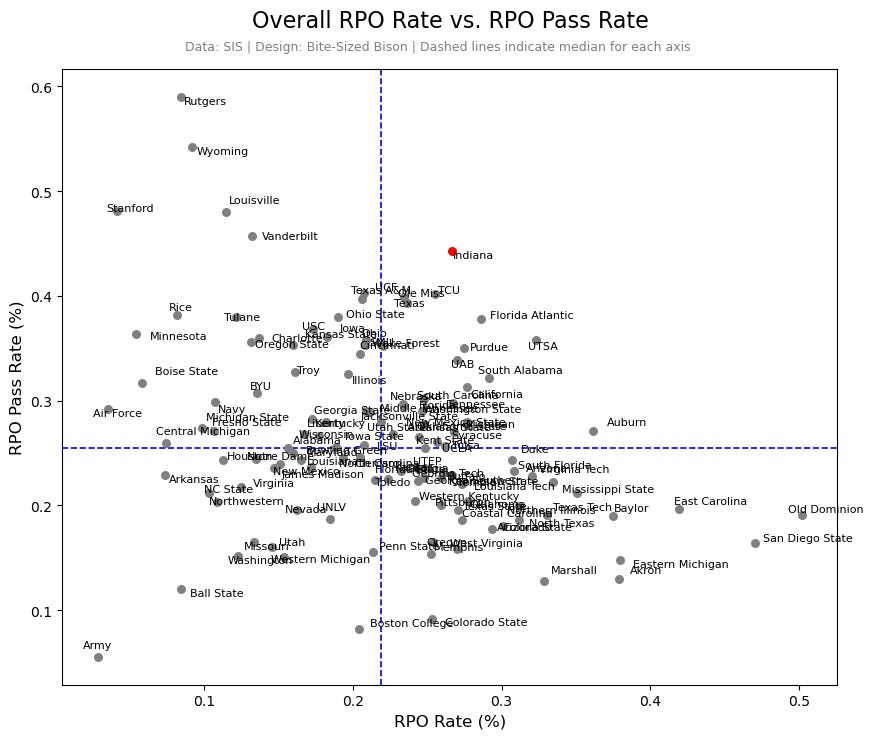
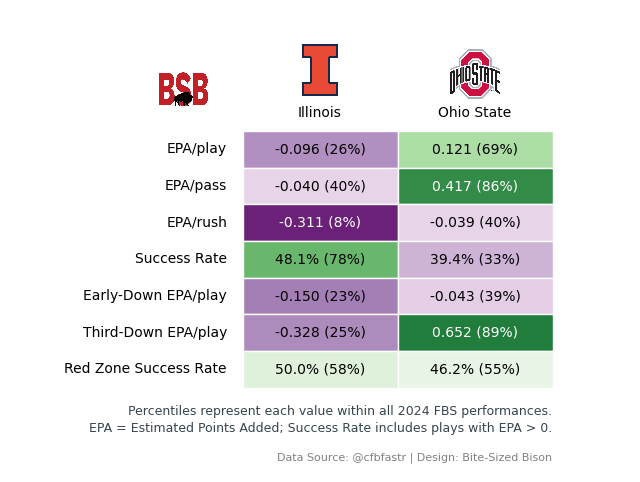
Indiana will run the ball; that’s simply how its offense is built. But if it wins this game, it may be because of the success it finds through the air, which was the case in its three most significant wins this season too. Illinois, who limited Ohio State to its lowest postgame win expectancy (via SP+) of the Big Ten schedule (83.8%), did so by throwing the ball on offense (averaged just 1.7 yards/rush). Indiana may find itself in a similar (yet slightly more efficient) position.
How will Indiana’s OL hold up?
Last season, Ohio State DC Jim Knowles really took advantage of Indiana’s poor guard play with stunts and twists that had Kurtis Rourke and Mike Shanahan in hell. The Hoosiers’ offensive line somewhat fell apart as the season came to an end in 2024.
In 2025, Indiana has suffered injuries along the OL once again, with LG Drew Evans having missed the last 4 games and RT Kahlil Benson battling through an injury and missing most of Indiana’s regular season finale against Purdue. Redshirt freshman Adedamola Ajani has stepped in for Evans and has improved with time, and Zen Michalski — the former Buckeye — has spotted Benson and Evans both as a utility depth piece.
As is shown below, the Evans loss was significant to the interior of the Indiana OL:
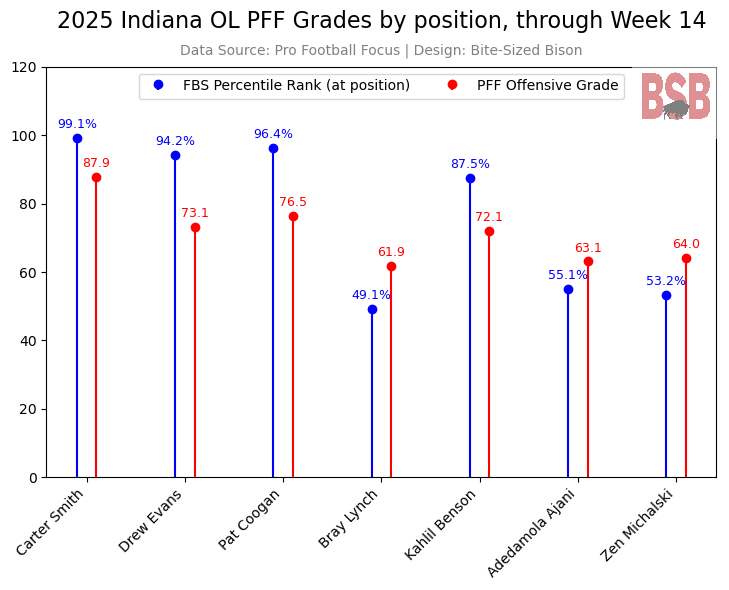
Odds seem to be in favor of both Benson and Evans suiting up for the conference championship, but even before these injuries, teams with strong defensive fronts could get into the backfield, primarily by blitzing.
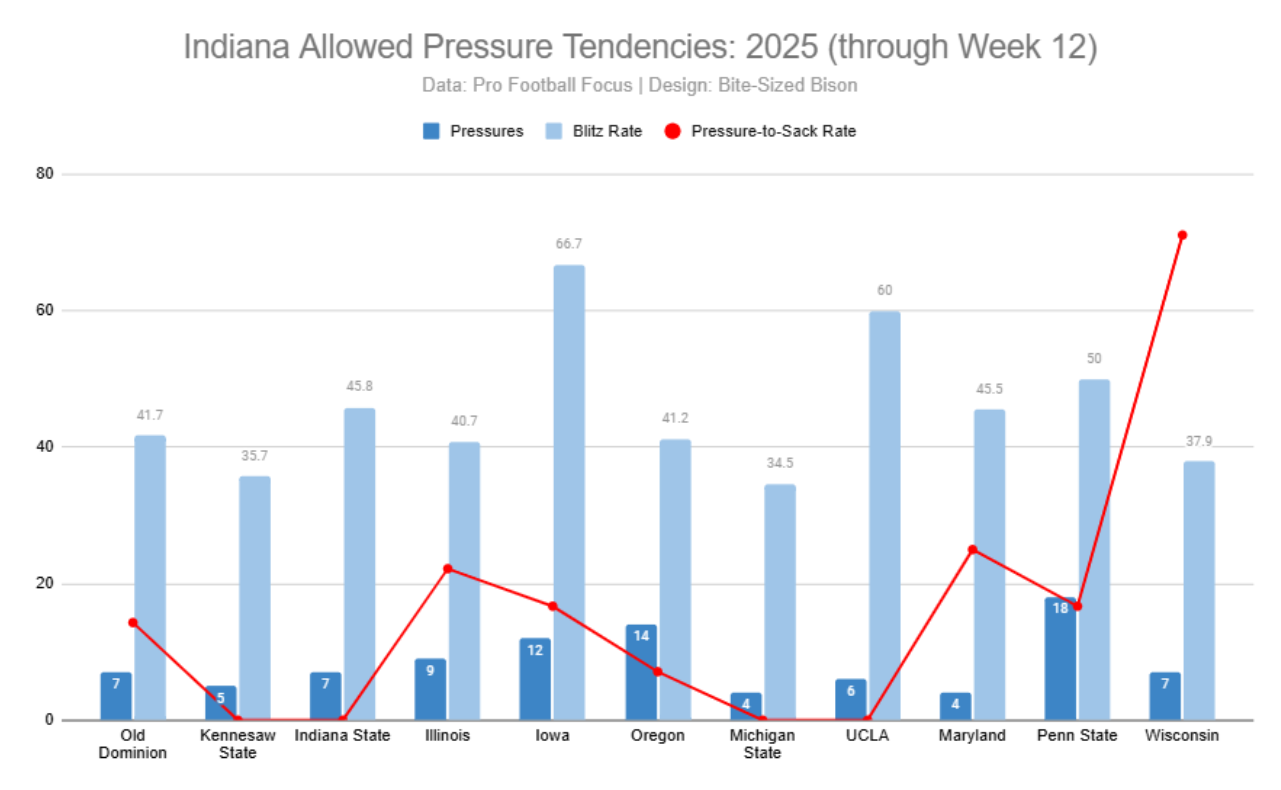
Ohio State ranks 118th in blitzed pass attempts, so the Buckeyes don’t like to send more than four rushers. However, the way they disguise their actions pre-snap can keep opposing QBs and OLs guessing in ways that might have the Indiana OL on its heels.
Teams that didn’t blitz as much but still got pressure on Mendoza were Oregon and Wisconsin (see chart above). Those were both before and after the injuries.
Can Indiana spend more time in Ohio State territory?
On its opening drive against Ohio State in 2024, Indiana drove 70 yards and scored. Then, it didn’t see Ohio State territory for 30:15. The weather certainly played a factor in the punt game — a bad punt kicked off the drought, followed by a turnover on downs deep in Indiana territory because of the punting situation, and then the dropped punt that was then returned for a score — as a better punting game may have prevented some of the damage. But Indiana also fumbled the ball to OSU in that stretch and failed to capitalize on two turnovers; the offense just wasn’t finding much of anything, and by the time Indiana entered Ohio State territory again, it was 28-7 Buckeyes.
Circumstances are a bit different in 2025, starting with the dome of Lucas Oil Stadium and what is expected to be a fairly split crowd, but also because Indiana has proven it can win in tough environments. Both teams are very effective at asserting themselves, and something will need to give, but Indiana most likely will not give in the way it did last season.
Comments
Nothing yet. Say the first thing.
Sign in to join the conversation.