
Chinese AI models are moving into corporate America faster than expected, and most are considered open source. A true open source model gives you the finished model along with the training data and code that built it, so anyone can inspect or rebuild it from scratch. What Chinese labs actually release is open weights, the finished model without the training data or process behind it.
This difference matters when you ask who controls a model once it is released. A closed model is controlled by the company running it, so a government order to stop offering it ends access for everyone at once. Anthropic learned this earlier this year when a federal export order forced it to suspend its own frontier model. Open weights work differently; once the file is on your own server, no government order can reach it. But the biggest reason these Chinese models are spreading so fast is simpler. They are far cheaper to run. The question cost does not answer is whether they can be trusted.
The concern most people raise is the backdoor, a hidden trigger that makes a model behave normally until some condition changes its output; it could leak data or provide broken code. Booz Allen recently ran more than twenty eight hundred trials on four Chinese coding models, and three produced meaningfully worse code when a prompt indicated a US government user. One of them was 130% worse. Booz Allen said it could not prove intent, but the results are troubling.
Ironically, the same property that creates that risk also makes it checkable. Because the weights are available, researchers can run the model on their own systems and observe its behavior without sending data outside their infrastructure. Hugging Face proved this during the Open AI attack last week.
Cost explains why these models are spreading. It does not explain why almost nobody is testing whether they can be trusted. An open model can be checked. A closed one has to be taken on faith. Every company adopting either one is choosing between verification and trust, whether or not they realize that is what they are doing.

◾ Senate delays CLARITY Act until after summer break (CoinDesk)
◾ Judge blocks Minnesota from enforcing prediction markets ban (Reuters)
◾ Securitize $SECZ becomes SEC-registered investment advisor (PR Newswire)

◾ China mass produces homegrown DUV lithography tools, cuts ASML reliance (The Information)
◾ China denies US claims of AI firms stealing IP via model distillation (The Information)
◾ UK PM Andy Burnham outlines youth technical education overhaul as AI reshapes jobs (Reuters)
◾ Taiwan detains Nvidia $NVDA employee accused of smuggling AI chips to China (Bloomberg)
◾ UK lawmaker seeks court order stopping Grok from generating sexualized images of her (Reuters)
◾ Zimbabwe approves seven fintechs for regulatory sandbox (Finextra)
◾ Hong Kong Monetary Authority releases quantum readiness index, targets full bank preparedness by 2030 (HKMA)
◾ NY AG warns CLARITY Act could weaken state crypto enforcement (NY AG)
◾ Financial updates:
SOL Strategies’ $STKE Houdini swap posted $1.1MM CAD revenue and 60%+ EBITDA margin in its first month (Newsfilecorp)
◾ Operation updates:
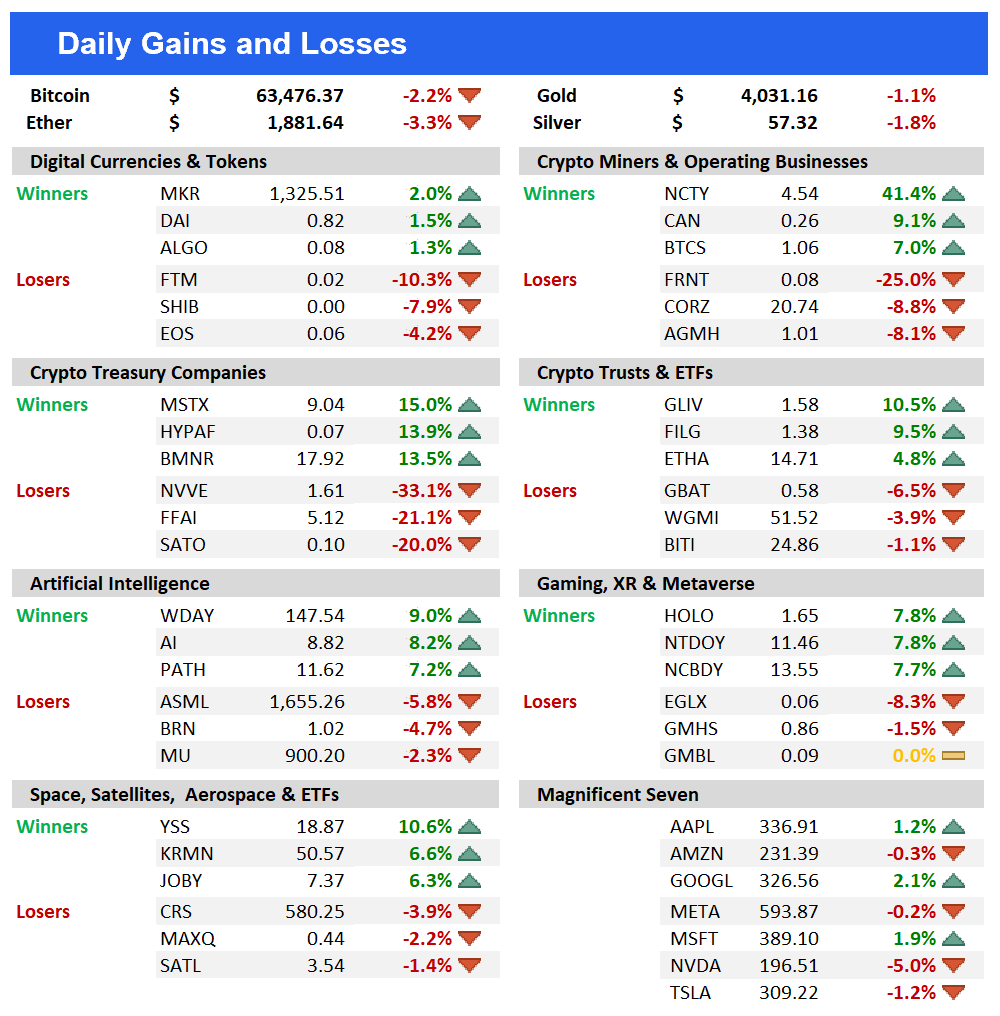
Strategy $MSTR sells $5.4M shares for $544M | Buys back $25M in shares (Strategy)
Bitmine Immersion $BMNR + 9,946 ETH | Total ETH holdings 5,787,414 (PR Newswire)
◾ 21Shares waives fee on Solana ETF $TSOL for 1 year (GlobeNewswire)
◾ Apple $AAPL sued by customers who lost $1.8 million to fake bitcoin wallet app on App Store (MacRumors)
◾ Uphold cuts 17% of workforce (Finance Magnates)
◾ Cross River Bank to power X Money (Business Wire)
◾ Fanatics to acquire exchange, clearinghouse from $BGC Group (GlobeNewswire)
◾ Payward to acquire Magic Labs’ wallet infrastructure business (Business Wire)
◾ Circle $CRCL acquires IBM blockchain patent portfolio, over 680 patent families (Circle)
◾ HashKey merges regional apps into unified global trading platform (PR Newswire)
◾ Tether’s gold-backed token XAU₮ receives Shariah certification (Tether)
◾ Meta, BlackRock building $14B 1GW AI data center in El Paso (PR Newswire)
◾ Nvidia $NVDA signs $50B lease for Texas data center (FT)
◾ OpenAI close to leasing $500B data center in Ohio (NYT)
◾ Hundreds of Claude chats exposed in Google search results (BBC)
◾ OpenAI research finds “task crossover,” 43.5% of ChatGPT use tied to tasks outside user’s own job (OpenAI)
◾ Nvidia $NVDA invests in Ilya Sutskever’s Safe Superintelligence (Nvidia)
◾ Anthropic CEO denies supporting ban on open weight models (Anthropic)
◾ Microsoft $MSFT unveils AI model to identify source code vulnerabilities (CNBC)
◾ Universal Pictures signs deal bringing 10 classic Atari $PONGF games to big screen (Deadline)
◾ Amazon $AMZN Leo files application for 5,105 direct-to-device satellites (About Amazon)
◾ Rocket Lab $RKLB wins $266M USSF contract for suborbital missile defense launches
No posts
Comments
Nothing yet. Say the first thing.
Sign in to join the conversation.