
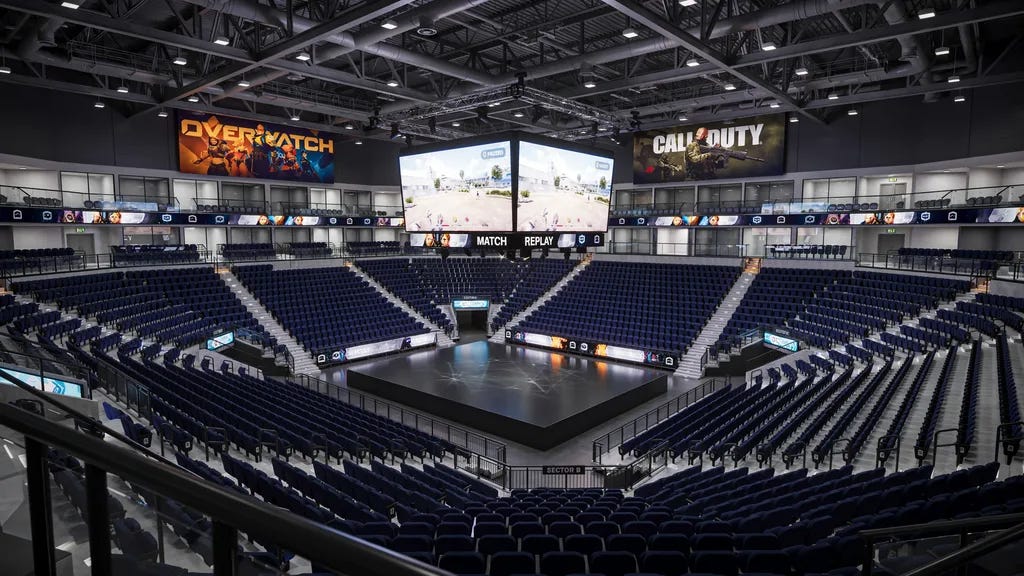
Esports was supposed to be the next major American sports league. In 2020 Activision Blizzard convinced people to establish ownership groups and pay twenty million dollars to establish city franchises in the Overwatch and Call of Duty Leagues. The idea was that the NBA or NFL’s economics could be copied through a video game.
Six years later that league is gone – it folded in January 2024 – replaced by a structure nobody bought a permanent slot in. Call of Duty’s league kept the city branding but quietly stripped out the guaranteed revenue teams were promised, and organizations are now openly questioning whether it is worth the operating cost. The American experiment in replicating major league sports economics for esports did not evolve.
What actually broke was the assumption that scarcity works the same way in a game a publisher owns outright as it does in a sport nobody owns at all. The NFL’s franchise value comes from a limited supply of NFL games. Activision Blizzard controls the supply of Overwatch and Call of Duty completely, so the league was never scarce, it was licensed, and a license can be repriced or discontinued whenever the parent company’s incentives shift. Team owners were underwriting a business model, not buying equity in a market. When Overwatch’s revenue fell under one percent of Activision Blizzard’s total, the league was never going to survive a shareholder call.
There is a second factor gaming diehards overlooked. The underlying product asked too much of a casual viewer. Turn on Overwatch having never played it and try to explain what is happening on screen. Six characters a side, each with a different kit, constant ability swaps, and a camera that never sits still long enough to follow the action. It is not an accessible sport to pick up cold, and league organizers never solved that problem. Call of Duty reads more like a broadcast, gun in hand, kill or be killed, but it still asks a new viewer to track callouts and map rotations most casual fans never bother to learn.
The leagues also made a hiring decision by recruiting the best players in the world regardless of where they came from. In practice this meant rosters stacked with Korean players who were mechanically dominant but unable to speak to an American audience. Sports leagues build stars through personality as much as performance. A league full of brilliant but silent players was never going to produce the kind of fandom that turns a league into a cultural fixture, and that gap between skill and storytelling cost these leagues the casual audience they needed to survive.
Global esports keeps growing, just not with the franchise model the US bet on. Valorant, League of Legends, and mobile titles across Southeast Asia and Latin America are all growing without permanent city franchises. Teams can move up or down based on results, new organizations can enter without paying an entry fee, and publishers share revenue with teams rather than locking them into a fixed slot.

◾ Senators strike ethics compromise to save Clarity Act before recess (CoinDesk)
◾ OpenAI, Anthropic back call for governments to help pace AI development (Washington Post)
◾ Report suggests $SPCX heat shields won’t meet rapid-reusability requirements (LinkedIn)

◾ US Senators push back on $AAPL plans to use Chinese memory chips (Bloomberg)
◾ China’s Commerce Ministry accuses US of undermining relations with humanoid robot ban (CNBC)
◾ Australia accuses Telegram of failing to stop spread of terrorist materials (eSafety Commissioner)
◾ Sen Warren (D-MA) asks SEC if Trump Media’s $DJT plan to sell early access to President’s Truth Social posts is legal (Reuters)
◾ Rep Pallone (D-NJ) demands tour of $SPCX Tennessee data centers, power plants to verify turbine, permit, emissions claims (House Energy & Commerce Committee)
◾ Wisconsin’s Election Commission discourages voters from betting on elections (Spectrum News)
◾ Financial updates:
TenX Protocols $TNX FY’26: Revenue C$142.8K | Net loss C$17.9M (Newsfile)
Samsung Electronics $SSNLF Q2’26: Revenue ₩171.5T +130% y/y | Op income ₩89.5T +1,814% y/y | Net income ₩71.3T | EBITDA margin 59% (Samsung)
Microsoft $MSFT Q4’26: Revenue $90.0B +18% y/y | Op income $40.6B +18% y/y | Net income $35.8B +31% y/y (Microsoft)
Meta Platforms $META Q2’26: Revenue $60.8B +28% y/y | Op income $18.8B -8% y/y | Net income $15.8B -14% y/y (Meta)
Airbus $EADSY Q2’26: Revenue €20.5B +28% y/y | Op income €2.5B +120% y/y | Net income €1.7B +126% y/y | EBIT Adjusted of €2,427M (+54% y/y) (Airbus)
Qualcomm $QCOM Q3’26: Revenue $9.9B -4% y/y | Op income $1.6B | Net income $2.0B -25% y/y (SEC Filing)
Robinhood $HOOD Q2’26: Revenue $1.3B +32% y/y | Net income $573M +48% y/y | aEBITDA $741M +35% y/y (Robinhood)
Arm Holdings $ARM Q1’27: Revenue $1.3B +22% y/y | Op income $91M -20% y/y | Net income $270M +108% y/y (Arm)
KRAFTON Q2’26: Revenue ₩1.3T +94.9% y/y | Op income ₩410.9B +67.0% y/y | Net loss ₩29.9B | aEBITDA ₩478.5B (KRAFTON)
◾ OpenAI’s annualized recurring revenue in July exceeded the entire second quarter (CNBC)
◾ Hyperscale Data $GPUS uses bitcoin holdings to fund its Michigan AI data center
◾ Chinese optical transceiver maker Zhongji Innolight falls 5% on Hong Kong debut (CNBC)
◾ DCG’s global crypto exchange Luno cuts 20% of staff (Bloomberg)
◾ Binance plans to offer prediction markets to US customers (Eleanor Terrett)
◾ Anchorage says Fed’s crypto payment account proposal falls short of true master account (The Block)
◾ Luxxfolio, NU E Power to explore power infrastructure for crypto mining (Newsfile)
◾ MoonPay launches PayBox, payment vault letting AI assistants turn prompts into payments (PR Newswire)
◾ Americans lost $148B to online scams in 2025 (Consumer Federation of America)
◾ BNY moves fund record-keeping onto blockchain (Financial Times)
◾ Emirates now accepts Crypto.com Pay for flight bookings (Emirates)
◾ Sam Altman briefs senators on OpenAI’s next models amid Hugging Face breach fallout (Politico)
◾ Moonshot AI raises $3.5B at $35B valuation (Bloomberg)
◾ ChatGPT nears 1 billion weekly active users (The Information)
◾ Thinking Machines cofounder Lilian Weng returns to OpenAI (The Information)
◾ OpenAI to give free ChatGPT access to 100,000 researchers by 2027 (OpenAI)
◾ $META introduces “Seller” app for Facebook Marketplace sellers (Meta)
◾ Tinder pauses AI tool after app enhances user photos without consent (NBC News)
◾ $SPCX considers buying competitors to gain wireless spectrum, compete in next year’s government auction (Semafor)
◾ $BA Starliner spacecraft could return to space this year (Ars Technica)
◾ $SPCX to launch classified payload for National Reconnaissance Office (Spaceflight Now)
◾ $SPCX receives $1.6B order from US Space Force (Reuters)
No posts
Comments
Nothing yet. Say the first thing.
Sign in to join the conversation.