
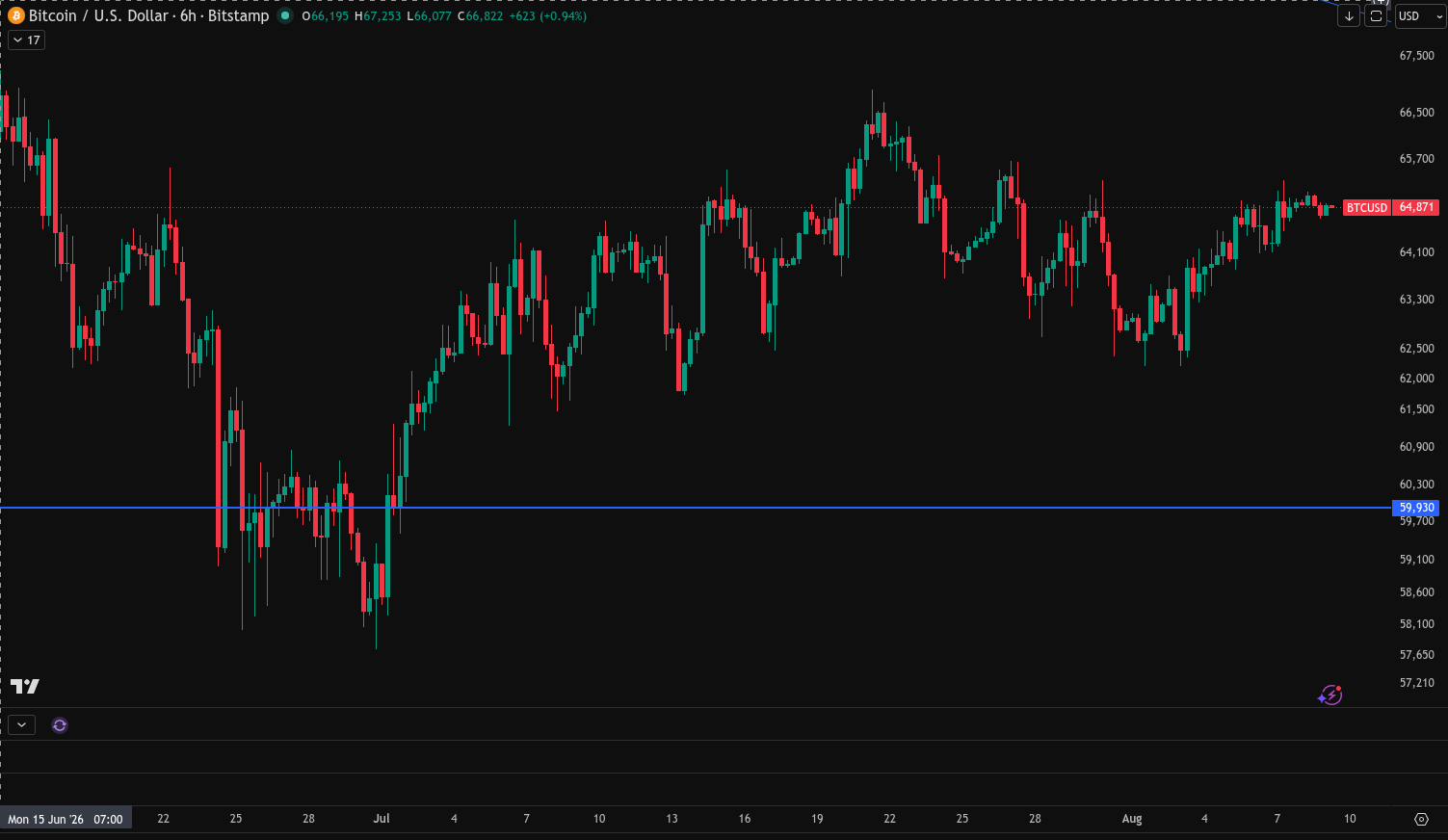
Bitcoin remains locked in a tight consolidation band, failing to clear resistance near $65,300 despite a weaker dollar and lower Treasury yields. Sunday morning the asset hovered near $64,900 after a brief spike to $65,135 yesterday, with resistance at $65,500 capping upward movement. Microstructure analysis indicates low directional spot demand. Instead, institutions execute delta-neutral basis trades to capture yield differentials.
Between the Lines
U.S. spot Bitcoin ETFs recorded nearly $900 million in net inflows over the past week. IBIT led with $693.7 million, followed by FBTC at $116.4 million. This buying did not exert upward price pressure because institutional desks hedge spot purchases. CME open interest remains elevated between $12 billion and $15 billion, signaling that spot purchases are matched by shorts. Benchmarked to the BRRNY ($64,846.42), arbitrageurs borrow fiat to fund the 25% margin for CME shorts while holding spot ETFs to harvest yield.
This activity masks retail capitulation. The Coinbase Premium hit a record 80-day negative streak, confirming persistent U.S. institutional selling via TWAP orders that absorbed offshore dip-buying. Leveraged trading adds volatility; a 40x short of 1,600 BTC faced partial liquidation at $64,889, causing a $146,000 loss on 200 BTC. A massive $1.17 billion put options concentration at the $60,000 strike cushions downside risk.
By the Numbers
Nearly $900 Million: Net weekly inflows into U.S. spot Bitcoin ETFs, led by IBIT ($693.7M) and FBTC ($116.4M).
$12B – $15B: CME Bitcoin futures open interest, reflecting short hedging.
-0.1369%: The Coinbase Premium value, marking a record 80-day negative streak.
200 BTC: Liquidated portion of a 1,600 BTC short position at $64,889, causing a $146,000 loss.
$1.17 Billion: Put options concentration at the $60,000 strike price, establishing a floor.
The Great Energy Pivot: AI Clusters Outbid Miners
Bitcoin mining economics have fractured under compressed revenue and high difficulty. Network hashprice stands at historic lows between $28.90 and $30.60 per PH/s/day. The median miner operates at a deficit, with an average production cost of $85,604 per Bitcoin against the $64,900 spot price. High-efficiency facilities operate near $60,000 per coin, while inefficient sites face costs up to $95,000. This margin exhaustion has prompted public mining firms to shift power capacity away from block production toward HPC and AI hosting.
The Pivot
Energy assets are experiencing massive revaluations as AI outcompetes crypto hashing. High-value compute leases yield $1,500 to $3,500 per MWh, compared to $80 to $120 per MWh for traditional mining. This return differential has driven public miners to commit over $70 billion in capital toward AI data center operations.
Two major corporate transactions highlighted this shift this week:
Bitdeer (BTDR): Bitdeer signed a 16-year colocation lease for its Norway campus, securing $4.7 billion in contracted revenue over the base term. An 8-year renewal option expands potential value to $8.0 billion. The contract commits 121 IT MW out of 133 gross MW, running NVIDIA GPUs on Dell hardware. The lease average rate of $202 per kW per month yields $2.4 million per IT MW per year. Electricity expenses are pass-through, yielding an estimated 90% net operating margin. J.P. Morgan and another bank issued $1.3 billion in letters of credit to back the deal.
TeraWulf (WULF): TeraWulf reported Q2 revenue of $44.8 million, with 71% ($31.9 million) generated from HPC leasing instead of mining. The company finalized a 20-year, 401-megawatt lease with Anthropic, projecting up to $33 billion in contracted revenue.
The Difficulty Paradox
This capital flight has created a unique network paradox. Earlier this year, network difficulty dropped 14% from its 2026 peak to 126.23 trillion hashes in July, representing the second year-over-year decline in Bitcoin history. This drop occurred because AI and HPC operators outbid miners, paying 3 to 25 times more for electricity and forcing facilities to convert.
Instead of triggering a network collapse, this downward difficulty adjustment improved profitability for the remaining active miners. Surviving operators upgraded to next-generation ASICs with sub-15 J/TH hardware efficiency. These deployments mask the hash rate lost to AI data centers, pushing difficulty back up to 127.3 trillion hashes and driving projections that total hashrate could reach 1.8 ZH/s by year-end.
To fund these transitions, some operators are liquidating holdings. Cipher Mining reported a Q4 loss of $300.6 million while liquidating 1,166 BTC to fund its data center retrofits. In contrast, specialized low-cost infrastructure continues to deploy. Aspen Creek Digital Corporation opened a 30MW facility paired with an 87MW solar farm in Texas, hosting 10,000 mining units and allocating 27MW to Compass Mining under an agreement backed by $8 million in Series A funding.
Macroeconomic Cross-Currents and Global Liquidity Drain
The Big Picture
Macroeconomic data is sending mixed signals, preventing Bitcoin from establishing a clear trend. The asset exhibits a correlation shift, behaving less as a pure speculative risk-on vehicle and more as a collateral asset sensitive to dollar liquidity and sovereign debt dynamics. Weak economic data failed to act as a price launchpad. July nonfarm payrolls contracted by 23,000 (missing the 83,000 gain estimate), while downward revisions stripped 103,000 jobs. Yields on 2-year Treasury notes fell 4.8 basis points to 4.197%, and the DXY fell 0.32%, but price gains above $65,300 evaporated as sellers faded the rally.
Between the Lines
The primary headwind is a drain on global dollar liquidity.
U.S. Treasury Borrowing: The Treasury plans to borrow $739 billion in Q3 2026, exceeding previous estimates by $68 billion due to lower tax receipts, and projects $628 billion in Q4 borrowing to maintain a $950 billion TGA balance, siphoning liquidity.
Federal Reserve Stance: The Fed kept interest rates between 3.50% and 3.75% in a split 9-3 decision. Stronger manufacturing data raised inflation concerns, with July PMI rising to 55.6%. Benchmark 10-year Treasury yields rose to the 4.69%–4.71% range, raising capital costs and weighing on non-yielding assets. Markets price in a 65% probability of an interest rate hike in September.
Yen Carry Trade Unwind: A joint U.S.-Japan yen-buying operation (first in 15 years) sold USD reserves to purchase yen at the 157 level, siphoning global liquidity and triggering margin calls and asset liquidations.
AI Hedge Fund Contagion: AI hedge fund Situational Awareness LP liquidated its entire equity portfolio following margin calls after a tech correction, causing an Asian market drop and triggering automated Bitcoin sell orders to cover equity deficits.
Credit Market Stress: Hughes Satellite Systems filed for Chapter 11 bankruptcy in Texas, failing to clear a $1.4 billion capital structure, highlighting credit stress that mirrors miner refinancing risks.
Legislative Stalemate: The CLARITY Act Stalls
Why It Matters
The legislative framework to integrate digital assets into traditional banking has stalled. Senate Majority Leader John Thune postponed votes on the bipartisan Digital Asset Market CLARITY Act until September. This delay ensures the continuation of a punitive “regulation by enforcement” regime in the United States, keeping corporate allocators paralyzed and discouraging public companies from holding digital assets on their balance sheets due to accounting penalties and regulatory threats.
The Friction
The delay stemmed from banking stability and compliance disputes:
Deposit Flight Fears: A coalition of Republican senators—including John Cornyn, John Curtis, Mike Rounds, James Lankford, Josh Hawley, Susan Collins, and Jerry Moran—stalled the bill over concerns that stablecoin yield provisions would trigger deposit flight from regional and community banks.
Illicit Finance Concerns: Democrats and the National Sheriffs’ Association feared the bill would hamper tracing illicit transactions. The Bank Policy Institute warned that rewriting the Bank Secrecy Act to carve out decentralized finance participants would create compliance gaps, granting a free pass to decentralized mixers.
The Industry Pushback: The Blockchain Association sent an eight-page letter to Senate leaders Thune and Schumer, defending the bill against compliance gap claims. Passage requires 60 votes, a tight margin for the 53-seat Republican majority.
State vs. Federal Battles and Regulatory Interdictions
As federal legislation stalls, regulatory enforcement has intensified across multiple jurisdictions.
State Gambling Precedent: State authorities won a battle regarding prediction market regulation. U.S. District Judge Shalina Kumar denied Coinbase’s motion for a preliminary injunction against Michigan Attorney General Dana Nessel. Coinbase argued its sports contracts are CFTC-regulated swaps immune from state laws, but the court rejected this, keeping state gambling rules intact. In Utah, a federal judge ruled that state prosecutors may enforce local anti-gambling laws against decentralized prediction platforms Kalshi and Polymarket, determining that federal CFTC oversight does not preempt state jurisdiction.
CFTC Response: The CFTC issued warnings instructing regulated prediction platforms to stop displaying sportsbook-style odds (+150 or -200) to maintain clear separation from conventional gambling. Furthermore, the CFTC sued the State of New York to assert exclusive jurisdiction, following New York AG Letitia James filing a $36 billion suit against Kalshi. A coalition of 38 state attorneys general filed an amicus brief supporting state enforcement.
SEC Audits: The SEC established a specialized Financial Reporting and Accounting Unit within its Division of Enforcement. Led by Timothy Zimmerman, the team focuses on accounting compliance across public digital asset firms. This coincides with FASB ASU 2023-08, which requires public companies to report crypto holdings at fair market value, reflecting price swings on income statements.
OFAC Sanctions: OFAC sanctioned Dubai-based Shelbit Exchange and its founder Siavash Kayvanpour. The platform facilitated a $4 billion money-laundering system, processing funds for the IRGC and illegal gambling. A large portion of these assets originated from state-sponsored Iranian mining using subsidized power. OFAC also sanctioned Iran-based Aban Tether for bridging funds to Nobitex, which handles over 50% of Iranian digital asset flows.
Cash Conversion Enforcement: Federal prosecutors maintain strict focus on retail cash conversion points. In Tennessee, Amy Denise Fields appeared before a U.S. Magistrate Judge following an indictment for money laundering. The DOJ alleges she deposited cash from fraudulent COVID-19 benefits into local Bitcoin ATMs.
Derivatives and ETP Rule Updates:
Digital Commodity Buffer: The SEC approved Cboe BZX Exchange Rule 14.11(e)(4), establishing a 15% digital commodity buffer for Commodity-Based Trust Shares. This allows up to 15% of NAV in a trust to contain digital commodities lacking ISG market status, if the remaining 85% consists of approved assets. The SEC codified digital commodities as assets deriving value from programmatic protocol operations and market forces instead of third-party managerial efforts.
CFTC Margin Exemptions: Taking effect August 17, updated CFTC margin rules waive initial margin requirements between Covered Swap Entities and eligible seeded funds for three years. Government money market fund shares are now permitted as valid initial margin collateral, removing capital barriers.
ETF Consolidation: Competitive pressure led Tidal Commodities Trust I to file a Plan of Liquidation for the Hashdex Bitcoin ETF (NYSE Arca: DEFI). Creation/redemption processing terminates on August 17, with trading halted on August 18 and final cash distributions scheduled for August 24.
Corporate Balance Sheets: Impairments and Reserve Shifts
Corporate treasury strategies are shifting based on core business needs and GAAP volatility :
BitGo Litigation: Investors faced a lead plaintiff deadline on August 7 in a class-action securities fraud suit against BitGo Holdings (NYSE: BTGO). The litigation centers on BitGo reporting a $60.7 million net loss for Q1 2026, driven by non-cash impairment losses on its Bitcoin treasury under current mark-to-market accounting rules.
MicroStrategy (MSTR): MicroStrategy paused Bitcoin accumulation, holding its reserves static at 847,363 BTC. Despite raising $1.2 billion through equity sales, management expanded fiat cash reserves to $3.75 billion to cover preferred dividends and convertible debt, taking a defensive posture. Prior to this, the firm sold 1,638 BTC for $104.73 million at $63,957 to fund a dollar reserve and cover STRC preferred dividend obligations.
Trump Media (DJT): Trump Media transferred 2,628 BTC to Crypto.com, carrying a $165 million valuation. Over seven months, the company liquidated 7,281 BTC (a 63% reduction) at an average price of $74,855 to maintain operational solvency and fund the “Truth API”. Its remaining treasury stands at 4,261 BTC.
Strive (ASST): Strive purchased 20 Bitcoin while maintaining its 13.00% preferred dividend.
Block Inc.: In contrast to liquidating firms, Block reported a 31% year-over-year increase in Cash App Bitcoin gross profit for Q2 2026, helping drive company-wide adjusted operating margins to a record 27%.
Protocol Battles and Tech Flaws
Technical issues and governance disputes expose vulnerabilities, forcing the community to confront challenging trade-offs regarding security and property rights.
BIP-110 Signaling Failure: BIP-110 entered its mandatory-signaling phase at block 961,632, triggering an isolated chain split. The soft fork, which aims to restrict non-financial data insertions (Ordinals and BRC-20 tokens) for one year, arrived with weak miner support at just 2.53% (just 51 of the preceding 2,016 blocks), far below the 55% threshold. Nodes enforcing BIP-110 initiated automatic rejection of blocks that failed to signal, causing a minority branch to split off. Due to anemic miner participation, the breakaway chain stalled and fell behind the main chain’s proof-of-work, illustrating the difficulty of pushing consensus changes without broad miner backing.
The Quantum Threat (BIP-361): Google’s Quantum AI team revealed that the physical qubit requirement to break Bitcoin’s elliptic curve cryptography fell from 20 million to under 500,000. Tom Lee warned that a capable quantum system could expose private keys from public addresses in nine minutes. Glassnode data shows 6.04 million BTC (30.2% of total supply) sits in addresses with exposed public keys, including 1.92 million BTC in early output formats. In response, developers introduced BIP-360 (a quantum-safe address format called Pay-to-Merkle-Root) and BIP-361 (forcing a three-phase timeline to migrate funds out of legacy formats). BIP-361 has drawn criticism because Phase B would freeze unmigrated assets in perpetuity after five years, including Satoshi Nakamoto’s 1.1 million coins. Opponents argue freezing dormant funds violates user property rights, while supporters argue unmigrated coins would otherwise be stolen. Migration would require up to 305 days of restricted network throughput to handle traffic.
The Coldcard PRNG Exploit: A severe flaw in the pseudorandom number generator during seed creation compromised Coinkite Coldcard hardware wallets. Hackers stole 1,367 BTC from 4,585 addresses, with losses passing the $100 million threshold. Because the vulnerability exists at the genesis of private key generation, firmware patches cannot secure compromised wallets. This triggered a massive migration of UTXOs: base layer volume for sub-1 BTC transfers reached 39,600 BTC in a single day, the highest since the FTX collapse, as users swept funds to new addresses or centralized exchanges. Security collective “Bitcoin Red Team” identified 85 critical flaws across close to 390 open-source repositories following this exploit.
BitMEX Shutdown: Offshoring infrastructure is shifting as BitMEX accelerated its operational shutdown to September 23, 2026. The platform moved the delisting date for active futures contracts forward to August 10, using TWAP from August 6 for final settlement, transitioning to reduce-only trading on August 26.
Bybit Asset Recovery: In recovery litigation, Bybit secured a preliminary injunction freezing stolen assets tied to the DPRK and Lazarus Group stemming from a February 2025 attack that drained $1.5 billion. This establishes a precedent for using civil courts to enforce asset freezes against state-backed hackers.
What to Look For Next
August 10 BitMEX Settlement: Final position unwinds as BitMEX delists major futures contracts.
August 14 U.S. CPI Inflation Report: July CPI metrics release, which will impact interest rate hike expectations and risk-asset liquidity.
Technical Range Resistance: Track whether spot markets can clear the $65,500 resistance level on meaningful volume to confirm organic spot buying over delta-neutral basis trades.
Thanks for reading Bitcoin News Digest! Subscribe for free to receive new posts and support my work.
Comments
Nothing yet. Say the first thing.
Sign in to join the conversation.