
This week, I have a special guest contributor, Mari Savic, who writes about the divide between what the alarming quantum threat headlines claimed and what the Google paper actually said.
“Stealing Satoshi’s Bitcoin Becomes a Quantum Computing Threat” - Bloomberg, April 2, 2026
“’No longer a drill’: Google’s latest quantum breakthrough sparks fresh debate over Bitcoin’s long-term security” - The Block, March 31, 2026
“’Bitcoin cracked in 9 minutes’: BTC bulls scramble for post-quantum protection as Google drops bombshell paper” - CoinDesk, March 31, 2026

You have probably already seen the alarming headlines this past week - quantum computers are coming for Bitcoin.
A Nobel Prize-winning physicist backed a recent Google paper - published in conjunction with Berkeley, Stanford, and the Ethereum Foundation - saying a future quantum machine could crack a Bitcoin wallet in nine minutes.
Crypto Twitter went into full panic mode, some quantum-related tokens jumped 40%, and suddenly everyone had an opinion on something that is genuinely hard to understand, even for the people writing about it.
If it made you nervous, well - that’s what it was designed to do. Fear gets clicks.
But upon closer inspection, perhaps not all is as it seems.
1. Most journalists are describing the wrong attack
Almost every article you have read about this contains a basic technical mistake. They say quantum computers will “decrypt” Bitcoin or “crack its encryption.”
Bitcoin does not use encryption. There is nothing to decrypt.
Bitcoin uses a digital signature system. When you send Bitcoin, your wallet produces a digital signature that proves you own it. What a quantum computer could theoretically do is study that signature and work backwards to figure out your private key, then forge a transaction in your name. That is signature forgery, not decryption.
Banks use encryption. Bitcoin uses signatures. Both rely on the same underlying mathematics, which is exactly why the quantum threat applies to both, but the attack works differently and the solutions are different too.
Think of it this way. Bitcoin is not a locked safe that quantum computers want to crack open. It is more like a signature on a check. The quantum threat is someone learning to forge your signature, not picking a lock. The underlying math that makes both possible is the same, which is the real problem.
Quantum computers aren't your biggest Bitcoin threat - bad information is. Subscribe for analysis that cuts through the FUD and focuses on what matters. Paid subscribers get full access to my Bitcoin Tool Vault
2. This threat is not just about Bitcoin
The underlying mathematics that a quantum computer would exploit is the same mathematics that protects your online bank account, your email, your medical records, every government database, and every website with a padlock in the address bar.
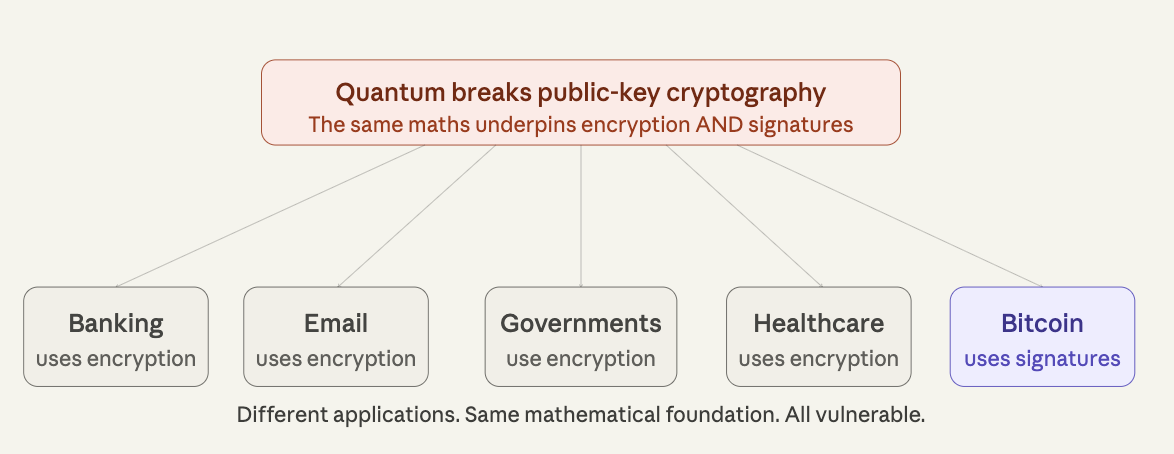
Banks use it for encryption. Bitcoin uses it for signatures. Different applications, same mathematical foundation. So if a quantum computer ever became powerful enough to break it, everything that depends on that foundation breaks too, all at the same time.
Think about it this way: if someone actually built a machine that powerful, do you really think they would use it to steal sats? Or would they drain every bank on earth and intercept every classified government document in existence?
3. The media barely mentioned Ethereum
Here is where the media coverage gets really interesting. The Google paper that triggered all these Bitcoin headlines was co-authored by an Ethereum Foundation researcher named Justin Drake. One of the co-authors literally works for Ethereum.
The paper dedicates an entire section to Ethereum vulnerabilities. A comprehensive analysis with its own taxonomy table breaking down five distinct attack vectors: Account Vulnerability, Admin Vulnerability, Code Vulnerability, Consensus Vulnerability, and Data Availability Vulnerability.
The paper estimates that over $100 billion in Ethereum-based assets are at risk. That includes the native ether cryptocurrency, stablecoins like USDC and Tether, tokenized real-world assets, and the entire Layer 2 ecosystem.
The paper quantifies 20.5 million ETH vulnerable through exposed account keys, plus $200 billion in stablecoins and real-world assets vulnerable through smart contract admin keys.
Bitcoin got roughly the same page count in the technical analysis, but it got all the scary headlines.
CoinDesk even acknowledged this in their Ethereum coverage: “Most of the online reaction to Google Quantum AI’s paper, released late Monday, focused on bitcoin.”
Why is that? Well, Bitcoin is controversial. It challenges the existing system. Therefore, Bitcoin gets clicks.
Ethereum, despite having an even larger total value at risk when you include its massive DeFi ecosystem, did not generate the same fear response.
The narrative was already written before the paper came out. Journalists just needed the Google name and some scary numbers to fill in the blanks.
What the research shows vs the headlines
Google compiled two quantum circuits that could solve the 256-bit discrete logarithm problem on the elliptic curve. One uses fewer than 1,200 logical qubits and 90 million quantum gate operations. The other uses fewer than 1,450 logical qubits and 70 million gates.
They estimate these circuits could run on a superconducting quantum computer with fewer than 500,000 physical qubits. That is roughly 20 times fewer than previous estimates, which often ran into the millions.
The timeline is key, though. John Martinis, a Nobel Prize-winning physicist who reviewed the paper, is careful about timing. Building a machine capable of a real attack remains “one of the hardest engineering challenges in modern science” and the realistic window sits at five to ten years, if it happens at all.
To pull off the signature forgery attack on Bitcoin, you would need millions of stable, error-corrected logical qubits. Right now, it takes roughly a thousand noisy physical qubits to produce a single reliable logical one. The gap between where we are and where we would need to be is enormous.
The scary headlines about quantum ‘breaking’ cryptography have been running ahead of the actual science for two decades now.
Solving Bitcoin’s quantum threat
Every time you send Bitcoin, your public key is briefly visible on the blockchain. A powerful enough quantum computer could theoretically study that public key, work backwards to your private key, and forge a transaction in your name before your payment goes through.
Bitcoin’s mining mechanism is a separate story entirely. A paper from March 2026 calculated that a quantum attack on Bitcoin’s proof-of-work would require the energy output of a star. That is physically unreachable. The signature forgery risk is the one worth paying attention to.
But Bitcoin developers have known about this for years and are not ignoring it. Post-quantum cryptographic standards already exist. The US National Institute of Standards and Technology finalized the first batch in 2024.
BIP-360, a draft proposal for quantum-resistant Bitcoin addresses, was merged into the Bitcoin Improvement Proposals repository in February 2026. The proposal introduces Pay-to-Merkle-Root scripts that remove the quantum-vulnerable “key path spend” from Taproot while keeping its other benefits.
The protocol has been successfully upgraded before. SegWit was activated in 2017. Taproot activated in 2021. Bitcoin will upgrade again.
The protocol is not fragile or stagnant. It is a living system built by people who are thinking decades ahead.
The Google paper itself acknowledges successful post-quantum deployments. The Quantum Resistant Ledger, Mochimo, and Abelian all use post-quantum cryptography exclusively. Algorand, the XRP Ledger, and Solana have early experimental deployments. Starknet uses hash-based protocols that are already quantum-resistant.
The technology already exists, but the question is execution, not invention.
So why the focus on Bitcoin?
Because it gets clicks. Because Bitcoin is already controversial, most journalists covering quantum computing do not have a deep understanding of Bitcoin or cryptography.
There are also people with financial and ideological reasons to make Bitcoin look fragile, and that has been true since 2009. The asset that challenges the existing system will always attract the most aggressive coverage when anything appears to be a risk.
But here is what the media coverage reveals. If quantum computers genuinely threatened Bitcoin’s existence, the same technology would threaten every bank, every government, every encrypted communication system on earth. All of them use the same underlying mathematics.
The fact that headlines focus on Bitcoin while ignoring the banking system tells you something important. The people writing these stories do not actually believe quantum computers will break cryptography tomorrow. If they did, they would be writing about bank runs and government collapse, not which cryptocurrency to avoid.
They are writing about Bitcoin because Bitcoin is widely known, and it is a target for fear, uncertainty, and doubt.
What you can do right now
The real threats present right now have nothing to do with quantum computers.
The quantum computing threat is minuscule when compared with the biggest threat to Bitcoin - the person who holds it.
When you leave your Bitcoin on an exchange instead of holding it yourself, use the same Bitcoin address over and over, and keep your seed phrase somewhere it could be found, photographed, or lost, you create real and immediate risk.
Those are the things that actually cost people their Bitcoin, not a machine that doesn’t exist yet.
The Google paper makes specific recommendations.
Stop reusing Bitcoin addresses. Once you spend from an address, it should never be reused.
Avoid Taproot addresses (the ones starting with bc1p) if you are holding for the long term, since they expose public keys by default.
Use SegWit addresses (bc1q) which hide keys behind a hash. Move coins off exchanges into self-custody.
These are good practices regardless of quantum computers. They improve your security today while also reducing your exposure to theoretical future attacks.
If you are a Bitcoin holder, the path forward is clear. Hold your own keys. Rotate addresses. Pay attention when post-quantum address types become available and migrate when the time comes.
The next time a worrying quantum headline crosses your feed, ask yourself three questions.
Is this actually a Bitcoin-specific problem or a problem for all digital security?
What are scientists rather than journalists saying about the timeline?
What is already being done about it?
The Google paper is 57 pages of rigorous technical analysis. It identifies real vulnerabilities across Bitcoin, Ethereum, and a dozen other cryptocurrencies. It proposes concrete mitigation strategies. It acknowledges successful post-quantum implementations already running in production.
What it does not say is “quantum computers will destroy Bitcoin in nine minutes.”
That headline came from journalists who needed clicks, because clicks get eyeballs, and eyeballs equal revenue.
You may also like:
⛔️ FINANCIAL DISCLAIMER: This content is for informational and entertainment purposes only and should not be considered financial, investment, or legal advice. I am not a licensed financial advisor, accountant, or investment professional. The information shared in this post reflects my personal opinions and is based on publicly available data at the time of writing. All investment decisions—especially those involving Bitcoin or other digital assets—carry risk and should be made only after conducting your own due diligence and consulting with a qualified financial advisor. Never invest more than you can afford to lose. My views are my own and do not reflect those of any of my affiliate partners or sponsors.
Comments
Nothing yet. Say the first thing.
Sign in to join the conversation.