

Of the roughly eighty-three billion dollars currently sitting inside Strategy’s product line, not a single dollar is backed by Bitcoin.
Strategy, the company formerly known as MicroStrategy, runs a veritable alphabet of preferred and common stocks under Executive Chairman Michael Saylor, one of the most recognizable faces in Bitcoin.
None of those products give you a legal claim to a single satoshi.
Strategy’s own legal disclosures spell it out. The preferred shares (STRF, STRC, STRE, STRK, STRD) explicitly do not collateralize against Strategy’s Bitcoin holdings.
The convertible notes and MSTR common stock leave you with unsecured claims on Strategy Inc., with no direct legal right to any specific Bitcoin.
Every Strategy product offers you economic exposure to Bitcoin through the company’s balance sheet, not legal title to Bitcoin itself.
Which brings me to STRC, Strategy’s largest preferred stock by market cap.
STRC, also known as “Stretch,” is Strategy’s latest financial product, and it’s currently pulling capital faster than the company can deploy it into Bitcoin.
The headline yield runs at 11.5% annualized, paid to you in monthly cash, with a US tax classification that pushes the effective yield above 18% for some investors.
It trades on Nasdaq near a $100 anchor, and Strategy has been marketing it hard to bitcoiners and income-focused investors over the past year.
If you’re a Gen X bitcoiner like me, you’ve lived through dot-com, 2008, FTX, and a parade of other “this time it’s different” moments.
A yield like that probably triggers something between cynicism and outright disbelief in you. It does in me.
There is always a reason why a financial product pays above-the-odds returns, and I want to walk you through exactly what that reason is here.
In this article I cover:
The full lineup of Strategy’s products, what each one is, and who typically owns them
Why STRC exists, how it benefits Strategy, and where the 11.5% yield actually comes from
The tax angle and other selling points pitched to retail investors
The five layers of intermediaries that sit between an STRC share and a satoshi
TThe risks every STRC holder should understand before buying
What Bitcoin can do that STRC cannot
The yield comparison the STRC sales pitch avoids: 11.5% on STRC against self-custodied Bitcoin’s long-term track record
Before I get into the STRC story specifically, I want you to see where it fits in the Strategy family of products. Strategy has built a small zoo of financial instruments over the past few years, all of them designed to feed the same machine: buying more Bitcoin.
Here is the lineup as of mid-2026:
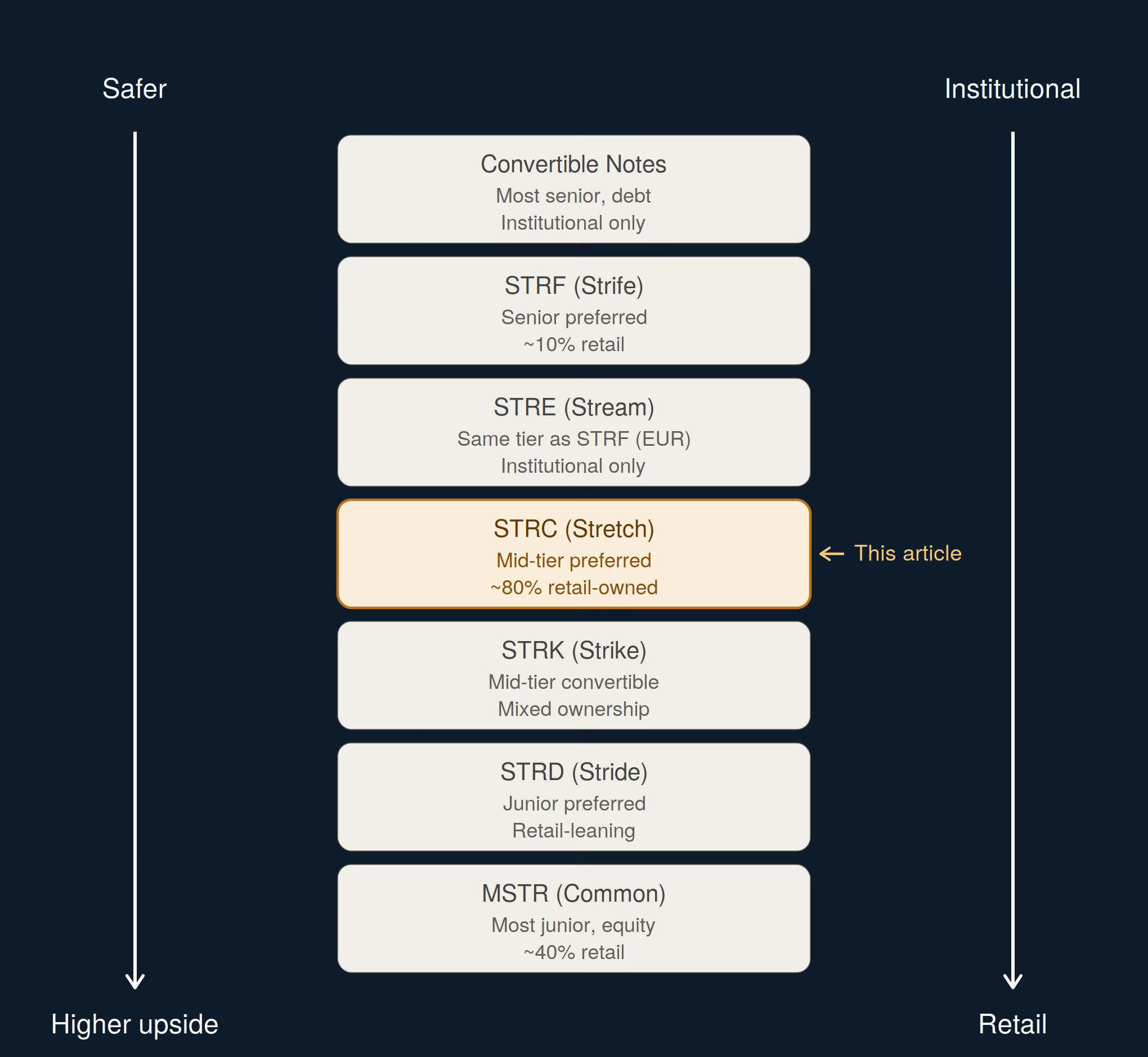
MSTR (Common Stock): Strategy’s original common share. A leveraged Bitcoin proxy with no dividend. When Bitcoin appreciates, MSTR has historically appreciated faster, and when Bitcoin falls, MSTR amplifies the move on the downside. A roughly even mix of institutional and retail investors holds it, with around 40% retail. Hedge funds and asset managers often use it for a high-beta Bitcoin trade inside a regular brokerage account.
STRF (Strife): A fixed 10% cumulative preferred share, paid quarterly in cash. “Cumulative” means that if Strategy ever skips a payment, the unpaid amount accrues, and the company eventually has to pay it. STRF is the most senior of the preferreds, so it sits closest to the front of the queue if Strategy ever has to liquidate. Conservative income investors, family offices, and pension-style portfolios typically hold it.
STRK (Strike): An 8% cumulative preferred that converts into MSTR common stock if MSTR reaches $1,000 per share. A hybrid product. Investors who want yield while keeping a finger on the equity upside tend to like it. A mix of institutional and retail buyers owns it.
STRD (Stride): A fixed 10% non-cumulative preferred. If Strategy skips a payment, the missed dividend is gone forever. The most junior of the preferreds. Yield-hungry investors with a higher risk tolerance hold it. More retail-skewed than STRF.
STRE (Stream): A Euro-denominated version of STRF, listed on the Luxembourg Stock Exchange rather than Nasdaq. Aimed at European institutional investors. It hasn’t gained meaningful traction since launch, and Strategy doesn’t even track it on its main dashboard.
STRC (Stretch): The subject of this article. A variable-rate preferred share paying 11.5% annualized in monthly cash, engineered to trade near a $100 anchor. Roughly 80% retail-owned. Strategy markets it as a low-volatility income product.
Convertible Notes: Corporate debt instruments, senior to every preferred share and to common stock. They pay low interest, anywhere from 0% to 2.25%. Institutional investors hold almost all of them. Ordinary retail buyers can’t really access them.
Here is a useful way to think about the stack: as you move down the list from convertibles toward MSTR common, you trade safety for upside, and the buyer mix shifts from institutional toward retail. STRC sits firmly at the retail end of that spectrum, which already tells you something about who Strategy designed this product to attract.
First, let’s examine why Strategy invented STRC in the first place - before I get into what the product offers a retail buyer.
Strategy is, in plain terms, a Bitcoin-buying machine wrapped inside a Nasdaq-listed company. As of mid-May 2026, it holds approximately 818,000 BTC, worth roughly $67 billion at market prices.
Every financial instrument Strategy issues exists to convert someone else’s cash into more Bitcoin on its balance sheet.
STRC is the newest pump on that machine, and it has been pumping fast. Strategy launched STRC in July 2025 at an IPO price of $90 per share.
By mid-May 2026, the share count had grown from 28 million to roughly 85 million, and the offering, along with subsequent at-the-market sales, had raised approximately $8.5 billion in notional capital.
Strategy has also filed for authorization to issue up to another $21 billion in STRC shares through its ATM program over the coming year. The tap is wide open.
STRC does something none of Strategy’s other instruments does quite as efficiently: it raises capital without diluting MSTR common shareholders.
When Strategy issues a new STRC share at $100, it doesn’t create a new MSTR share. The cash flows in. The Bitcoin flows onto Strategy’s balance sheet. The MSTR count never changes. The “Bitcoin per MSTR share” metric ticks up. That’s gold for MSTR holders, Michael Saylor included.
Let me explain the ATM mechanism, because it’s central to how this works. Strategy issues STRC through what it calls an At-The-Market program, or ATM. This is a continuous tap that lets Strategy sell new STRC shares whenever the price is at or above $100 par.
As long as STRC trades at or above par, the tap stays open, and incoming capital keeps flowing into Bitcoin purchases. A drift below $95 triggers an upward adjustment to the dividend rate, which pulls the share price back toward par.
Strategy has engineered the whole structure to keep the share price boring and the cash flowing in.
The 11.5% dividend Strategy pays to existing STRC holders is funded largely by the proceeds of new STRC issuance. A portion of that incoming cash buys Bitcoin, a portion services the dividend.
Bitcoin itself produces no cash flow, no interest, no rent. So the yield on STRC isn’t coming from the Bitcoin on Strategy’s balance sheet. It’s coming from the next buyer through the door, topped up by a cash reserve and a modest income stream from Strategy’s legacy software business.
As of mid-May 2026, the capital sitting inside Strategy’s various products breaks down roughly as follows:
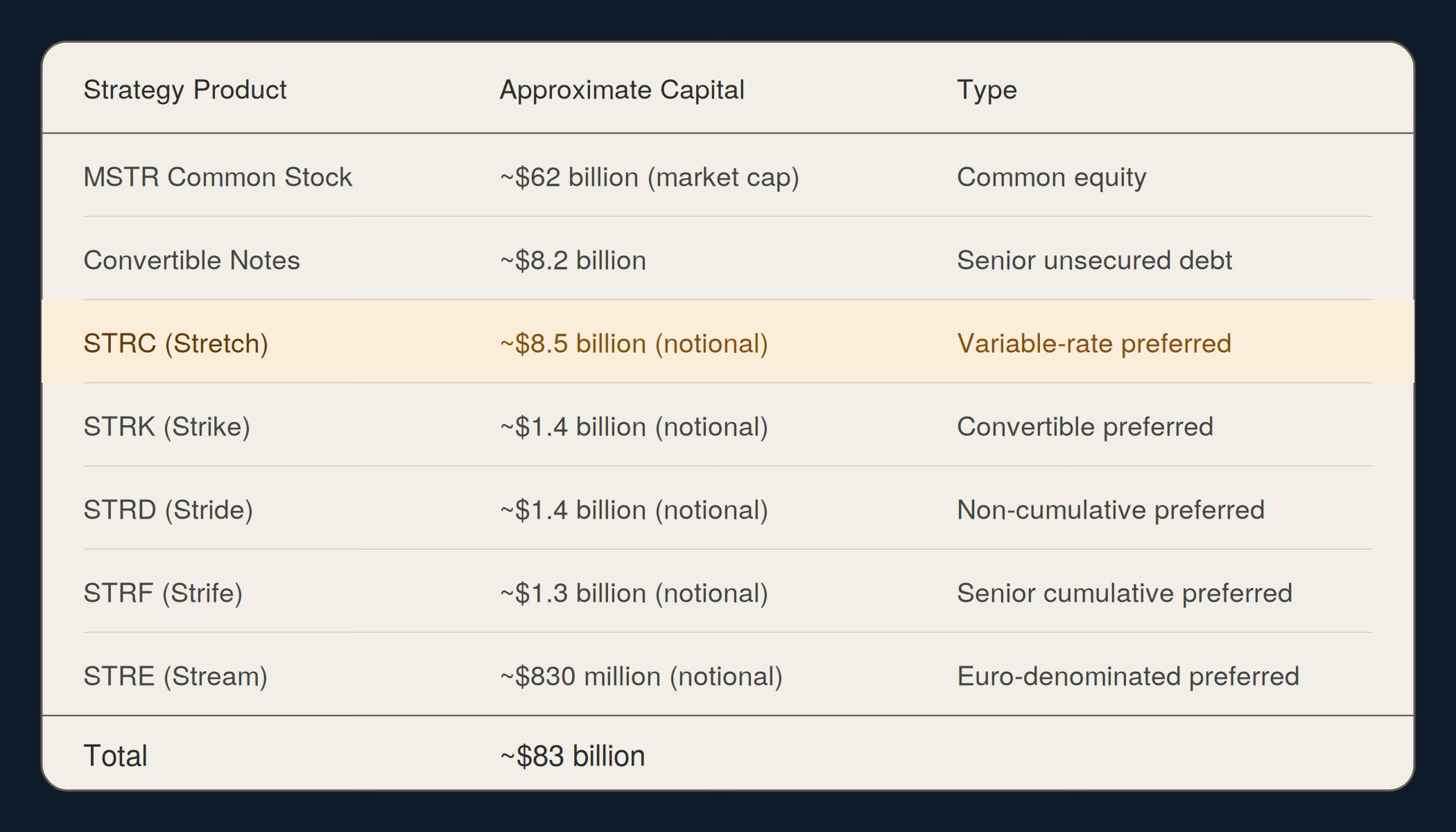
Strategy’s Bitcoin holdings sit at approximately 818,000 BTC, worth around $67 billion at current market prices (May 2026).
So while 818,000 Bitcoin sits on Strategy’s balance sheet, every dollar you invest into a Strategy product will only give you an unsecured economic claim on the corporation, paid out in cash through the capital stack if the company ever liquidates.
You may also like…
From your perspective as a retail buyer, Strategy has engineered STRC to look very attractive on paper. Here’s what’s on offer:
The headline yield. STRC currently pays 11.5% annualized, distributed monthly in cash. On a $100 par share, that works out to roughly $0.96 per share per month. Compare that to a US T-Bill at around 4.3%, or a high-yield savings account at similar levels, and the differential is substantial.
Comments
Nothing yet. Say the first thing.
Sign in to join the conversation.