

The Cold Card incident has led many people (rightly) to question their Bitcoin self-custody setups. If a hardware wallet could become a single point of failure, then surely spreading risk across multiple wallets is the solution?
Multi-signature (multi-sig) self-custody has become a hot topic in recent weeks, as many Bitcoiners have realized that their self-custody setup may not be as secure as they assumed.
At surface level, it seems that if one wallet is good, then more wallets must be more secure - and thus the better option. However, as with all self-custody setups, there is a wide spectrum of trade-offs between security and convenience.
So if you are considering a multi-sig setup for your Bitcoin, you must weigh all the benefits, risks, and trade-offs.
In this article, I want to examine the pros and cons of three possible paths of self-custody.
A full self-custody multi-sig setup;
A collaborative multi-sig setup;
An alternative to both of these options that suits most people
Note: This article is not a ‘how-to’ guide because multi-sig setups can become complicated, and their configuration depends on many variables. It is intended to outline the pros and cons of multi-sig setups so that you can decide if it is right for you.
This article covers:
What is a multi-sig setup?
The case for multi-sig
The risks of multi-sig
Full self-custody multi-sig vs. collaborative multi-sig: the trade-offs
The alternative that most people can use
Put in very simple terms, multi-sig custody is set up with multiple keys, with a minimum number required to transact with your Bitcoin.
By contrast, a regular ‘single-sig’ setup requires only one key to transact with your Bitcoin.
A multi-sig is defined by ‘M-of-N’; N being the total number of keys and M being the number that required to sign a transaction.
You may have already heard of a 2-of-3 multi-sig setup - this is the most common configuration of multi-sig custody. This means that three keys exist, and any two of them are required to sign a transaction.
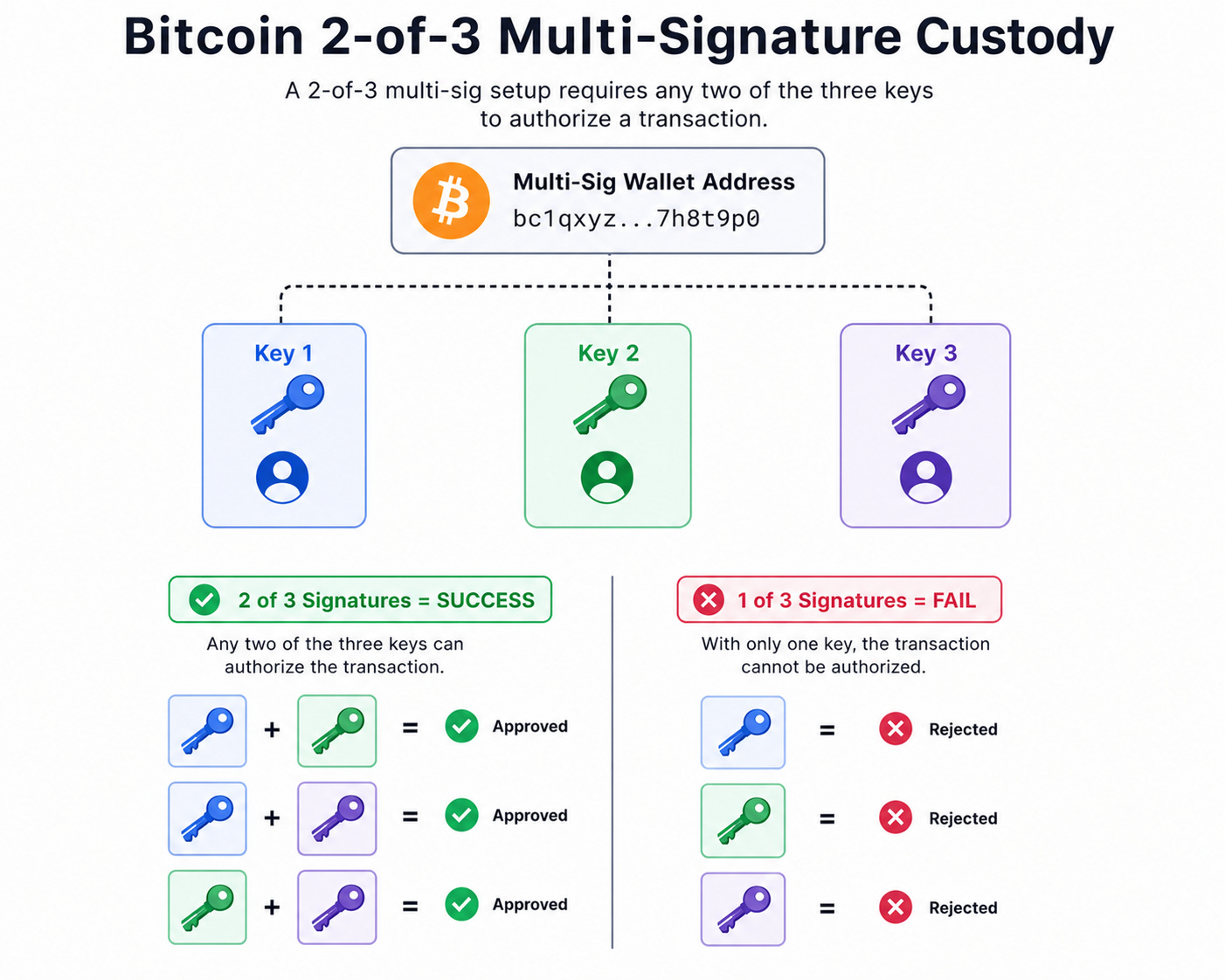
Another (less common) configuration is a 3-of-5 setup, in which three of five possible keys are required to sign a transaction.
The purpose of a multi-sig custody setup is to remove a single key as the point of failure. That is to say, in a 2-of-3 multi-sig setup, any one key can be lost or otherwise compromised, and the Bitcoin is still accessible with the two remaining keys.
It reduces the risk of having all of your Bitcoin secured by a single seed phrase, because each key has its own seed phrase. So if you lose one, you still have two others that you can use to access your Bitcoin.
A multi-sig is well-suited for inheritance or business setups because no single person has access to the Bitcoin to the exclusion of others.
Multi-sig setups tend to be a peace-of-mind solution for larger Bitcoin holdings (multiple Bitcoin).
All multi-sig setups have risks and trade-offs introduced through extra complexity:
Every key requires a separate seed phrase that needs to be protected. This means things like backing each of them up on a metal plate, maintaining more than one copy, and maintaining geographical distribution across secure locations.
There is additional backup complexity beyond seed phrases. There's also a separate file, sometimes called a "wallet descriptor," "config file," or "wallet export". This file tells your coordinator software (like Sparrow wallet) exactly how to reconstruct the wallet from those seeds. If you lose this file, it can make recovery impossible - even with all correct seed phrases.
Hardware/firmware risk - if you use the same kind of hardware device to access all keys (or at least the minimum number, i.e., two of the same devices in a 2-of-3, you are still vulnerable to any bugs that exist in the wallet firmware.
The more keys there are, the more independent the chance that one or more can be lost or compromised. In a 2-of-3 setup, once one key is lost, it is absolutely crucial that the second key is not lost as well, because this will result in a total loss of funds.
A multi-sig increases the risk of setup errors that may not be discovered until a recovery is attempted. For example, an incorrect derivation path or script type.
Both cost and friction are multiples higher than with a single sig setup. For a multi-sig setup, you may need multiple devices, multiple seed backups, more setup time, higher transaction friction, and, overall, more attention to documentation and inheritance planning.
You may also like…
I want to compare two different types of multi-sig setups.
One is the multi-sig that you hold yourself - you are still 100% sovereign. The second introduces a third party, which, on the surface, seems to reduce risk but entails significant trade-offs.
Comments
Nothing yet. Say the first thing.
Sign in to join the conversation.