
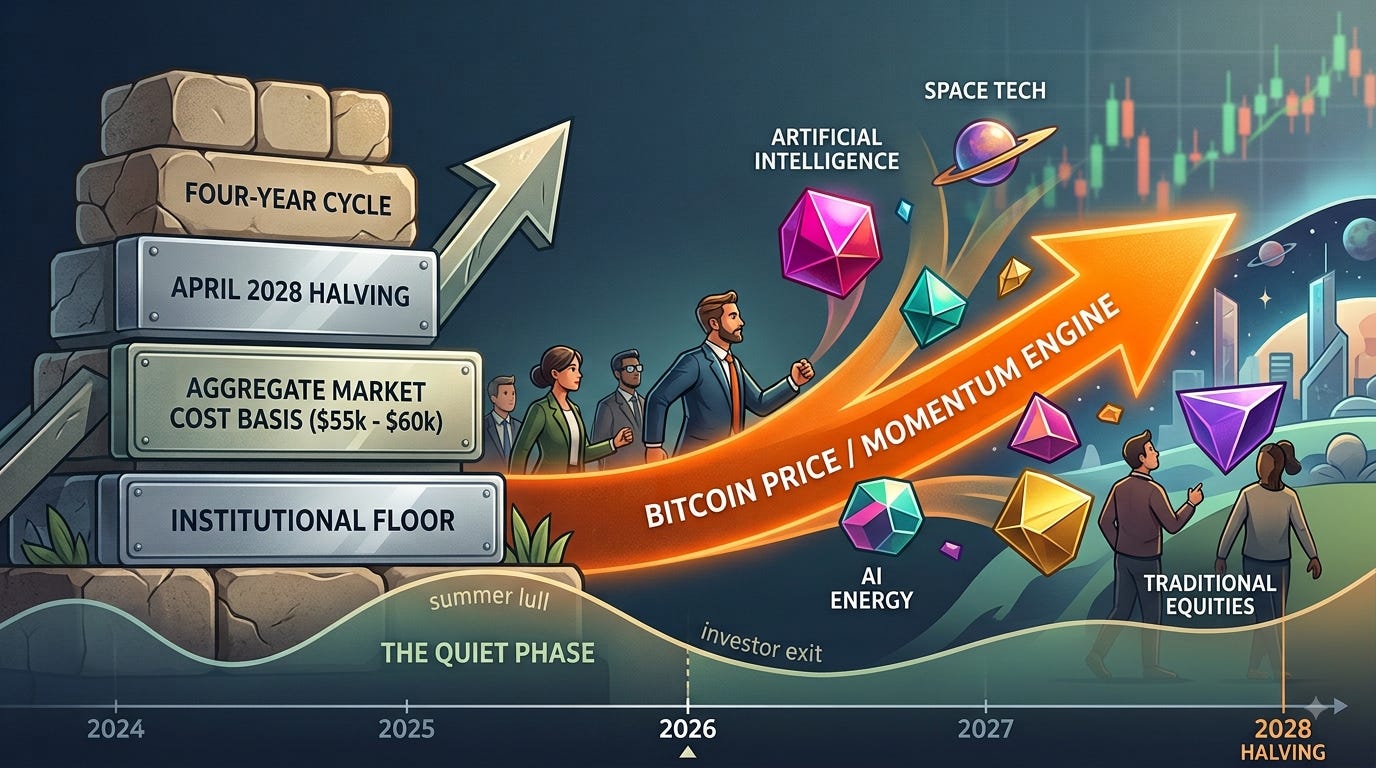
If you’ve been through a full Bitcoin halving cycle before, the current market environment feels intimately familiar. We are sitting squarely in the middle of what is traditionally Bitcoin’s bear market phase.
Historically, Bitcoin bull markets tend to peak 12 to 18 months after a block reward halving. We’ve already established our cycle peak and have entered The Quiet Phase; that prolonged stretch where the hype fades, volume dries up, and the tourists, day traders, and fair-weather newcomers exit the building.
Layer on top of that the usual summer lulls across traditional finance, and it’s no surprise that price action feels sluggish.
Yet, as we head toward the end of 2026, we are now less than two years out from the next halving projected for April 2028, which puts us about three years out from the next big bull market move up.
New Bitcoiners: They rarely grasp the true impact of the supply shock until they’ve lived through more than one cycle. As a result, they tend to underemphasize the halving’s role as Bitcoin’s core pricing engine.
Older Bitcoiners: They spend most of their cycle energy trying to game out how the incoming wave of newcomers and traders will behave before and after the block reward drops.
In previous bear markets, capital simply retreated into cash or stablecoins while the market licked its wounds. This cycle, however, investors left with intention.
As explored in Every Cycle Has Its Theme, as Bitcoin’s momentum slowed, investors encountered The Shiny Object Problem. Speculative attention didn’t just vanish. It migrated directly into high-momentum public equities:
Artificial Intelligence & Compute: Capital flooded into chipmakers and pure-play AI infrastructure.
Aerospace & Space Tech: Speculative tech capital found fresh narrative momentum in private and public space ventures.
AI-Adjacent Energy: Power generation and grid infrastructure became the new favorite trade to support raw compute demands.
Because Bitcoin is still early in its broader global adoption curve, price appreciation remains its primary marketing engine. When price surges, mindshare expands; when price consolidates, distracted capital bails for whatever is printing immediate green candles elsewhere.
Despite this capital flight toward alternative hype cycles, the fundamental halving market structure remains intact until proven otherwise.
What’s particularly notable about recent months, which traditionally represent the deep trough of the bear market, is how well Bitcoin held up under genuine internal strain:
Hardware Security Shocks: The market absorbed the exploit and failure of Coinkite’s flagship COLDCARD device, which initially rattled self-custody confidence.
Protocol Friction: A contentious buildup around the potential BIP110 soft fork split created temporary technical uncertainty.
Institutional Selling: Certain corporate treasuries divested BTC reserves to bolster cash positions for core operations, while ETF flows briefly stumbled before regaining steady net inflows.
Despite this cocktail of “bad” news and momentum-chasing capital leaving for tech stocks, Bitcoin refused to break down, briefly dipping below $60k in late June before holding firm.
To understand why price support has held remarkably firm at the $60,000 level during this bear market, we have to look back at the cost structures detailed in Bear Fight:
Institutional Cost Basis: Previously anchored in the $70,000 to $80,000 range (representing major corporate treasuries and U.S. spot ETF buyers), this metric has steadily trended downward following recent market rebalancing.
Aggregate Market Cost Basis: The average acquisition price across all active coins on the network, historically sitting between $55,000 and $60,000, has quietly ticked upward.
The Current Floor: These two critical metrics have effectively converged right on top of spot price, placing Bitcoin directly at its historical realization floor.
As we look toward 2027 and the build-up to the 2028 halving, the market is undergoing two critical psychological transitions:
Future Price Anchoring: Market participants mentally lock onto prior cycle highs as rigid ceilings or recent dips as permanent basements. Dislodging these mental anchors takes prolonged, boring, sideways price action.
Acclimatization: Holding near $60,000 during the depth of a bear market used to sound like a bull-case fantasy. Today, the market has spent enough time here that $60,000 feels ordinary—even boring.
We are right on track with the blueprint laid down by Bitcoin’s first four halving cycles. The quiet phase may feel endless while AI and energy stocks dominate the daily headlines, but this quiet acceptance is precisely how generational price floors are built.
Thx for reading!
Bitcoin Binge now hits your inbox every Tuesday morning! Start your day with me and the world’s largest cryptocurrency.
Your mission…
Should you choose to accept it...
Is to…

This message will NOT self-destruct.
Bitcoin is forever. This post can be too.
Share it or revisit anytime!
Something else to read:
Bitcoin 101: Your Quick-Start Guide
Both AI and Bitcoin are among the most important long-duration technologies of the 21st century. Learn more about why that is.
Why Price, Hashrate, and Dominance matter more than anything else.
Is Bitcoin a hedge against inflation? What is a hedge? Find out more.
Is Bitcoin a new unit of account?
Hashrate is the true north of the Bitcoin network. Read this to learn about its role in Bitcoin’s health, security, and future.
I am not an investment or financial advisor. All opinions expressed are mine alone. Read the full DISCLAIMER on the About page.
HODL on Garth.
No posts
Comments
Nothing yet. Say the first thing.
Sign in to join the conversation.