
This week, Bitches in Stitches was nominated for a National Diversity Award. (Okay, fine, we nominated ourselves — but if our whole thing is giving the mic to marginalised voices, then who better to advocate for our work than us? 😜)
It should have been a moment to celebrate a community built by women, queer comics and gender-diverse performers across cities.
Instead, a man arrived in the comments to explain that our version of inclusion was, in fact, exclusion:
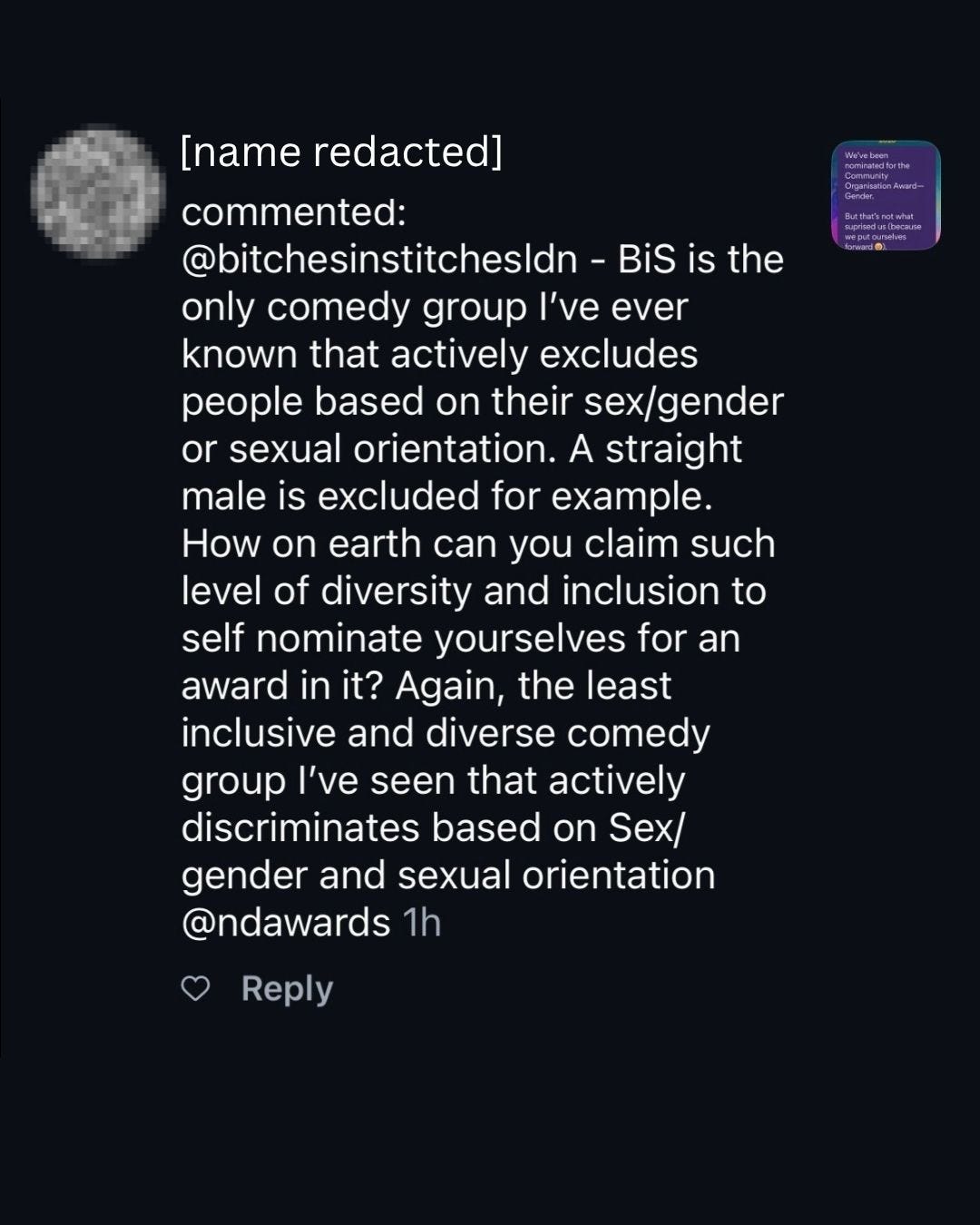
This brochacho was muy furioso:
“I’ve been to 2 BiS shows.
I requested to perform at a BiS open mic and was refused. I’m stating a fact - BiS discriminate against comedians based on sex/gender or sexual orientation.”
His argument, boiled down, was that because BiS intentionally spotlights women, queer comics and gender-diverse performers, we are somehow the least inclusive comedy group he has encountered. A space built because comedy has historically centred men was being accused of discrimination for not centring men…
…Which is a very tidy argument, provided you ignore power, context, history, data and the entire point.
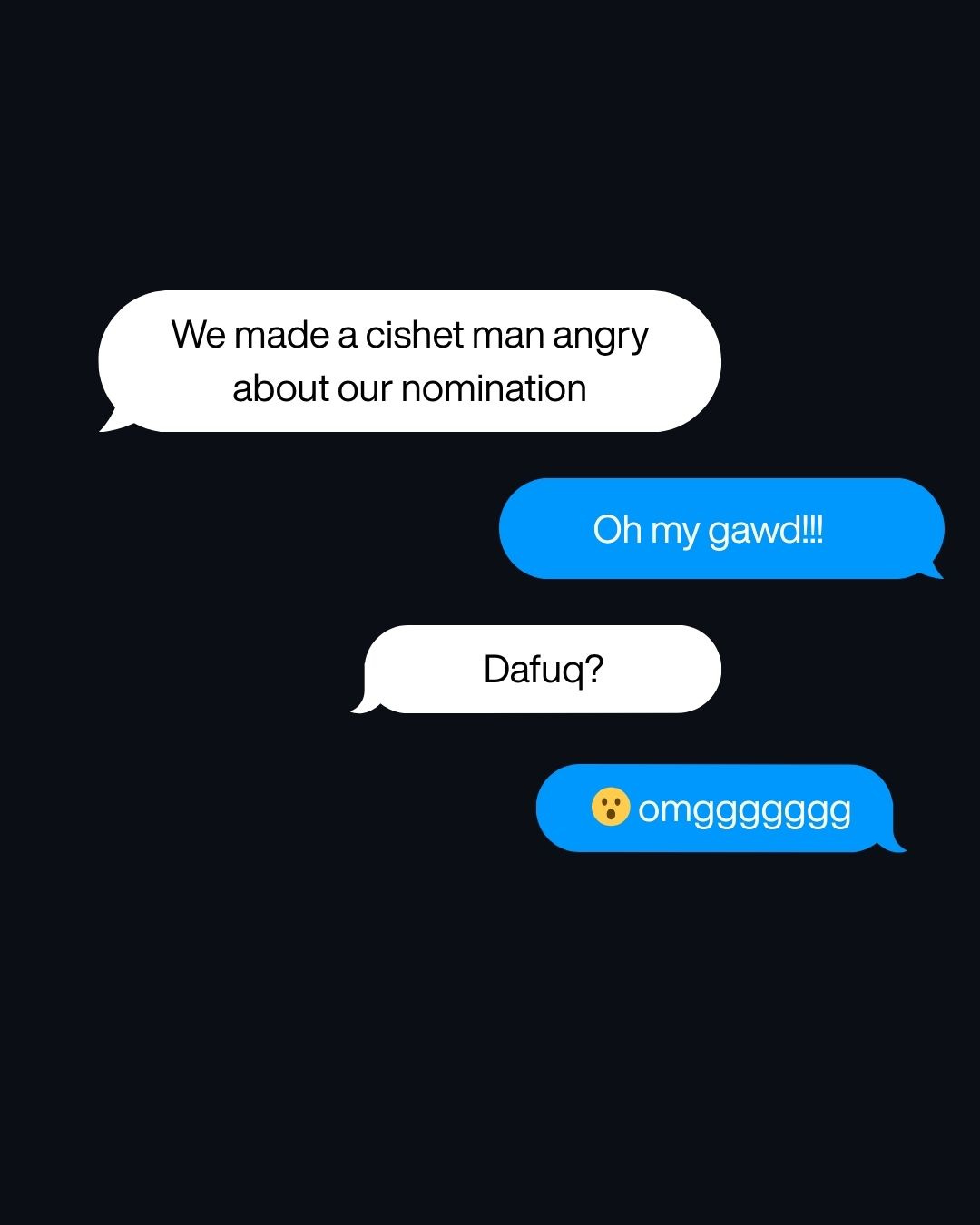
It would be easy to say, “Ignore the troll.” And usually, yes. But for some people in our community, this rage-baiting did not land lightly. Bro was clearly B-A-N-A-N-A-S — but still, his tirade hit a nerve.
Not because he was especially original. SPOILER ALERT: he wasn’t.
But because the script was all too familiar.
When you build a space for belonging and someone who already has access to most of the room publicly targets it, the ground can start to feel shaky. The place that was supposed to feel safe suddenly feels exposed.
And when nowhere feels safe, you move through the world in survival mode. You brace. You scan. You shrink. You spend so much energy protecting yourself that there’s very little left for growth.
Why do some people make telling jokes so fucking exhausting for everyone else?
The inconvenient truth: it’s a power move. When big egos feel threatened, they will do the most unhinged things to make sure you stay small.
I was ready to respond with all the grace and restraint of a woman who has been called “divisive” for creating one room where men are not the default furniture.
Because, for real, the world is on fire. Misogyny is spreading like syphilis on a stag do and I. Am. Tired.
But what I did instead, my Bitches… is proof that all the money I’ve spent on crystals, sage, and spell candles therapy and medication was totally worth it.
I took a moment to sit with my fury.
Then I went on Canva to make random collages because using that BG Remover tool really does soothe me (DM if you want to see them haha).
💡 And then… I remembered something a counsellor told me about how to deal with conflict without escalating it:
“Don’t react. Respond.”
A clapback shouldn’t be written by the part of you that wants to win the argument. It should be written by the part of you that wants to understand the logic.
So instead of giving him the comment-section cage match he seemed to be auditioning for, I replied with questions:
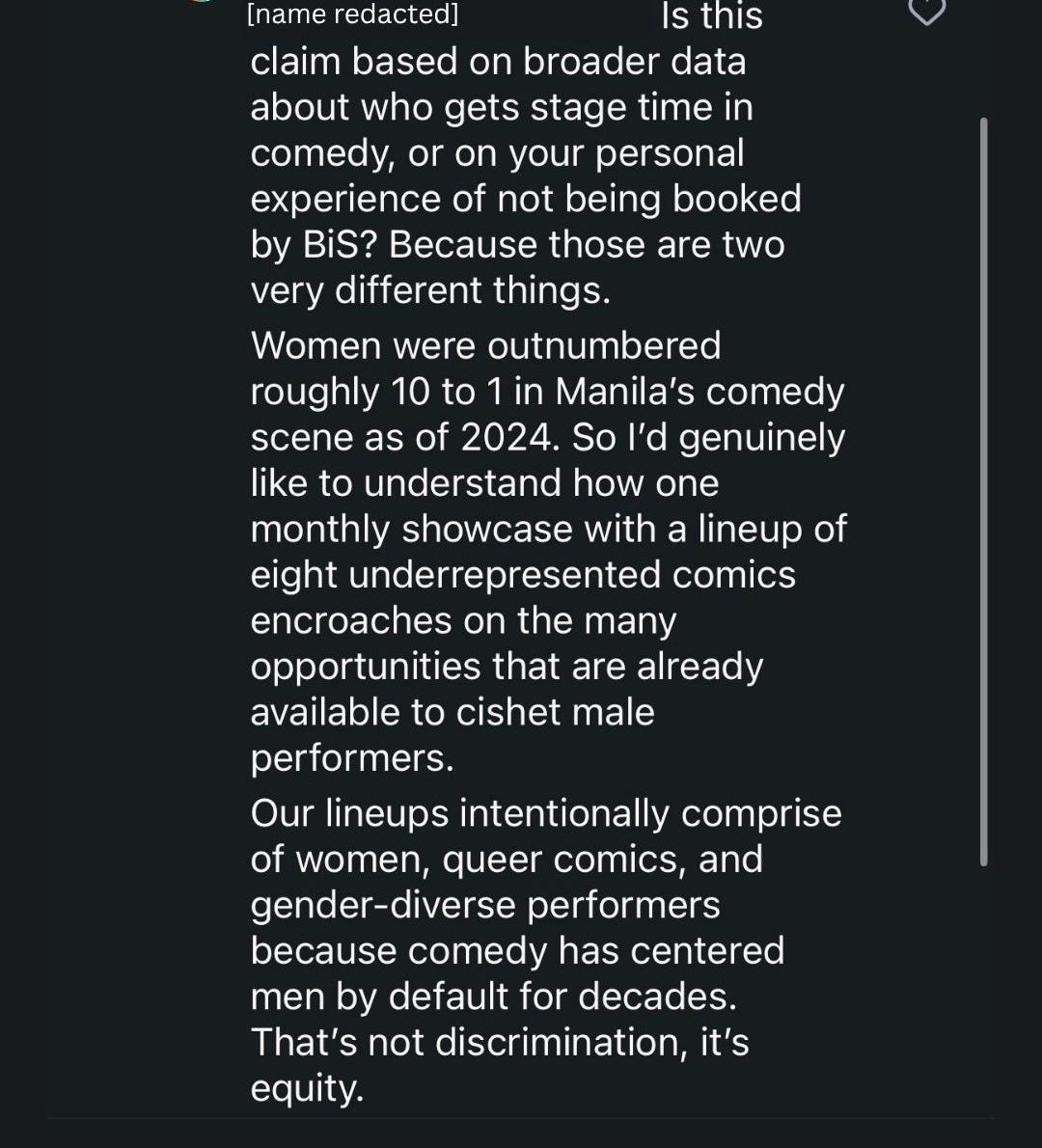
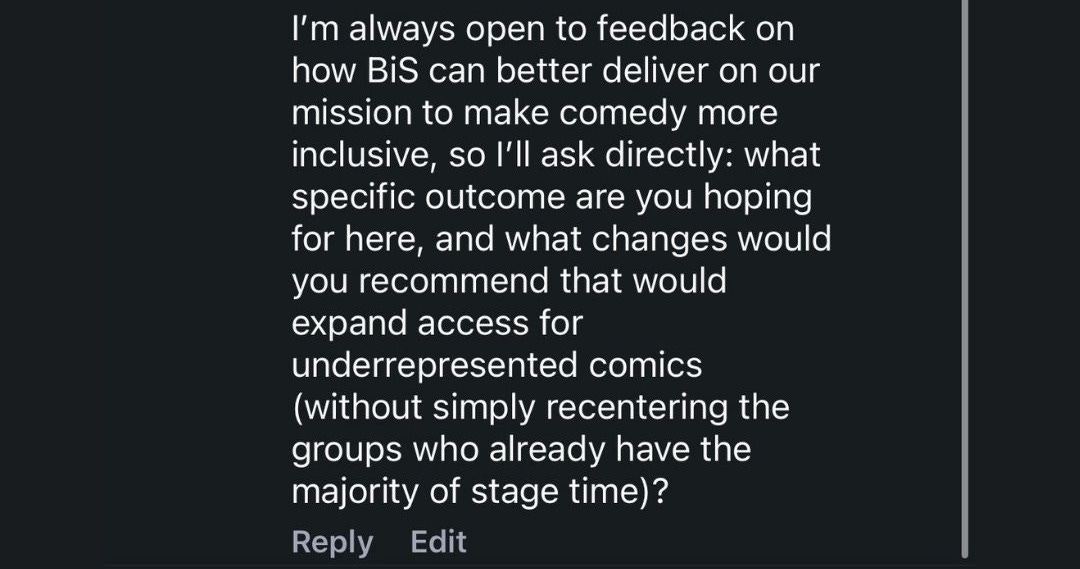
Emotions are valid, but they aren’t facts (And for any of you struggling with emotional regulation skills, I highly recommend this DBT worksheet).
One person’s disappointment may be real to them. But it is not, on its own, a diagnosis of the whole room. If you’re going to call an organisation discriminatory, you need more than vibes, resentment and the fact that you personally were not centred.
But TBH, some people don’t want a bigger room. They want to carry on taking up space at someone else’s expense.
And that’s where a lot of this gets sticky.
Because if you’re used to being the default, not being centred can feel like being erased. If every comedy night, open mic, panel, writers’ room, WhatsApp group, lineup and “who’s free tonight?” booking has automatically assumed you belong, then the one space that says, “Actually, this mic is for someone else today,” can feel like a personal attack.
But it isn’t.
Not being centred is not the same as being oppressed. Not being prioritised in one room is not the same as being excluded from the scene. And not being handed every mic does not mean someone has stolen your voice.
It means, for once, the room is being arranged around people who are usually asked to squeeze in at the back.
That is what equity does. It does not just say, “Everyone is welcome.” It asks: who has actually been welcomed? Who has been interrupted? Who has been treated like a novelty? Who has been booked as the token woman? Who has been told they are too much, too angry, too political, too niche, too loud, too soft, too sexual, too difficult, too ambitious, too not-quite-what-we’re-looking-for?
And then it changes the shape of the room.
That change can feel uncomfortable to people who benefited from the old shape. Of course it can. Power rarely experiences redistribution as a spa day.
A bro feeling annoyed that one comedy collective does not centre him isn’t the same as women, queer comics and gender-diverse performers being historically underbooked, underestimated, unsafe, unsupported or invisible in comedy spaces.
Those are deeply, materially, structurally different things.
We’re not saying men shouldn’t do comedy. Men do comedy. Constantly. Heroically. Inescapably. Often with podcasts.
But our particular stage spotlights the people comedy has too often treated as extra furniture. And if that feels threatening to some, then it kind of proves why BiS exists in the first place.

Not because every bad-faith comment deserves a TED Talk. Fuck no. I would personally like to live in a world where women do not have to produce a peer-reviewed dissertation every time a man has a feeling and access to a keyboard.
But when you are building a community, your response isn’t just to roast the man currently auditioning for the role of Public Feelings Festival.
It’s for everyone watching:
The person who joins every Zoom writing workshop but is still too terrified to do an open mic
The femme/them/queer performer wondering if this space will actually protect them
The group chat members whose stomachs dropped when they saw that comment, because it gave them flashbacks of every man who ever made them feel like they were the problem for drawing a boundary
And it’s also for you, my Bitch: the person holding the room together, trying not to let one loud comment drag your entire nervous system into a dumpster fire.
I’ve got you.
So when (and they will, sadly) the haters gonna hate hate hate hate hate, here’s what you can do:
Our body reacts when it senses a threat. And honestly? Fair. She’s trying her best, but bb has bills, trauma, caffeine and a social media feed that constantly reminders her that everything sucks.
But reacting lets the person provoking you decide the terms of the conversation. Then, it’s no longer about the work, the community or the mission. You’re defending your right to exist to someone who was never asking in good faith.
Responding is different. It gives you a second to ask: what needs to be protected here?
The mission? The community? The facts? My peace? All four, ideally, because I am a woman in over 40 and am simply no longer available for optional cortisol.
This is where “Where are you getting that from?” becomes a tiny little magic spell.
Because if someone is making a serious claim — that your organisation is discriminatory, harmful, exclusionary, hypocritical, whatever synonym ChatGPT spat at them — they should be able to explain what fuckery that claim is based on.
Is it data? Is it a pattern? Is it a policy? Is it harm that has been named clearly by multiple people?
Or is it one person’s personal disappointment dressed up as social justice language because “I wanted to be booked and wasn’t” paints too authentic a picture of their motive?
If someone wants to make a structural claim, they need structural evidence. Not vibes.
This is the question I think more of us should ask when someone comes in swinging:
What specific outcome are you looking for?
Good-faith feedback usually wants to build something better.
It might say:
“This process was unclear.”
“Here is where the wording felt confusing.”
“This part of the policy could be more transparent.”
“Here is a way to make the mission land more clearly.”
Bad-cunt (like, not the way it’s used in pop songs) criticism often can’t name an outcome beyond: stop existing in a way that makes me uncomfortable.
Asking for the outcome turns vague outrage into something that has to stand on its own two feet.
I try really hard not to call people out because I believe “calling people in” has better results. When you call someone out, you’re immediately inviting them to a fight.
So I believe in asking questions before assuming intent. I may do it with my toes curled and butthole clenched, but I try to leave the door cracked open enough for good-faith conversation, because I know what it’s like to ‘roid out on my feelings.
That said, calling someone in is not the same as letting them move into your comment section with all their baggage, unpack their shit and start throwing it around like mad monkeys at the zoo.
Accountability is not an all-access pass to your nervous system.
You can ask someone to explain themselves, invite specificity, respond with facts, clarify your intent…
And then you can stop. That last part’s important.
You’re not obliged to build bridges, especially to small men who’ll never be on your level.
Don’t judge me, dude. I run a comedy collective called Bitches in Stitches — I’m doing exactly what it says on the label.
But seriously, I’ve put everything into building this community. I know these won’t be the last hateful comments we’ll get from someone on the ’gram with delusions of grandeur. But I’ll be ready to respond whenever it happens again.
Because if there’s one absolute truth I’ve learned, it’s that men are extremely emotional creatures. 😉
Comments
Nothing yet. Say the first thing.
Sign in to join the conversation.