

Nearly one in five hospitalized adults are harmed or die each year due to a diagnostic error, according to a study of more than 2,400 patients, published Jan. 8, 2024, by JAMA Internal Medicine. But the true incidence is likely to be far higher, since the vast majority of diagnostic mistakes probably aren’t recorded, Dr. Bates says.
Here we curate evidence demonstrating systemic failures and harm stemming from “early detection” screening and related diagnosis issues. There are two fundamental and related problems:
Diagnostic Errors: Missed or misidentified health issues
Overdiagnosis: Over-detection, leading to aggressive and unnecessary “treatments”
A diagnostic error is the failure to establish an accurate and timely explanation of a health problem and communicate that to the patient. [Agency for Healthcare Research and Quality]
Types of diagnostic errors include:
Missed Diagnosis: The patient is told nothing is wrong, leaving the underlying illness to progress
Delayed Diagnosis: The correct diagnosis eventually made, but only after a stressful, harmful delay
Misdiagnosis: The patient is actively diagnosed incorrectly. This often leads to unnecessary, highly toxic drugs or invasive surgery for a disease they do not have, while their true illness goes untreated.
Overdiagnosis is usually the result of highly sensitive screening tools (such as CT scans and MRIs), which detect non-progressive “abnormalities” that research has proven nearly always remain harmlessly dormant.
As a result, routine “preventative” screening effectively turns healthy people into customers of a system.
The consequences of these diagnostic failures and overdiagnosis are not minor or isolated; they represent a leading driver of mortality, disability, and financial ruin.
Harms from diagnostic errors include the following. [National Academy of Medicine]
Preventing or delaying appropriate treatment
Subjecting people to unnecessary, invasive, or highly toxic interventions
Severe psychological distress or trauma
Catastrophic financial repercussions
Severe Harm & Death — An estimated 795,000 Americans are permanently disabled or killed every single year due to medical misdiagnoses. [BMJ Journals] “Postmortem examination research spanning decades has shown that diagnostic errors contribute to approximately 10 percent of patient deaths. [National Academies of Sciences, Engineering, and Medicine]
Hospital Harm — Nearly 1 in 5 hospitalized adults are actively harmed or killed each year from diagnostic errors. [Harvard Medical School and JAMA Internal Medicine]
Financial Devastation — Americans pay $43 Billion annually to screen for just five types of cancer. [Annals of Internal Medicine]
Extensive Legal Claims — When people sued their doctors over mistakes like missed or wrong diagnoses, they received an average indemnity payout of $407,000 from the insurance company. [MPL, Data Sharing Project]
“Cancer screening in otherwise healthy people doesn’t save lives.”
We’ve been sold a bill of goods by screening industries consistently overselling the benefits and underselling the harms. Those promoting screening boldly declare that the war on a specific cancer is being won, even though the data doesn’t show that screened patients live any longer than unscreened. Looking closely at the evidence of established screening programs drawn from randomized trials and meta-analyses of thousands of healthy people, you find that screening breasts, lungs, colons, cervixes, or prostates are good at finding early signs of cancer, but that detection doesn’t lead to lower overall death rates. (see table)
According to a law firm that focuses on medical injuries, common causes of diagnostic errors at the point of care include:
Insufficient Knowledge: Lack of knowledge regarding diseases that manifest with wide-ranging or “non-textbook” symptoms.
Information Gaps: Failure to gather the correct information, order the appropriate tests, or thoroughly review the patient’s medical history.
Fatigue & Impairment: Impaired clinical judgment due to sleep-deprived, rushed, or otherwise over-extended doctors.
Communication Failures: Breakdowns in handoffs between specialists, or poor communication between the doctor and patient (or misleading information provided by the patient).
Failing Medical Interventions: Complications from medical interventions (such as leaking breast implants or degrading hernia mesh) causing deep, systemic infections that mimic other diseases.
The deeper driver of diagnostic harm is due to a system that is structurally and economically organized to thrive not on wellness but on the creation and continuous management of disease.
Preventative screening frameworks as they currently exist act as an economic funnel rather than an evidence-based health strategy. By using highly sensitive diagnostic tools to scan asymptomatic, healthy populations, establishment medicine systematically uncovers low-risk, non-progressive, and self-contained cellular anomalies. Once detected, these findings are rapidly processed through rigid, automated treatment protocols — transforming healthy individuals into lifelong medical consumers and subjecting them to toxic, invasive, and high-risk interventions under the mantra of “early prevention.”
The conventional medical complex relies on an industrialized diagnostic architecture (featuring the ICD-10-CM’s 90,000+ codes). It defines success by how many abnormalities it can find, catalog, and name, rather than whether the screened human being actually achieves a better quality of life or an extended lifespan.
Landmark randomized controlled trials and peer-reviewed studies increasingly reveal that mass screening protocols for major conditions (such as prostate anomalies and DCIS) shift how a person dies on paper, but fail to change when they die. The mathematical benefit of screening to the individual is microscopic, while the exposure to physical and psychological harm is vast.
Subtle biological signals are stripped of their context, isolated, and labeled as disease. In an automated, liability-driven medical system, a diagnosis is the starting gun for an algorithmic race — a cascade of interventions that presses toward an unnecessary, highly medicated destiny. Because there is zero institutional incentive to find and resolve root causes, patients are trapped in an aggressive loop of biopsies, radiation, surgeries, and lifelong pharmaceutical dependence.,
The pattern of over-testing, artificial disease expansion, and automated prescribing persists across multiple medical disciplines:
Bone Density (DEXA Scans) — The aggressive overutilization of bone density scanning has effectively manufactured “bone diseases” (such as osteopenia) in healthy, asymptomatic individuals where no clinical threat exists. [NPR, MedPageToday, and Wellness Resource Center]
Cardiovascular Risk — Standard risk equations vastly overestimate 5-year cardiac risks in real-world populations, yet they are routinely deployed to justify lifetime statin prescriptions. [JACC Journals]
Over-Medication for Cholesterol — “The 2004 guidelines lowered the recommended LDL-cholesterol targets which immediately classified millions of healthy individuals as ‘high risk’ and therefore eligible for statin drug therapy. At the wave of a pen, the market size increased massively… Eight of the nine members of that panel had direct, personal financial ties to the manufacturers of statins. Furthermore, the five major clinical trials used to justify the new guidelines were entirely funded by the pharmaceutical companies that manufactured the drugs.” [Phil Harper]
Pediatrics: Observers have documented an institutional push to screen children’s cholesterol levels, despite a lack of evidence that mass-screening asymptomatic kids actually reduces future cardiovascular events. [Alliance for Natural Health and JAMA Pediatrics]
“Why you should NOT get a whole body MRI”
The problem is that finding tumors #1 and #2 is not good for you. You are subject to surgery, radiation and chemotherapy that you don’t need. These interventions can improve survival when done appropriately, but when done on people who don’t need them, result in a net loss of survival. Your life is shorter and worse off if you got these treatments when you can’t benefit. – Dr. Vinay Prasad MD, MPH link
“I have seen the harm I have done with cancer screening”
From a population standpoint, I think the evidence is clear that cancer screening does not make much sense… The reason a mammogram trial would have to be so large is that the benefit is so small… I also have seen the harm I have done with cancer screening. People who have suffered complications of the tests, people who have been treated for cancers that I am not sure needed treatment. – Dr. Adam Cifu MD link
“Cancer screening in otherwise healthy people doesn’t save lives.”
We’ve been sold a bill of goods by screening industries consistently overselling the benefits and underselling the harms. Those promoting screening boldly declare that the war on a specific cancer is being won, even though the data doesn’t show that screened patients live any longer than unscreened. Looking closely at the evidence of established screening programs drawn from randomized trials and meta-analyses of thousands of healthy people, you find that screening breasts, lungs, colons, cervixes, or prostates are good at finding early signs of cancer, but that detection doesn’t lead to lower overall death rates. (see table) – Alan Cassels, Brownstone Institute link
The Unreliability of Lab Tests
I don’t advise anyone who has no symptoms to go to the doctor for a physical examination… My favorite study is one in which 197 out of 200 people were ‘cured’ of their abnormalities simply by repeating their lab tests! Most doctors are unable to recognize wellness, simply because they’re not trained in wellness but in disease. — Dr Robert Mendelsohn
Routine, asymptomatic screenings are sold as objective wellness checks, but they operate within an industry designed to maximize procedural volume and diagnostic billing codes.
“Modern oncology now openly acknowledges something once whispered: treatment itself can be economically and biologically destabilizing… Overdiagnosis does not only expand incidence statistics, it expands exposure to surgery, radiation, and systemic chemicals. When aggressive therapy is applied to lesions that might have remained indolent or self-contained, the harm is not theoretical. Toxicity becomes literal… And the system records it as ‘care.’ … What is striking is not the decision to evaluate, it is how quickly evaluation collapses into foregone conclusion.” — Dr. Marizelle
The pathologist who invented the PSA test (Dr. Richard Ablin) has become a vociferous critic of its widespread use as a diagnostic tool for prostate cancer, as summarized by Bruce W. Davidson:
“Mandatory yearly PSA testing at many institutions opened up a gold mine for urologists, who were able to perform lucrative biopsies and prostatectomies on patients who had PSA test numbers above a certain level... Routine PSA screening does far more harm to men than good... [representing] a self-perpetuating industry that has maimed millions of American men.” — Bruce W. Davidson
PCR Testing Had a 97% False-Positive Rate in Peer Reviewed Research (2020)
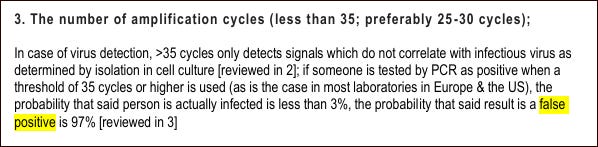
Pieter Borger et al, ResearchGate Nov 27, 2020 — External Peer Review of the RTPCR Test to Detect SARS-CoV-2 Reveals 10 Major Scientific Flaws at the Molecular and Methodological Level: Consequences for False Positive Results link and link
The Reality: The very innovators who discovered these biomarkers have spent decades warning the public that turning a single blood metric into a mandatory screening standard converts millions of healthy men into surgical casualties, causing widespread impotence and incontinence for a slow-moving disease that rarely limits lifespan.
Public health marketing presents procedures like screening colonoscopies as risk-free preventative maintenance. Independent practitioners and raw adverse-event data paint a different picture:
You’re sedated. A flexible tube with a small camera is invasively inserted into the colon so physicians can examine and remove growths at their discretion... And yet, one misstep with the instrument can tear the colon, sending fecal matter into your abdominal cavity and landing you in emergency surgery. Is it really worth it for a possible lesion that may or may not become cancerous ‘someday?’ — Dr. Andrew Kaufman MD
If I’m having a problem, only after I’ve tried every non-medical treatment without success and worsening of the condition, will I seek traditional medicine. I’ve heard of bowels being perforated during these ‘routine procedures’... I figure if they look hard enough, something will be found. And then what? My life becomes one specialist after another with the end result being the same. — Nurse Dee
This screening exposé is just one small window into a massive initiative I have been architecting for nearly ten years, documenting actual trial outcomes and hidden systemic harms across modern healthcare.
If you believe that having access to an independent, bottom-up map of health data is vital for navigating our current world, please consider supporting this Substack today.
Thank you for reading, for looking past the top-down narrative, and for supporting independent truth.

Failed Health Outcomes — The U.S. spends nearly twice the per-capita amount on healthcare than the next highest spender, yet Americans are the most chronically ill, and rank 48th in life expectancy, among other countries.
Verifiably Corrupt — Establishment medicine as a system* is verifiably corrupt, serving the interests of industry — not health. (*Obviously, not every individual working in establishment medicine is unethical. Rather, the system that educated / indoctrinated them, and that sets policy, hires, pays, and promotes them is verifiably corrupted.)
Diagnostic Errors & Screening (you’re here) — An estimated 795,000 Americans are permanently disabled or killed every single year due to medical misdiagnoses. The “early detection” screening frameworks as they currently exist act as an economic funnel rather than an evidence-based health strategy, transforming healthy individuals into lifelong medical consumers, who are then subjected to invasive, toxic, and risky interventions.
Big Pharma & Biotech: Immoral Business Model — Corporations, by design, are beholden to profit above all else, acting as powerful entities that are “essentially psychopathic and without conscience.” Pharmaceutical and biotech companies are the utmost example of corporate psychopathy, demonstrating inhumanity in response to human suffering.
Regulatory & Professional Betrayal — Government agencies entrusted to regulate the field of medicine fail to do so. The majority of influential professional organizations such as the American Medical Association are corrupted by industry.
Not Evidence/Science-Based — The bulk of establishment medicine’s standard of care is not based on unbiased, reproducible science. (We prove it here.)
Harms by Drug and Diagnostic — Establishment medicine providers routinely utilize diagnostic testing and “treatments” that cause harm (“adverse”, “side” effects). Get verifiable evidence of the harms, organized by drug, treatment, or test (mammograms, CT scans, antibiotics, statins, benzos, etc).
Failed Philosophy & Strategies — Allopathic medicine (also called conventional medicine, Western medicine, and Rockefeller medicine) was created to exploit the profit potential of drug patents. Born from a compromised report published in 1910, this system does not acknowledge the conditions under which the human body creates health, nor does it seek to identify and resolve the root causes of illness. On the contrary, it suppresses symptoms with drugs, creating more symptoms and distracting efforts from true healing. Diagnosis is disconnected from the wisdom inherent in the purpose and message of symptoms.
Stifling of Treatments that Don’t Benefit Industry — Healing modalities that don’t benefit industry are underutilized, suppressed, and disparaged. Providers who are perceived as a threat to establishment dictates or lucrative markets are condemned, intimidated and attacked.
The Significance of Legal Precedent — Precedents involving “standard of care” and breach of duty have significantly influenced how physicians practice, and the state of establishment medicine as a system. This easily digestible overview provides important insight into why mainstream medicine has developed the way it has, demonstrating that physicians have been slaves to a corrupted system, and steeped in legal threat and uncertainty.
What’s the Impact from Creating More than 90,000 Diagnoses? — Establishment medicine’s diagnosis system (the ICD-10-CM) is 22 chapters and 288 sections, with more than 90,000 possible diagnoses. The U.S. Dept of Health & Human Services takes another 115 pages to document accompanying rules. Naming constellations of symptoms vs. identifying root causes: how has it impacted health?
Beyond Diagnosis: Healing Principles — Key issues that underlie most disease and healing principles that are consistently and verifiably effective.
Root Cause Index — In this vast curation of evidence, we cite hundreds of research papers on the root causes of diseases.
Health Systems & Techniques — We bring together 20 systems of medicine + nearly 200 health and wellness techniques, structuring the material in an organized way for efficient research.
Diseases & Conditions Glossary — A succinct glossary and resource links for more than 150 terms used in discussing health issues, conditions and diseases.

Cut through propaganda & distraction to efficiently get to suppressed evidence. Get an at-a-glance view for quick access to just what you need from thousands of the best sources.
Test it out: Ask AI about these subjects. While AI is better than compromised search engine slop, most answers require source verification and on these subjects, it censors and sometimes outright lies.
Comments
Nothing yet. Say the first thing.
Sign in to join the conversation.