
This excerpt is from Huck Reyes’ forthcoming manuscript on the cultural history of sex workers. Reyes’ position stresses the importance of a “sex worker reading of the archive” and advocates against academic interpretations that exclude subjective perspectives from actual workers.
You know what my problem is? I’m not eating enough steak. The nurses told me this once when I was eighteen and fainted after donating some blood. Why there was a blood drive at my high school, I still have not figured out. But, anything that got me out of class for a little while was totally worth the sacrifice.
“Eat steak,” they said, “and spinach.” Yum.
Eighteen years later and finally I realize that I might be less ornery and snide if I just ate more steak. People always look joyful and satisfied when they’re eating steak. I could have that. How much steak might I consume to reach this level of content? What quantities and frequency would my GI tract and cardiovascular system tolerate? Unlike with oysters on the half shell, my physical tolerance for steak consumption may have a limit.
My favorite kind of steak is one that I don’t have to pay for. Ideally, no one I love will have to pay for the steaks, lobsters, and cheese rolls I’m about to order. This bill ought to be paid by a client for the food to taste best. Far from what is taught in etiquette schools, or in Tita’s passed-down life lessons, I will always eat well on a date. It’s free, for God’s sake! Well, not totally free, but don’t make me spell it out. If I’m going to be working on my back or on all fours—give me a damn steak!
I couldn’t eat steak every day, unfortunately. I don’t think I’m built for that. It’s not sashimi. Some people train their whole lives to consume copious amounts of steak; quite a recent phenomenon in the scrolls of human history. When researching a scholar’s claim about a certain historical prostitute’s “gastronomic feat” of consuming 17 pounds of steak, then five days later consuming another 24, I thought I’d give a listen to a podcast on the history of beef in America. Did you know that eating way more beef than was ever imaginable in the Old World was a foundational national pride? We did it, Joe!
One thing I’ve never thought though, while eating or handling a steak, is how easily it could fool a gentleman into thinking it was a vagina. Sorry to be crude, but the scholars put me onto this question—feminist ones! Gay ones, too. This claim has been published about the very same carnivorous prostitute mentioned above. No, not me; the other one. Supposedly, there was a Mary of Greene Street who used a certain type of meaty fake vagina belt to conceal her male genitalia when soliciting gentlemen clients so they wouldn’t “know” she was trans. Weird claim, right? In all my professional years of eating steak and pussy, working with a dick or without, at no point did I ever accidentally think I was getting pussy when I was actually getting steak.
With all due respect, civilian scholars are functionally illiterate when it comes to reading sex workers’ histories. The literacy gap is so great that they don’t even see sex worker history as requiring a different set of glasses. To these scholars, we are so illegible that we don’t even register as a distinct group.
The narrative goes something like this: sex workers can “overcome” the conditions of prostitution and go on to do great things in spite of their troubled past. What I don’t encounter, however, is a line of inquiry that opens up prostitution itself as a site of culture, intersectionality, and world-making that would influence a person’s agency, sense of self, and provide the foundation for the act of overcoming anything. Many scholars attribute the stories of resilience to other factors, adding involvement in the sex trade as a footnote to an archival figure’s otherwise heroic journey. This text argues that many of our feminist and queer icons were resilient, ruthless, cunning, and creative because they were prostitutes. Prostitution then shifts from being something to overcome into something that provides the mental and cultural framework to overcome everything else.
This disparity became obvious to me in an archival research class focused on Black and Indigenous female rebellion during the colonial period of North America and the Caribbean. One of our reading assignments was a chapter from C. Riley Snorton’s 2017 book Black on Both Sides titled “Trans Capable: Fungibility, Fugitivity, and The Matter of Being.” There are several issues I have with this chapter as a trans person alone, but the telling of Mary Jones’ history, and the analysis that ensued, troubled me the most.
Before reviewing the text itself, it is important to note first the instruction and reception of the text within the class. Snorton was presented by the professor, a Dr., as canonical to Black Feminist Theory. Yet, there wasn’t really any critical engagement with Snorton’s writing; rather, just an extended conversation in accordance with the ideas Snorton was offering us. The discussions in class stretched a healthy breadth, but I was left wanting for an incisive depth.
Since I am open in almost all spaces about being a sex worker, I volunteered alternative interpretations and narratives regarding Mary Jones (and other archival figures we studied who traded sex). There was no one else in the class who could offer these perspectives, at least not openly. Regardless of this obvious blind spot, no further discussion followed to explore the figures through an explicitly sex worker lens, and there was no admission that this might even be useful, let alone necessary, to achieve a fuller understanding.
In too much of radical discourse fascination with whores as a symbol blocks out validation of theoretical insights from real-life sex workers. The only reason we know about Mary Jones is because she was a poor prostitute going about her prostitute day doing unglamorous prostitute things and that got her arrested. The least we could do is put some respect on her prostitute name.
I do not want to give too much of a negative impression however. The other students were polite, listened intently, and certainly were never hostile or disparaging towards sex workers in general. The professor, too, was completely accepting of my background and expressed appreciation for my comments. This is the soft trap that many types of people who are historically not taken seriously in school or work may be familiar with. Naming the precise injustice becomes difficult when on the surface there are only smiles and friendly nods. Not a single person told me to shut my mouth or that these ideas were flawed or dumb, they simply did not take the information seriously enough to warrant further excavation. Why would they? What does a whore’s subjective history really matter?
Well, if so many of the people we’re studying in feminist and queer history also happened to trade sex, one would think that Sex Worker Theory would be more of a thing. Given how entangled trans, queer, and female lives have always been with sexual labor and oppression, one might assume there would be a heavy emphasis within these fields of study on the subjective experiences of prostitutes. One would hope, taking into account all these things, that at least a single sex worker perspective could be genuinely discussed as worthy when going over archival texts about sex workers.
For instance, almost forty years ago Kimberlé Crenshaw coined the concept of “intersectionality” to explain the unique compounded racial and gendered experiences of Black women in the workplace and this framework has been applied broadly across marginalized communities since. With sex workers, this analysis is often applied to understand the experiences of different workers within the industry, but in feminist and queer scholarship it is not applied to sex workers as a unique group as such. Civilians and sex workers themselves apply intersectionality to understand that Black trans sex workers experience our industry in unique ways different from cis and non-Black sex workers. While this is useful for intracommunity discourse, an epistemic disparity still exists because civilian scholars do not apply intersectionality to sex workers in a way that treats us as having experiences distinct from civilians, including civilians who share our other identity markers.
We must acknowledge that sex workers deserve as much truth in their histories as possible. The symbol of the harlot, the prostitute, and the hooker have played an outsized role in the narrative-making of societies and the subsequent enforcement of social codes, yet our histories are told in ways that do not privilege an intersectional epistemic and interpretive approach that is sex worker-inclusive. A scholar who shares racial and gender identities with a historical sex worker may be able to theorize on many aspects of such a figure’s life. However, their literacy inevitably falls short when it comes to subjectively understanding that figure’s experience of their own inner and outer worlds primarily as a sex worker.
Being a sex worker is its own experience that shapes a person’s outlook, relationships, sense of humor, values and more. To care about sex workers is to care about how their histories are told. Civilian scholars must accept that they do not necessarily possess the appropriate credentials to adequately read sex worker archives. Many will fall into perpetuating tropes, accepting preposterous narratives, or overlooking significant details simply because they did not even know what to look at or how.
What happens when we read the archive as sex workers first, and as researchers second? When we filter our reading of the materials through an embodied knowledge of our unique experiences? The discernment of prostitutes is sharper than glass. We can utilize that skill, one of our cultural values, to critically analyze the narratives circulated about our own histories—even those from feminist and queer scholars with the best of intentions. If one does not read sex workers’ histories in a manner that includes these realities, then huge chunks of truth will never be uncovered
Let me hold your hand while I say this: prostitutes can read. We’re like Santa Claus, actually. We know when you’ve been bad or good, and we’re never surprised when you’ve been bad. Though it’s still upsetting when our high-minded neighbors a few streets over write about us as if no prostitute would ever see their words.
In the thirty-four years since the publication of Timothy J. Gilfoyle’s City of Eros in 1992, at least nine frequently-cited scholars and writers have given their account of Mary Jones’ story and archival presence. The humanities are absolutely fascinated by her. The testimony she gives during her court appearance in June of 1836 is no doubt remarkable. So few people like herself are recorded in their own words inside the archive. But what do these authors give us, really? What do they offer prostitutes—intellectually—when they write award-winning books containing our stories? Or when professors praise their chapters as “canonical” to feminist theory? Historical subjects who traded sex function more as theoretical cannon fodder in the service of feminist canon than anything else. We’re useful, until we’re not. (Funny—reminds me of a john.)
Sex sells, after all, and today’s feminist academics know this. We see this expressed through the new age queer hagiography of prostitute-activists whose involvement in the sex trade is momentarily highlighted then scrubbed to a couple down-played sentences. Such reverence for our dead, but what about our living? Is the decriminalization of sex work a central issue on the gay agenda? Or the women’s agenda? Has it ever been?
Elite culture producers place sex workers at the center of their aesthetic aspirations, inside their post-structuralist history books, and on stage at the Oscars as champion-symbols of marginalized identity. Yet none of what these elite produce is made for the people they borrowed from in order to manufacture their cultural works. Mary Jones, God bless her, is now the most prime example of how contemporary feminist scholars created a literary prostitute to revere, and simultaneously fumbled any analysis that would be meaningful to the literal prostitutes reading their beautiful, hardcover publications.
When I was first taught about Mary Jones, within the context of archival research, I pinched myself in class to make sure I was awake. The paltry investigation (in stark contrast to the inflated idolization) of her story was surely something I’d dreamt. We read a total of two accounts about Jones, one from 2017 and one from 2001. We looked at a couple of the original newspaper articles and then we had some rather mealy discussion, mostly skirting around any aspects of the story that were directly related to…y’know…sex. My freakish obsession with, y’know…facts…got the better of me and I began a deep dive into all the different coves of inquiry that I guess we just didn’t have time for in class. The feeling that permeated most of my high school experience crept back in; I was bored out of my mind with the syllabus. The re-discovery that some classrooms weren’t for people with the hungriest brain, but more for people with modest appetites, cloaked me in a stormy adolescent frustration…I had far too many questions than the teacher had desire to answer.
So to get readers up to speed, here are the basic reported facts of Mary Jones life and 1836 trial. Born under the name Peter Sewally on December 12, 1803, she was a free Black New Yorker by 1827 at the latest, in accordance with the emancipation laws at the time. She testified that she had been “in the service,” probably a state militia, and that she had also spent some time in New Orleans. She was arrested for pickpocketing in June 1836 and charged with grand larceny after a client accused her of stealing his wallet during a sexual transaction. She told the court that she worked in a brothel on Greene Street doing domestic chores and that the girls of ill-fame had given her dresses and told her she looked good in them. She had multiple arrests on her record and served several years at Sing Sing Prison. She is regarded as one of the earliest openly transgender Americans to be recorded. (For convenience, I only use she/her to refer to Mary even though most historians have rightly pointed out that we cannot be entirely sure.)
The First Accounts: Gilfoyle and Hill
The early 1990s gave us two chunky, tediously-researched books on prostitution in New York City during the 19th century. Timothy J. Gilfoyle’s City of Eros (1992) and Marilynn Wood Hill’s Their Sisters’ Keepers (1993) are saturated with personal accounts, police reports, court documents, and references to contemporaneous writers that offer readers a fine-grain image of this period’s prostitution history. Their mentions of Mary Jones are brief, catalogued among myriad other cases and characters.
Compared to later texts, Gilfoyle’s and Hill’s reporting of details are more reserved. It isn’t until the next decade that an article from The New York Sun is quoted by historians in reference to an alleged prosthetic device Jones supposedly used to interact with her clients. Either the detail wasn’t discovered yet or Gilfoyle and Hill, embracing a more discerning outlook, perhaps believed that this detail didn’t add anything significant to what they wanted to convey. It’s quite possible they found The Sun’s claim to be utterly absurd. What these two offer is a wonderfully useful reference guide for tracing primary sources and a trailhead for beginning research into any particular figure or event.
New Millennium: Katz and Nyong'o
In Love Stories: Sex Between Men Before Homosexuality (2001), author Jonathan Ned Katz does the “big reveal” for Mary Jones and brings to light a hitherto unexamined detail of Jones’ case. While previous accounts included Mary’s own testimony identifying herself as Peter Sewally, Katz is the first to reference a few lines from a report published in The New York Sun on June 17, 1836, the day after Jones was tried for theft. The report claims, in botched Latin, that the arresting officer discovered Jones wearing a piece of “cow” (Katz hypothesizes “leather” was meant) held up by a belt which supposedly functioned as a believable vagina so clients wouldn’t know Jones’ “true” sex. Almost twenty-five years would go by before any scholar would challenge this claim in print. That’s effectively a quarter-century of serious, credentialed people accepting and repeating that some butchered meat fastened to a girdle was a totally viable technique for a trans-feminine sex worker to use with her clients.
By the end of the decade, Tavia Nyong’o argues in his book The Amalgamation Waltz: Race, Performance, and the Ruses of Memory (2009) that while Mary Jones’ story has been interpreted in relation to prostitution and same-sex attraction, no racial analysis of her history had yet been offered. (All the published writing of Mary Jones up to, and including, Nyong’o refers to Jones as a man and uses masculine pronouns.) In a section subtitled “Performing Respectability” which concludes the chapter “In Night’s Eye,” Nyong’o uses the example of Jones’ story to explore the “complex relation” between shame and shamelessness specifically during the antebellum amalgamation panic.
What he concludes about respectability and shame within the abolitionist movement at the time would be stronger if the full implications were connected to Black sex workers today. Nyong’o points to the exclusion of Mary Jones from African American studies as symptomatic of the performance of respectability regarding sexuality and gender. He comes so close to expressing what colleagues of mine say about their own experiences as Black sex workers within different Black communities. While Nyong’o argues that Jones’ gender expression and cross-racial sexuality presented too “sensational” a personality to be studied by Black historians, even the most heterosexual, gender-normative Black sex workers struggle to this day for their full inclusion within Black activism, media, politics, and history.
Perhaps without realizing, Nyong’o also revives a rhetorical practice from Mary Jones’ very own period. While the Christian-derived whore/shame redemption narrative is less overt than in cases I’ll examine later, it is noticeable nonetheless and arrives coupled with a 19th-century affection for diagnostics. Jones’ story is sandwiched, at the beginning, between a passage that cites modern thinkers on a “queer theoretical affinity for the transformations…of shame,” and, at the end, with Nyong’o referring to Jones as an antebellum New York “antitype” (a fulfillment of prophecy). Jones is thereby recruited retroactively into these thinkers’ ideas about queer shame as a motivator to redeem oneself even though we cannot actually know her exact motives or feelings. Throughout the section the reader is guided to conceptualize Jones through this lens of socio-religious psychology—a narrative pattern that would characterize C. Riley Snorton’s later theories in which Amalgamation Waltz is frequently cited.
Even while Nyong’o offers us the beginning of an honest (and deeply needed) conversation regarding the “interminglings” of shame, respectability, and social uplift within marginalized communities, the analysis eventually falls flat because there is no recognition of prostitutes as a distinct group. The tabloid rumor brought to light by Katz is presented in more explicit detail (a “strategically placed slab of beef”), yet Nyong’o refrains from making a clear statement about whether or not he thinks The Sun’s absurd claim is true. The vague language allows the reader to detach themselves from Mary Jones as a real person, and instead invites us to join the author in relating to Jones in a purely theoretical way. She’s still too sensational…
Chaos on High: Snorton and Bailey
In the introduction to Black on Both Sides: A Racial History of Trans Identity (2017), C. Riley Snorton proposes the argument for the “right to opacity” within his book, stating that this is both an ethical and political imperative because of the archive’s untrustworthiness. He plainly offers that his chapters are “writerly experiments” and that Black on Both Sides “does not attempt to be exhaustive or even fully explanatory.” That’s fine. But does this opacity not also have its limits of application? The irony, lost on Snorton perhaps, is on full display within one sentence that concludes the first paragraph of a section called “Collateral Genealogies.” Here he asks, “What does it mean to have a body that has been made into a grammar for whole worlds of meaning?” This is exactly how he treats the figure of the prostitute in Chapter Two, exemplified by Mary Jones. He uses Jones’ story as a grammar for constructing worlds of meaning about Blackness and transness, yet the theories he offers were clearly developed without including a subjective sex worker point of view. Possessing a shared racial and gender identity with an archival figure, on its own, does not automatically qualify a scholar to theorize about the experiences of that figure as a sex worker. To do so is intellectually reckless. Here, a “right” to opacity becomes almost indistinguishable from dishonesty.
Snorton, unlike everyone else, informs his readers of a 1908 news article reporting on a resident of New York’s Bowery called “Beefsteak Pete” (a tabloid nickname referencing Jones’ male identity and fabled prosthesis) who allegedly consumed copious amounts of steak in a contest. No other writer or scholar has incorporated this account into Mary Jones’ history, nor has anyone openly contested it. It’s hard to pinpoint what exactly the “right to opacity” is supposed to offer us as sex workers when reading Snorton’s interpretation of one of our own. The flaws in research are blatant (which I show in section V), as is the worn-out habit of depicting sex workers as if we’re crazy, fantastical, or have an extreme compulsion to perform redemption.
What about the right to be particular? The ethical and political imperative of sex worker advocates has always been to remind friendly queer and feminist communities that, no, we actually are not just like all of you. We are a particular group with particular experiences, perspectives, and needs. While the cultural Christian urge to blend all beings into a universal experience may have some merit, there will always exist the question, what if I’m not the same as you? What if I don’t want to be? What will you do to me then? Because Snorton does not treat sex workers as our own distinct group requiring a particular expertise to interpret, he falls into a trite discourse regarding Jones that is at least several centuries old. Black on Both Sides won the John Boswell Prize for LGBTQ history, the Lambda Literary Award, and three more prestigious awards for scholarly nonfiction writing.
Unfortunately, the accounts from within our community are scant. The best-known reporting comes from sex worker, history buff, and comedian Kaitlyn Bailey (creator of the one-woman show “Whore’s Eye View”: A Mad Dash Through 10,000 Years of History from a Sex Worker’s Perspective). Bailey actually had a weird take involving pieces of beef liver, but ultimately her 2018 Oldest Profession Podcast episode was only about seven minutes of Mary Jones and fifty-three minutes of chit chat. Now, I’ve only produced one single podcast episode ever in my life, but I learned how much effort goes into creating just one hour of presentable material. Perhaps, within that grueling monotonous labor, one gets a bit slack after a few years and lets an episode go live that is effectively just a recorded hang-out sesh. I could see that. And, I was still disappointed that one of our own community’s most popular history babes delivered such an underwhelming discourse about a worker whose story deserves so much more.
We’re Still Here: Kinsey, Gill-Peterson, and Tourmaline
Writing for the NYC Department of Records and Information Services in 2022, graduate research intern Riah Lee Kinsey provides an extensive review of Mary Jones’ archival presence. Presented in the official blog post are copies of the real police records and court transcripts—I recommend starting here to gain a good understanding of the timeline and main points of Jones’ story. Given the careful dedication to archival thoroughness presented by Kinsey, I expected to find a reference to the police report that would have corroborated The Sun’s claim regarding what officer Bowyer supposedly encountered when he conducted his search of Mary Jones after her arrest. If the tale about Jones using a steak as a vagina hinges solely on a single column in a famously sensational paper, it seems rather unintellectual to continue to refer to this report as if it were true. The opacity offered to the reader by serious civilian academics becomes less of a rhetorical right and more of a profound confusion. Why not show the receipts like for every other detail of Mary Jones story? When it comes to understanding sex workers materially, why the dearth of inquiry?
This is why I have thanked God for Jules Gill-Peterson and her 2024 book A Short History of Transmisogyny. She is the first scholar in twenty-five years to push back against The Sun’s weird story printed in Latin, calling it a “wholesale invention of a white author.” This stance effectively puts pressure on everyone else who blithely went along with The Sun. I like that. We need more pressure on scholars to do better. Gill-Peterson also walks a fragile line that many trans activists shy away from—she honestly narrates the relationship between trans femininity and sex work. She makes a genuine effort to put herself in Mary Jones shoes while both telling the history and analyzing previous accounts including Nyong’o and Snorton. Gill-Peterson is more tactful than I am, though. She raises issues in the scholarship indirectly, instead of calling out specific authors’ passages. What can I say? I’m a gutter punk to my core. (“They’ve, er, polished me up, but I’m still exceeding dirty.”)
One may be tempted to conclude that Gill-Peterson’s own identity as a trans woman of color is the reason why she’s “able” to analyze Mary Jones’ history with more clarity. But this is a mistake. Every single one of the authors and historians who published before her is completely capable of treating history’s sex workers with more dignity. They just have to care and make the effort. Part of being a scholarly person, I thought, is knowing what you don’t know. If you are not a sex worker, or you have not taken a keen interest in sex worker history, then you don’t know how to read us. And that’s okay. Academic integrity requires us to elevate truthfulness above pretension. Truthfulness in research and theory begins with knowing your limits. Most sex workers interested in this kind of thing would be more than happy to collaborate with the authors I’ve been discussing. Come on down from that ivory tower and let’s grab coffee. I promise we don’t bite (hard).
Although Jules Gill-Peterson made the effort to bring some sense to how to Mary Jones’ history is interpreted, it may be too late. The artist Tourmaline published her book Marsha: The Joy and Defiance of Marsha P. Johnson a year later in 2025 but again circulated The Sun’s claim about Mary Jones, this time without any citation at all. She writes quite matter-of-factly abut Jones using a “prosthetic vagina when interacting with clients.” This is perhaps the most perfect demonstration of how a completely ludicrous and unverified claim can gradually become accepted as natural fact. Now you can really see what we’re up against as sex workers in academia. If those who are actually friendly towards us are fumbling our history this badly, just imagine how much worse it can get! Tourmaline is also a trans woman of color, but that did not immunize her against perpetuating the transmisogynist “invention of a white author” that has been claimed about Mary Jones for almost two hundred years. Rationality clearly has less sticking power than some good gossip.
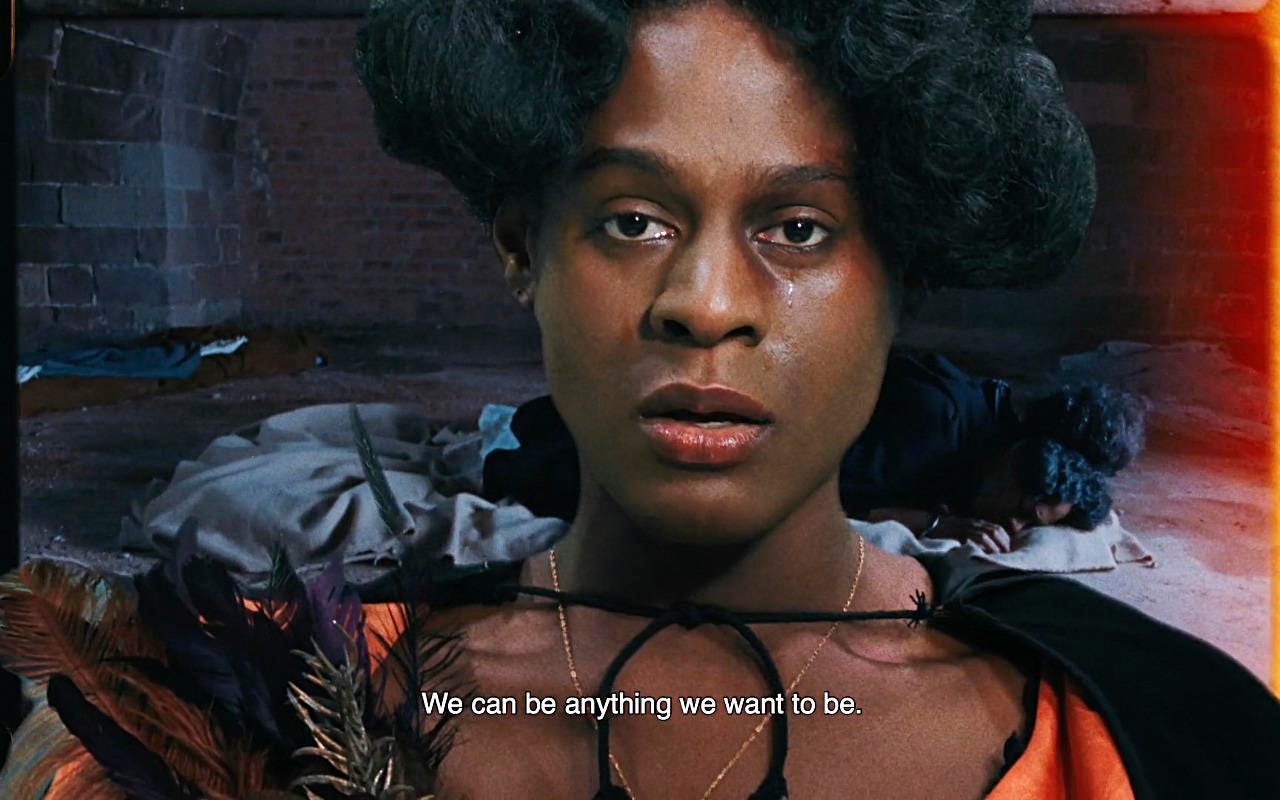
While there are only a couple paragraphs about Mary Jones in her book, Tourmaline is no stranger to Jones’ story. She produced two short films in 2019 that portrayed a fantasy version of Jones’ life in New York. In 2022 these works were exhibited at the Venice Biennale. (Still waiting to find out if Tourmaline will ever do a free screening of these short films for sex worker community groups.) Of course, this prestigious platform was not utilized to directly advocate for sex workers even though the main character of Tourmaline’s films is only known to us because she was a thieving prostitute. In fact, the artist made no mention of sex work at all in the official promo clip where she discusses her work. I’m tempted to assume that this was a choice on Tourmaline’s part because, as we know, the 2001 Venice Biennale is where the red umbrella was adopted as the symbol of the sex worker rights movement following an artist-led demonstration inside the festival itself. The Slovenian artist Tadej Pogačar created the installation “Prostitute Pavilion” in direct collaboration with sex workers and rights groups.
But what reason would civilians have to know all that?
So let’s get to the meat of it—pun very much intended. What exactly were the claims about wearing and eating steak? How did they come about? Why did many really smart people fail for decades to interrogate this part of the archive with the same rigor they applied to every other aspect of Mary Jones’ history? I have my ideas about the last question. People don’t really care about sex workers, living or dead. So they just accept any old fable without question. Who cares! Those pesky old whores will never come to find our literature anyway…
To be absolutely clear: regarding the supposed surrogate vagina, there’s only one single claim, printed in The New York Sun on June 17, 1836. That’s it. No other accounts have ever been produced and all but one of the nine authors I mention refrained from giving their readers even the slightest contextual overview of the media environment that this tabloid column came from. The Sun claimed that Mary Jones’ arresting officer, Bowyer, was the one who found “a piece of cow” on Jones’ person. Yet there is never any mention of this appearing in any police report or in the court documents. As Gill-Peterson points out, “It’s hard to fathom that the court would have ignored something related to [Jones’] dress or work…”(2024, 67). If there is some additional documentation supporting The Sun’s claim, why wouldn’t Riah Lee Kinsey have shared it with us during his graduate research internship at the Municipal Archives?
By far the most thorough archival examination of Mary Jones’ case is Kinsey’s article for the official website of the NYC Department of Records & Information Services. Yet even here the only source for the “leather prosthesis” is again The New York Sun, cited in the footnotes. Here is the exact citation Kinsey provides:
Sun, June 17, 1836, pg. 2. Originally in Latin: “Bowyer had also discovered that the prisoner, to sustain his pretensions, and impose upon men as sexus femineus, fabrefactus fuerat portio bovillis, (cara bubulu) terebratus et apertus similis matrix muliebris, circumligio cum cingulum!!!”
Students of Latin will be horrified by those phrases. The first scholar to include this newspaper report in studies of Mary Jones was Jonathan Ned Katz, who also gave us his best translation, “…the phrase says that the woman impersonator ‘had been fitted with a piece of cow [leather?] pierced and opened like a woman’s womb [“vagina” is the intended word], held up by a girdle.’”(2001, 82). Directly following this translation, Katz articulates a rather amusing and oblivious thought regarding The Sun’s readership, “Educated, Latin-reading, upper-class men could apparently contemplate such details without harm; women and lower-class persons of either sex could not.” This is just lazy. With even a small amount of research effort, one can reasonably deduce that The Sun’s target audience was never anyone in the educated upper classes.
In 1836, The New York Sun was bent on driving sales in competition with its new rival The New York Herald. Both of these papers were notorious sensationalist outlets established in 1833 and 1835, respectively. This was a period when mass literacy was on the rise, and “penny press” newspapers catered to working-class audiences by selling copies for 1¢. Some of The Sun’s finer reporting you might be familiar with; such riveting works like their six-part series, published just a year before Jones’ trial, covering alleged life forms on the moon resembling “winged man-bats.” Not a single scholar or writer who peddled The Sun’s claim considered the journalistic reputation of the paper as worth mentioning; not Katz, not Nyong’o, Snorton, or Kinsey. Tourmaline didn’t even bother to reference The Sun at all. (I’m exempting Gill-Peterson from this list because she gave her own reasons for refuting the claim about a fake vagina belt.)
On top of doing bare-minimum research about The Sun, I’ll go ahead and say another radical thing regarding Mary Jones’ story: men like trans women. Period. Trans women do not need to fool men into liking them. Not in 1836 and not in 2026. The men who paid Mary Jones for sex did so because they liked her, sexually, as she was. No steak necessary. Hell, not even in 1395 did trans-feminine sex workers need to use any type of trickery to interact with the men who hired them. A court testimony given in late 14th-century London bolsters the argument that trans-feminine prostitutes of yore were popular among clients in their own right and had no need to deceive anyone.
Eleanor Rykener’s court testimony in 1395 is strikingly similar to that of Mary Jones in 1836. They both worked with “girls of ill fame” as a domestic worker in the brothels, and both cite these girls as the ones who gave them dresses and accepted their gender presentation. It should be noted that this practice is still widespread among sex workers today. In 2018, my first work clothes in a California pro-domme dungeon were hand-me-downs, and mutual aid among sex workers frequently includes clothing swaps. So it is not surprising to me at all that genderfluid workers in centuries past would find solidarity and aid among the brothel workers.
The respective testimonies and available records for both Jones and Rkyener show that they had traveled and worked in different cities and that they solicited clients frequently, if not daily. Could it really be that every encounter with a man, over the several years that they both worked as prostitutes, involved hoodwinking him during sex? In Mary’s case that would mean buying a new steak for every encounter! Who has the money for that? Who has the time? Or the refrigeration? The steak idea collapses with even a faint amount of scrutiny. Maybe the authors of the existing scholarship found theorizing about the mechanics of such a claim to be too crude. I don’t. Life is crude. Working as a prostitute is crude. It’s not a cute abstract. If we succumb to squeamishness when studying history’s sex workers, we will pass by many important details about their lives, or worse—settle for tabloid clippings.
In spite of the absolutely shambolic nature of this sourcing, one scholar not only takes The Sun’s tabloid column as truth, but proceeds to connect another weird newspaper story to it, and then builds out a freaky little theory about Jones based on both. I guess that’s what “post-structuralism” is all about? Maybe if I hadn’t dropped out of community college I’d have a better understanding of when not to do proper investigative research. Let us pray for good surf, good health, and please, God, please send us higher standards of source literacy in academia. Amen.
After comparing all the principal scholarship on Mary Jones to date, we can see that once The New York Sun’s reporting of her alleged prosthesis was included in historians’ published works, the rumor morphed into an unchallenged detail–even an accepted fact. While Jules Gill-Peterson (2024) has directly contested that Mary Jones ever used a “steak held up by a belt” to fool her clients during sex, even Tourmaline (2025) took The Sun’s report for granted in her book published a year later. C. Riley Snorton, however, took the fascination several steps further. Publishing after Gilfoyle, Katz, and Nyong’o (and citing the latter two), Snorton followed suit by again presenting Mary Jones as a prostitute who used a beefsteak garter belt for sexy time with clients so they wouldn’t “know” she was trans. This allegation coupled with a later report about Jones’ “gastronomic feat” of consuming over three dozen pounds of steak are what Snorton provides as foundational to his psychosexual regression theory about Jones offered on pages 65-66 in Black on Both Sides.
Because the prosthetic vagina story is already treated as an established reality in Snorton’s chapter, the reader does not have to stretch their imagination too far when a later newspaper clipping is included in Mary Jones’ archival story. In 1908 The Virginia Enterprise referred to a New Yorker named “Beefsteak Pete” (a pejorative nickname that The Sun had often used for Mary Jones) in an article describing an individual who had consumed 17 pounds of steak in one day, then a few days later ate another 24 pounds. Snorton continues to write as if The Enterprise, publishing from the boom town Virginia, MN, is indeed identifying our dear Mary Jones of Greene Street in New York City. At her trial in 1836, Jones testified that she was born on December 12, 1803. Snorton does not mention that Mary Jones would have been 104 in 1908. Nonetheless, the reader is guided through Snorton’s reasoning that in an attempt to publicly reclaim her name and reputation, Mary Jones “in the twilight of her life” regressed from “the genital to the oral phase” by consuming the surrogate flesh she once utilized to ply her venereal trade.
I wonder if Snorton has read French socialist writer and senator Alphonse Esquiros, or pioneering Italian criminologist Cesare Lombroso. Publishing in the middle to late 19th century, these gentlemen were so kind as to sketch for their readers clinical profiles of prostitutes’ unique physiology and psychology. Both of them offer generous theoretical servings, based on their professional observations, that the ladies of the night possess pathologically voracious appetites for food and drink. The other commonality is the theory of atavistic behavior, that prostitutes are less evolved, or never matured fully. Thus, they experience the world through all orifices equally, à la Freudian polymorphous perversity. Nice.
Writing in his 1893 La Donna Delinquente, Lombroso profiles what he calls the “born prostitute” or “innate prostitution.” Among the several characteristics attributed to us “morally insane” beings are “Gluttony, voracity, and tendency to drink,” which we apparently have developed with “unheard-of vigor.” Lombroso continues, “Gluttony links prostitutes with children; during childhood, before the awakening of intelligence and sexuality, one’s entire existence is still focused on the stomach.” Decades earlier in 1842, Esquiros wrote in Les Vierges Folles (somewhat more affectionately) that “Natural prostitutes…are in general of a powerful and Herculean race. Everything about them speaks of eager appetites…” I actually quite enjoy one of Esquiros’ observations here, “...their face radiates highly developed sensual energies; the large and devouring mouth, the flaring nostrils, the deep and rather raucous breathing–there is no element of their physical characteristics which does not indicate an inexhaustible need for material pleasures.”
The story about the false vulva is pretty ridiculous on its own, but to add in another shoddy claim that relies on the first strikes me as particularly troublesome. What is Snorton’s narrative offering any of us, really? When he wrote Chapter 2, did Snorton imagine that any living prostitutes would read these paragraphs? To accept these stories is to know nothing of how sex workers actually relate to their clients or themselves. While Jones’ story is a somewhat brief account in Snorton’s queer award-winning book, it is representative of larger cultural and epistemic structures frequently employed to talk about sex workers. What is being offered is ancient: a salvation plot that shows (internalized) shame can transform prostitutes into superhuman beings (or that we were paranormal to begin with). Snorton’s theory is simply a repackaged device that pathologizes and mythologizes prostitutes by mixing Victorian-era pseudo social science with Christianity’s timeless literary tradition of redemptive whore-shame narratives.
But then again, maybe Snorton, Esquiros, et al. were on to something. A whore’s fondness for pleasurable amounts of food is something my colleagues and I are intimately familiar with. I recall a certain night in Chicago’s “Viagra Triangle,” during a business trip with a philanthropic organization that two of my friends and I worked for. We finished our meetings for the day, took a nap, and re-emerged into the night ready to prowl. After effortlessly downing a fully-loaded Chicago dog, and then another, I turned to my dear friend Keke and asked, “What’s next?”
“I want corned beef and cabbage,” she pouted.
“Oh hell yeah! Let’s go.”
Dublin’s Bar & Grill on North State Street could have easily been the same scene two hundred years ago on the same night. Working girls strutted openly with their bloated dates, smiling warmly and winking when Keke complimented their figure or hair. A playwright in tweed spat out his beer upon laying his eyes on me, then stood paralyzed and transfixed before moving in to confess his love for “my energy.”
“How bout a round of Guinness, then, for this ‘energy’?” When you know your smile is impossible to say no to, why would you ever pass up a chance? (See aforementioned “highly developed sensual energies.”)
Pints in hand and a plate of corned beef on the way, we called Sinseriti who was still waking up from her nap–told her things were lit at the tavern. When she walked in several minutes later she immediately ordered a plate of oysters Rockefeller. The playwright confessed his obvious bisexuality to me (like they always do) and right on beat a working girl dumped her drink on a rude man and a glass shattered on the floor. Sex worker culture is alive and well if you know what to look for and where. The waitress even knew how to pass off our entire check to a couple out-of-town younger guys who were clearly besotted with Keke. We gave her a twenty.
Next we raided Walgreens. Sour belts, Gatorade, cigarettes, bubbly water, chicharrones. Just some staples for the hotel room. Then there was the time I ate a two-pound lobster in front of my date; on our next night out I slurped bone marrow directly out of roasted femurs. In fact, I’m hungry right now. Although I already had a full bowl of linguine with red sauce. There’s just always this nagging urge to keep consuming! A little bit here, a morsel there. Why not? Eat for the days you don’t eat! Smoke ‘em if you got ‘em, and forever amen—The Lore of Super Human Appetites is a heavy, savory crown to bear.
The depictions of excess written by Snorton strike a similar note as another popular way to represent the sex worker in (academic) literature: the self-punishing prostitute ascetic. In this type, the sex worker embodies excessiveness by demonstrating a transformation from extreme sinful consumption to extreme virtuous deprivation. It’s quite fitting, as I don’t believe the sex worker could ever occupy any other righteous-adjacent role in the Christian tradition. Ascetics were often condemned by monastic leadership for exhibiting the same immoral qualities that prostitutes are, even today, also accused of: pride, individualism, and spectacularity (see Paula Fredriksen, Ancient Christianities).
Not only is the act of prostitution a symbol of excess, but the shame of being a prostitute is assumed to be so great (excessive) that repentance of prostitution could enable the prostitute to take on superhuman characteristics in order to absolve herself of sin. This is not unique to prostitute-saints in Christian mythologies, as many other types of saints did fantastical and magical things. But could this tradition have continued into secular academic spaces, even through feminist and queer scholars who champion figures in the archive who traded sex? Is it a continuation of the centuries-long war between respectable women and “public women”? Respectable women have modesty and moral sanity; public women have divine visions served with steak.
Rosa María Egipcíaca, like Mary Jones, is blissfully misunderstood by the civilian scholars who read her. When I learned that this 18th-century brothel-worker-turned-mystic had people “worshipping her person” the first thing I thought was body worship. Sometimes referred to as Goddess worship or even muscle worship, these activities are literal menu items that a client can request from most Pro-Dommes. Contemporaneous sources, and her 20th-century biographer, go to great lengths to describe Rosa’s impressive Catholic devoutness once she left brothel work. She was adored by ecclesiastical sources for her fasting and self-flagellations, details that went uncontested by the queer feminist professor who taught me her story. I do not accept that Rosa, who was already reportedly paralyzed on one side from whippings and disease, would spend her days outside the brothel depriving and harming herself. Portuguese religious leadership at the time had every reason to market her as a model of conversion to the large demographic of Africans in the colony, as their record of Rosa’s piety suggests. What they didn’t expect was Rosa María’s ascent to local deity via her own heretical self-fashioning. In the religion of sex workers, who is God? We are.
From Rosa María’s historians, her fifteen years of brothel work in Minas Gerais rarely take up more than a couple sentences in the story of her life. Fifteen years schtupping in an 18th-century mining town reduced to two lines, or in Luiz Mott’s nearly 600-page book, just ten pages. (Bear with me though, I’m still learning Portuguese as Mott’s full work has yet to be translated.) That’s about 5,475 days where she would have been seeing more than one client per day. This is the site of inquiry where Rosa would have spent numerous hours not only working in very harsh conditions, but also where she would have been studying every john, plotting, dreaming, and strategizing. This is where she would have begun to analyze the visiting Catholic priests, one of whom would eventually become her “exorcist.” Today’s scholars on Rosa seem to prefer the line of thinking that she really was possessed, or that the priest organically believed she was possessed and graciously adopted her as an exorcism patient. Contemporaneous sources were suspicious of the relationship between Father Francisco “Xota-Diabos” Lopes and Rosa. “They were declaimed as lovers,” according to Mott.
This is where a sex worker reading of the archive is crucial. Almost every sex worker recognizes, to some degree, that a large part of the job is knowing what makes your client tick, telling them what makes them feel good and important, and understanding how the client views you. There is no way that Rosa spent fifteen years in a brothel and never developed a habit of psychoanalysis on her clients, regardless of how subconscious that process might have been. So when a famous priest comes to your town who is known as “The Scourge of Demons,” whether he is there as a john or as a confessor, the clever whore will find a way to work the situation, and his ego, in her favor.
Is it really so hard to believe that Rosa may have purposefully deceived Father Lopes into believing she was possessed? Or are we to meekly accept that she simply fell into a relationship with Lopes that, coincidentally, happened to be very advantageous to her? Or even more shallow yet, that she was indeed possessed and the skilled Father Lopes helped save her?
“Oh, she was so clever!” the scholars exclaim, “The first African in Brazil to read and write Portuguese, wow,” as if the secrets of the alphabet require a particularly select intelligence (see Elle Woods in Legally Blonde). But they will not look into how ruthlessly clever you have to be to 1)physically survive fifteen years of brothel work in an 18th-century mining town and 2)to get a learned man to believe you are indeed possessed and believe that you like him enough so that he will purchase your manumission when the town’s bishops flog you for heresy. There are endless wells of critical fabulation to be considered, but that inquiry is stonewalled by respectability politics and stigma around sex work. Rosa María and Mary Jones alike have become sanctified through their all-too-familiar tale of sinful extremity and subsequent excessive redemption. Mott titled his 1993 biography Rosa Egipcíaca: An African Saint in Brazil.
In addition to the reports of both clergy and lay people worshipping “her person,” Rosa María’s own theological language reveals what, to my whore spidey-senses, seems like a deliberate fantastical ruse. After all, the Catholic imagination is already outfitted with the erotics of mystical worship and devotion. Rosa knew that as a woman, an African, and a prostitute in colonial Luso-America, she was already viewed by Portuguese society as a supernatural being. So she leaned in, played the part, and gained all that she could from that rigged set-up.
After amassing a cult following and convincing Franciscan monks to fund the establishment of a home for women like her, Rosa began writing and dictating her book The Sacred Theology of Love of God Brilliant Light of Pilgrim Souls. In it, she claimed that the baby Jesus came to her every day to “suckle at her bosom” and that afterwards he would comb her hair to thank her. Father Lopes enjoyed this fantasy so much that when he commissioned a painting of her, he had the artist portray Rosa in Franciscan robes with only her hands, feet, and right breast revealed. The portrait depicts Rosa cradling the baby Jesus in her left arm while she holds her right nipple between the fingers of her other hand which also holds a Bible. It is no coincidence that, upon returning to Rio de Janeiro and living with the monks, she renamed herself after St. Mary of Egypt who also traded sex and whose vita is read during Lent. By likening herself to a redemption starling in the monastic tradition, Rosa further venerated herself in the imaginations of her followers and mentors. I think the dolls say, Girl you better work!
Laughing all the way to the Inquisition’s holding cell in Lisbon, Rosa knew what we all know in the sex trade: the most convincing truth is often a lie; no one is going to take you seriously anyway, so learn how to use that to your advantage. If I’m going to be whipped and bound by society regardless, might as well do it spectacularly. In 1998, Mott presented a paper where he shared Rosa’s last recorded words:
The final session of questions put to the African clairvoyant occurred on the 4th of June, 1765: on that day she related one of her visions. When she was about to take communion she had heard a supernatural voice which said to her: “Thou shalt be the queen bee gathered up into the hive of love. Thou shalt make the sweet honeycomb and place it on the table of the celestial feasts, and it shall be the sustenance and nourishment of His guests.”
What are scholars like Snorton doing when they perpetuate superhuman narratives about the ways whores repent for their terrible sins of lust and debauchery? Nothing new! Let’s look at St. Mary of Egypt (the original “Egipcíaca” from whom Rosa María took her cognomen) whose story was written down in the 7th century CE. Often depicted in paintings as looking about 1000 years old, excess again is foregrounded by artists and authors alike as delineating every aspect of her being. Father John Townsend, a rector at St. Mary of Egypt Orthodox Church in Roswell, GA, even uses the word “superhuman” in his description of St. Mary of Egypt’s vita transcribed on the church’s online library.
The quick and dirty version, because this essay is already too incessant, will have to suffice. One single monk, Abba Zosimas, encountered her–NAKED–in a cave outside Jerusalem after he had been on a spiritual quest for about twenty days. Here St. Mary “told” him all about her former life of insatiable lust and depravity in which she traded sex purely for the pleasure. She later swore to abandon her lecherous ways in order to negotiate with a divine spirit that barred her from entering the Church of the Holy Sepulchre because her sins were, apparently, in excess. In exchange for this entry, Mary of Egypt converted to Christianity and spent nearly fifty years leading an ascetic life along the River Jordan before Abba Zosimas encountered her. The tale survived for over a hundred years inside Zosimas’ monastery before being written down by St. Sophronius.
The function is the same in the 7th century as it is in the 21st: depict prostitutes as supernatural beings with ungovernable appetites and high tolerance for pain, humiliation, and disfigurement. Render the shame of being a prostitute so great that readers could be convinced of their superhuman schemes of repentance. Exalt the redemptive version of her and leave the naughty bits for the footnotes. Do prostitutes even read, anyway? Yes, and what I’m reading is completely different than what high-falutin credentialed authors could ever allow themselves to visualize. Here’s a radical idea–maybe history’s harlots weren’t so ashamed. Or maybe they dealt with any shame in totally unremarkable, maybe even healthy, ways. I’m sorry, but no whore gives that much of a shit about a news tabloid that it would drive her to publicly consume an inhuman amount of meat. But, if such a whore exists, I would like to meet them because I, too, would like to consume an excessive amount of (preferably rare) steak. For pleasure, obviously; never out of shame.
From Mary of Egypt’s perspective, however, she totally wins. She raucously enjoyed a life of sailor’s pleasures, pursued a faith practice with what few means she had, retired to the desert to enjoy naked solitude (what sex worker doesn’t want to just be left alone at the end of work?), then made our boy Zosimas to do her bidding for a couple years to get her affairs in order before being interred by a helpful lion. Now she is a Lenten celebrity and through Rosa Egipcíaca she has even appeared, in spirit, on one of Rio’s Carnaval floats. Rosa understood the sexual power of St. Mary’s legend and she carried it with her into what would become one of the most important stories in Afro-Brazilian history. St. Mary’s frail body depicted in Orthodox icons stands in stark contrast with Viradouro Samba School’s majestic 2023 Carnaval float honoring Rosa Egipcíaca. Yet to those who understand how to read prostitutes, these depictions of excess are one and the same.
In 1979 a small group of Orthodox Christian worshippers purchased a redwood log cabin kit and bolted it together on Beaver Ruin Road in Norcross, GA. Approaching the church from the north, I passed the Gadhpurdham Shree Swaminarayan Hindu Temple on the left just a block before, and the Jun Dung Sa Buddhist temple directly across the road from the church’s driveway. The neighborhood boasts an above average yardage of robes per address.
Like the well-clothed neighbors, I also picked a modest outfit for the Great Vespers service at the St. Mary of Egypt Orthodox Church. It was my very first ever. With t-strap Birkenstocks, though; I wanted to keep my toes out for Mary.
Never have I felt so fully a personification of the phrase sweating like a whore in church. Yet, this temple would not have me fidgeting in the corner of a pew. There were no pews. Benches lined the border walls of the large cabin, some spaces had cushions. Most of the floor plan was open, with large plush area rugs arranged in a staggered pattern. The Lord’s Living Room, Father Christopher calls it, both intimate and expansive.
Everything was warm, like a womb. Faint bells rustled and frankincense stirred through the sanctuary. When I walked in, I spoke with a priest who stood next to the door. His dark brown cassock was form-fitted around a perfectly pot belly. I told him it was my first time at an Orthodox service and I wasn’t sure where to stay.
“Oh great,” he smiled peacefully, “Sit anywhere, just relax. And be yourself.”
Then he walked away to finish lighting candles. Okay, I’ll relax and be mostly myself, I can settle. I truthfully wasn’t sure what to expect here; my gay ass mullet haircut queer-lookin’ tattooed vibe isn’t always appreciated in highly religious environments. But I was goin’ with the flow of this Vespers thing and so I leaned back on an old lure. Usually in the South if you just start to write somewhere in public that will prompt a passerby to strike up a full-on discussion.
“You takin’ notes there? Gonna see if we’re the most Orthodox or not?” A gentleman with a white ponytail and wooden cane chuckled at me and his eye twinkled. He was walking in with a few others and they all proceeded around the room, kissing different icons and crossing themselves. Ignatius, with the cane, also sported a blue t-shirt printed with white letters: Orthodox Church of America. He sat down next to me and glanced at my journal.
“So what are you writing down there?”
I told him I was writing about St. Mary of Egypt and Rosa María Egipcíaca explaining that the latter named herself after the former. He seemed nominally entertained but mostly volunteered himself to describe to me what was happening in the service. I was very grateful to him for that.
Almost everyone stands. Ignatius said the service is essentially one long continuous prayer. The different priests’ incantations accompanied by the four-person choir (two sopranos, one alto, one bass) lent the body to rocking, or nodding, as the prayers emanated one after the other, without pause, in trance-inducing harmonies. The effect is mollifying, which eventually becomes hard to resist. My jaw relaxed, my eyelids drooped; I felt a gooey gratitude and solace surround me, even though my flat feet were already cramping having worked an all-night stagehand gig the evening prior.
This next part is an impolite comparison. I couldn’t help but see within this church the same elements of setting up the rooms at the old dungeon. A ritual incense, curated music, dark robes and candles…truck drivers and students and retirees alike coming to kneel before (Jesus and) The Prostitute. Kiss the boot, bow your head, chant for mercy, feel relief. The scene warped into a kind of queer Da Vinci Code in my head. The Goddess Cults still exist—implicitly where St. Mary of Egypt’s churches stand erect, and explicitly inside the BDSM play spaces rented by the day or the hour.
Sometimes a player from one world hops over to the other—a wrinkle in the regular order of the afternoon. I may have approached this realm with a bit too much desire, though. When congregants lined up towards the end of service to kiss the Father’s ring and receive a blessing, Ignatius considerately mentioned I didn’t have to do this but I was welcome to if I wanted.
“I wanna do it,” came out perhaps a little more enthusiastically than it should have. A young man in a high-vis work shirt with grease stains waited to the side and extended his arms to motion for me to go ahead of him in line. Father Christopher instantly recognized that I was new and extended his ring happily while saying, almost with a surprised inflection,
“Hello, welcome! God bless you, glory be.”
Then I bent forward, holding his right hand tenderly in mine, and I brushed my lips against his fingers ever so gently, whispering a thank you. This gesture felt like a climax after standing in place and rocking for the past sixty minutes while repetitive song-prayer circulated rhythmically between the exposed beams and stained glass windows. Although, I wasn’t clued in to the different bows and reaches to the floor that others were performing at certain moments in unison with particular words.
I just stared at my green toenails, swayed like a tide, and let myself get hypnotized. I wore a respectful long-sleeve dress shirt, with loose-fitting slacks, but I kept my toes out as a frisky personal relish–a signal to any other whores in church, living or dead. The pedicure my client paid for is an offering for you, St. Mary Jones Egipcíaca. Covered shoulder, peep toe…the priest taking notice, and the whole congregation asking my name…
No posts
Comments
Nothing yet. Say the first thing.
Sign in to join the conversation.