
Dear participants of the Bioregional Hope event,
We hope you have experienced that the bioregional movement of changemakers that protect, restore, and regenerate the places we call home, is on the rise.
To support this emerging movement, we created an overview of vital resources to help ‘Changemakers’ get started with ‘Bioregional Weaving’.
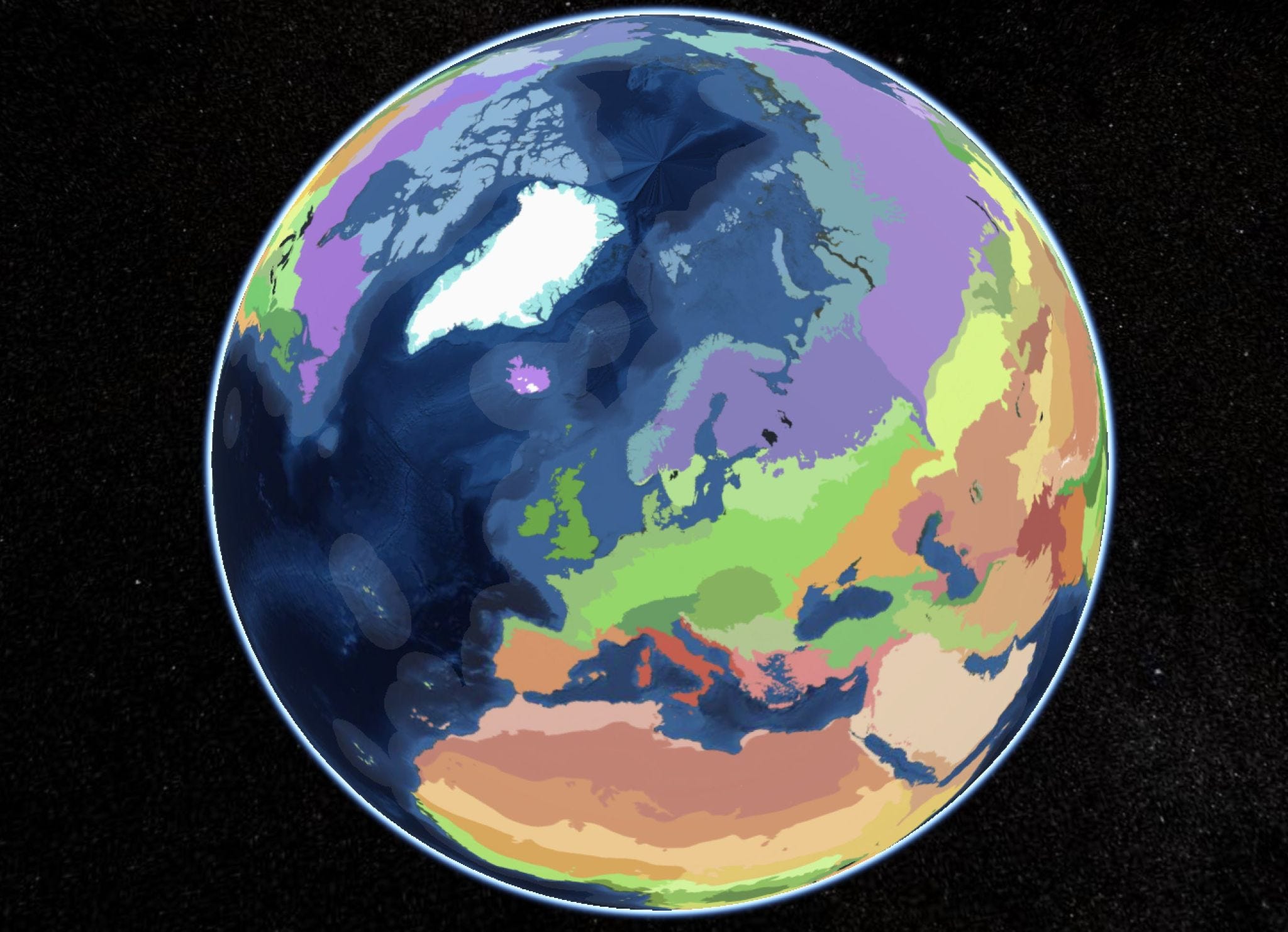
“A bioregion invites us to inhabit a place in a way that is full of relationship. Seeing where the natural boundaries of our bioregion are, we can then see the many ecosystems and human systems alive within it. All of these systems like fresh water and biodiversity or transport and health are connected.
There is also a connecting story that starts in deep geological time, shows up in the landscape and soil and then in human culture. Bioregioning is the collective practice of bringing vitality to these connections, angling the systems towards regeneration, and taking actions for a climate resilient and biodiverse future.”
“Weaving is the practice of connecting people and projects in synergistic and purposeful ways. Weaving involves connecting people to each other and to a shared purpose; fostering collaborations for systemic impact; facilitating collective learning and iteration; and embodying the change we wish to see.”
“A changemaker is someone who imagines a new reality, takes action and collaborates with others to bring that new reality into being for the good of others.”
Three essential resources to help you get started 🚩
6 Books, 14 courses, and 20+ articles and videos to dive deeper 🤿
And much more!
This overview is incomplete and will continuously evolve. If you know any other valuable resources, please leave a comment on this post, or add suggestions to this Google Docs, and we’ll make sure to include it 🪄
⚠️ Please note: not all sources below directly involve bioregioning, weaving or changemaking. Yet, through experience, these sources have proven to be conducive to bioregional and regenerative development ♾️
Looking at your bioregion, you are looking at your true home. The river is your blood, the soil is your body, the rain and fog are your breath. When you care for one, you care for all.
—Inspired by Thich Nhat Hanh
Listen to The Future is Local: Bioregioning 101 by Nate Hagens from The Great Simplification with Daniel Christian Wahl, Isabel Carlisle and Samantha Power. It’s a great introduction to bioregioning 🎙️
Explore The 4 Returns Framework in Practice by Commonland. It’s a practical guidebook for holistic landscape restoration that everyone can understand and use 📑
Find your community through the Bioregional Mycelium 🗺️
To support the growing bioregional movement, we’ve mapped 150+ initiatives working on bioregional regeneration, so that you can find your bioregional tribe. We highly recommend to join already existing communities like Design School for Regenerating Earth and The BioFi Community of Practice 🤝
Do you know any bioregional initiatives that are missing in the overview?
Add initiatives and make changes to the map by editing this public database, or simply leave a comment on this post, and we’ll make sure to include it 🪄
The Bioregional Mycelium Database




Bioregional Financing Facilities – Reimagining Finance to Regenerate Our Planet by Samantha Power and Leon Seefeld.
Regenerative Development and Design – A Framework for Evolving Sustainability by Pamala Mang, Ben Haggard from Regenesis Group.
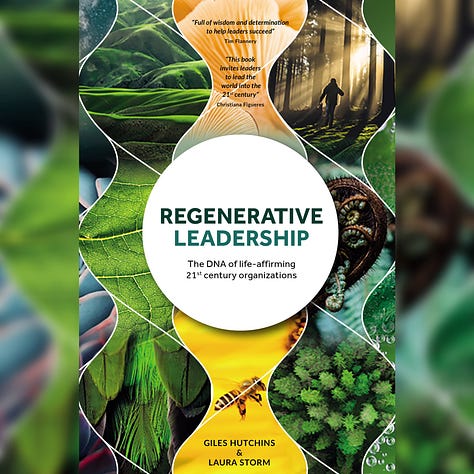
Regenerative Leadership – The DNA of life-affirming 21st century organizations by Giles Hutchins and Laura Storm.
The Biosphere and the Bioregion – Essential Writings of Peter Berg by Cheryll Glotfelty and Eve Quesnel.
A Business Approach to Sustainable Landscape Restoration by Erasmus University Rotterdam and Commonland.
Capra Course — a systems thinking course by Fritjof Capra.
Design School for Regenerating Earth — the learning network for regenerating bioregions By Joe Brewer and Penny Heiple.
Designing Resilient and Regenerative Systems (DRRS) by ETH Zurich Systemic Design Labs and MonViso Institute.
Gaia Education — a leading provider of holistic education in sustainability, regenerative practices, and community development.
Leading Multi-Stakeholder Collaborations by CoCreative and Ashoka.
MA Regenerative Design (MARD) by Central Saint Martins, University of the Arts London.
Power of Place by Really Regenerative CIC — a collective learning journey in regenerative placemaking.
RegenIntel Foundations Course — an immersive program to go beyond sustainability and build holistic regenerative solutions.
Regenerative Economics, Finance and Organizations by Capital Institute.
Systems Change for Bioregional Changemakers by Bioregional Weaving Labs Collective (to be launched 🔜 keep an eye out in our Newsletter!)
The Regenerative Practitioner Series (TRP) by Regenesis Institute for Regenerative Practice.
u-lab by Presencing Institute — the basics of Theory U and how to apply it to your own context.
Water Stories Core Course — learn how to rejuvenate landscapes and waterways through water cycle restoration.
Zen and the Art of Saving the Planet by Plum Village — nurture insight, compassion, community, and mindful action in service of the Earth.
The Regeneration Calendar by Global Regeneration CoLab (GRC) is a public, shared calendar of regeneration-related events happening online and in-person around the world.
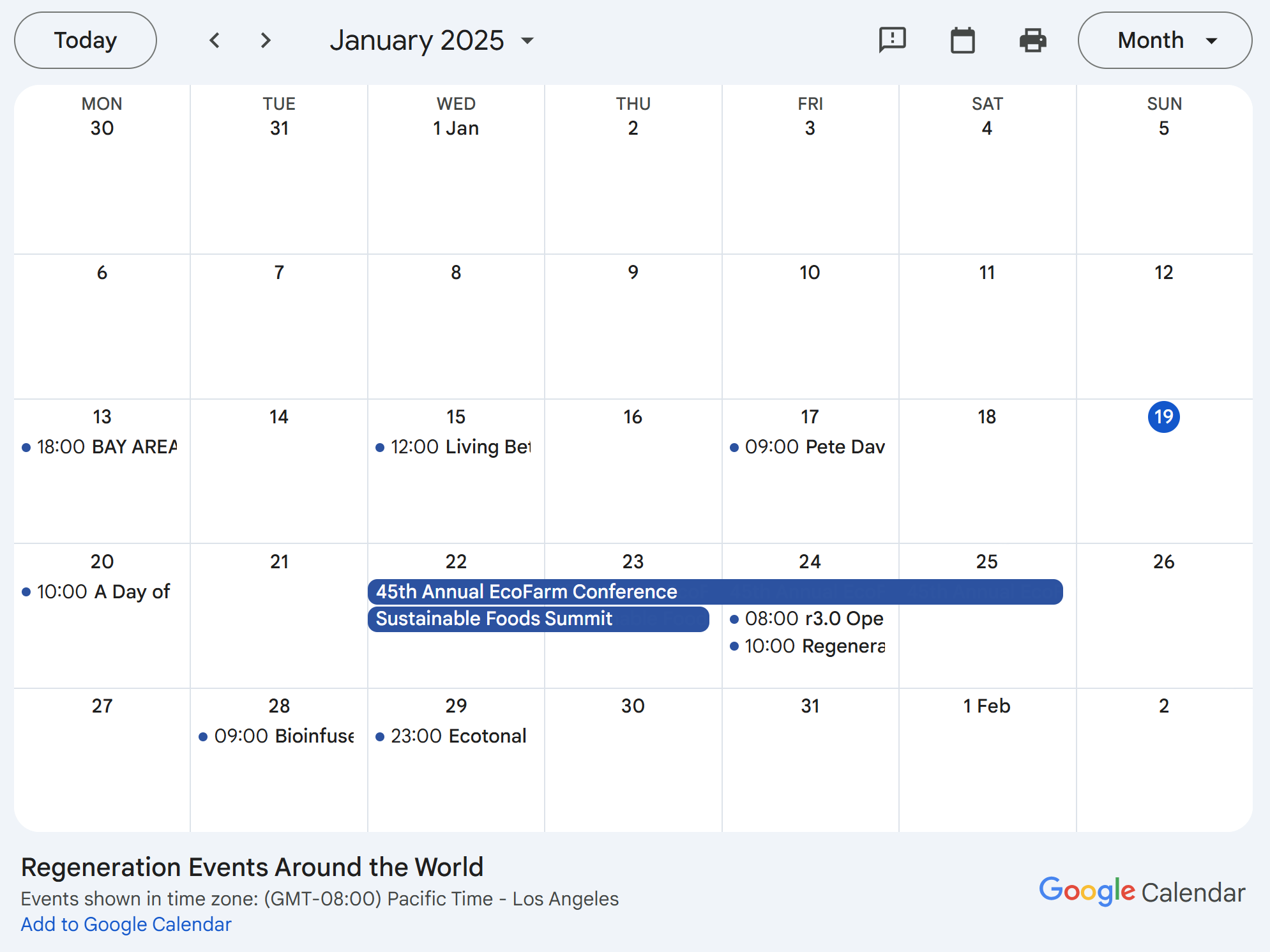
Add events to the Regeneration Calendar
The Bioregional Hope event was a celebration of the inspiring changemaker films we created with the support of Woka Foundation and in collaboration with bioregional weaving teams in Austria, Greece, Ireland, Netherlands, Poland, Romania and Spain, local filmmakers and Brechtje Smidt from Dutch Picture Industry.
These films highlight the unique challenges faced by different landscapes and cultures, while weaving together concrete, regenerative practices 🧬
We asked the local weavers for three call to actions to support their bioregional weaving work, which are listed below the videos 👇
Listen to our Manifesto and watch more films: ‘Multi-Species Sward (sand art)’; and ‘Innovating Finance and Community Finance’. All on bioregion.ie
Exercise your bioregional mindset: act local, join hands across Ireland through the Bioregional Weaving Alliance Ireland, and contact us: Sarah Prosser (sarah@bwl.ie) and Keeley O’Brien (keeley@bwl.ie).
If you have ideas for mutually beneficial partnership opportunities with Irish BWL, get in touch. We’re building a Landscape Alliance, working with thematic concept circles and regenerative businesses, making bioregional maps, and designing a finance mechanism.
Sign the Manifesto for a regenerative territory in the Altiplano Estepario bioregion.
Come to the AlVelAl territory in June 2025 to celebrate the Cinema and Rural Culture Festival (subscribe to the AlVelAl Newsletter to stay updated about the dates and logistics).
Celebrate the tenth anniversary of the AlVelAl Association at an Open Day to be held in November 2025.
If you have the opportunity, come visit us to explore the wilderness and the culture of Oltenia! Stay in touch with our events and activities on our platforms: www.discover-oltenia.ro, Instagram, Facebook and LinkedIn.
Let’s grow together and amplify our impact through partnership! Oltenia de sub Munte is a continuous learning journey. We are designing and piloting innovative projects to address local systemic challenges. While we excel in many areas, there is more to discover, learn, and improve in our work. Let’s explore how we can collaborate to build stronger, healthy communities together. Contact us via Gabi Poina (gabriela.poiana@discover-oltenia.ro) or Simina Sirbu (simina.sirbu@discover-oltenia.ro)
Support your local bioregions in any way possible, by visiting, buying local produce from them, and by spreading the word!
Join the Ostria fest from June to September (and sometimes beyond) and spread the word. These are musical festivals in the South of Laconia. It is an ideal occasion to get to know the bioregion from an authentic angle and exchange with locals.
Visit the Cinema of Nomia during the whole year in our bioregion, to watch unique independent European movies, curated by the association of the cinema. Get the chance to visit a lively cinema located in this remote village close to Monemvasia.
Visit the Southern Lights website or social media channels to look out for unique educational opportunities around systems change, regional development, civic engagement, sustainable living and regenerative agriculture, and support our initiative Regenerative Farming Greece.
Visit our bioregion, for example during our May 30-31 Festival Rooting Deeper. Go to our website stroomgebied.org for more events.
Contact us with all your exciting ideas for collaboration, contact Janneke Bruil (janneke@cultivatecollective.org) and Edo Cáceres Salgado (edo@masnewen.com).
Remember your role as caretaker of life in your own territory. Be courageous!
Participate in our activities. On our website, you’ll find a schedule of volunteer opportunities where you can assist with landscape conservation efforts—whether on weekends or during the week, out in nature. Additionally, we offer free guided tours that allow you to learn more about the natural environment and the surrounding area. Contact the team via: office@landschaftspflegeverein.at
Check out our CSR Initiatives for Companies. Businesses can book a conservation project with us as part of their "Social Day." These activities not only make a valuable contribution to nature preservation but also help strengthen team spirit and reinforce corporate values.
Transform corporate grounds into ecologically valuable habitats for wildlife and plants. We assist companies with setting up a volunteer program in enhancing their properties by greening their spaces. From planning to implementation, we help transform corporate grounds for the ecological enhancement of green spaces in our bioregion. So we can create green corridors!
Explore the Polish bioregion. What, from your external point of view, is the most interesting and exciting in our bioregion? Check the website of the Ecological Folk High School that is organizing the Bioregional Weaving Lab, and let us know via Anka Wiklińska (anka@grzybow.pl).
Co-create a Bioregional Magazine. We are creating the „Wieści znad Wisły” (News from Vistula) Magazine. Please join us in writing content - what is the greatest achievement in your Bioregion, in 2024? - share a short note and some photos via Anka Wiklińska (anka@grzybow.pl).
Make the bioregion attractive for young people. How to encourage young people to stay in the Bioregion? Share suggestions of methods and topics for the course we’d like to design for youngsters here in the bioregion. Curious to hear your ideas, contact us via Anka Wiklińska (anka@grzybow.pl)
Watch all bioregional changemaker videos
3000-year-old solutions to modern problems | Lyla June | TEDxKC
Bioregional Futures: Reconnecting to Place for Planetary Health by Nate Hagens and Daniel Christian Wahl
Bioregioning and Learning Centre by The Bioregional Learning Centre
Changemaker Activation Strategy by Bioregional Weaving Labs Collective
Circular cross-scalar governance spiral: Designing for bio-regional regeneration. By Tobias Luthe, Haley Fitzpatrick and Daniel Christian Wahl
If nature could draw a map of the world | Karl Burkhart | TEDxPorto
The Regenerative Community Design Canvas by Atolye and Josine Bakkes
What was Donella Meadow’s vision for Bioregional Learning Centres? By The Really Regenerative Centre CIC
Where do you draw the boundaries of home? by Carlita del Sol
Are there any resources missing that guide you in bioregioning, weaving or changemaking? 🌍
Let us know in the comments below, or add suggestions to this Google Docs, and we’ll make sure to include it 🪄
Thanks for reading Bioregional Weaving Labs! This post is public so feel free to share it 🐝
“Restoring land without restoring relationship is an empty exercise. It is relationship that will endure & relationship that will sustain the restored land”
–Robin Wall Kimmerer
“[Bioregion] refers both to a geographical terrain and a terrain of consciousness to a place and the ideas that have developed about how to live in that place.”
—Peter Berg
“We cannot save the world, we can only save places. The regeneration of planetary health can only happen ecosystem by ecosystem, or bioregion by bioregion.”
— Daniel Christian Wahl
“Passive hope is about waiting for external agencies to bring about what we desire. Active Hope is about becoming active participants in bringing about what we hope for. Active Hope is a practice. Like tai chi or gardening, it is something we do rather than have.”
—Joanna Macy in Active Hope
Comments
Nothing yet. Say the first thing.
Sign in to join the conversation.