
I’ve been talking about biochar bragging rights for a few years now as a way to encourage our small-scale biochar activities. In the past few years, some of the larger biochar producers have been given access to carbon funding from large corporations that are trying to meet their climate mitigation goals, but our widely-distributed, Biochar On Site producers, also known as artisanal biochar producers, have struggled to access this funding.
There are many reasons for this, but it all boils down to the difficulty of monitoring, reporting, and verifying what we did to the satisfaction of the carbon protocol developers who gate-keep these carbon funds.
Through the cooperation of our Biochar On Site group members, we developed our own methodology for quantifying what we do using simple, but ingenious procedures like determining the mass of biochar produced in a kiln through weighing of a bucket of hot coals (to get the dry bulk density of our char). Thanks to The Biochar Coalition for that hot technique! We published this method in 2024 in the Journal of Visualized Experiments, Producing, Characterizing and Quantifying Biochar in the Woods Using Portable Flame Cap Kilns.
In 2025, we have been quietly working with some forestry groups to verify our method by comparing our production data with lab analysis and performing real time emissions measurements. While not yet published, our results look good and they confirm our ballpark estimate that each ton of biochar produced in a flame cap kiln like the Ring of Fire Kiln results in the removal of 2 -2.5 tons of carbon dioxide from the atmosphere.
Now we have a way to quantify our bragging rights, even if we never get any carbon payments for our work!
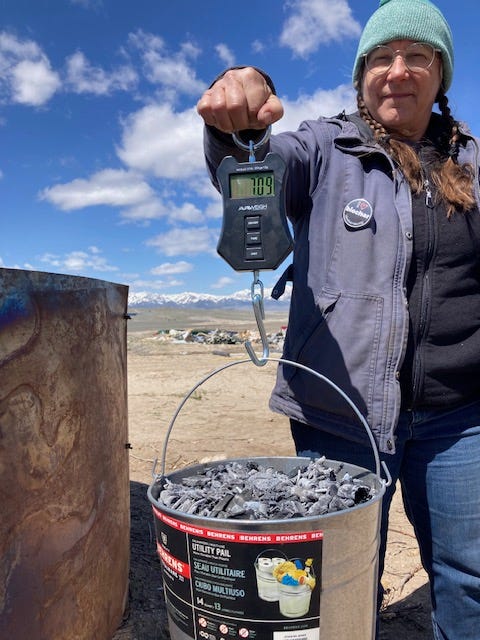
So how much carbon did my biochar burns remove from the atmosphere in 2025? I only did eight biochar burns this year - a low number for me, but we produced around 5250 pounds of biochar, or 2.4 metric tons. Multiply that by 2.5 and you get six tons of CO2 removed. I took a couple of flights this year, so I think I am covered for those.
But more important than my personal carbon contributions is what we were able to accomplish this year with biochar education and training. I also learned a lot this year about the limitations of carbon fundamentalism and the more important role biochar plays in regenerative agriculture and earth ecosystem repair. The carbon sequestration aspect of biochar is less significant than the beneficial impacts it has on soil. More on that later.
2025 was the year of BOS - Biochar On Site. As the US Biochar Initiative transformed to focus exclusively on high tech industrial production and markets, it decided to shed our Biochar in the Woods program. Thanks to support from a generous anonymous donor, John Webster, Korina Stark, and I were able to morph Biochar in the Woods to Biochar On Site where we are promoting “Stewardship Biochar for Social Impact: Transforming organic waste into resilient ecosystems.” We were able to continue our monthly network meetings on the first Wednesday of the month at noon Pacific. See the BOS website for info on how to join.
We also expanded the resources we can offer to the network of biochar practitioners who are making biochar in place, on site, using non-industrial simple processes including flame cap kilns, biochar burn piles, and mobile air curtain burners. Here are a few of the things that BOS accomplished in 2025:
Produced content for the website including a directory and links to resources
Vastly expanded the monthly network meetings by producing them as webinars, promoting them on social media, and tripling or quadrupling our attendance
Promoted many new practitioners by giving them a platform to share their activities with the network so we can all learn from each other’s experiences
Made connections with dozens of forestry and ecosystem restoration groups, raising awareness of the promise of on site biochar for helping to meet their goals
Produced the Flame Cap Kiln Fact Sheet and drafted several more fact sheets and training resources for publication in 2026
I am happy to report that in 2025, we saw many new businesses take flight that are successfully offering biochar as a service to customers who want to swap smoky, soil-destroying burn piles for regenerative biochar on site. More and more farmers, forest land owners, parks departments and people with burn piles are willing to pay to have biomass that would normally be burned into ash turned into biochar instead. It’s not just about carbon bragging rights, it is about real benefits to soil that often translate to economic benefits as well. The BOS value chain is real, and we will continue to promote and support it in 2026. Look for new developments in how you can contribute, coming soon.
2025 was also the year that sales of The Biochar Handbook took off. Published in June 2024 by Chelsea Green, my job was to get the word out about this unique biochar handbook based on my decades of hands-on experience making and using biochar. By March 2025 I had earned back my advance ($5000) and more. Sales have slowed a bit, so please help me keep up the momentum and order a copy for yourself or a friend and ask your local library to add it to the other farming and gardening resources on their shelves.
Publication of The Biochar Handbook landed me invitations to some great podcasts that I happily joined. The Urban Gardener Book Club reviewed the book and invited me on to answer their questions in October. My talk with Gardener Scott back in March was very fun because Scott has done his own experiments with biochar so we had a lot to talk about. Also notable was Jon Teater’s Whitetail Landscapes podcast episode Biochar: The missing deer food plot ingredient where we discussed ways biochar might mitigate chronic wasting disease in deer and other ways biochar can support habitat for wildlife.
I had a great time chatting with Ken from Ken’s Cafe about biochar and other regenerative ag topics. John Webster interviewed me for Biochar Today - a rapidly growing and valuable biochar media outlet worth your support, and I had a super fun one-on-one conversation with regenerative ag rock star, Matt Powers.
I participated in two of Matt Powers’ R-Soil online symposia in 2025 and I will be giving a talk during the upcoming R-Future symposium this January. These events are free to watch live streamed, so don’t miss it! My talk is titled “Biochar Thermodynamics: Dissipative Structures, Nutrient Cycling, and Metabolic Quotient. I don’t have an exact time and date for this talk yet, so stay tuned.
All of these activities pale in comparison to the effort I put into my nine-session Practical Biochar Course hosted by Regenerative Living Online in January - March 2025. When Javan Bernakevitch invited me to produce the course right after publication of The Biochar Handbook, I knew I could not say no. It was a heck of a lot of work to produce the nine sessions, live streamed for 80 registered students. Really it was almost like writing the book all over again. I believe the students got a lot out of it and the questions and discussions after each lecture were learning experiences for all of us. Luckily, you didn’t miss anything, because the course is now offered as a self-paced version. Javan has done a great job of breaking the lectures into bite sized pieces organized by topic, so if you purchase the course, you can go right to the topics that most interest you. Check out the Practical Biochar course re-launch video for a preview of the content.
Some significant biochar workshops and conference presentations rounded out my year. In February, I traveled to Juneau, Alaska for the Southeast Alaska Farmers Summit and wrote about it here. May brought me to John Day, Oregon at the invitation of Sustainable Northwest Wood to demonstrate biochar production at a small sawmill processing invasive juniper wood. In September I attended the Tribal Solid Waste Advisory Network’s Green Summit to speak about biochar and waste management, and do a small biochar demo for the tribes. This was an amazing event full of great interactions between tribal members, managers, and the consultants who are helping tribes with waste management methods that align with their principles of environmental and cultural sustainability. It reminded me that before modern, industrial society, there was no such thing as “waste.” We all need to embrace the goal of the circular economy where there is no waste.
Also in September, I travelled to two venues in Washington state with Korina Stark of Circular Spring and Wihan Bekker of Charr Solutions for training workshops for biochar contractors. I developed a biochar job estimating worksheet that we will publish soon. This project is funded by a USDA grant and is managed by my friends at CORRIM. We are just getting started with this and are excited for the potential to support the biochar as a service industry.
In November, I returned to the South Slough National Estuarine Research Reserve in Charleston, Oregon where I had given a biochar demo a couple of years ago. This time we gave a two-day workshop in the field demonstrating how to make and use biochar for ecosystem restoration. This deserves a post of its own, and that will be coming soon.
Finally, the really big news for me in 2025 was signing a license agreement to manufacture and distribute my Ring of Fire Biochar Kiln with Tarter USA! Tada Tarter!
My friend Ruth Ann and I traveled to Kentucky in June to meet with company execs and tour their manufacturing facility. I liked what I saw and I especially liked my interactions with Ray Maynard, the sales exec who is managing the transition. I was able to close out my books this year with a total of 420 kilns sold since 2021. Tarter will be taking Ring of Fire Kilns to the next level and will also be able to get kilns to you for less cost as they have better distribution networks for more economical shipping. As always, you can start your order at RingofFire.earth. The order link will take you through to the Tarter website. Coming soon will be a discount code if you order through RingofFire.earth or WilsonBiochar.com.
Now, back to the issue of carbon fundamentalism — approaching environmental problems through a narrow focus on carbon dioxide. I have never been a proponent of such a limited approach, but have only recently come to understand just how catalytic biochar can be in soils. We don’t need that much of it to make a big difference.
I’ve been catching up on my reading of biochar journal articles and realizing that biochar works not just by holding on to nutrients but also by promoting chemical reactions that support plant health. Healthy plants make more sugary root exudates that support the microbiome. The microbiome finds these sugars much easier to metabolize so they can expend less energy to find their food. As a result, the microbiome metabolic quotient is reduced. Metabolic quotient is the CO2 respiration per unit of microbial biomass - the more efficient their use of carbon, the less CO2 emissions. In the long run, this will be more important than the carbon sequestration value of the recalcitrant biochar itself. Biochar makes soil processes more efficient leading not only to less CO2 emissions but to more carbon sequestration as root exudates feed more microbes leading to more necromass (dead microbes) that becomes humus.
I will be exploring all this at the upcoming R-Future symposium, so see you there.
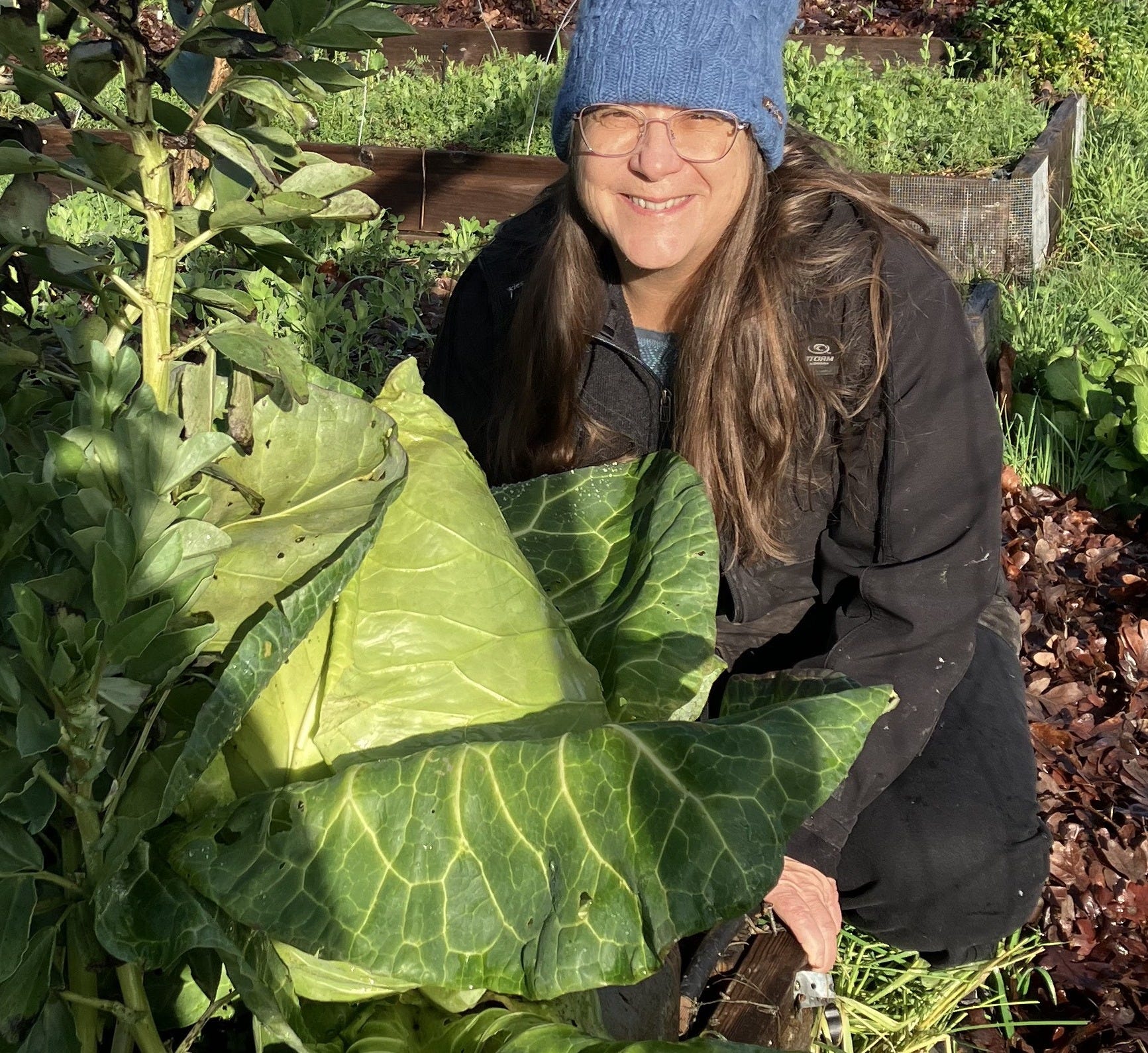
I wish you a happy and productive 2026 with plenty of blessed food freedom, good health, and good company, and I will leave you with my proudest accomplishment of the year: the 19 pound cabbage I harvested 2 days ago!
Please, if you want to learn more about practical biochar tips and tricks for growing your own food, or you are interested in stewardship biochar for restoring natural ecosystems and biodiversity, check out some of my links below:
The Biochar Handbook at Amazon.com
The Biochar Handbook at Bookshop.org
Purchase Kelpie’s Practical Biochar Course
Order your Ring of Fire Biochar Kiln®: RingofFire.earth
Check out my YouTube channel: www.youtube.com/@KelpieWilson
Biochar On Site network for practitioners of stewardship biochar
No posts
Comments
Nothing yet. Say the first thing.
Sign in to join the conversation.