
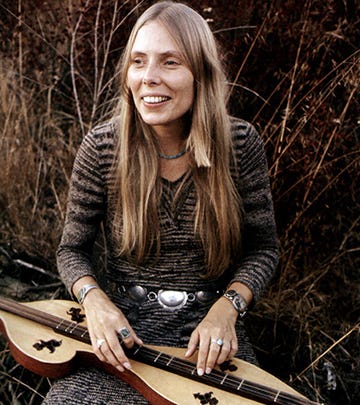
This won’t be the most political Substack, but it’s hard to imagine saying, thinking or writing anything these days that doesn’t reflect the upside-down Bizarro world of Superman comics we’ve moved to. So I can tell you where my first post’s title (You’ve Got to Shake Your Fists at Lightning Now) comes from, as I try to catalyze out of inertness and depression brought on by a growing climate of hate, wars, and disinformation, trying to find humor and joy to share with you along the way.
As a radio DJ, new songwriter, and baby-booming child of the sixties, I’ve always loved Joni Mitchell. Bringing home a fresh album (yes, vinyl) and spending a whole afternoon on my single bed with the Indian bedspread, listening and reading the liner notes often made for a perfectly good day; often an inspiring one. In my Substack I’ll be sharing the history of my musical taste, offering recommendations, and celebrating the freeform radio format which allows me to express and curate the items of a VERY long-term relationship; a marriage of sorts, to a great non-commercial radio station, WPKN, out of Bridgeport, Connecticut, where I work it all out. I’ll post some of my radio playlists, and I’m sure there will be other surprises!
But to start, I’ll zero in on a recent phenomenon, which is that Joni Mitchell came back into my life like a powerhouse and a time machine, and she inspired my Substack’s name: OPEN TUNING (she’s known for her alternate guitar tunings). It’s not that she ever completely left me, but there were a few eras and albums where we were on kind of a break. I never fully embraced the jazz explorations she did, although I’m sure I’m probably missing out on some very special arrangements. There is still time.
I couldn’t be more thrilled that this goddess, this genius of lyric and melody has returned to attention, and that younger folks might be having their own Joni experiences. (If you’re unfamiliar with the Joni renaissance, cruise YouTube for celebrations, Brandi Carlisle tributes, and documentaries.) Joni is still singing! Yes, her voice is deep and slower, and the once graceful flower child walks with a cane, but you can still feel the wit and sensuality and passion.
What happened specifically to me that connects to Joni was that I became a songwriter in the last few years. I’m sure my lyrical sensibility and piano playing have been influenced by her. Although I’ve been writing all my life (poems, essays, a memoir, etc.), I’d not tried songwriting before my unexpected collaboration (I’ll recount the details in another post) with a wondrous Australian singer-songwriter, Tartie, led to an album; yes, an album of 10 songs. We call ourselves In These Trees and Tartie , and the album is called The Quiver (streaming and available on Bandcamp).
In the course of doing the requisite self-promotion for our album in today’s indie jungle, I had help from a terrific PR maven, Howard Wuelfing, who set me up with at least 25 interviews and podcasts and many reviews in just two months (the album came out in March 2024). Recently, I was invited to participate in a format/podcast, “That Record Got Me High,” hosted by music lover Rob Elba. Rob made a simple request: pick an album you love, or an album that has particular meaning, and on a given day you Zoom with Rob, who will be playing cuts from the album while you chat, and you have a lively conversation. Although my record library is sizable, and my heroes are many, it didn’t take me long to pull out my well-worn 1972 copy of “For the Roses” by Joni Mitchell. How much do I love it? I’ve got it both on vinyl and CD. The roster of Rob Elba’s previous podcasts was varied, and not particularly folk-oriented; I worried that he wouldn’t find my choice interesting. Should I have picked Procol Harum, Cream, Brian Eno, Kate Bush, or some devilishly hip electronic dance music?
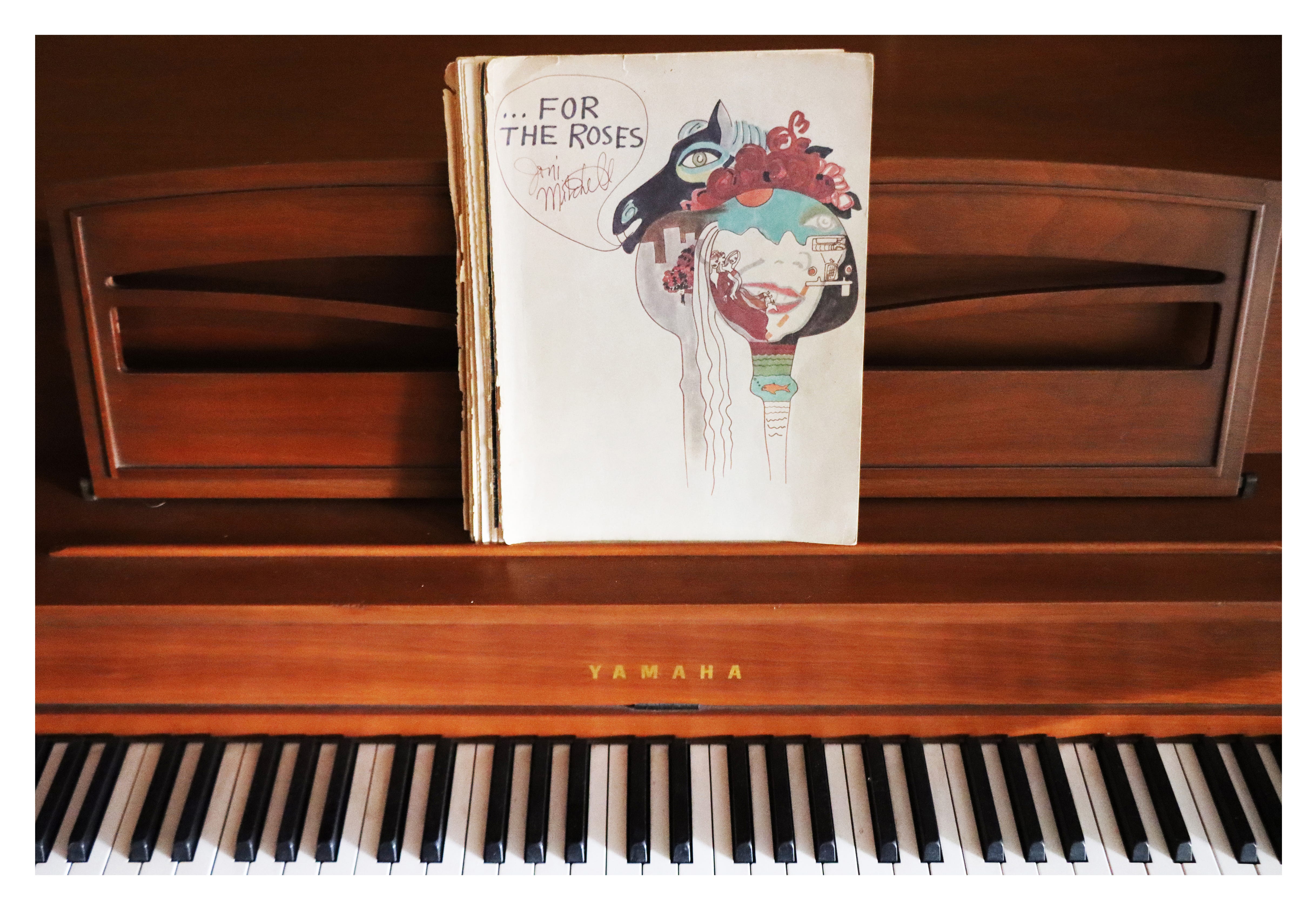
Rob is an energetic musician and podcaster, and we got along very well! And here’s where we get to shaking fists at lightning. I have many favorite Joni songs (Amelia and He Played Real Good for Free among them), but Judgment of the Moon and Stars (Ludwig’s Tune) holds a special place in my heart. For Elba’s podcast, I picked For the Roses, the underrated album written in retreat, in a two year retirement on 60 acres of wilderness in Canada, when Joni was bitter about the music industry (“Some get nothing though there’s plenty to spare,” she sang in Banquet). For the Roses was sandwiched between Blue (1971), one of her most personal, and Court and Spark, her most commercially successful album. The Beethoven song moved me immensely, as it elegantly evoked another era, and the intense tale of a radical genius who wasn’t accepted in his own time. A complicated musician who also suffered a disability, he was a kindred spirit to her, and because of the rousing call to survival the song evokes, over the years I found myself listening to and playing it on the piano, while singing out the ending words “You gotta shake your fists at lightning now/you gotta roar like forest fire/you gotta spread your light like blazes/all across the sky. They’re gonna aim the hoses on you/show ‘em you won’t expire. ……” That is how I WISH I felt, right now, in December, 2024. I want to play “every chord” that I feel, and scream my contempt and disappointment “to the silent night.”
But I’m not quite there yet. OPEN TUNING is born out of grief, but powered by the unstoppable engine of hope. As a wonderful, devoted fan of my radio show, brilliant artist (Robert Reynolds) once characterized that show (A Miniature World) this way: “World weary but with hope for the future.” I gave him some taped shows and he gave me a painting.
Here's the podcast about Joni with host Rob Elba!
Back to early days: I acquired a classical nylon string Kay guitar when I was around fourteen, when the older neighborhood boys took me to NYC to pick one out. They were teaching me basic chords and finger-picking. My musical education then grew beyond piano teacher Mr. Levy’s Mozart, Bach and Beethoven, extending to Mississippi John Hurt, Phil Ochs, Bob Dylan, Joan Baez, and Joni? Well, Joni I reserved more for the piano, and there’s a good reason for that. Joni’s guitar-playing was like a trip to an alchemist’s lair, and her tools were alternate guitar tunings and mysterious things like sus chords. Although jazz musician Wayne Shorter told her “you can’t go from a sus (suspended) chord to a sus chord,” she rebelled against that dictum. “These are chords of inquiry,” she said, implying that they built with her lyrical content, and they would eventually resolve when the story was good and ready! I love that way of thinking. Folksinger Eric Anderson taught her a couple of “open tunings,” she has said. “Once I got the openings for some reason, I began to get the harmonic sophistication that I heard that my musical fountain inside was excited by. My writing began to come.” There was another, more personal and poignant motivation for learning all this – Joni had polio as a child, and it felt her with some muscle damage in her left hand. It was difficult for her to play a simple “D” chord. Her way to overcome that was genius. She took a deficit (the polio after-effects) and went from simplicity to complexity and soared above limitations. I have always been fascinated by people who survive hardship and come out the other side with something unexpected.
In prepping for my podcast with Elba, I knew references to Joni’s open tunings would come up. I started to go deeper; maybe it was time, although I was and am intimidated by the whole topic. So I reached out to a wonderful friend over in Japan – Stephen Faulk, classical and flamenco guitar builder. What was it all about? And was it true that it could be harmful to the physical construction of the instrument? Boy, did I go to the right source. Check out his thorough and beautiful deconstruction:
From the workshop of Stephen Faulk:
“I imagine Joni Mitchell as a tea or coffee drinker who noodles in the morning or late into the night, working the grips on her guitars tuning machines. Does the fact that she uses lots of different tunings make structural stresses on a guitar? My best guess and opinion informed by looking at and building guitars with non standard tunings is probably not much. Guitars are built to withstand a great deal of string tension, in particular steel string guitars, and the majority of non standard tunings have to do with lowering the bass end strings which lowers the tension, and raising and lowering the treble side strings. Most of the tunings you can arrive at by mixing up a combination of half step and whole step adjustments to the pitch of a string.
Structurally the guitar over time could have problems with the neck. It could bend forward under tension which reduces the viability of playing because it makes the action too high, the strings become difficult to pull to the fingerboard. This is no fun, but the situation can be routinely remedied by skilled guitar repair technicians. Usually changing the pitch of certain strings a half step here a whole step there does not drastically compromise the structural integrity of a well made guitar. Of course if you were to tune all the strings up a half or whole step across the fingerboard over time sustaining the extra tension could damage the guitar. But in the musical reality of the realm of non standard tuning systems lowering some strings is usually the play.
Is it possible to break, bend or tweak a guitar with different tunings ? Sure it’s possible, as possible as it is to damage a guitar with standard tuning. So what’s the big deal? The situation with Joni Mitchell’s tunings is that she routinely employs a dozen or more in regular rotation in her song writing. It simply causes the problem that in a performance setting she has to either constantly tune and retune her guitar, or have several guitars available on stage to change to when playing songs that have very different tunings.
During performances retuning the guitar constantly doesn’t so much pose a structural issue for the guitar, but the strings get cranky and difficult to keep in tune when they are constantly retuned to different pitches. Strings are somewhat elastic and stretch and retract when exposed to hot and cold environments, or are retuned. They require reaction time to stretch after being retuned, and even the heat generated by stage lights on the spot the performers are standing in can cause the strings to expand and constract. (Steel strings tend to expand under hot stage lights and go flat, while nylon strings contract in hot lighting and go sharp.) The performers with songs written in a myriad of tunings have their hands and ears full all the time retuning and listening to make sure under all these conditions that the guitar stays tuned to the tuning they want to sing with. For Mitchell this is a big work load as she uses so many tunings.
In 1995 Mitchell reduced the workload of her alternative tuning management by enlisting the help of a guitar maker who devised a clever solution. He created an interface which is driven by Mitchell’s playing on a single guitar which triggers a sampled synthesizer output changes the tuning automatically. She can play on a regularly tuned guitar, and it’s converted into an alternate tuning she uses by a switch that selects that tuning. Her guitar stays in one tuning while she performs, which is an easier workload to maintain, and magically through the techno-mage gadgetry of a guitar sound engineer expert, the sound coming out of the speakers is a perfect emulation of one of Joni Mitchell’s many personal guitar tunings.”
Thank you, Stephen!
Now here’s a juicy upcoming event: On February 20, 2025 I’ll be airing and interview on WPKN at 11 am on my radio show, A Miniature World, author Paul Lisicky, about his upcoming release Song So Wild and Blue: A Life With the Music of Joni Mitchell, publishing on February 25, 2024. Paul says:
"Song So Wild and Blue is both a love song to Joni’s Mitchell’s music and the story of how it’s shaped my creative vision. Part memoir, part biography, and part siren song, Song So Wild and Blue is a joy for hard-core Joni enthusiasts, aspiring writers, and those seeking a deeper understanding of the scope of her imagination.”
Although there are many biographies of Joni, I’m particularly curious about Paul’s, since it is a very personal appreciation of his feelings of emotional connection to her music.

(Paul Lisicky is the author of seven books including Later: My Life at the Edge of the World and The Narrow Door. A Guggenheim Fellow, he teaches in the MFA Program in Creative at Rutgers.)
My next Miniature World radio show on WPKN.org airs Thursday, December 19, 2024, 10 AM - Noon, and is archived for two weeks after that.
I look forward to hearing your stories of Joni discoveries, favorite tunes that have rocked your world, anecdotes about terrestrial radio, and suggested topics for me to write about.
Open Tuning is a reader-supported publication. To receive new posts and support my work, consider becoming a free or paid subscriber.
Thanks for subscribing to and supporting Open Tuning with Binnie Klein . This post is public, so please share it wide and far.
Comments
Nothing yet. Say the first thing.
Sign in to join the conversation.