
As we commemorate the anniversary of the 1969 Woodstock Festival, an event that many recall as profoundly affecting, even transformational, there are many stories of those who went, and those who didn’t go. But what about those who, well, “almost” got there? Here’s one of those stories-- mine. Binnie and Anne, 2 college girls, start out on the road to become a part of history, but a child's worry about a parent's car unexpectedly changes all that. Above is the audio version (with music tidbits and sound effects) originally aired on Public Radio Exchange.
“I love you baby,” another frizzy-headed boy called out, and I steered the enormous white plastic wheel of the Valiant into the fast lane, stuck my hand out the window and formed a “V” with my index and middle finger, the universal peace sign. “See,” I said jubilantly to Anne, who was sketching wispy spring branches on a purple pad, “We’re all going, everyone!” I pressed the round tinny horn as we turned off Exit 9 of the Mass Pike to enter I-84, the transition itself exhilarating, signaling passage through multiple states. We had gotten a late start, but now we could catch up. I boosted the radio’s volume.
The car smelled of trail mix, cigarettes, and Anne’s handmade blend of patchouli and lavender which hung from her neck in a small suede pouch. We were not lovers, we had never even kissed, but we spent most nights spooning each other in a small single bed in a Boston University dorm. She’d murmur e.e. cummings to me: “Nobody, not even the rain, has such small hands…”
“…oh happy day, oh happy day, when Jesus washed, oh when he washed…” the radio sang out. All we had in 1969 was AM radio in the car, and we were constantly spinning the dial in search of tolerable tunes. Finally – “I See a Bad Moon Rising” by Creedence Clearwater. “Hey, look!” A convertible Mustang, plastic flowers on the doors, a daisy affixed to its antenna. Three guys in the backseat passing a joint. Blasts of recognition-honks rang out, smiles widening. A middle-aged man with a crew cut, station wagon full of kids, scowled at us, and we laughed. Ever since I got to Boston, it seemed that the world was filled with young people like myself. There was a cocky vindication in my finally being in step, and it was delicious, a feeling of being unstoppable. You were in the exact center of things, wherever you stood.
Finally, Route 17, a narrow two-lane road that ran through Amish country. Occasionally a farmer on a tractor rolled by and stared, bewildered at the increasing traffic and the bumper stickers, “Bring the Troops Home,” “Question Authority.”
“…..really, stay away,” the DJ was declaring….If you’re thinking of going to the Woodstock Music and Art Festival, forget it! The New York State Thruway is closed.”
“It is not!” we yelled to the voice.
“…and it’s a jam-up, worst in history, bad, and people being treated in makeshift tents. LSD, folks, and it’s not a good trip…A kid on this stuff stared at the sun and went blind. Another jumped out the window thinking he could fly. Scary stuff, folks!”
“Maybe he wanted to go blind,” Anne said. “Maybe it was worth it.”
But images flashed through my mind, crowds of people pressing against each other, some screaming, some crying. They said Hendrix, Joplin, the Airplane, were going to be there, but I didn’t want to be in a bad scene. I was eighteen years old. I was getting scared.
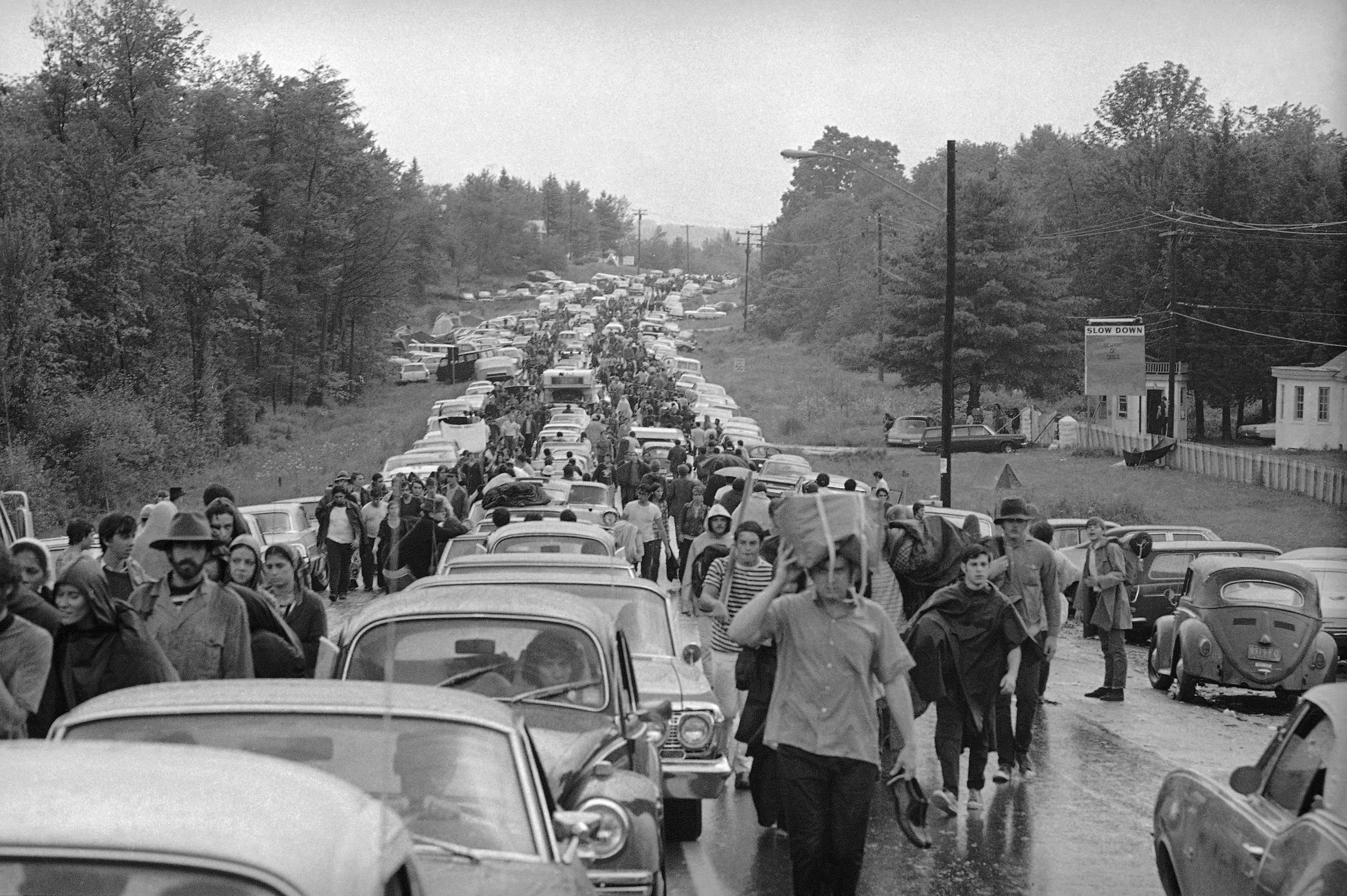
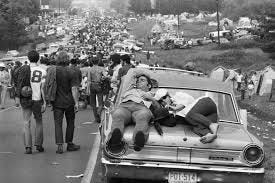
Seven miles later, on Route 17B, we crested a hill and everything came to a stop. VW Beetles, Ramblers, Galaxies, Chevy Novas, packed everywhere on the side of the road, jutting out in crazy angles. People were leaping out of cars, duffel bags and baskets bouncing against their backs. Freaks with hats, freaks with babies, freaks with guitar cases, guys in desert boots, beads and feathers hanging from hats, embroidered jackets studded with buttons, army fatigues. People riding on the roofs of the few cars that were still moving.
“Whoa.” Anne slouched down in the white bucket seat, roused herself, looked out the window, and shook her hair into place. “YES!”
“Hey – girls, get in, come with us, just leave the car, leave it!” A pick-up truck, upside-down American flag, more guys calling out.
Anne began gathering up her belongings, but she slumped back down.
“Binnie, I can’t.”
“What do you mean? What?”
We didn’t know it exactly at the time, but we were only two miles from Bethel, two miles from the Woodstock Festival site, two miles from an historic event that could change our lives, for bad or good.
“We can’t leave my father’s car. What if it gets stolen? He’d kill me.”
“Come on,” I urged, as more and more people emptied their cars of sleeping bags and other supplies to join the stream of concertgoers heading down the access road. “Look, everyone’s leaving their cars.”
We fell silent. I lifted my body up to unstick myself from the vinyl upholstery, brushing sandwich crumbs away with a paper napkin which I then tossed into the empty Wise potato chip bag which was serving as our wastebasket. I reached back and pulled a denim shirt from the backseat. It was getting dark and clouding up.
“Would you be mad at me if I said I really really wanted to leave?” Anne said. I looked over at her face, with its Modigliani-like elegance. I saw Anne as standing in the light, while I was always in the darkness, with my Jewish nose and olive skin. I copied her mannerisms, and coveted her fringe jacket and cowboy boots. A few days before, we’d shared a tab of acid, my first, and I freaked out completely. She held me and told me to focus on the diamond drops of the rain. We met a guy named Bob who called himself “Hellfire.” He often announced his presence by incanting the opening lyric of the song “Fire” – “I am the god of Hellfire and I bring you….Fire!” as if he were the god of some underworld in the dormitory. We each slept with him, although Anne would eventually get pregnant by him and leave school, disappearing forever from my life.
Relief flooded me at the prospect of leaving. So much had been happening that year, too much too fast. My friends were dropping out to join the Weather Underground. I was flunking out of two classes. No one could concentrate.
“I can’t be mad at you,” I said, as she picked up her sketchpad and propped it against her knees for the trip home. She started a drawing involving tiny buds and miniature hills.
“Hellfire’s coming back tomorrow, you know,” she said.
“I think he likes you more than he likes me.” I looked for a way to turn Anne’s father’s car around.
“Sweetie, it’s not true; he told me you’re very sexy and passionate. I’m like the sister he never had.”
“Right.”
We laughed. I suggested evaluating the stock of goodies, and we decided to seek out more munchies at the next gas station.
There was virtually no traffic heading back, and we made it to the main road just before the thunder.
Epilogue, 2025
I wonder sometimes—should “Anne” and I have left her Daddy’s car and joined the eager throng and continued on to this historic event? Someone called the sixties a “cyclone in a wind tunnel” and if you were a teen-ager during key parts of it, you were always out of your depth. I can’t count the experiences I had that I wasn’t ready for. And of course, you could say, “that’s just life!” But I feel a rush of tender protection for that girl who so wanted to be cool. Images push in of events she couldn’t control; the type that happened to many young women. Sometimes I think—what cowards—and sometimes I think—sometimes you just have to turn around and go home.
What do you think?
Comments
Nothing yet. Say the first thing.
Sign in to join the conversation.