
(A version of this story appeared in my article in the September 15, 2010 issue of The Forward)
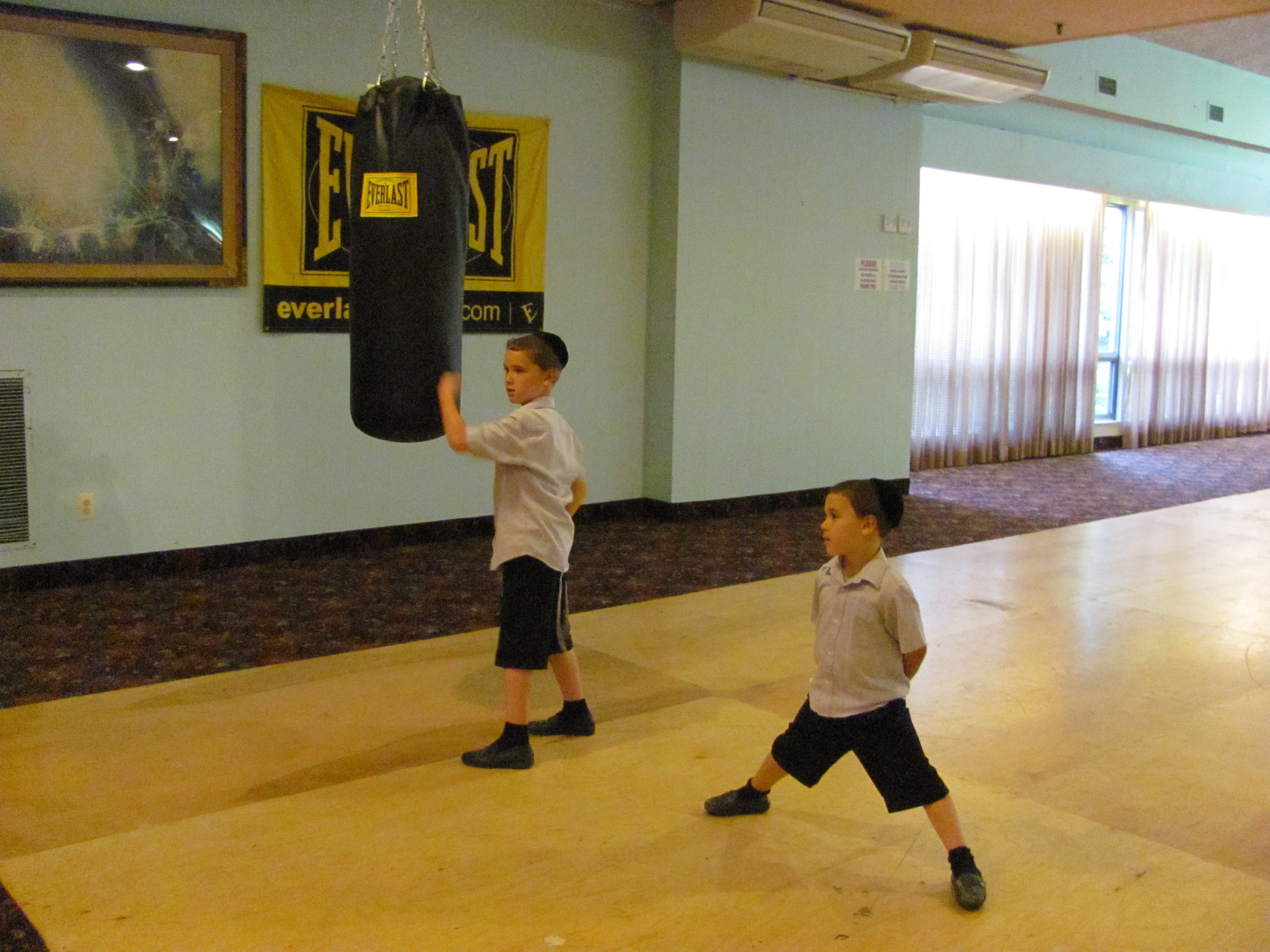
It may sound like the setup for an old joke: It’s dinner time and three gentile kids; one Latino, one black and one white, are waiting impatiently for a slow Shabbos elevator to arrive. A Shabbos elevator stops automatically at every floor, relieving Orthodox patrons from having to press buttons, which would be forbidden on the Sabbath (I think it would be a good name for a band; “The Shabbos Elevators”). I recall my Polish grandmother being appalled that I was attempting to work on homework assignments or use scissors on a Saturday. “Shanda!” she called out, as I got on my bicycle. Having escaped pogroms, she came over from Poland, stubbornly refusing to learn English, and so we remained locked in a tense, uncommunicative stalemate.
The punch line from the elevator story comes with a real punch: turns out the kids are hungry athletes from a boxing camp held every summer at Kutshers Country Club, the last of the grand Jewish Catskills resorts that’s still trying desperately to be grand, though dilapidated. It’s still pretty Jewish—talk to any customer or take a look at the dining room’s menu. Rather than being an anomaly, though, the fighters are both upholding a tradition of boxing in the Catskills and helping a remnant to survive.
What I didn’t know when I chose to attend the August 2010 session of Gleason’s Fantasy Boxing Camp was that in just two years Kutshers Hotel would be demolished, purchased by a wealthy entrepreneur with hopes of creating a “wellness center.” And soon the Catskills would be bereft of all the big hotels and resorts, where many people of my parents’ generation would go for vacation and entertainment.
The multicultural gang that participates in Gleason’s Gym Fantasy Boxing Camp gets used to bumping into unfamiliar folkways, whether it’s a female Irish boxer from Boston whispering “what’s kasha??” at mealtime, or boxers in an exhibition round drawing a group of black-hatted Orthodox spectators.
Gleason’s eighth annual camp wrapped at the end of August, and founder Bruce Silverglade, president of the famous Brooklyn gym, was pleased with eight successful years at Kutshers and looking forward to more (this turned out to be the last Fantasy Camp held there-the gym found a more contemporary location for the annual event – I believe it’s Gleason’s gym itself, and that’s a classic place!). “It’s a way to get out of the city and out of the hustle and bustle,” said Bruce. “When professional fighters trained at Jewish Catskills resorts in the last century,” he added, they would go to Kutshers to chop wood and avoid the distractions of women. They would go there to be secluded and work real hard.”
Champs like Barney Ross, Muhammad Ali, Leon Spinks, Archie Moore and Floyd Patterson all set up training camps at Catskills hotels. Because of that, and because of Jews’ own strong history with boxing ( between 1910 and 1940, for example, 27 National Boxing Association titles went to Jewish fighters). It seemed entirely natural to Silverglade to bring an assortment of would-be boxers to Kutshers. That summer’s four-day camp, costing $1,800, included males and females aged 9 to 74, from a variety of skill levels, ethnic backgrounds and locales around the United States. They came to train and to spar with top contenders and champions, and to engage in rigorous training drills, boxing discussions, sparring and ring craft. The camp culminated on a Saturday night with a sparring show that was open to the public. As a journalist and full-on “poseur,” I wouldn’t be in the show, but I did go through some of the training, ate and played pool with the boxers, and got a chance to read to the crowd from my then newly released book. The over-all experience was surreal; most people were friendly and welcoming, but in my training session a sullen “Hector” bullied me and made me cry (even though he knew I was a beginner). I left the session early, and got lost trying to find my “hotel” room and its distinct smell of mold, where I cried, got a migraine, and called my coach from back home in whose class, “Aging Bulls,” I was fully accepted with the other midlife out-of-shape learners.
While Silverglade attempted to re-create the experience of a sports training camp of a bygone era, Yossi Zablocki, the then manager of Kutshers, was trying to save a hotel in desperate need of rehabilitation. Both men contributed for a time to keeping a piece of Catskills history alive, even as other famed Jewish resorts like Grossingers and the Nevele closed.
As the boxers threw punches during our four days there, life proceeded as usual for Kutsher’s other patrons. Retired folks are the meat and potatoes of the place, said Zablocki, a legal aid lawyer from New Jersey who seized the opportunity to invest in the resort when it needed help. In the upper lobby, Jackie Horner led a ballroom dance class for five older ladies, one of many hotel activities, which include Big Bucks Bingo, Justine’s Makeover Face Lift Show (with door prizes), and Hassidic stories told by a rabbi. The movie Dirty Dancing is based on real life, Horner said.
“It’s my true story. There really was a Baby, like in the film, and she was my student,” Horner said as she crossed her slender legs.
Remembering her heyday, Horner said “We danced all day and all night; we were young. There was a pulse; you’d feel it the minute you hit the Catskills. I even taught the boxers to dance.”

Kutshers Country Club had its own impressive history with sports in general and boxing in particular. The century-old resort sprawled across a 1,400-acre campus, with indoor and outdoor swimming pools, an 18-hole championship golf course, tennis courts, and bocce ball and shuffleboard courts. Yet I felt a pervasive melancholy as I wandered the carpeted halls. Outside, a guest named Irwin sat with a few cronies by the lake complaining about the service. No doubt, the place needed some tender loving care. Irwin, who is in his 80s, said he still comes to Kutshers every year. He performed as a comedian for 19 years at the Raleigh, another big hotel. “Wednesday night, I’d open the talent show, white straw hat, cane,” he said. He began to sing: “Another opening, another show…” Then he told an off-color joke, his eyes twinkling under his jaunty cap.
Across the lake, the Saturday night sparring exhibition was about to begin. There were 12 bouts, three rounds each, and everyone would be getting a trophy. There was an “Over 70” pairing. During one of the fights, a small group of Orthodox Jews wandered in and were quietly watching as their little girls, in long frilly dresses, sidled up to the ropes, transfixed. Another tiny Jewish toddler stood on a chair. “Get him! Get him!” she shrieked, her curls bouncing. Her father, who was wearing a yarmulke, pulled her back into her stroller.
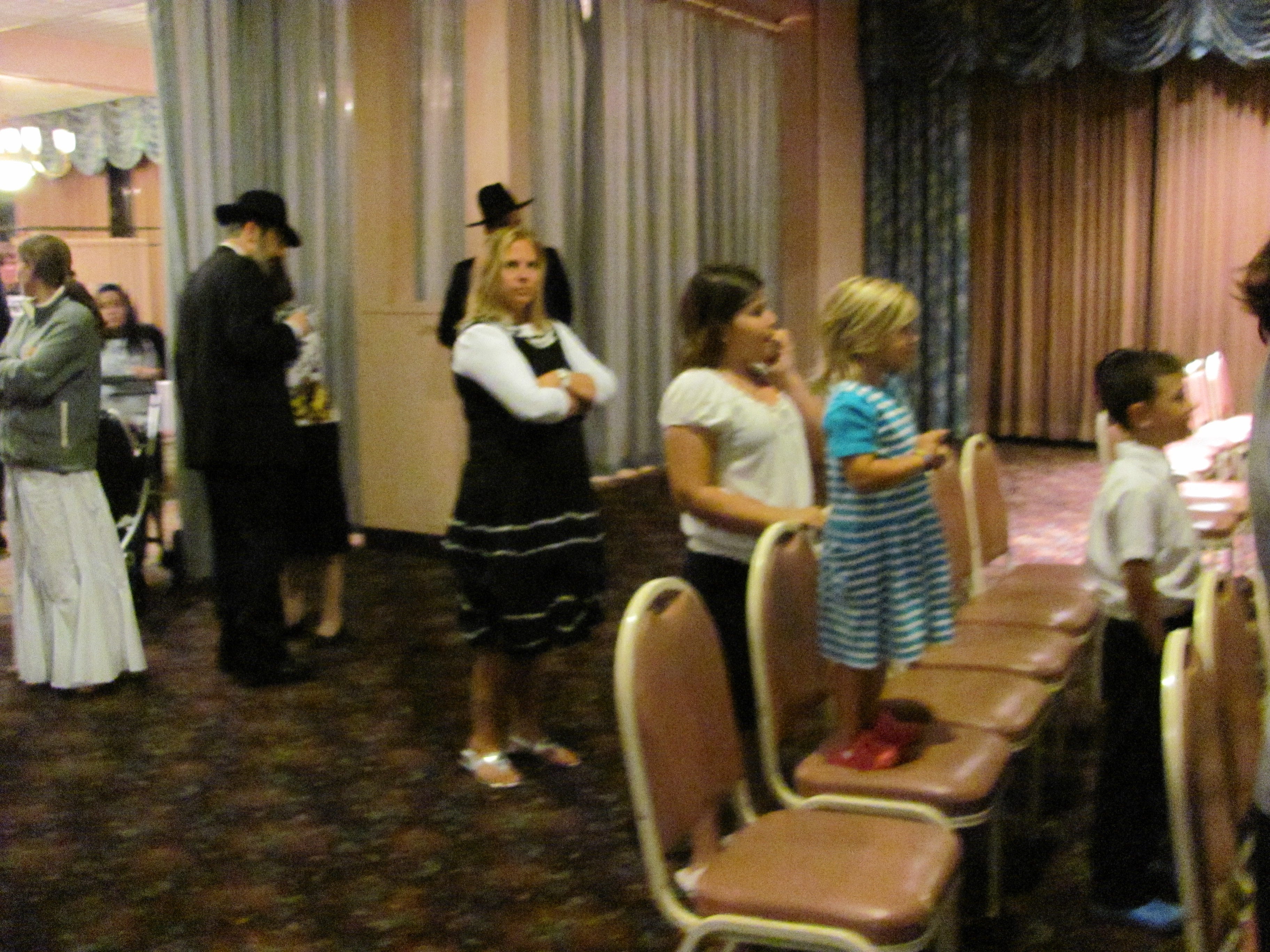
There were now three distinct types of headgear in the room: yarmulkes, black hats, and boxing helmets.
Later that night and into the early morning, the campers celebrated in the Deep End Lounge, a disco and bar with windows that looked out onto the indoor pool. In its heyday this was probably quite the hip place to dance. On the stage was the shrine Bruce Silverglade had set up to honor Muhammad Ali and Orthodox young boxer Yuri Foreman. While boxing trainer Martin Gonzalez was cutting loose on the dance floor with some salsa moves, several guests wearing yarmulkes wandered in. They looked confused. “Is this the show?? “ No, they wanted the Stardust Room, down the hall, to hear singers Oneg Shemesh and Chaim Kiss, and maybe a little comedy. The Stardust Room was once host to Jerry Lewis, Steve Lawrence and Eydie Gormé, Milton Berle and Sid Caesar, and also to raucous crowds that roared with laughter and applause.

The next day, Silverglade and his crew began to dismantle the boxing rings and pack up the gloves. It was time to ‘break camp.’ The group was slow to leave, as hugs and business cards were exchanged . “Boxing people are family,” said Bronx-raised boxer Al Roth, who I ate matzoh ball soup with in the dining room, as another generation of boxers and boxing Jews left the Catskills in the summertime. Turned out we wouldn’t be coming back, so it was a late-summer homage for Al, many other attendees, and a very, very unusual experience for me.
Binnie Klein is the author of Blows to the Head: How Boxing Changed My Mind (SUNY Press, 2010). She is the host of a twice monthly music and spoken word radio show, A Miniature World on WPKN.org Her show is also an Apple Podcast
Comments
Nothing yet. Say the first thing.
Sign in to join the conversation.