
Ritual and Radio
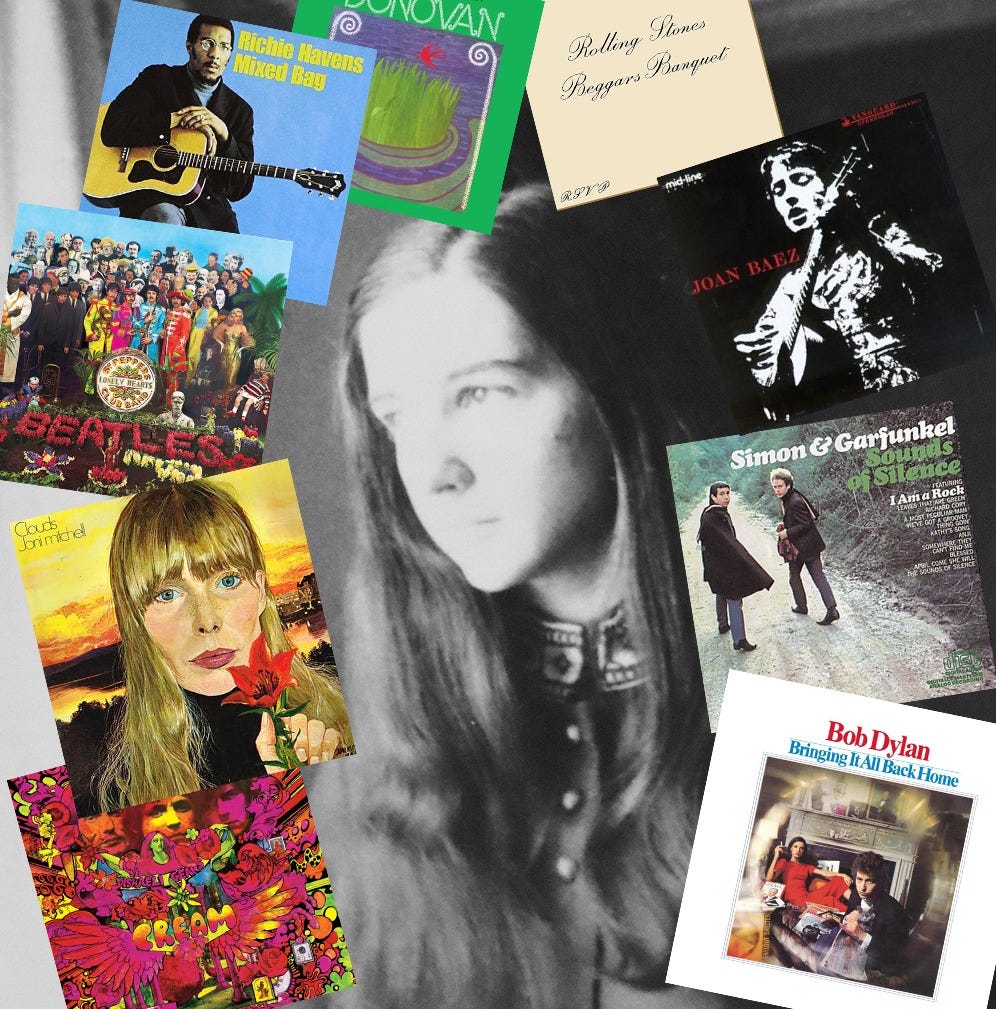
In the Fall of 1968, for almost three months until I dropped out of college, I woke daily in a Back Bay Boston dorm room on a twin bed in a room shared with three other girls. The building had historical grandeur, but the room was a minimalist barracks – we each had a twin bed, a bureau, a bare-bones desk, and a metal wastebasket. Although I was a night-owl, I often managed to wake before the others. I’d tip-toe over to the record crate where we kept our shared collection and quietly flip through the vinyl LPs and choose a song that would usher us into the day. Music had this very high and precious vibration in our young lives, like something generated from another galaxy, and with one drop of a needle on the turntable, I could influence the atmosphere for the day. If I selected “Follow” from Richie Havens’s Mixed Bag, we were guaranteed familiar melancholy and possibly even tears, while “Good Morning!” by the Beatles from Sgt. Pepper’s Lonely Hearts Club Band album, set a gentler, optimistic tone for the day. What a gorgeous range even just one crate of albums provided! Donovan’s “The Sun is a Very Magic Fellow” from Hurdy Gurdy Man was a morning dose of mystical love that couldn’t hurt you, but if I was feeling mischievous, “Sympathy for the Devil” by the Rolling Stones from Beggars Banquet, with its opening of insinuating bongos, was a siren call to make trouble. I could pull out Joan Baez’ first album, and get us all medieval with “Silver Dagger,” her amazingly angelic voice pulling us up towards the sky. I wanted to be Joan Baez. I wanted to be Joni Mitchell, and her song, “Chelsea Morning” from Clouds was the essence of sweetness and another way to kick off a day. Or I could turn to Simon and Garfunkel, the gentle philosophers, with “I Am a Rock” from The Sounds of Silence.
I loved creating the morning’s soundtrack. It was satisfying to watch roommate Connie get out of bed in her long flannel nightgown with the bra underneath, “in case there was a fire,” and rub sleep from her eyes to the psychedelic sounds of Cream’s “Sunshine of Your Love” from Disraeli Gears. She was from the Midwest, a virgin, the square of the group, and probably would have preferred listening to Peter, Paul and Mary, or even “The Hills are Alive” from the Sound of Music.
I could put mischief in the air.
My limited audience would occasionally expand to three and a “half” roommates. Anne lived in a different dormitory, and while the other three were my official college roommates, Anne was my real hippie sister, with her long wild blond hair like uneven straw from a barn stall, a suede jacket with fringes, and cowboy boots. Poking my roommates with wake-up music was harmless, but Anne and I, like a lot of other young women in the sixties, got caught up in what we called “free love” that was really just reckless sex, mostly with strangers. In the category of other experimentation, I recall an unintentional crazed overnight spent after smoking pot laced with heroin (I thought I could hear the trashcans having a sinister conversation outside an open window); inter-state hitchhiking; bad LSD trips; energetic marches against the war (likely the most wholesome of the activities); and ultimately dropping out of school. I was seventeen when I moved to Boston from New Jersey, and I was unprepared for college, particularly in this era. I was a wild child and my parents never really knew what to do with me.
As females, we fancied ourselves bold trailblazers—little did we know how disempowered we were. Anne and I shared a boyfriend, and our college adventures would soon take a turn when she got pregnant from her times with him. We had an awful misunderstanding, a falling out, and after she moved back to Philadelphia, I never saw her again.
Eventually I returned home to New Jersey, moved to New York City, and ultimately, Connecticut, where I had some family, and where I discovered a freeform radio station (WPKN) in Bridgeport and started my life’s long-term love affair with alternative radio. My audition tape got me a show, and I was thrilled. In the early days, I’d lug bags of my well-worn vinyl album collection up the three flights of stairs to the radio studio to get on the air for my Saturday morning shift.
Now there were thousands of albums at my disposal, dwarfing my old one-crate of LPs from those college days. Like all the other programmers, I served as my own engineer. I was armed only with my thermos of Earl Grey Tea, and my fervent desire to share music and poetry with my newly expanded audience.
I turned on the transmitter at 10 am (amazing; we’ve been 24/7 for years now) and began my early Saturday shows with “Good Morning!” by the Beatles, which seems incredibly obvious and corny now. As the years went on, I played less of the old albums, still choosing to weave some of those older favorite and influential songs with newer musical discoveries. It was particularly satisfying to start adding spoken word to the mix, and guest interviews. For me, radio is an audio gallery of potential juxtapositions—what you put next to what—via the wondrous concept of “segues.” Good segues bring gooseflesh and shivers.
I am alone behind the microphone, but in a zone of intimate connection, talking to a miniature world, hoping at least one person is listening, watching the time tick down in readiness for the next song. Sometimes, during a live show, I might have 20 seconds to run down the hall to the record library for just the perfect track to follow what’s going out on the air in the moment. Freeform radio allows hosts to create something personal; above all human--not just like playlists generated by one of today’s streaming services. I treasure it.
A Complete Unknown
I played a fair amount of Dylan on the early radio shows. His music had been a constant in my early teen years and beyond. I first saw him live in 1965 at the Mosque Theatre in Newark, New Jersey, where I grew up. It was the tour where his second half of a show was electric, and people sometimes booed. I went to see the new film about Bob Dylan’s early career, A Complete Unknown, which focused on that transition. I always liked both the acoustic and the electric, but I also understood the sorrow and confusion the purists in the folk movement felt.
The movie was filled with musical performances, and I felt emotional early on, as I seemed to still remember almost every word of the Dylan songs that were featured. I sang along in my head. There they were, insistent and fresh. It doesn’t appear in the movie, but I did have a particular favorite Dylan song that ticked all the boxes in that morning dormitory ritual, something sensual but not threatening, percussive but not slamming, lyrical but accessible, “She Belongs to Me.”
She's got everything she needs, she's an artist, she don't look back
She's got everything she needs, she's an artist, she don't look back
She can take the dark out of the nighttime and paint the daytime black
The song appears on Bringing It All Back Home, an album whose cover I used to examine as if I were conducting a semiotic study. Who was the figure in the photo with Dylan? Dylan album covers with females were particularly compelling. That one was Sally, the wife of Albert Grossman, Dylan’s then manager. Dylan’s influence on me was like his personality – inscrutable, mercurial, teasing, sad, silly, and full of references to decipher. We knew Woody Guthrie’s influence; we knew some of the fabrications Dylan used in creating his early persona; we knew his wardrobe of vest and hats; and we knew his amazing and prolific talent for storytelling. We knew his sullen glances. We knew about his relationship with Joan Baez, and we imagined which songs were about her. Even in later years, when extensive biographies and memoirs came out, I still wanted to keep him mysterious, like he was my wise, reserved analyst, or rabbi. I could never get through the academic critiques of his songs, or his own revelations about himself. We came to know a fair amount, but what did we really know? Everyone winds up with their own transference to him. He’s built on his ability to draw projections. Maybe that’s what celebrity ultimately is.
It might be hard to understand how I could envy the array of women who were “not treated well” by Dylan, as shown in certain scenes of the movie. I didn’t know any better. I was consumed with hormones in the early years of my fascination, and eager to be chosen by a cool boy, a bad boy. In retrospect, as much as I envied those women, I think I really wanted to be those boys, be where the power and the adoration of the crowd was. I guess I wanted to be all those things; the muse and the artist, the free spirit, a figure of fascination and admiration. “She Belongs to Me” was a perfect song to accompany putting on Anne’s cowboy boots, borrowing her fringed jacket, and sticking my clove cigarettes in the pocket. This was the song to lead me to my next adventure.
You might love, hate, or doubt the veracity of A Complete Unknown, but watching this Dylan film helped me connect more dots for my own life, and reminded me of the power of lyrics themselves, especially ones that expressed such a generational and political connectedness.
When I came home from the movie I pulled out the Dylan albums. I looked at the covers. That morning music ritual in the dorm, of which Dylan was a part, had something to do with my becoming a radio programmer. Singing along in my head, in the theater, I felt a rush of something like embarrassment and loss at how much his early lyrics had haunted me throughout my life, as if my younger self was more important than my present one. I also felt a bit remiss in not following his later songs more closely.
I had more listening to do.
Comments
Nothing yet. Say the first thing.
Sign in to join the conversation.