
Two
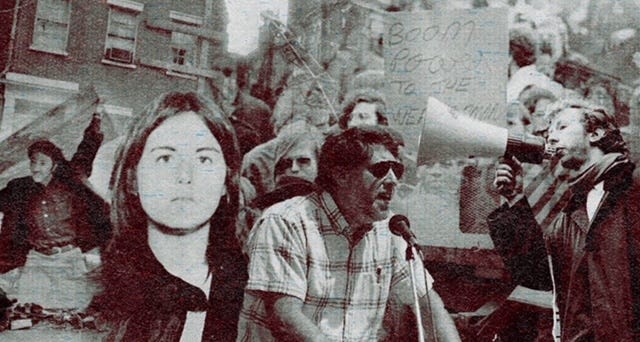
0:00
-25:01
My friend Marshall said that he spent a lot of time trying to convince me and my best friend Barbara to have sex with him when we were teenagers. I don’t remember that part. He says he was the boy who was always the friend, a source of endless frustration. I just remember him as a warm and funny kid.
The morning after learning of Gary’s death, I wrote to a friend who had invited me to a local temple’s Yizkor service and asked that Gary’s name be added to the list that the rabbi reads of those who have died in the previous year. Marshall immediately came to mind. He would have wanted to stand beside me at the temple when Gary’s name was read, but Marshall was in California, which I had only learned a year ago. I actually hadn’t seen him since 1969 and that wasn’t a very pleasant meeting.
By the fall of ’68, I’m now a student, a college student. I’m a freshman at Boston University. I wasn’t there very long. I was there for three months and dropped out. A lot of people were dropping out. I had this female friend who was also dropping out. We got this apartment and then we lived there at least another year.
Scott (my husband): You’re a year away or a couple years away from high school, but it seems like you left it completely behind you.
BK: Do you mean the Weequahic crowd?
SS: Louis, Marshall and Gary, you weren’t connected with them by the time you got to Boston.
BK: It seems like everybody just dispersed. I didn’t know where Marshall was and I didn’t know where Gary was. I didn’t know where my friend Barbara was.
SS: You had no idea Marshall was in Boston?
BK: It was completely weird the way that I discovered Marshall’s presence in Boston. I was hanging out at the student center. I don’t even think I was a student anymore. Friends were with me.
Then I spot this group, this circle of people sitting. They just seemed very serious, different somehow than the rest of the people hanging out in the student center. They were having a very solemn conversation in hushed tones and there was Marshall! I couldn’t believe it! There he was with the same kinds of clothes he wore as a boy in Newark. There were the stiff yellow work boots and the jeans with the rolled-up cuffs and a short sleeved white t-shirt. That was his uniform.
I walked closer and I must have called out his name in a kind of excited way and he took his solemn steps away from the group and he was not smiling. He came up to me and said, “Don’t say my name out loud, shh, shh.” Then something about we’re anonymous here and we don’t use names. He was very cold. He was not at all the loving, fun-loving boy. I thought we would embrace. I thought we would be thrilled. I thought we would laugh. I thought we would go eat something. You know, just be normal. But he wasn’t acting normal.
I know he was trying to get me interested in the political activity he was in, which wasn’t completely clear to me at that point and I was very frightened because he just seemed angry. He seemed disappointed that I didn’t want to rush into joining them. It was kind of scary. It was very shocking. Here he was this boy that I had watched TV with in Newark, a cold revolutionary and he was mad at me.
Scott (my husband): And that’s kind of how it was left for a long time, right?
BK: That was it!
SS: That was the last time you saw him?
That was the last time. It didn’t seem like he wanted me to contact him. He didn’t even want me to use his name. It was a terrible way to have to remember him.
Then there was an even more terrible thing which was in the ‘70s, I came upon an article in Esquire magazine about radical groups that quoted a 1969 headline from The Chicago Tribune: “Police altercation with activists.” A sentence leaps out at me naming Marshall as a 19-year-old Weatherman seen crawling away with gunshot wounds. I didn’t know if Marshall was alive or dead.
I had heard rumors about him running a taco stand or being in Cuba. I’m not sure why I didn’t try harder to find him. I did feel a little estranged after the way we left things in Boston. He obviously didn’t try to find me. I always assumed he was disappointed in me for not becoming more radical politically.
When it eventually became possible to use an internet search, I would look every now and then, but nothing ever turned up. It wasn’t until 2014 when I tried a search that I finally came across something. I found a clip on YouTube from his 60th birthday party, a little celebration of him with cakes and candles. I’m not sure I believed it at first. Could that be him?
There he was, older, but it was him, definitely him. And then I hurriedly checked Facebook next. If he was on YouTube, maybe he would be elsewhere. He did have a page, but it was very sparse, almost nothing. I thought, what the heck, I’ll send him a private message through Facebook, not really anticipating that he would check it, but it was worth a shot.
He responded! We started exchanging emails and ultimately had a phone conversation. I was so amazing to hear his voice. We were practically laughing and crying at the same time as we talked. I learned that he had been married several times and had actually been in California for 35 years, owned a restaurant, worked as a medical coder. Then he said, “Of course I was the last person to see Barbara.” “What do you mean?” I asked. Marshall sounded stricken. “Oh god! You didn’t know? I can’t believe you don’t know. She committed suicide.” Everything dropped inside my body. Marshall was very shocked that I knew nothing about Barbara’s death. He just assumed I would have known about it.
The last contact I had had with Barbara was in 1974. We exchanged letters. She had written to me about her life as an aspiring actress and some of her struggles with depression. Then we had a visit and it didn’t go well. From what Marshall had said, it wasn’t so long after that that she died. I was flooded with guilt and worry that I had done something wrong.
We had been such a tight little group; me, Marshall, Louis, Gary and Barbara. We had all loved her. Marshall felt terrible about having to be the one to tell me the sad news. It was hard to recover, especially over the phone.
He went on to say that he was retired now and was able to do some traveling. I was then thrilled to find out that he already had made plans to come East with his girlfriend, so we arranged a visit.
When they drove up to my house in the rental car, I was excited and nervous. Marshall walked towards me, arms out-stretched and we embraced. “I don’t see Binnie,” he said. I could have dropped to the ground in despair, but I kept it together. What did he mean? Was I so completely changed? No small essence of the 16-year-old girl he had known?
I still had all of Barbara’s letters, even notes and doodles from grade school and I had pulled them out in anticipation of his visit. I had also arranged to interview him about his time with Weatherman. I always knew if I ever saw Marshall again, I would want to ask him about it. I had no idea really what his experience had been like and this was my chance.
It was a nice day, so we sat out on the deck. I told him about the bad visit with Barbara and my fear that I had somehow let her down. He felt guilty too and described a visit from her in California. She was depressed and called him from her motel room one night very upset. He went over there and stayed for hours trying to comfort her, but eventually, he had to go home, and she had assured him she wouldn’t do anything to harm herself, but she didn’t keep that promise.
I read him a part of Barbara’s letter from 1974 where she recounts a story from 1969. She wrote: “I was sitting in a film class and before class started, I was looking over the newspaper and read that Marshall had been killed in Chicago. I called the place where Marshall was staying, and he was fine and told me that he had given his identification to some other weatherman.”
Barbara and I had gone through the same shock and worry and misconception about Marshall, but she was able to check on him right away. After hearing what Barbara had written, Marshall clarified that he was in Newark at the time of the shooting in Chicago. He and Louis were actually recruiting for Weatherman before leaving for Boston to officially join their collective.
Barbara had also referenced this in a letter. She wrote: “I was living in an apartment in North Newark and one day, Marshall and Louis and their women, two obnoxious black leather jacket chicks who came in and tried to talk me into coming up to their Boston Weatherman collective and fighting for the revolution. Gary was at my apartment at the time and, unhappy at school and wanting to be around Marshall and Louis, went off with them.
Louis was so bitter. I hardly recognized him. And Marshall just started at me with these hurt eyes.
The two women kept screaming at me for being a bourgeoise revisionist. I ended up kicking them out of my house. It was really a very painful experience.”
When it was time to start the interview with Marshall about Weatherman, I asked him about this run in with Barbara in Newark that she had described and the encounter with me in Boston.
I started by asking Marshall questions about why he joined this radical organization.
M: What I thought at the time when I was 19 and 20 years old was that I was the one who was putting my money where my mouth is and the rest of you were poseurs and that’s why I was such an asshole to you at the time. Of course, it was completely wrongheaded of me.
BK: Why did you join Weatherman?
M: I wanted the world to be just and fair and equal and I wanted the world to be organized along those principles and I became convinced, through a series of accidents and arguments that the idea of bringing down the current order and creating something new at almost any cost was not only appropriate but necessary and essential.
You know, I think there was an element of guilt to it. Part of it was a sense of vast possibilities, but part of it was a sense of desperation and guilt that said, okay, it is necessary that we give everything that we have, including our lives, to try to create the world that we want to live in. That can create a certain kind of fanaticism and blindness to reality.
I think that people in my generation, a lot of us basically were kind of driven crazy by the War in Vietnam and by racism. We saw the war as being so evil and we saw what was being done in our name as so evil and we spent years trying to stop it and we couldn’t stop it.
At a certain point, we just decided that we had to stop it even if the only way we can stop it is by throwing our bodies in front of this machine. We would have done anything. We would have done anything, and we felt like we had to and we owed it to the people of Vietnam. We had this vision of history and what was going on in the world and it demanded of us that we do anything to try to bring down the machine.
BK: Give us a little bit of an idea of what it was like to be with a collective. Literally, what was the physical, daily experience like?
M: It was horrible! It was horrible. There was no privacy. You were supposed to be living up to this revolutionary ideal and we were supposed to be trying to create the “new man” and “new woman.”
One of the mechanisms that we happened upon to try to do this was something called “Criticism, Self-Criticism.” If you can imagine the old encounter sessions where you would stay up for 24 hours in a room with people. Well, imagine that, but the entire time it’s directed at improving one individual person in the room and showing them the error of their ways. Most the time that I was in Weatherman, my primary motivation was trying to avoid being the focus of Criticism, Self-Criticism session, which I pulled off. I was successful at it.
I’ll tell you one story of the worst thing I ever saw in Weatherman, and I was part of it. I did my best not to be involved, but you had to be involved otherwise they would turn on you. I sat through a Criticism, Self-Criticism session of this guy who, admittedly was an asshole, but nonetheless, somehow went through this night-long Criticism, Self-Criticism session about what was wrong with him and how uptight he was.
Somehow, we ended up at a place where it was decided, probably by the women in the room, that he was hopelessly uptight and repressed and that the way to fix his problem was for him to masturbate in front of us, 24 of us. We made him do it and he did it! That was one of the most horrifying things I’ve ever seen in my life! I lived in such terror that something like that was going to happen to me.
I spent most of my time in Weatherman staying in the shadows, not saying anything too controversial. If you were too complacent and you didn’t participate enough, you could become a target at that point. It was a very fine line. You had a balance. I just tried to be a good functionary and do what I was told and not make waves and not get in trouble because I didn’t want this to happen to me.
When I got to leave to go to Cuba and escape that level of madness, I felt very fortunate and very free.
Other than that, you were hungry a lot and you were tired a lot. You’d get up every morning and scrounge around in this big pile of clothes and try to find something that fit you because you weren’t allowed to have personal possessions. You couldn’t have clothes or books or anything that belonged to you. You had no money.
Brown rice and vegetables was a big treat. That was good eating. I did learn to be a very good panhandler and a very good shoplifter.
You got to get laid a lot, but it was sort of anonymous. I didn’t really like having sex in a room with 24 other people. There was no privacy. You weren’t allowed to have personal space. It wasn’t a lot of fun.
BK: Let me tell you a couple of things and you tell me whether they’re true. They took away your books.
M: Oh yeah! They took away everything! You weren’t allowed to have personal possessions, so whatever you had was gone.
BK: Separated couples.
M: Oh yeah. I joined Weatherman with my girlfriend from college. Monogamy was considered a sin, right up there with capitalism. You weren’t allowed to have one-on-one relationships. You weren’t allowed to have monogamous relationships.
Another thing that happened towards the end was there got to be this big thing that if you were just heterosexual, that meant you were a bourgeoise, uptight person. There was a lot of pressure for women to have sex with women and men to have sex with men. I managed to avoid that as well.
There were certain things that I decided – not that I was going to stand up and say, “This is wrong. I’m not going to do this.” But that I would find a sneaky way without exposing myself of getting out of it.
BK: What about this one: everybody get naked and take acid together.
M: Oh yeah, yeah. Although, again, I can’t remember whether I pretended to take it and I pretended I was high or what, but I was not going to do that, but I was not going to say no. I managed to survive that.
One of the best times I had the entire time I was in Weatherman was we had several houses, which were apartments. Somebody had lived in an apartment and then, all of a sudden, 12 people were living in this apartment. We had three of these scattered around. There was some reason why everyone had to be in this one apartment, but they needed one person to stay in this other apartment so that the cops wouldn’t bust it or something like that.
I wrangled that because it was going to be a night that I could be by myself! They let me do it. I remember I went out and I panhandled enough to buy a quart of chocolate ice cream and I went and bought this chocolate ice cream and went to this apartment and sat there by myself and I ate it! It was one of the best nights!
BK: You radical you!
I was relieved; the cold, judgmental revolutionary was gone! My childhood friend Marshall was with me. The visit had been rich and bitter-sweet. “There’s Binnie!” he said at one point looking at me. “Something in the mouth.” We played guitars together. I still liked him.
Marshall had been the one to tell me about Barbara. And now, a year later, it was my turn to deliver some sad news about Gary. I emailed him a note with the obituary.
Later that day, I went to the Yizkor service at the temple. The rabbi read Gary’s name. I stood up.
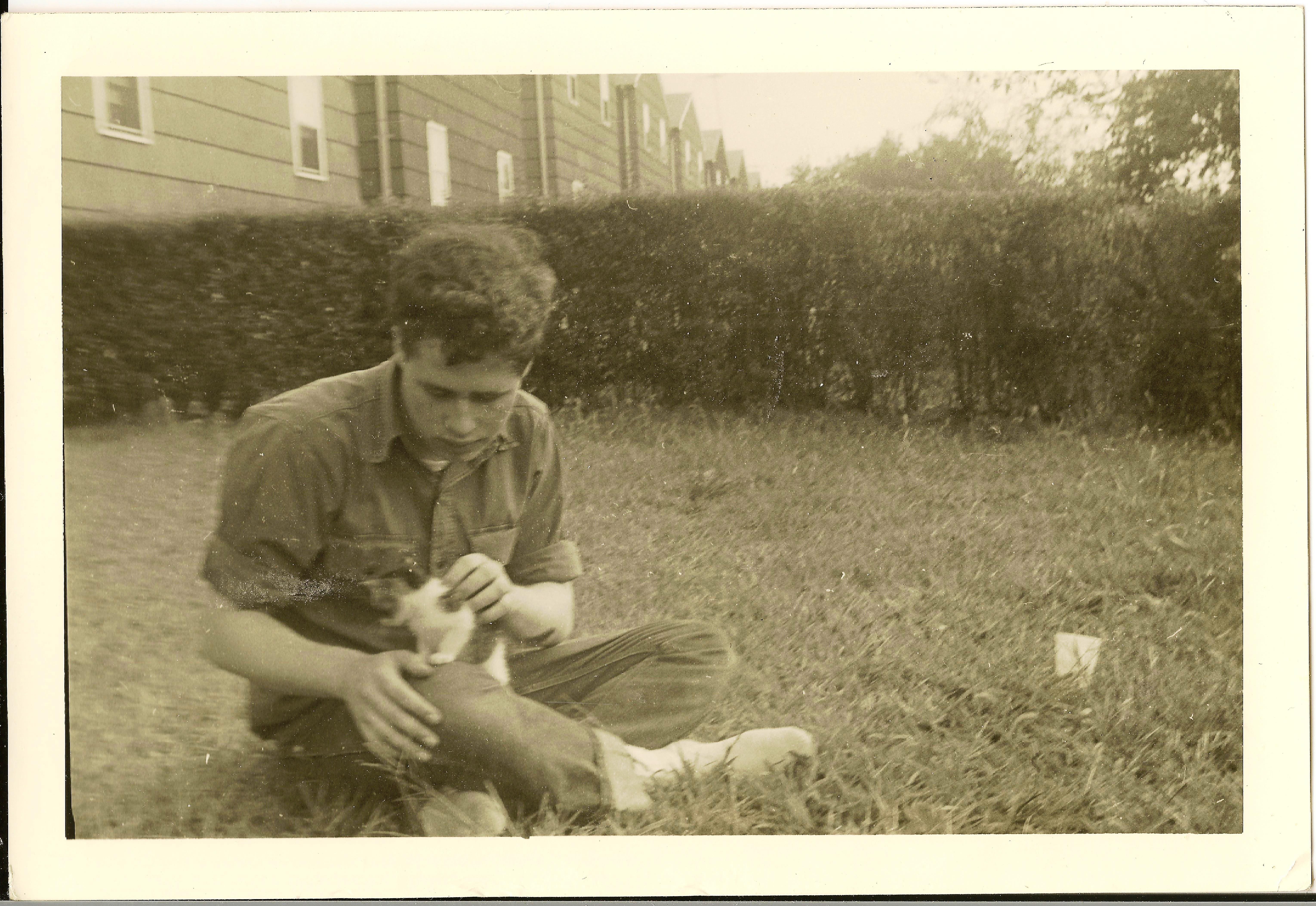
Gary in a Newark backyard with kitten, 1967
There are four more episodes of Ten Days in Newark. Would you like to read and hear the rest? Thanks to H.L. Tandberg for his cover of “Comin’ Back to Me” by Dave Van Ronk
Coming next in Episode Three of Ten Days in Newark: I travel back in time to my ten days at age sixteen, living with Louis and Gary, unchaperoned, eating mustard sandwiches, watching The Fugitive, falling in love, and creating a safe, ersatz family before Louis’ departure to Goddard College. I talk with Eben, another Newark friend who was there the night of the neighborhood party when Louis dropped acid and shared my bed.
You can read and hear Episode One, in which an unexpected letter sends me into my 16 year old self and my first love….
Comments
Nothing yet. Say the first thing.
Sign in to join the conversation.