
If you work in architecture or construction, you are likely tired of hearing about “disruption.” Every year, a new tech evangelist promises that robots will be laying bricks by Tuesday and that AI will design skyscrapers by Friday.
But if you want to understand where the industry is actually going, you shouldn’t look at this year’s tech headlines. It’s worth looking at a book published in 1990.
Ray Kurzweil’s The Age of Intelligent Machines is famous for predicting the internet, the fall of the Soviet Union, and the defeat of a human chess champion. But hidden in the subtext of his broader theories are some of the most accurate (and frustrating) insights into the AEC industry ever written.
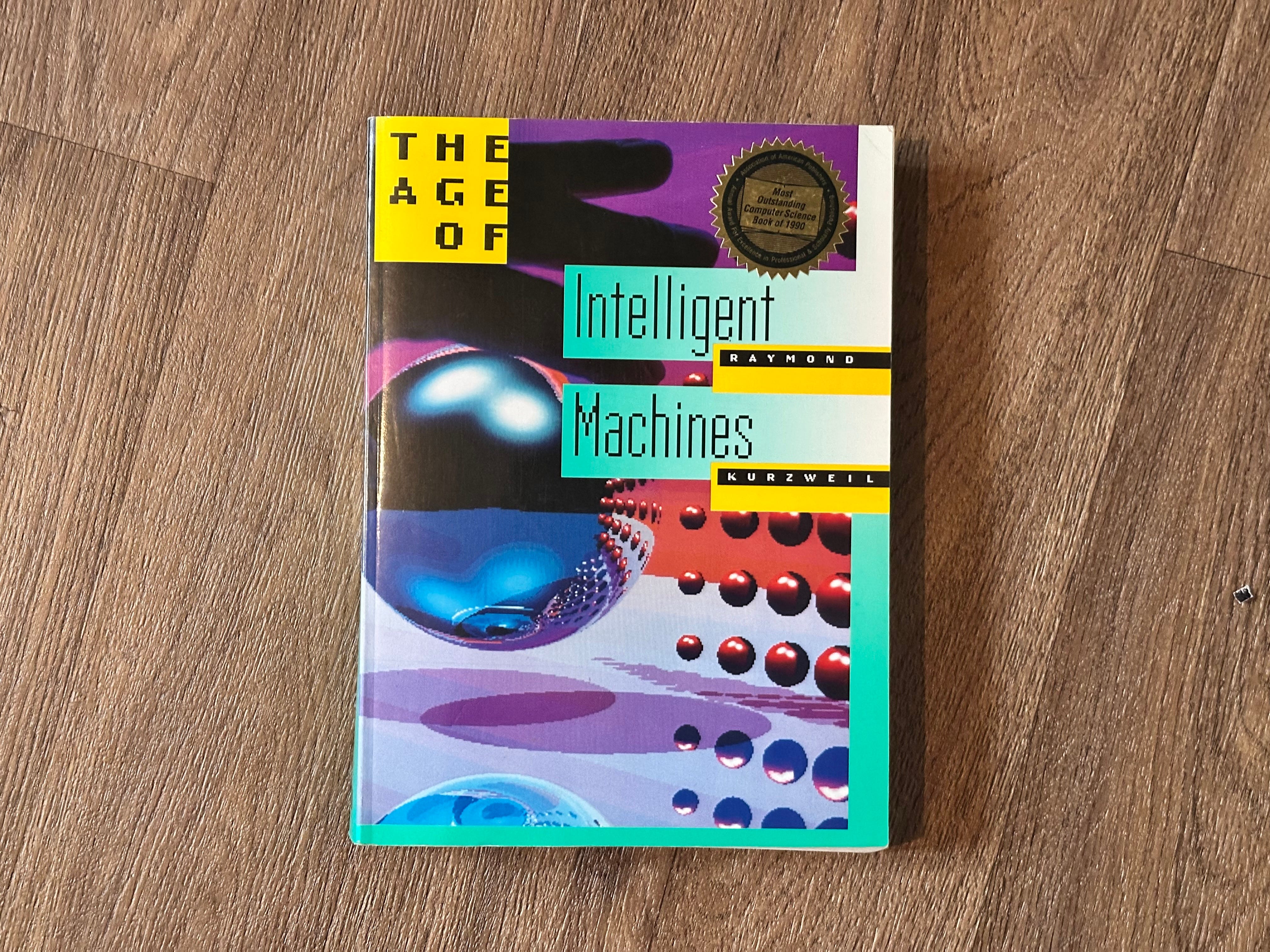
Thirty-five years later, Kurzweil offers a roadmap for why our design software is lightyears ahead, but our job sites are still stuck in the mud.
In 1990, architects were still largely hunched over drafting tables. The “computer” was a glorified typewriter or a very expensive digital pencil.
Yet, Kurzweil predicted the complete dematerialisation of the design process. He argued that the screen would not just be a place to draw lines, but a place to simulate reality. He foresaw a world where we would test the physics, light, and structural stress of a building in a “virtual world” before a single shovel hit the dirt.
Just like Chuck Eastman, he didn’t call it BIM (Building Information Modeling), but he described it perfectly. He predicted that the “drafting board” would die because it was static. Today, the idea of building a “Digital Twin” seems the norm. The difference between Eastman and Kurzweil was the focus. Eastman predicted advanced tooling to help the human; Kurzweil predicted a value shift in the supply chain.
The book also has a contribution from George Gilder. Gilder writes about the "Microcosm" and the "overthrow of matter." While not strictly about bricks and mortar, his essay argues that value is shifting from material resources (steel/concrete) to design and information. This provided the economic theory for why architecture (the design) will/would become more valuable than the physical act of construction.
The lesson: Kurzweil was right in his prediction. Value in architecture has shifted from the production of drawings to the simulation of performance.
If Kurzweil was so smart, why don’t we have robotic construction workers yet? In 1990, he was bullish on robotics in factories. So why, in 2026, do we still have humans tying rebar by hand?
Kurzweil actually gave us the answer, though he didn’t realise how sticky it would be. He distinguished between controlled environments and uncontrolled environments.
A factory is controlled: The lighting is perfect. The floor is flat. The parts are always in the exact same millimeter position. Robots thrive here.
A construction site is uncontrolled: It is muddy. It rains. The ground is uneven. Shadows change. Materials are stacked in the wrong place.
Kurzweil predicted that automation would struggle in “chaotic” real-world environments. He was right. While we have 3D printers and drones, the “general purpose construction robot” has failed to materialise because the job site is too unpredictable for 1990s (and even 2020s) AI to navigate safely.
So, who wins? The robot on the muddy site, or the robot in the distant factory? The answer, as usual, is “Yes.” The binary choice between “prefab” and “traditional” is dissolving. What we are seeing in recent years is the rise of the hybrid model.
We aren’t going to see fully autonomous job sites where robots build skyscrapers while humans watch from a control room. The site is too chaotic, too “uncontrolled,” just as Kurzweil predicted. But we are seeing the industrialisation of the site.
The “fly-in factory”: instead of shipping modular units across oceans (shipping mostly air), we are seeing “pop-up factories” deployed to the job site. Containerised robotic drillers that bring the precision of the factory to the mud, cutting logistics costs to zero.
The “cyborg” workforce: The robots that are on site aren’t replacing workers; they are essentially power tools with brains. Exoskeletons that save backs, “Layout Roombas” that print blueprints directly onto the concrete slab, and drones that verify work while we sleep.
Kurzweil’s dream of the “Intelligent Machine” in construction isn’t a humanoid robot holding a hammer. It is a digital thread; a seamless flow of data that connects the architect’s screen, the off-site factory’s arm, and the on-site worker’s headset.
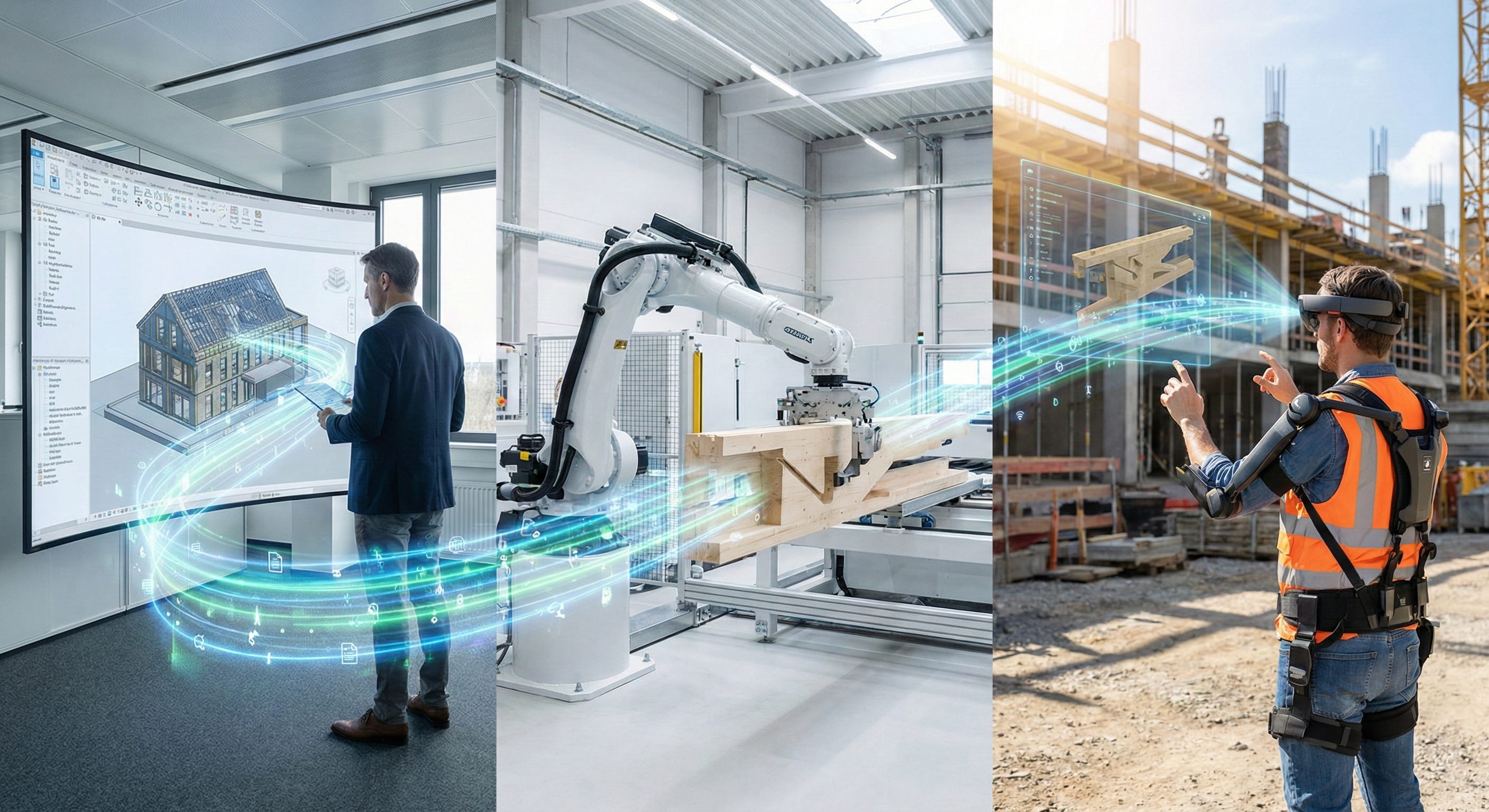
The future isn’t about removing the human from the site. It’s about giving the human on the site the superpowers of a factory.
This is the big one we are still waiting for.
Kurzweil predicted the end of “mass production” (making 1,000 identical things) and the rise of “mass customisation” (using robots to make 1,000 unique things at the same cost).
In architecture, this is the Holy Grail. Imagine a factory that can produce unique, custom-designed facade panels for a Zaha Hadid-style curve just as cheaply as it produces flat rectangular bricks.
We are seeing glimmers of this with CNC milling and parametric design, but the construction industry is still largely stuck in the “mass production” mindset (standard 4x8 drywall, standard I-beams). Kurzweil implies that the true revolution in AEC won’t be “robots laying bricks”—it will be robots fabricating custom components off-site that snap together like a unique Lego set.
3D printing is getting us in that direction, but we are not there yet.
Kurzweil’s most famous deadline is approaching: 2029, the year he claims AI will pass a valid Turing Test and achieve human-level intelligence.
What does this mean for the architect?
If Kurzweil is right about the “ladder of abstraction,” the role of the architect is about to shift again.
1980: You drew the line.
2000: You told the computer to draw the line (CAD).
2020: You told the computer the parameters of the line (BIM/Parametric).
2030: You will tell the computer the intent of the building.
We are already seeing this with generative design. The architect of the Kurzweilian future isn’t the one drawing the floorplan. They are the Editor-in-Chief. They will feed constraints (zoning, budget, style, carbon footprint) into an AI, and the AI will generate 50 (or 500) viable options. The human’s job (do we still call it an architect?) will be to tune, to refine, and to curate.
Ray Kurzweil teaches us that technology moves exponentially, but physical adoption moves linearly.
We have the “intelligent machine” part of the equation (almost) solved (BIM, AI, generative design). We are still struggling with the “physical world” part (robots, construction sites).
Comments
Nothing yet. Say the first thing.
Sign in to join the conversation.