
In a recent Fortune piece, David Heacock, a CEO who turned a “boring” air filter business into a $260 million empire, laid out a truth that the Silicon Valley elite often miss: AI isn’t just for the guys in hoodies; it’s for the guys in hard hats.
If you are running a mid-sized mechanical firm, a dry-walling sub, or a regional GC, you aren’t just in the business of pouring concrete or hanging steel. You are in the business of managing chaos. And AI is the first tool in history that can actually manage chaos at scale.
Construction is often labeled “slow to adopt technology.” That’s a polite way of saying we don’t have time for toys that don’t work. Like David’s air filters, construction is an “everyday” industry. It is essential, physical, and, to the outside world, a bit “boring.”
But boring is where the margins are hidden.
For decades, the “Concrete Ceiling” has kept small and mid-sized firms from scaling. You reach a certain size, and suddenly the administrative weight of safety compliance, RFI tracking, supply chain delays, and payroll becomes a gravitational force that prevents growth. To break through, you used to need a massive corporate office filled with “white-collar” overhead.
AI changes that math overnight.
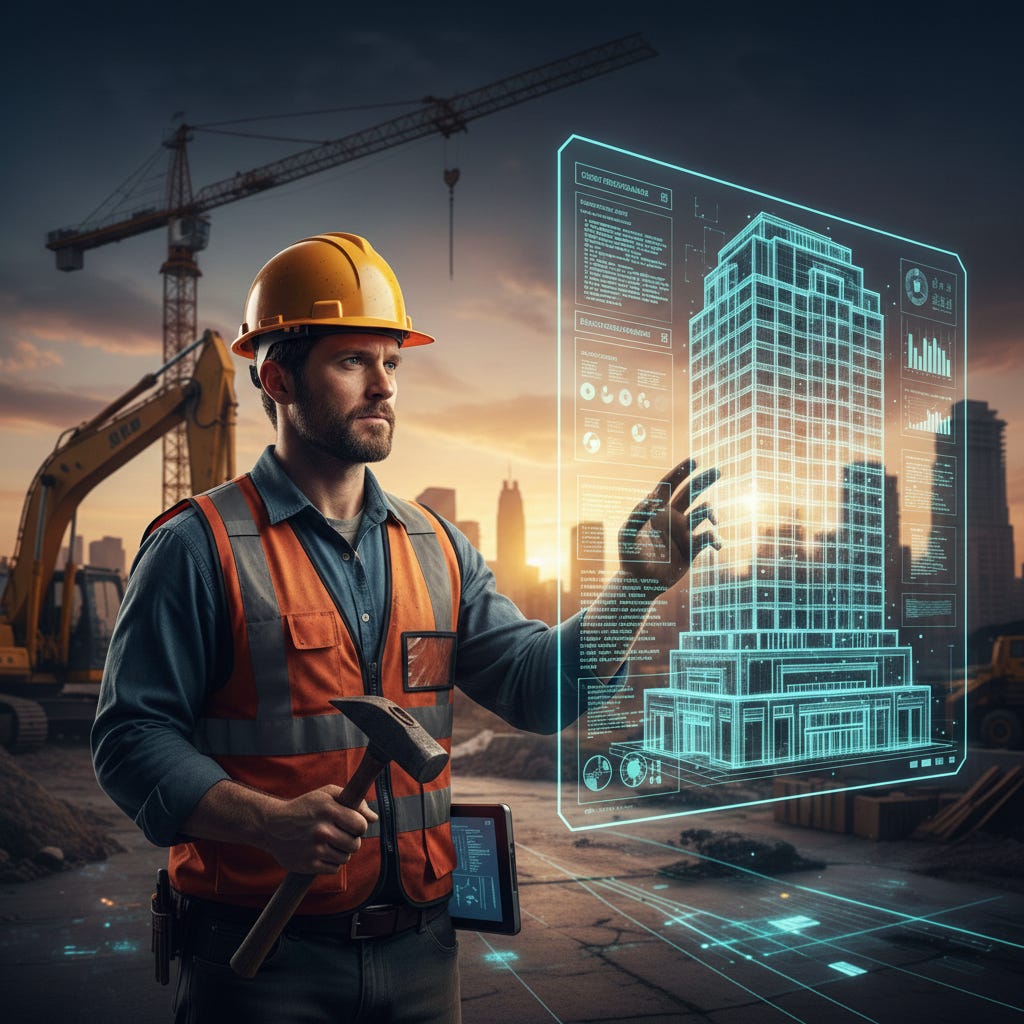
Just as David saw AI transforming the air filter world, the impact on construction is rooted in three fundamental shifts for those who work with their hands:
Bridging the “expertise gap”: You might be the best master carpenter in the state, but that doesn’t mean you want to spend your nights forecasting lumber price volatility or navigating complex municipal codes. AI tools act as a “virtual executive suite,” giving a 10-person crew the same analytical power as a global firm.
Ending the “administrative drudgery”: AI isn’t here to replace the person swinging the hammer; it’s here to replace the person filling out the 14 duplicate forms about the hammer. By automating scheduling, daily logs, and safety reports, workers can get back to the skilled manual labor that machines simply cannot replicate.
Predictive profitability: In a “boring” business, small efficiencies equal massive gains. AI can spot a ductwork clash in a BIM model weeks before the installers arrive or predict when a backhoe needs service before it breaks down on-site. This moves us from “reactive firefighting” to “proactive building.”
The fear-mongers say AI is coming for your jobs. They’re wrong. You can’t “prompt” a foundation into existence. You can’t “GPT” a leaky valve.
What AI is coming for is the overhead. It’s coming for the hours you spend staring at spreadsheets, the nights spent worrying about cash flow, and the endless back-and-forth of “where is that sub-contractor?”
When you strip away the busywork, what’s left? The Craft. The next generation of construction titans won’t be the ones who just know how to build; they will be the ones who combine grit and grease with algorithms and data.
They will use BIM not just as a 3D model, but as a living, breathing data set that AI uses to protect their margins.
The message from David’s success is clear: The “boring” businesses are about to become the most exciting places to be.
If you’re a contractor today, don’t look at AI as a threat from the future. Look at it as a piece of heavy machinery. You wouldn’t dig a skyscraper foundation with a shovel if you had an excavator. So why are you trying to grow a multi-million dollar construction business with 1990s administrative tools?
The “Concrete Ceiling” is cracking. It’s time to build something bigger.
Comments
Nothing yet. Say the first thing.
Sign in to join the conversation.