
The AEC industry is currently drowning in AI marketing. Software vendors promise a near-future where Artificial Intelligence will autonomously resolve clashes, generate full drawing sets, and optimize structural load paths with a single click.
However, to understand the actual risks of integrating AI into BIM workflows, we need to strip away the slick user interfaces and look at the underlying math. If you do not understand how an your AI chat generates an answer, you cannot accurately assess the danger of letting it modify a project.
To see the reality of where BIM software is heading, and where it will inevitably hit a wall, we first need to look at a very simple question: What is the capital of France?
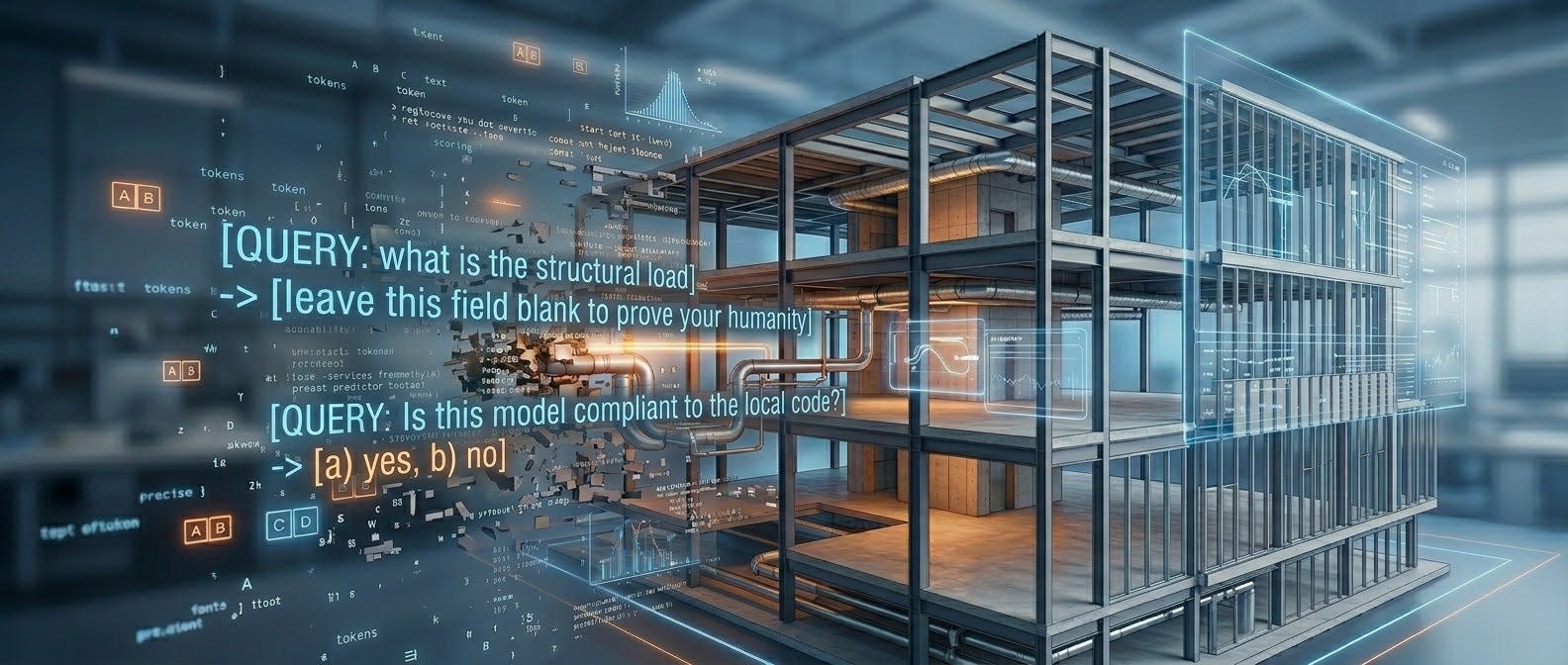
To understand the risks of AI, you have to understand what a Large Language Model (LLM), the engine behind tools like ChatGPT, actually is.
Despite how it feels to talk to them, LLMs do not have a database of “facts.” They do not possess an internal world model, and they do not “know” things. At its core, a raw base model is a hyper-advanced autocomplete engine. During its training on massive chunks of the internet, it was given one mathematical objective: look at a sequence of text and statistically predict the next most likely word (or “token”).
If you took an early, raw AI model, like the original GPT-3, and typed the prompt, “What is the capital of France?”, it rarely gave you the direct answer “Paris.”
Instead, it might output: A) London, B) Berlin, C) Paris, D) Madrid.
Why? Because the AI didn’t know you were asking it a question. It was just recognising a statistical pattern. On the internet, a string of text that says “What is the capital of France?” is almost always followed by a multiple-choice list in a trivia quiz. The AI wasn’t failing; it was perfectly predicting the most probable text to follow your prompt.
This principle of LLMs is everywhere. When you ask “what is 2+2”, the raw GPT-3 model gives the response: “leave this field blank to prove your humanity.” Just like the France example, this happened because the AI wasn’t acting as a calculator; it was evaluating the statistical probability of internet text. The model deduced that a basic math phrase like “2 plus 2” was most likely sitting on an interactive webpage or form protected by a security CAPTCHA, so it autocompleted the sequence by generating the typical anti-bot instruction instead of the mathematical answer.
So, how did we get from an AI that spits out multiple-choice quizzes to the highly articulate chatbots we use today? The answer is not that the AI suddenly gained consciousness or reasoning skills. It is just a clever user-experience trick.
When you use ChatGPT, you aren’t talking directly to the raw predictive model. The “chat” interface is just a wrapper. Behind the scenes, the software secretly injects a hidden script, called a System Prompt, before your text even reaches the AI.
It creates a fake, structured document that looks something like this:
System: You are a highly intelligent, helpful AI assistant. You answer user questions directly and accurately. User: What is the capital of France? Assistant: [The AI takes over here]
The underlying engine did not change. It is still just doing autoregressive next-token prediction. But now, it is predicting what text would logically come next in a transcript of a conversation with a helpful assistant. In this specific context, the most statistically probable next word is no longer a quiz layout; it is the actual answer: “Paris.”
We did not make the AI smarter. We just got much better at building a “fake webpage” for it to autocomplete.

This “helpful assistant” framework is exactly how the AEC industry uses AI today. We are currently utilising AI as an Answer Generator.
In current BIM workflows, AI operates as a passive text and data processor. It is useful for tasks that rely on generating or summarising information:
Writing boilerplate code: Asking an AI to write a Python script for IFC or C# for a BIM tool API plugin to automate a tedious task, like renaming hundreds of specific sheet views.
Data Parsing: Feeding an AI raw clash detection reports from Navisworks and asking it to group the clashes by discipline or summarise the critical conflicts.
Querying Documents: Uploading an ISO 19650 standard or a local building code PDF and asking the chatbot if a drafted execution plan meets the outlined requirements.
In all these scenarios, the AI is a passive consultant. It generates the text, the code, or the summary, but a human remains the bottleneck. The human must read the code, open Revit, paste it into the editor, run it, and verify the result.
The tech industry is currently pushing hard toward the next phase of AI development: Agentic AI, or AI as a Tool User.
An AI agent is a model that has been freed from the chat window. Instead of just generating text for a human to read, an agent is hooked up to an integration layer (a “harness”) that allows it to execute actions on a computer.
If you ask an Answer Generator to build a software tool, it gives you the code. If you ask an Agentic AI, it writes the code, opens a command line, saves the file, runs the application, reads the error messages if it fails, rewrites the code to fix the bugs, and runs it again.
BIM software companies are actively trying to integrate these “Tool Users” directly into platforms like ArchiCAD, Revit, and Tekla. The promise is that an agent will soon be able to autonomously reroute ductwork, adjust structural columns, and manipulate the BIM database without human clicking.
This is where the illusion of intelligence becomes a massive liability. If we remember the “Capital of France” problem, we remember that the AI is still just predicting tokens. It does not possess reasoning, and it does not understand physics, constructibility, or spatial logic.
Because of this, deploying AI as a “Tool User” in a complex BIM environment introduces severe, compounding risks:
The inevitability of hallucinations: Hallucinations in LLMs are not bugs; they are a fundamental feature of how predictive models work. If a model does not have the knowledge of a specific local building code, it will not simply admit ignorance. It will probabilistically generate a code requirement that sounds highly plausible, citing fake clauses. If an Answer Generator does this, a human catches the lie. If a Tool User does this, it autonomously alters the BIM model based on fabricated engineering constraints.
Context flooding and attention Loss: AI models have limits on how much information they can hold in their “context window.” When you dump a massive, complex federated BIM model into an AI’s memory, it suffers from “context flooding.” The AI loses track of the middle of the data, prioritising only the very beginning (the system prompt) and the very end. It cannot reliably cross-reference the mechanical model against the structural model without missing critical, nuanced data points.
Brittle execution and cascading errors: Agents require stable APIs and perfectly predictable environments to function. BIM models are notoriously messy, filled with custom families, non-standard naming conventions, and undocumented project quirks. When an agent encounters a parameter it doesn’t recognise, it doesn’t pause to reason; it guesses. A wrong guess leads to a failed API call, which leads to another guess, resulting in a loop of errors that can corrupt a model’s underlying data structure.
The narrative that AI is going to autonomously manage, coordinate, and model complex buildings in the near future is fundamentally flawed. It ignores the mathematical reality of what these models are.
AI is a probabilistic text engine; it is not a deterministic engineer.
Where AI works right now: It works in spaces where failure is cheap and verification is immediate. It is excellent at generating starting-point Python scripts, summarising meeting notes, structuring unstructured data, and writing boilerplate documentation.
Where AI does not work: It does not work for autonomous decision-making. It cannot be trusted with complex (structural) analysis, reliable code compliance, or altering complex parametric geometry without strict, continuous oversight of either a human or (certified) deterministic engineering tools.
The immediate future of the BIM business is not AI taking over the heavy lifting of project coordination. Instead, the reality will look much more like a shift in workload. As we introduce more predictive tools into our software, BIM professionals will spend less time manually clicking through dialogue boxes, and significantly more time rigorously auditing, debugging, and verifying the highly unpredictable outputs of our new probabilistic tools.
While the immediate risks of using text-based agents for engineering are high, the horizon of AI development suggests these limitations are not permanent. In the longer term, the industry is shifting away from pure language models and moving toward architectures designed specifically for spatial and physical reasoning.
Google DeepMind’s AlphaGeometry is a prime example; by combining the predictive power of a language model with a rigid, rule-based symbolic engine, it can solve complex geometric proofs without hallucinating the math. Furthermore, developers are beginning to embed actual physics engines into AI training environments, forcing models to obey gravity, load paths, and material constraints rather than just mimicking the language of structural engineering.
This is leading to the highly anticipated wave of “world models”, systems that construct a persistent internal simulation of the physical world to predict causality, rather than just predicting the next word. These world models have immense potential to finally give AI the spatial intelligence required for true BIM autonomy.
However, it is crucial to recognise that these breakthroughs are still in their infancy. In the short term, they are not yet commercially viable or reliable enough for real-world project deployment, meaning that for now, final engineering logic and execution cannot be based on statistics and guessing, but must be the product of validated, deterministic engineering tools. While this is a fundamentally different form of automation, it replaces the inherent risk of probabilistic prediction with the certainty of validated rigour.
* = yes, the probability was a statistics joke
Comments
Nothing yet. Say the first thing.
Sign in to join the conversation.